Skip to content
DevMeme
3225 of 7435
UDP Explained: Fire and Forget
Networking Post #3546, on Aug 17, 2021 in TG

UDP Explained: Fire and Forget

Why is this Networking meme funny?

Level 1: Toss and Hope

Imagine you want to send a message to your friend, but instead of handing it to them or getting a thumbs-up that they got it, you decide to do something silly. You write your message on a paper airplane, stand on a hill, and throw it as hard as you can toward your friend’s house — then you immediately turn around and go home without checking what happened. Maybe the airplane will glide perfectly into your friend’s window… or maybe a gust of wind will blow it off course into the river. The point is, you won’t know because you didn’t wait to find out. That’s exactly the funny idea in this meme: the computer server is like a goofy dad who just throws the “data” and doesn’t even watch to see if someone catches it. Usually, when we send something important (like a text or a package), we look for some sign that it arrived safely — a reply text, a delivery confirmation, a thankful phone call. But here, the server acts like it says “Eh, I’m sure it’ll be fine” and walks away. It’s a silly, carefree attitude applied to a situation where you’d normally be very careful. That contrast is what makes us laugh. Even if you don’t know the technical details, it’s easy to see: throwing your data over a wall without looking is just as crazy (and comical) as a parent literally tossing their kid into the air and not checking if they landed okay. The meme takes a complex computer idea and makes it simple and absurd: sometimes, computers send out information without checking if it got there, and we’re left picturing that as a dad flinging a child into the great unknown and casually dusting off his hands. It’s wacky, a little shocking, and that’s why it’s funny!

Level 2: No Handshake, No Guarantee

Let’s break down what UDP really is. The acronym stands for User Datagram Protocol, though many jokingly call it the Unreliable Datagram Protocol. It’s one of the core network protocols computers use to send data to each other, sitting in the transport layer of the networking stack (alongside its more responsible sibling, TCP (Transmission Control Protocol)). When we say UDP is connectionless, we mean that unlike TCP, it doesn’t set up a dedicated connection or session with the receiver beforehand. There’s no greeting and agreement phase (no handshake). In TCP, two computers perform a “three-way handshake” (kind of like saying “Hello, you there? Yes, I’m here – let’s talk!”) before any real data flows, and they keep checking in with each other as data is sent. UDP skips all that. It’s essentially like shooting off a quick text without waiting for a “Typing.../Seen” confirmation. The server in the meme just flings the data out immediately, which is exactly how UDP operates: send the packet and move on.

In UDP, the data sent is called a datagram (a single packet, analogous to a short message or letter). The server labels this packet with the destination address and a port number, and then yeets it into the network. There is no built-in acknowledgment from the receiver in UDP. An acknowledgment (or ACK) is a little message the receiver would normally send back to say “Got your data!” In TCP, acknowledgments are automatic; if a packet doesn’t get acked, the sender knows to retry. But in UDP, if a packet gets lost due to network issues (e.g., congestion, noise, a router dropping it), the sender is blissfully unaware. It doesn’t hear anything back – no “I got it” and no error message either. This is what we mean by “unreliable” or “best-effort” delivery: UDP will try to deliver your data, but it won’t guarantee anything. It’s like leaving a note on someone’s desk and walking away; if the wind blows it off or someone tosses it, you wouldn’t know unless the recipient tells you later.

Why would anyone use such a seemingly careless method? The advantage of UDP is that it’s fast and lightweight. With no need to establish a connection or track each packet, UDP has very low overhead. This makes it perfect for scenarios where speed matters more than perfection. A classic example is video streaming or online gaming. In a video call, you’d rather have the conversation continue in real-time even if a word or two gets garbled, instead of awkwardly pausing everything to ask “Can you repeat that?” for every lost syllable. UDP allows those real-time packets to just flow. If one packet (maybe containing 0.01 seconds of audio) doesn’t arrive, the application can simply ignore it and use the next one that comes. Similarly, many online multiplayer games use UDP for things like players’ position updates. If one update drops, the next update will have the latest position anyway, so it’s not worth slowing down the game to resend something obsolete. In these cases, “no news is good news” — the app assumes the data arrived unless it hears otherwise. And if it really needs to ensure important data got through (like a critical game action or a file transfer), the developers will code a custom acknowledgment or retry system on top of UDP. Essentially, UDP hands you a quick-send mechanism, and it’s on you as the programmer to decide if you need extra confirmation from the other side.

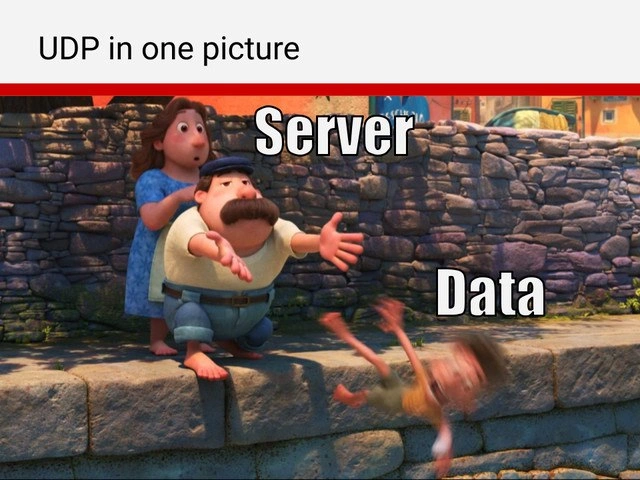
The meme labels make it really clear: Server is the machine or process sending out data, and Data is the information being sent. The server (that mustachioed cartoon dad) isn’t waiting to see if the data (the poor flung child) lands safely. In networking terms, the server did a sendto() operation on a UDP socket, and that call just returned “mission accomplished” without any guarantee of delivery. For those unfamiliar with the slang, “yeet” basically means to throw something energetically (often without much concern for the outcome). So when the title says the server yeets data off a cliff “without acknowledgment”, it’s highlighting that UDP involves no acknowledgment packet coming back. This lack of return receipt is why using UDP can feel like shouting into the void. If you’re new to socket programming, imagine this code snippet representing UDP behavior:

import socket
udp_socket = socket.socket(socket.AF_INET, socket.SOCK_DGRAM)  # DGRAM indicates UDP
udp_socket.sendto(b"Hello, there!", ("example.com", 8080))
print("Data sent. No clue if it was received.")  # UDP won't tell us if it arrived

The last print line is essentially what the meme is showing visually. The server has done its job sending the "Hello, there!" (or yeeting the data-child) and now carries on, not waiting for any “Got it!” reply. For a beginner, this might be surprising. We usually expect some confirmation when we send important information, right? That’s why the meme is funny – it takes this technical behavior to an extreme, showing a parent literally tossing their kid (data) without checking, which is a ridiculous image. But it’s a memorable analogy for UDP’s “send and not look back” style. Once you understand this, you’ll know why certain applications use UDP and also why they have to be designed to tolerate some losses or implement their own checks. UDP is a powerful tool in the network toolbox – just one that comes with the caveat that you, as the developer, need to trust but verify (or decide not to verify) at a higher level. And as every developer eventually learns, if you absolutely need every packet accounted for, UDP by itself isn’t the tool for the job – you’d reach for TCP or add your own acknowledgment layer. If you don’t need that guarantee, though, UDP lets your data fly free… just like in the meme!

Level 3: Yeet and Forget

In practice, UDP is that friend who sends you a message by chucking a paper airplane and then walks away – if it lands in your lap, great, if not, oh well! The meme nails this with the burly father labeled “Server” literally yeeting the child labeled “Data” over a wall. Developers familiar with network programming instantly grin at this cartoonish depiction of connectionless, no-acknowledgment transmission. “Yeet” is internet slang for vigorously throwing something, and here it perfectly captures the server’s attitude: send it and don’t look back. There’s no handshake, no “Did you get that, buddy?” – the server just launches the packet into the void. The poor “Data” flying through the air represents a UDP datagram’s journey: once it leaves the sender, its fate is out of the sender’s hands. The mother standing and watching might as well be the concerned developer or system admin, witnessing this reckless abandon with a mix of amusement and horror.

The humor bites because it’s “so true” to anyone who’s dealt with UDP networking. We’ve all had that moment in systems or game development where we send data via UDP and hope for the best. For example, think of a logging service where the application sends logs via UDP to a collector. If the network is congested or the collector is down, those log packets get dropped silently – no retries, no errors, nothing. It’s as if the server shouted information off a cliff; if no one hears it, it simply vanishes. In a more dramatic real-world scenario, consider cluster heartbeat messages: one server periodically yells “I’m alive!” via UDP to others. If a few of those heartbeats get lost, the cluster might panic thinking a node died, when in fact the messages just fell into the network abyss. Anyone who’s been on call at 3 AM because of a false alarm like that can relate to the mix of exasperation and dark comedy in “UDP just yeeted the updates and now everything’s on fire.”

This meme also pokes fun at how UDP leaves reliability as your problem. High-level protocols or applications that need data integrity have to build their own acknowledgment and retry mechanisms on top of UDP. It’s a rite of passage for many programmers: you start using UDP for something (maybe a fast-paced multiplayer game or a custom lightweight service) because it’s simple and low-latency. Then you realize your messages sometimes don’t arrive. So you add a manual “ACK”—perhaps the client sends back a “got it!” message. But what if that ACK gets lost? Do you resend the data, or send an “ACK of ACK”? Before long, you’ve reinvented a clunky version of TCP’s reliability, and you’re chuckling at the irony: if you truly need all those guarantees, maybe you should have just used TCP. This is a common pattern (and pitfall) in distributed systems design: at-most-once vs. at-least-once delivery. UDP, by default, is at-most-once (the data might arrive at most one time, or not at all, and the sender won’t try again). Implementing at-least-once (keep sending until an ack) or exactly-once delivery over an unreliable network is tricky, hence the shared industry wisdom and wry smiles when we see a meme like this.

The caption “UDP in one picture” sums it up: the server doesn’t establish any connection or perform handshakes, it just throws the data out there as fast as possible. This “throw and go” behavior is often described as “fire-and-forget” in technical lingo. It’s efficient and even desirable in the right contexts – for instance, live video streaming or voice calls use UDP because it’s better to drop a few frames or words than to delay the whole stream waiting on lost packets. As a result, seasoned devs recognize both the value and the hilarity: UDP is wonderfully simple, but it demands a Zen-like acceptance that some packets will vanish. There’s even that inside-joke among programmers: “I would tell you a UDP joke, but you might not get it.” 😏 This meme is essentially that joke in visual form. The server yeets the data without waiting, and maybe the client gets it… or maybe that packet is now floating face-down in the ocean of the internet. Either way, the server has already moved on to chuck the next one. It’s a perfect comedic exaggeration of UDP’s no-strings-attached approach to data delivery.

Level 4: The Two Generals Problem

In the theory of distributed systems and networking, there's a classic thought experiment called the Two Generals Problem. It illustrates why achieving perfect agreement over an unreliable channel is fundamentally impossible. Imagine two army generals on opposite hills (like two computers on a network) trying to agree on a time to attack by sending messengers through enemy territory. Even if they send acknowledgments back and forth (“Message received”, “Ack of your ack”, “Ack of your ack of my ack”…), there's no guarantee the last confirmation gets through. They could keep adding more "ACK" messages forever and still never be 100% sure both sides know the plan. This paradox underpins why no network protocol can guarantee delivery with absolute certainty — at some point, you have to stop asking “Did you get that?” and just assume things are okay.

UDP (User Datagram Protocol) embraces this reality by design. It forgoes handshakes and ongoing confirmations, aligning with the end-to-end principle of internet architecture. That principle (formulated by early Internet pioneers) says reliability can be handled at the endpoints if needed, rather than making the network do all the work. UDP operates on a fire-and-forget model: the sender launches a datagram into the network and doesn’t wait around for an answer. This makes UDP beautifully simple and fast – there's minimal overhead, no connection state, and no requirement for the receiver to even be ready. The trade-off is that reliability is not built-in. If a packet gets lost or dropped along the way, UDP itself won’t know or care.

From a theoretical standpoint, UDP’s simplicity avoids the complexity (and partial futility) of endless acknowledgments. Even TCP, which is UDP’s reliable big sibling, doesn’t truly solve the Two Generals Problem – it just makes failure unlikely by using timeouts and a limited number of retries. TCP’s three-way handshake and sequence acknowledgments drastically improve reliability in practice, but they don’t create mathematical certainty; they simply reduce uncertainty to a very low probability. UDP on the other hand says, “Let’s not even try for certainty in the transport layer; if you need reliability, handle it above me.” This design reflects a deep understanding: sometimes, it’s better to accept a bit of uncertainty than to incur the cost of chasing impossible guarantees. In essence, UDP is unapologetically unreliable by intention, cutting through the theoretical quagmire with a pragmatic approach – just yeet the data and move on, come what may.

Description

A meme with the heading 'UDP in one picture' that uses a scene from the Disney/Pixar movie 'Luca' to explain a networking concept. In the image, an animated man with a large mustache, labeled 'Server,' is casually tossing a small boy, labeled 'Data,' off a stone wall. This visual serves as a perfect metaphor for the User Datagram Protocol (UDP). For experienced engineers, the joke is instantly recognizable: UDP is a connectionless, 'fire-and-forget' protocol. It sends packets of data without establishing a connection or guaranteeing their delivery, order, or integrity. The server simply throws the data into the network and assumes it will get there, much like the character in the meme carelessly tossing the child

Comments

14
Anonymous ★ Top Pick I'd tell you a UDP joke, but you might not get it
  1. Anonymous ★ Top Pick

    I'd tell you a UDP joke, but you might not get it

  2. Anonymous

    UDP: achieving sub-10ms p99 by redefining “delivered” as “left my NIC”

  3. Anonymous

    After 20 years of explaining UDP to junior devs, I've finally found the perfect analogy - though ironically, there's only a 60% chance they'll actually receive this explanation, and I'll never know if they did

  4. Anonymous

    UDP is like that senior engineer who deploys to production on Friday afternoon and immediately goes offline for the weekend - packets sent, delivery confirmation optional, and if something breaks, well, that's a Monday problem. At least it's fast

  5. Anonymous

    UDP: Where servers architect low-latency bliss by shoving packets off the cliff, then architecturally pray latency budgets cover the stakeholder fallout

  6. Anonymous

    UDP: where the server's SLA ends at the NIC and delivery is a best-effort rumor

  7. Anonymous

    UDP: success is when sendto() returns without errno; everything else is SRE’s postmortem

  8. @Apm1000 4y

    I don't get it

    1. @RiedleroD 4y

      UDP has no error checking in place, it just sends data and doesn't care if it reaches its target, therefore making this meme similar to how UDP handles data transfer

      1. @RiedleroD 4y

        there's a similar UDP meme with someone throwing a baby, but I can't find it rn

      2. @Apm1000 4y

        I know. I just tried to continue the joke😅

        1. @RiedleroD 4y

          ahhh bruhhh

        2. @RiedleroD 4y

          flew right over my head

          1. @Apm1000 4y

            Well, you can never be sure, what other people know

Use J and K for navigation