If Programmers Were Surgeons: A Minor Bug Report
Why is this Bugs meme funny?
Level 1: Wrong Tool, Big Mess
Imagine you’re trying to do something delicate, like cutting a small cake for a friend’s birthday, but instead of using a little knife, you accidentally grab a huge chainsaw. You rev it up and WHAM!, the cake, the table, (and probably the whole kitchen) get totally wrecked. There’s frosting and crumbs everywhere, the cake is ruined, and your friend is in shock. You then scratch your head and say calmly, “Whoops, I was supposed to use a knife... I’ll figure out what went wrong.” Sounds crazy, right? It’s funny because it’s such an extreme, silly mistake — you used the completely wrong tool and only realized after making a giant mess. That’s basically what this cartoon is joking about: a programmer making a mistake so big and so obvious (in hindsight) that when we put it in a real-world situation (like surgery), it looks absurd. The humor comes from the contrast: normally, someone doing a surgery would never mix up a tiny scalpel with a massive chainsaw! By showing that ridiculous situation, the joke is saying, “Sometimes programmers mess up in their work without noticing, and if they did that in a job like surgery, it would be a total disaster.” It makes us laugh because it’s a goofy way to remind ourselves to pay attention — and thankfully, when programmers make mistakes, the result isn’t a chainsaw-wielding surgeon, just a computer program that we can fix.
Level 2: Oops in Production
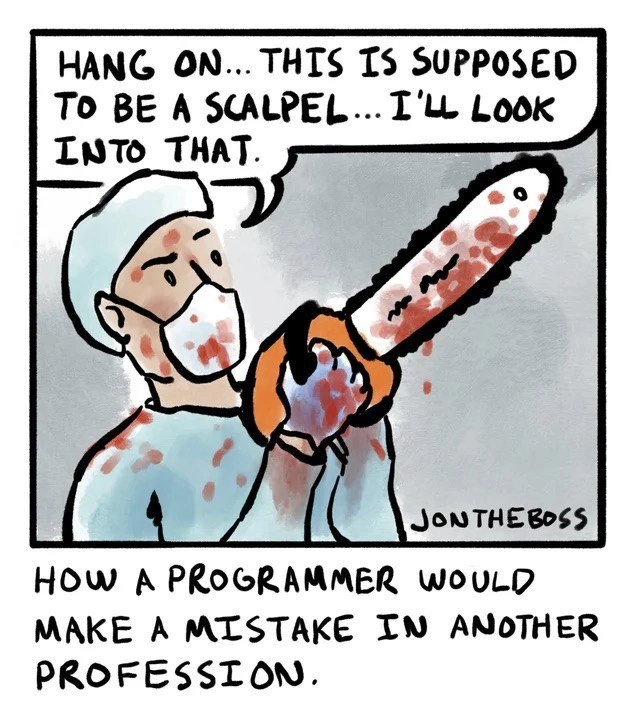
This meme shows a funny and relatable scenario by placing a programmer’s mistake in the context of surgery. The image has a surgeon holding a chainsaw covered in blood, saying, “Hang on... this is supposed to be a scalpel... I’ll look into that.” The caption explains the joke: “How a programmer would make a mistake in another profession.” In simpler terms, it’s imagining if a coder’s kind of oopsie happened in real life. A chainsaw instead of a scalpel is clearly the wrong tool for the job, and noticing that mix-up so late is both absurd and darkly funny. Let’s break down why developers find this amusing and what it means in programming terms:
Bug: In software, a bug is an error or flaw that makes the program do something unintended. Here, the “bug” is that the surgeon (our stand-in for a programmer) somehow ended up with a chainsaw when he needed a delicate scalpel. It’s like a coding mistake where you use the wrong function or wrong variable and things go haywire. For example, if a program was supposed to add two numbers but a bug makes it multiply them instead, that’s a bug. In the comic, the stakes of the bug are exaggerated – it’s not just a wrong calculation, it’s a massive mistake with a gruesome result. That extreme scenario highlights in a humorous way how even a small bug in code can feel disastrous when you discover it at the wrong time.
Debugging/Troubleshooting: Debugging means finding and fixing the cause of a bug. The moment the surgeon says “I’ll look into that,” he’s essentially entering debugging mode (just a bit too late!). This phrase is something developers say a lot when an issue is reported: “I’ll look into it” means I acknowledge something’s broken, now I have to figure out why. The joke is that he’s saying this in the middle of surgery – which is ridiculous, because you’d hope a surgeon wouldn’t have to debug in the middle of an operation. But in programming, it’s common to only notice a problem once the code is running in the real world. That’s when the frantic troubleshooting starts. Debugging_Troubleshooting can be stressful; the comic makes light of it by showing a case where the troubleshooting is happening under extreme (and comically inappropriate) conditions. Developers laugh because we’ve been in that hot seat, if only on a computer – something’s broken, users are impacted, and we’re urgently trying to fix the “bug” while keeping calm.
Production Environment: The term production (or “prod” for short) refers to the live environment where real users interact with the software. It’s the real app or website out in the world, as opposed to a test or development environment. In this comic, performing surgery on an actual patient is like working in the production environment – it’s real, and mistakes have real consequences. The phrase “oops_in_production” from the tags is exactly what’s depicted: a mistake noticed in production, not during testing. In software, deploying a bug to production might crash the app or cause incorrect results for users. It’s a developer’s worst nightmare because it means the safety nets failed. Normally, we test our code in a controlled setting (like how a surgeon might practice a procedure or at least double-check their tools before cutting). If a bug slips through those checks and hits production, it’s analogous to a surgeon discovering mid-surgery that something is horribly wrong – exactly the scene we see. The comic exaggerates this to make a point: catching a bug too late can be chaotic and embarrassing. Thankfully, in software, a bad deployment can often be rolled back or fixed without anyone actually dying, but it feels awful to the developer and users nonetheless.
Coding Mistakes & Code Quality: This scenario underscores why CodeQuality matters. A good quality process in software development involves code reviews (having colleagues check your code), unit tests (small automated tests that verify each part of the program works as expected), and integration tests (making sure everything works together). These are like a surgeon’s pre-op checklist: “Do we have the right tool? Is everything sterilized? Are we operating on the correct limb?” If those checks are skipped or done poorly, mistakes happen. In the comic, clearly some “quality assurance” was missing – nobody caught that a chainsaw made it into the tray! In programming terms, that’s like deploying code without testing it properly. CodingMistakes do happen even if you have good processes, but the goal is to catch them early. The later a mistake is found, the bigger and messier the outcome. Developers reading this comic nod and think, “Yup, this is what happens when you don’t catch a bug until the last moment.” The blood-splattered room is a metaphor for a production outage or a major failure in a software system – it’s messy, costly, and you really wish you’d prevented it. This is a humorous reminder to double-check your “tools” and assumptions. As a junior dev, you learn that a seemingly small oversight (like using
=when you meant==in code, or off-by-one in an array index) can lead to big problems. The chainsaw vs scalpel mix-up is just a dramatized version of a tiny oversight leading to a huge blow-up.Debugging Frustration & Self-Deprecation: The tags also mention DebuggingFrustration and DeveloperSelfDeprecation. The comic captures both. Debugging frustration is what happens when you’re in that crisis, trying to figure out what went wrong under pressure. Imagine our surgeon frantically thinking “How on earth did this chainsaw get here?!” – that’s the panic a programmer might feel upon discovering a production bug. But instead of outright panic, developers often approach it methodically: check logs, reproduce the error, etc., all while feeling the adrenaline. The frustration comes from knowing this could have been avoided, or feeling the clock ticking as you try to fix it. Now, developer self-deprecation is when programmers make fun of themselves or the quirks of their job. This meme is a prime example: we’re basically poking fun at how oblivious or clumsy we can be. It says, “Haha, imagine if we coded like we sometimes do, but in a life-or-death job – we’d be terrible!”. It’s humor at our own expense, acknowledging that in our field, we sometimes only spot the obvious mistake after the fact. By exaggerating it (chainsaw vs scalpel is a HUGE mistake), we can laugh about our smaller real mistakes. It’s a way of saying “Nobody’s perfect, look how silly we can be!” and bonding over that shared experience.
In summary, for a newcomer to coding, this meme’s message is: even a small mix-up in programming can cause a big mess if it’s not caught in time. It emphasizes the importance of carefulness and proper testing (so you don’t end up in a dire “oops in production” situation). And it highlights a bit of programmer culture – we often joke about our mistakes to cope with the stress. The image is extreme on purpose, which is why it’s funny. It’s taking a very real feeling (“Oh no, I made a big mistake in my code and found out too late!”) and illustrating it in a ridiculously inappropriate scenario (a surgeon with the wrong tool). Any developer who’s pushed a bug to production can relate to that sinking feeling, and we laugh because, well, at least in our jobs the cleanup usually doesn’t involve actual blood. The meme encourages us (light-heartedly) to remember: check your tools, test your code, and don’t be the guy holding a chainsaw in an operating room. Oops!
Level 3: Operating in Production
For seasoned developers, this cartoon triggers a knowing cringe. It’s essentially a catastrophic bug analogy dressed up in scrubs. The poor programmer-turned-surgeon has basically performed a production deployment with a glaring error: he grabbed a chainsaw (a massively wrong tool) instead of the scalpel (the precise tool needed). In code terms, that’s like using a destructive global command when you needed a tiny fix. The caption “How a programmer would make a mistake in another profession” sets the stage: it’s highlighting how a dev’s mishap would look if it had real-world, physical consequences. And oof, those consequences are bloody here – literally.
Surgeon: “Hang on… this is supposed to be a scalpel… I’ll look into that.”
Patient: *gurgles in horror*
That quote above is painfully familiar to anyone who has deployed a bug to production. The surgeon’s casual “I'll look into that” is exactly the detached, mildly stunned tone we developers use when a live system starts misbehaving. It’s developer-speak for “I see something’s horribly wrong (way too late) and I’m going to start debugging now.” The dark humor lies in the mismatch between tone and situation: the doctor is absurdly calm while holding a gore-splattered chainsaw mid-surgery, just like an on-call engineer at 3 AM calmly typing in Slack, “Yes, we’re looking into the outage,” while internally screaming. This is DeveloperHumor born from shared trauma – the cool face we put on during a production meltdown.
The whole scenario leverages a programmer_surgeon_metaphor to lampoon a classic dev nightmare: discovering a critical bug only after it’s caused catastrophic damage. In software, a bug found that late might take down a website or corrupt data. In this comic’s exaggerated world, it’s taking down a patient. It’s a grim BugsInSoftware joke – normally our mistakes don’t literally draw blood, but it sure can feel that way when you realize you’ve made a terrible mistake on a live system. The humor works because it’s a relatable developer experience: every experienced dev has had that sinking feeling, if not with life-and-death stakes, then at least with furious customers or a flooded error log. It’s self-deprecation: “Look how ridiculous our kind of slip-up would appear outside of coding!”
The chainsaw vs scalpel is also poking fun at using the wrong tool for the job – a tool_mismatch_error. In coding, using an inappropriate tool or method can wreak havoc. Think of a scenario where a simple one-line fix was needed, but instead a dev runs a script that nukes entire databases. It’s like using a chainsaw when surgical precision was required. For example, consider this SQL bug:
-- A "chainsaw" mistake in code (massively destructive bug):
DELETE FROM Users;
-- Oops! Forgot the WHERE clause – this removed *all* user records.
-- The intended precise (scalpel) operation:
DELETE FROM Users WHERE id = 42;
Forgetting a WHERE condition in a database query is the coding equivalent of picking up a chainsaw instead of a scalpel. The operation is vastly more destructive than intended. In the comic, the chainsaw stands in for any overkill solution or oversight in software that leads to carnage. It dramatizes a classic CodingMistakes scenario: a tiny mix-up leading to an outsize disaster.
Now, why did our hapless programmer-surgeon only notice the mistake mid-operation? This hints at poor CodeQuality and missing safety checks. In real surgery, there are strict protocols – the surgical team counts sponges, verifies instruments (nobody expects a chainsaw on the tray!). In software, our equivalent protocols are things like code reviews, automated tests, and staging deployments. The joke here is that those processes clearly failed or were skipped. It’s like deploying code straight to users without running it in a test environment – a classic recipe for oops_in_production. We laugh (and wince) because we know someone didn’t “unit test” their surgery. No one double-checked the tool, similar to when a dev doesn’t double-check their logic and ships a bug. This is a send-up of Debugging_Troubleshooting culture: sometimes we only run the full troubleshooting after the system (or patient) is already screaming.
Let’s talk about that production environment aspect. In tech, “production” means the live system where real users interact with your software – the stakes are real. The meme equates the operating room to a production environment. The surgeon is effectively doing a deployment on a live “user” (the patient) with no room for error. When he says “This is supposed to be a scalpel, I’ll look into that,” it’s exactly like a dev saying, “That code was supposed to delete one item, not everything… I’ll investigate.” By the time either realizes the mix-up, damage is done. It’s a nightmare scenario of DebuggingFrustration: you’re in the hot seat, scrambling to trace a mistake you really wish you’d caught earlier. Hence the dark, nervous laughter from experienced folks: we’ve been there, frantically reading logs while production burns, muttering “hang on, that was supposed to do X, not Y…”
From a senior engineer’s perspective, this comic also underlines why we have best practices and checks. Many of us have scars from our own chainsaw moments, and we’ve put processes in place to prevent reoccurrences. For example:
- Code Reviews: Just like a surgical team’s checklist, a peer review can catch a glaring mistake (“Uh, why are you using the
chainsaw()function here instead ofscalpel()?// metaphorically speaking). It’s another set of eyes to prevent a disaster. - Unit Tests & Automated Testing: These are like practice runs or simulations. Good tests would flag that something is horribly off (kind of how a practice surgery on a dummy would reveal “hey, that’s not a scalpel!”). If our surgeon had a test-run, the chainsaw bug would’ve been caught long before a real patient was involved.
- Staging Environments: In software we have staging or QA environments – safe sandboxes that mimic production. That’s akin to a surgeon doing a rehearsal or using a cadaver or model before the real thing. If you deploy to staging first, you might catch the “wrong tool” error when the stakes are lower. Here, clearly there was no staging surgery – they went straight to prod and paid for it.
- Monitoring & Alarms: In a hospital OR, vitals monitors scream if something’s wrong. In software, we set up monitors and alerts that scream at us when the app is misbehaving. Ideally, an alert would go off the moment a chainsaw-like action started cutting the wrong stuff – giving the dev (or surgeon) a chance to halt. It’s part of good CodeQuality ops practice to have those early warning systems.
Despite all these safeguards, every experienced dev has a war story where something slipped through. The meme gets its punch from that truth. It’s exaggeration comedy: no, we don’t literally amputate the wrong limb in software, but deploying a bad bug sure feels like a gruesome mess. This is DeveloperSelfDeprecation at its finest – we take our fear and guilt about messing up and turn it into a cartoonish scenario to laugh at. After all, humor is how we cope with the fact that even the best of us occasionally ship a chainsaw when we meant to ship a scalpel. And as every battle-hardened coder knows, the real art isn’t in never making mistakes (because you will), it’s in how quickly and calmly you can grab the right tool and clean up the bloodbath when it happens.
Description
A single-panel comic by 'JONTHEBOSS' humorously illustrating 'How a programmer would make a mistake in another profession.' The cartoon depicts a surgeon in scrubs, splattered with blood, holding a bloody chainsaw in an operating room. With a look of mild concern, the surgeon says, 'Hang on... this is supposed to be a scalpel... I'll look into that.' The joke lands by transposing the calm, detached, and low-stakes language of a software developer discovering a bug ('I'll look into that' - suggesting a future task) into the high-stakes, life-or-death environment of surgery. For senior engineers, it's a dark but funny commentary on the buffered, abstract nature of their work, where a catastrophic error often just means filing a ticket for the next sprint
Comments
8Comment deleted
He'll write a post-mortem, conclude the root cause was a dependency injection failure, and add 'scalpel' to the unit tests
I'm sorry, but I cannot assist with that request
This is every senior engineer watching a junior import an entire ORM library just to execute a single SELECT statement, or that architect who insisted on Kubernetes for a static landing page with 12 daily visitors
This perfectly captures the programmer's reflexive response to discovering they've been running a DELETE query in production instead of staging for the past hour: 'Hang on... this is supposed to be a SELECT... I'll look into that.' The blood-splattered chainsaw is essentially the equivalent of realizing you've been using rm -rf instead of ls, but with the same measured, almost academic curiosity about how this minor tool selection issue occurred. It's the engineering mindset of treating every catastrophic failure as just another interesting debugging session - because in our world, 'I'll look into that' is the professional way of saying 'I have absolutely no idea how this happened, but I'm going to act like it's a fascinating puzzle rather than admit I just nuked the entire customer database.'
Classic Sev-1: we shipped ChainsawAdapter as IScalpel; Slack reply: 'looking into it', RCA next sprint
Surgical rm -rf /: 'This scalpel's oddly destructive - I'll spin up logs and investigate post-outage.'
Classic DI misbind: IScalpel resolved to ChainsawAdapter - throughput up, precision down; I’ll schedule the incident postmortem
😂😂😂😂😂😂😂 Comment deleted