The Unpopular Suggestion of Reading Documentation
Why is this Documentation meme funny?
Level 1: Reading is Hard
Imagine a group of friends trying to build a big LEGO set together. The group leader asks, “How should we figure out how to build this faster?” One friend excitedly says, “Let’s just search online for a quick trick!” Another friend chimes in, “Or ask someone who built it before!” But then a third friend, sitting with the big instruction booklet, says, “Maybe we should read the instructions first and follow the manual.” Suddenly, the room goes quiet and everyone stares at that third friend like he just suggested something outrageous. In a silly twist, the leader gets so annoyed at the “read the instructions” idea that he playfully tosses that friend (and the thick instruction book) out of the room! 🤦♂️
Of course, this is a joking exaggeration – no one really gets thrown out for suggesting something sensible. But it’s funny because it shows how people often react: nobody really wants to slow down and read the boring manual. They’d rather take a shortcut to get the answer. Reading instructions is the right way to understand how to do something properly, but it takes patience. A lot of times, when we’re impatient or feeling lazy, we just want the quick answer – we’ll ask someone or search for a short solution on the internet. This cartoon is like saying: “Ha! See how silly we are? The guy who suggests doing the homework (reading the docs) gets kicked out, while the ones who want easy answers are praised.” It’s making fun of the fact that reading the manual, which could really help, feels too hard or too slow, so people joke that it’s practically a forbidden idea. In simple terms, the meme is funny because it’s true – we often don’t want to read long instructions, even if that would make us better in the end. We can all laugh because we’ve all been that person who said, “Nah, I’m not reading all that!” when faced with a big instruction book. The cartoon just takes that feeling and makes it extreme and silly to get a good laugh.
Level 2: Who Reads Manuals?
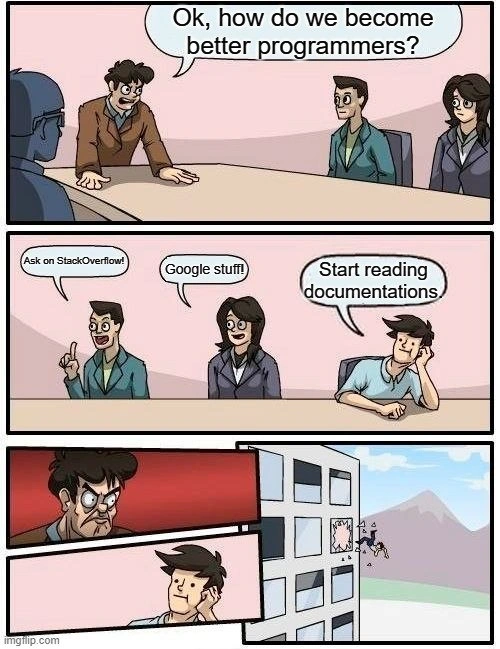
This four-panel cartoon uses the popular “boardroom suggestion” meme format to highlight a joke about developer learning habits. In the first panel, a boss asks his team, “Ok, how do we become better programmers?” The team’s answers in the second panel are telling:
One coworker says “Ask on StackOverflow!” – Stack Overflow is a hugely popular Q&A website where programmers post questions and get answers from the community. It’s basically a giant forum of coding knowledge. Suggesting StackOverflow means, “let’s rely on the community’s answers whenever we’re stuck.” This is very common – many developers quickly search Stack Overflow for error messages or how-tos and often copy-paste code snippets as solutions. It’s almost a running joke that if you have a programming question, someone on Stack Overflow has likely asked it before and the answer is one search away.
The second coworker says “Google stuff!” – This is even more general: just use Google search for any programming issue. In practice, Googling a programming problem often leads you to helpful resources – Stack Overflow answers, blog posts, or official documentation pages. “Google it” is a default reflex for developers whenever something breaks or when they need to learn how to use a function. It’s quick and easy, leveraging the fact that answers are probably already out there.
The third coworker suggests “Start reading documentations.” By “documentation,” he means the official docs or manuals for whatever technology or language they’re using. Documentation in this context is the official guide or reference written (usually) by the creators or maintainers of a software tool – for example, the official Python documentation on python.org, or the official guide for a library or framework. These docs typically explain how to use the tool in detail, list out all the functions or commands, and provide usage examples. The idea of reading the docs is often phrased as “Read The Docs” or even joked about as RTFM (“Read The ___ Manual,” a phrase old-timer tech folks use to tell newbies to read the manual first). It’s basically saying, “let’s learn properly from the source, instead of just winging it.”
Now, the humor kicks in with the last two panels. Panel 3 zooms in on the boss’s face looking angry and offended. In Panel 4, the boss literally throws the third coworker out of a high-rise window for his suggestion (you see the guy flying out through a broken window frame). Of course, this is a comic exaggeration – in reality no one’s physically throwing you out for preferring documentation! But it’s a visual gag to show just how unpopular the “read the documentation” idea is among the group. This format (sometimes called the “boardroom window” meme) is a classic: the person who gives a suggestion that the boss or group doesn’t like gets tossed out the window in the final frame. It’s been used in many scenarios as a funny punchline. Here, the unexpected twist is that the seemingly reasonable suggestion (reading docs) is the one treated as outrageous.
Why is this funny for developers? Because it’s relatable. In many coding teams or online communities, people often jokingly admit they rarely read official docs front-to-back. Instead, they rely on quick answers from forums like Stack Overflow or just Google search results. Reading documentation has a reputation for being boring, time-consuming, or hard, especially when you’re eager to solve a problem right now. Many newer developers (and even experienced ones under time crunch) will first try a quick Google search rather than open a hefty manual or a long reference guide. The meme is basically laughing at ourselves: we know we should read the docs (since they contain the authoritative info and sometimes crucial details), but more often we just look for a shortcut. The other two team members’ suggestions (“StackOverflow!” and “Google!”) represent those shortcuts. They’re immediate and familiar. The third guy’s suggestion represents the more studious approach – which gets shot down in a comically over-the-top way.
This contrasts two approaches to learning and problem-solving in programming:
- Using community knowledge (Stack Overflow/Google): fast and targeted. You can often find an exact answer to your exact question. But you might end up copying code without fully understanding it, or you might miss out on broader knowledge that the documentation would provide.
- Reading official documentation: thorough and comprehensive. It’s the source of truth and often contains best practices and explanations. But it requires more patience to sift through, and not all documentation is well-written or easy for beginners. It can feel overwhelming to read dozens of pages when you just have a quick question.
The meme exaggerates the preference for the first approach. It’s highlighting a real developer experience issue: official docs are sometimes seen as a last resort. Some devs even joke about being “allergic” to reading manuals. The term “RTFM” itself comes from older tech culture, where a frustrated expert would tell a newbie to “read the freaking manual” if they asked a question that was answered in the documentation. Nowadays, though, many people will ask on a forum or search the web before they ever open the manual. It’s a bit ironic!
By showing the boss angrily ejecting the documentation-suggester, the comic is saying: in our programmer world, telling people to read the manual can get you metaphorically kicked out of the room. It’s a playful jab at how we often behave. We know reading docs is helpful (even necessary for tough subjects), but we still groan at the idea because it’s not as instantly rewarding as a Stack Overflow answer. This is an example of DocumentationHumor and RelatableDeveloperExperience rolled into one small cartoon. Any programmer who has spent an afternoon frantically Googling error messages instead of calmly reading the official guide will smile at this because they’ve been there. The meme uses the familiar boardroom skit to make the lesson entertaining: ironically, the fastest way to get “thrown out” of a dev discussion is to earnestly say, “let’s read the docs.”
Level 3: Doc Defenestration
In this classic boardroom meme scenario, a team lead asks how to become better programmers, and the punchline is that suggesting "read the documentation" gets you literally thrown out the window (a defenestration of the docs devotee). The humor strikes a chord with seasoned engineers because it satirizes a real developer habit: skipping the official documentation and jumping straight to Stack Overflow or Google for quick answers. This meme exaggerates a common workplace dynamic in developer culture. The manager’s furious reaction (Panel 3) is a tongue-in-cheek way of saying that reading docs is so undesirable in practice that it’s treated as blasphemy. We’ve all encountered that unspoken documentation aversion: why spend hours combing through dry reference manuals when a copy-pasted snippet from an answer forum might solve the problem in 30 seconds?
On an industry level, this reflects a StackOverflow dependence that has seeped into daily Developer Experience (DX). The first two coworkers blurt out the favored strategies: “Ask on StackOverflow!” and “Google stuff!” – these are essentially the go-to lifelines for devs under pressure. It’s poking fun at how modern learning strategies in teams often prioritize quick fixes from dev communities over deep understanding from primary sources. The third coworker’s suggestion, “Start reading documentations,” is portrayed as the absurd option – which is ironic, because systematically studying official docs is arguably a more sustainable way to become a better programmer. But in real life, it’s often met with groans or rolled eyes. Why? Because reading documentation can be time-consuming, sometimes painfully verbose, and not as instantly gratifying as finding a pre-made solution. The meme captures this tension brilliantly: the RTFM approach (short for “Read The Friendly Manual” – or a less polite F-word variant known in programmer slang) is theoretically the correct path to enlightenment, but culturally it’s treated as a joke.
There’s a deeper truth here that senior developers recognize. Many of us have battled poorly written docs or outdated manuals, and we know the temptation of a quick Stack Overflow search when a deadline looms. The meme’s dark humor hints that even management might undervalue documentation – the boss character literally ejects the one guy suggesting proper documentation reading. This satirizes workplaces where taking time to read and learn is seen as “not productive.” It’s the age-old irony: learning by reading the docs would improve code quality and developer skill in the long run, but short-term crunch culture and the lure of cut-and-paste solutions throw that idea right out the window (quite literally in the comic). DevCommunities like StackOverflow have become the de facto documentation for many, offering bite-sized, targeted answers that official docs often bury under mountains of text. The boardroom meme’s exaggerated violence is a wink to every engineer who’s felt the peer pressure to just “look it up online” rather than crack open the official guide. It’s a hyperbolic reflection of our collective behavior: we adore quick answers and often shun the hard work of reading the manual, even if that manual was written for our own good. The result is a piece of DeveloperHumor that’s painfully relatable – we laugh, perhaps a bit guiltily, because we know exactly why that poor guy got booted for suggesting something so sensible.
Description
A three-panel comic meme in the 'Boardroom Suggestion' format. In the first panel, a business manager at a conference table asks his team, 'Ok, how do we become better programmers?'. In the second panel, employees offer solutions: one enthusiastically suggests, 'Ask on StackOverflow!', another says, 'Google stuff!', while a third, looking bored and resting his head on his hand, nonchalantly adds, 'Start reading documentations.'. The third panel shows the manager with a furious expression, followed by an image of the third employee being thrown out of a high-rise office window. The humor lies in the violent rejection of what is technically the most sound advice. It satirizes the common developer tendency to seek quick, specific answers from Google or Stack Overflow rather than engaging with comprehensive, but often dense, official documentation - a shortcut even experienced developers are guilty of taking
Comments
7Comment deleted
Senior developers will tell you to read the docs, but their own browser history is just a long, purple-link-filled testament to the power of Stack Overflow and Ctrl+C, Ctrl+V
Proposed a ‘read-the-docs’ spike - turns out the org’s preferred low-latency rejection pattern is defenestration-as-a-service
The same senior architect who insists we read the docs just spent three hours debugging an issue that was clearly explained in the migration guide's deprecation warnings from two years ago
The irony is that after spending 3 hours cobbling together a solution from 7 different StackOverflow answers (each from 2014, using deprecated APIs), reading the actual documentation would have taken 15 minutes and given you the correct, current implementation. But we've all convinced ourselves that Ctrl+C, Ctrl+V from SO is 'research' while opening the docs is 'admitting defeat.' The real kicker? That perfectly-formatted SO answer you're copying was written by someone who... read the documentation
Docs: the unscaled monolith where even distributed teams fear to summit without a SO sherpa
Proposed "read the docs" and got routed into our only zero-copy, low-latency pipeline: window-based message passing
Suggesting 'read the docs' got me ejected; apparently our knowledge base is a distributed cache of StackOverflow snippets with undefined TTL - on a cache miss, we page Google