Skip to content
DevMeme
1443 of 7435
Ruin a Language in One Letter: TypoScript
Languages Post #1617, on May 23, 2020 in TG

Ruin a Language in One Letter: TypoScript

Why is this Languages meme funny?

Level 1: One Letter Laugh

Imagine you have a game where you change one letter in a word to make a new silly word. For example, if you take the word "book" and change the letter b to a t, you get "took" – which is a completely different word and might sound funny in context. In this meme, programmers are playing that game with the name of a programming language. The original language name is TypeScript. Now, if you swap just one letter in "TypeScript", you end up with "TypoScript". Why is that goofy? Well, a "typo" means a small spelling mistake, like when you accidentally type gril instead of girl. So "TypoScript" sounds like a make-believe language that's full of spelling mistakes! It’s funny because TypeScript (the real language) is normally all about being very correct and catching errors, but by changing it to TypoScript, it suddenly sounds like the opposite – a language where everything is a bit wrong. It’s like calling your neat, organized friend by a nickname that means "messy". People find it hilarious for the same reason we laugh when someone makes a pun or silly twist on a familiar word – it’s a tiny change that makes our brains go "Oh! That’s upside-down now!" Everyone who has ever mistyped something and laughed about the silly result can appreciate this joke. Essentially, the meme is saying: even a one-letter difference can turn something serious into something completely absurd, and that surprise is what makes us giggle.

Level 2: Mind Your Types & Typos

Let’s break this down in simpler terms. TypeScript is a programming language (actually an extension of JavaScript) that is all about types. In programming, a type is a category of data, like a number, a string of text, or a boolean (true/false). TypeScript makes you tell the computer what types your variables and functions are supposed to be. Why? So it can catch mistakes early. For example, if you said a variable should hold a number but accidentally tried to assign it a word, TypeScript will politely yell at you before you run the program. This is called static typing – the code is checked for type errors at compile time (basically a pre-run check). Regular JavaScript doesn’t do this; it would only throw an error (or misbehave) while the program is running, which is harder to debug. That’s why many developers love TypeScript: it’s like having a spell-checker for your code’s logic and data. It prevents a lot of those “oops, I called the wrong thing” moments. In fact, if you accidentally use a variable name that you never defined (often due to a typo), TypeScript will catch it. For example:

// Plain JavaScript example (no type checking):
let userName = "Alice";
console.log(usernName);  // <-- Oops, typo in variable name.
// JavaScript will run this and likely output "undefined" or throw a ReferenceError in strict mode at runtime.

In JavaScript, the above code might silently introduce a bug (or throw an error only when you run it) because usernName was a typo. Now see what happens with TypeScript:

// TypeScript example (with static typing):
let userName: string = "Alice";
console.log(usernName);  // <-- Same typo as above.
// TypeScript error at compile time: Cannot find name 'usernName'. Did you mean 'userName'?

TypeScript catches that misspelling before the code ever runs, saving you from a potential headache. Pretty cool, right? Typos (short for typographical errors) are just mistakes in spelling or typing. In coding, a typo could be writing pubic class instead of public class (a classic embarrassing error!), or missing one letter in a function name. These small slip-ups can cause big problems: the code might not run, or worse, run incorrectly without you noticing immediately. Beginners quickly learn that computers are extremely literal. If you spell something slightly wrong, the computer doesn’t understand it – unlike a human who can guess what you meant, a program will just throw its hands up and crash or misbehave.

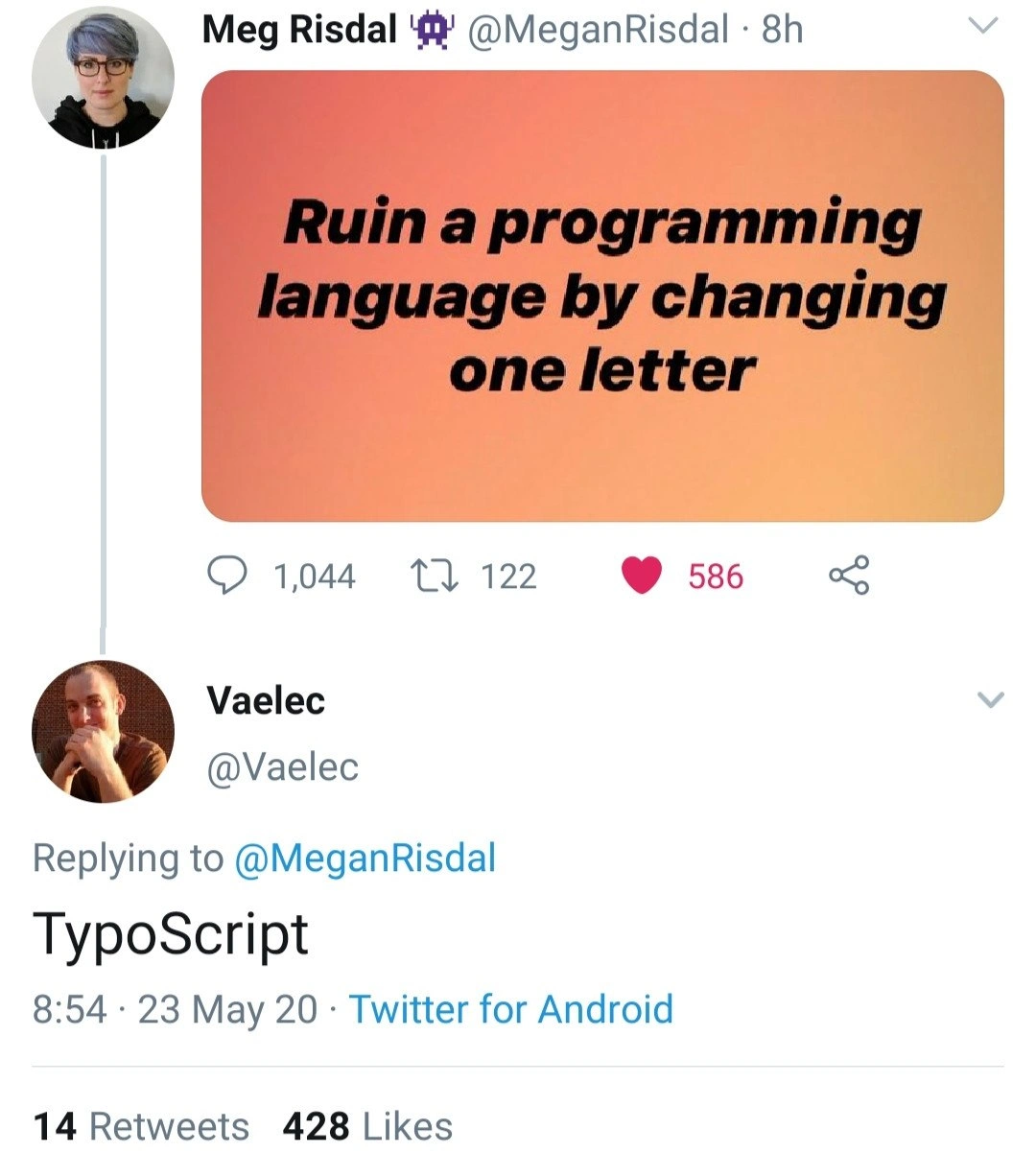
Now, about the meme: it’s referencing a fun game among programmers on Twitter. The prompt says: “Ruin a programming language by changing one letter.” This means you take the name of a programming language and change or substitute one letter in its name to make a new, silly name. In the screenshot, someone did this with TypeScript and came up with "TypoScript". Why is that funny? Because TypeScript is known for correctness and catching mistakes, whereas the word "typo" literally means a mistake in typing. By altering the name to TypoScript, it sounds like a language all about making mistakes! It's a perfect play on words: Type vs Typo. Just that single added letter "o" transforms the meaning. It "ruins" the original name in a humorous way. This falls under SyntaxHumor and LanguageQuirks because it's joking about language names and spelling.

For a new developer (or anyone learning coding), there’s also a relatable truth here: one letter can change everything. You might have experienced writing code and nothing works, only to find you had a variable spelled wrong by one character. This joke exaggerates that idea by pretending the whole programming language got messed up by one character change. Also, notice on the tweet that many people replied (over 1,000 replies!) with their own one-letter-off language names, and this TypoScript reply got a lot of likes. That means a ton of folks found it clever. It’s like a big inside-joke among coders: we take something normally serious (programming languages) and make it goofy with a tiny tweak. And specifically picking on TypeScript is extra funny because developers know how picky TypeScript can be about correctness. Calling it TypoScript is like saying “let’s have a language that’s not picky at all – one that’s all typos!”. Of course, no such language actually exists; it’s just an entertaining thought experiment and pun.

Level 3: One Letter Off

In TypeScript, every character in your code matters. It's a statically-typed superset of JavaScript that brings rigorous type checking to catch errors before your code runs. The Twitter prompt in the meme challenges developers to "ruin a programming language by changing one letter," and the winning reply was a cheeky mutation of TypeScript into TypoScript. This wordplay tickled so many engineers because it flips TypeScript’s core promise on its head. TypeScript is beloved for preventing those pesky mistakes that slip through in plain JavaScript – it’s like a guardian against variables spelled wrong or functions used incorrectly. By contrast, the made-up "TypoScript" sounds like a language where everything is spelled wrong – a nightmare of slip-ups rather than strict rules. It’s hilariously ironic: the language meant to eliminate errors is being "ruined" by embracing errors in its very name.

From a seasoned developer’s perspective, this joke lands because we've all been there: chasing a bug for hours only to find it was a one-character typo. TypeScript was created precisely to battle such chaos – it forces us to declare types and catch ReferenceErrors or mismatched types early. So the idea of TypoScript strikes a chord: it’s as if someone took our hard-won tool for code safety and introduced the one thing we fear in code – a simple spelling mistake – as a feature! There's also a subtle jab at language naming and LanguageQuirks. Modern languages often have sleek, meaningful names (TypeScript emphasizes “types”); change one letter and that serious name becomes comical. The tweet garnered hundreds of likes because developers recognized both the clever pun and the underlying truth: one wrong character can ruin everything in programming. In fact, TypeScript itself will tell you if you mistype a variable name. It’s saved many of us from shipping code with embarrassing typos. So seeing it intentionally turned into “TypoScript” is absurd in the best way.

This touches on a broader inside joke in software: naming is hard. A single letter can make or break meaning. The prompt spawned countless replies (over 1,000) with similar one-letter disasters because it's a common dev exercise to tweak language names (think Java -> lava, or Python -> Python 🐍✨). TypeScript was ripe for this because swapping the 'e' for an 'o' yields "typo", which is a real word with a funny, self-deprecating meaning for coders. (Fun fact: there actually is something called TypoScript in the wild – a configuration language for the TYPO3 CMS – but that’s an unrelated coincidence!). The real humor here is tied to shared developer experience: whether you’re a fan of TypeScript or not, you know the pain of typos. TypeScript devotees tout how it catches mistakes; detractors joke it’s overkill. TypoScript as a concept pokes fun at both sides – what if a language embraced mistakes? It's a satirical twist that makes us laugh and cringe, imagining a bizarro-world language where the compiler might say "typo? no problem!" instead of erroring out. In short, this meme deftly combines DeveloperHumor and SyntaxHumor: it’s a one-letter gag that reflects the very real importance of correct syntax in our daily coding lives.

Description

A screenshot of a Twitter thread. The initial tweet is from user Meg Risdal (@MeganRisdal) and includes an image with a reddish-orange gradient background. On this image, bold black text reads, 'Ruin a programming language by changing one letter'. Below this tweet, another user, Vaelec (@Vaelec), has replied, 'TypoScript'. The humor is a clever pun on the programming language TypeScript. By changing a single letter ('e' to 'o'), the name becomes 'TypoScript,' which ironically suggests a language prone to errors or typos. This is funny to developers because TypeScript was created to add static typing to JavaScript, a feature primarily designed to catch type-related errors and typos during development, long before the code runs. The reply perfectly and concisely fulfills the prompt's challenge while making a sharp, self-referential joke about the very purpose of the language
Comments

7
Anonymous ★ Top Pick They call it TypoScript, but let's be honest, that's just vanilla JavaScript after three developers have touched the same file
  1. Anonymous ★ Top Pick

    They call it TypoScript, but let's be honest, that's just vanilla JavaScript after three developers have touched the same file

  2. Anonymous

    TypoScript: the strongly mis-typed superset of JavaScript where the compiler promotes every misspelling to `any`, so the build never fails - only the post-mortem

  3. Anonymous

    TypoScript: where your type definitions are just suggestions and the compiler autocorrects 'string' to 'strong' because it thinks you need more confidence in your code

  4. Anonymous

    The real genius here is that TypeScript didn't just change one letter - it added an entire type system, a compiler, and years of 'any' type escape hatches. But sure, let's pretend the only difference is swapping 'Java' for 'Type' while we spend three hours debugging why our perfectly valid JavaScript now fails at compile time because someone decided `undefined` and `null` should be distinct types

  5. Anonymous

    PoScript: the PostScript mutation where your PDFs render haikus instead of pages - pure legacy lang nightmare fuel

  6. Anonymous

    TypoScript: TypeScript with strict:false, skipLibCheck:true, and a thousand any types - basically a glorified spell-checker for your PRs

  7. Anonymous

    TypoScript: the edition where a single misspelling in tsconfig promotes “any” to senior architect

Use J and K for navigation