Finally, A Tangible JVM
Why is this Languages meme funny?
Level 1: Cloud in a Jar
Imagine someone talks about storing files in “the cloud” (which really means on the internet), and then a kid runs outside with a jar, scoops up a bit of fog, and says, “Look, I caught the cloud to save our photos!” We’d laugh because the child took an invisible idea and treated it like a physical thing. This meme’s joke is very similar. In programming, the Java Virtual Machine is an invisible helper – sort of like an imaginary friend that helps run Java programs behind the scenes. It’s not a machine you can see or touch. The meme pretends that a scientist finally turned that pretend helper into something real you can hold in your hand. The scientist is proudly holding a test tube as if it contains the magical “Java Real Machine.” It’s funny because we know you can’t actually bottle a virtual idea, just like you can’t keep a real piece of a cloud in a jar. The humor comes from that silly mix-up between what’s real and what’s make-believe. Even if you don’t know the technical details, you can laugh at the excited look of the scientist celebrating a totally ridiculous “discovery.” It’s like cheering because someone found a way to hold a make-believe thing – a playful reminder that computer terms sometimes sound like everyday things, even when they’re not literal at all.
Level 2: Virtual Machine, Real Confusion
Java is a popular programming language, and one unique thing about it is how it runs. When you write Java code and compile it, you don’t get a normal program that your computer’s processor understands directly. Instead, you get something called Java bytecode (a generic set of instructions not tied to any single type of CPU), and that needs a special helper to run it. That helper is the Java Virtual Machine (JVM). Despite the name, the JVM isn’t a physical machine at all – it’s a piece of software that pretends to be a machine. It provides a fake computer inside your real computer.
Think of the JVM as a translator or middleman between your Java program and your actual hardware. Your real machine (like your laptop’s CPU) only understands its own low-level binary instructions. The Java Virtual Machine reads the Java bytecode and interprets or compiles it on-the-fly into those native instructions that the real hardware can execute. This extra step is what makes Java cross-platform: the same compiled Java .class file can run on Windows, Mac, or Linux, as long as each system has the JVM program installed. In simpler terms, Java doesn’t ship executables for each type of computer; it ships one standardized set of instructions (bytecode), and the JVM on each computer knows how to run it.
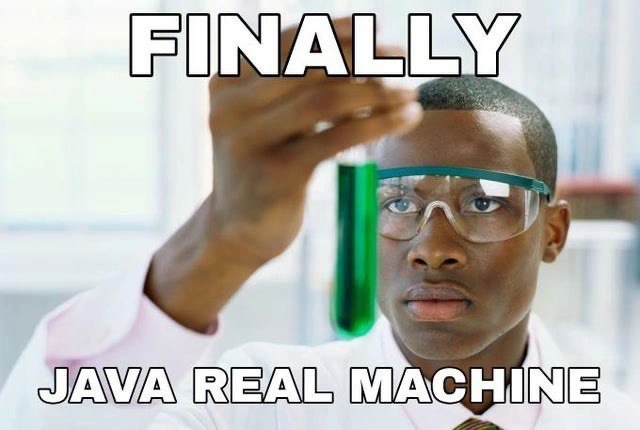
Now, the meme shows a scientist in a lab coat and safety goggles, holding up a test tube filled with bright green liquid and looking very proud. The bold text on the image says: “FINALLY” at the top, and “JAVA REAL MACHINE” at the bottom. This is funny because in reality there’s no such thing as a "Java Real Machine." It’s a made-up phrase that riffs on the term Java Virtual Machine. The joke imagines: what if someone actually found or built a physical machine for running Java? The picture with the test tube is pretending that the scientist has finally distilled or discovered this mythical real machine. Of course, he’s just holding a regular chemical solution, not a tiny computer! But treating that tube of liquid like it’s a revolutionary piece of computing hardware is the goofy part.
Let’s clarify the terms in plain language:
- A virtual machine is not something you can touch; it’s basically a software simulation of a computer. It’s like a pretend computer running inside a real computer.
- A real machine means actual physical hardware – the chips and circuits you could hold in your hand or see on a motherboard.
So when the meme says “Java Real Machine,” it’s mashing up a technical term with a literal twist. It’s as if the scientist finally turned the pretend computer (the JVM) into a real object you can hold. This plays on the word “virtual” versus “real.” Developers often refer to the JVM as a virtual machine, and nobody expects there to be an actual, dedicated Java machine sitting in a lab. That’s why this image is silly – it’s joking that after years of talking about the virtual machine, someone got impatient and said, “Let’s make it real!” The bright green liquid doesn’t represent anything in particular from Java (Java’s icon is a cup of coffee, not a neon potion!), but it makes the scene look like a wacky science experiment.
If you’re a new developer, you might remember how confusing it was the first time you heard “You need Java installed to run that program.” You might have thought, “Java installed? Do I need some special machine for this?” In truth, installing Java just means putting the JVM software on your computer, not adding any new hardware. The meme plays on that initial confusion. It’s relatable because many of us have had moments where computer terms sounded weirdly literal. Language quirks like calling a piece of software a “machine” can definitely cause head-scratching at first! Here, the joke is shining a light on that quirk: the term Java Virtual Machine sounds like it could be a gadget, so the meme imagines it as one.
Also notice the meme’s visual style: the text is in big, bold white letters with a black outline – the classic Impact font meme look. This format is common in developer humor and tech humor circles for sharing inside jokes. By using the serious-looking scientist image with the dramatic “FINALLY” caption, it sets up a fake heroic discovery. The punchline is the text “JAVA REAL MACHINE,” which immediately tells those in the know that it’s a pun. It’s a lighthearted example of coding humor that points out how funny technical jargon can be when you take it at face value. Even if you’re fairly new to coding, you can chuckle at how the meme literally turns an abstract concept into a lab experiment. It’s basically saying: even our serious programming terms can sound pretty silly if you don’t remember they’re just metaphors!
Level 3: Bytecode in a Beaker
FINALLY
JAVA REAL MACHINE
In this meme, a lab scientist triumphantly holds up a test tube of bright green liquid as if he’s made a groundbreaking discovery. This image is a classic scientist meme template, often used to humorously announce some absurd or long-awaited invention. The all-caps Impact font captions shout “FINALLY” at the top and “JAVA REAL MACHINE” at the bottom. It’s a playful twist on the well-known term JVM (Java Virtual Machine) that experienced developers recognize instantly. By replacing "Virtual" with "Real," the meme cracks a joke about turning an abstract software concept into a tangible physical object.
As seasoned developers know, the Java Virtual Machine isn’t a physical device at all – it’s a software runtime environment that executes Java programs. Think of the JVM as an imaginary computer that sits on top of real hardware. When you run a Java application, the Java compiler doesn't create a native machine-code binary tied to your CPU (like C++ or Rust would). Instead, it produces bytecode (in a .class file) that gets executed by the virtual machine. This extra layer of abstraction offers Java its famous “Write Once, Run Anywhere” capability, meaning the same compiled Java code can run on Windows, Mac, or Linux as long as each has a JVM. But that convenience comes at the cost of having an invisible middleman between your code and the actual hardware. The JVM acts as an interpreter and just-in-time translator, managing things like memory and garbage collection on the fly.
The humor here comes from an absurd literal interpretation. The caption “Java Real Machine” implies that after years of dealing with a virtual machine, someone has finally concocted a physical, real machine for Java. The scientist’s excited expression and the triumphant “FINALLY” play into a shared inside joke: we developers often dream about making our tools more concrete or efficient. It’s as if some intrepid researcher got fed up with Java’s abstract layers and proclaimed, “Enough! I’m going to bottle the JVM in a test tube.” The bright green fluid in the tube is arbitrary – perhaps a tongue-in-cheek potion representing the essence of Java’s runtime, magically distilled into hardware. The whole scene exaggerates the idea of capturing an elusive software concept and holding it up like a Nobel Prize discovery.
For veteran Java engineers, the meme also pokes fun at performance tropes and language rivalries. In the grand old days of language wars, Java was often ribbed by C/C++ programmers for not running on “the bare metal” (i.e. directly on the CPU). Instead of producing direct native code, Java relies on a managed runtime — first interpreting bytecode, then using a JIT (Just-In-Time) compiler to translate bytecode to native instructions on the fly. Back then, it was common to joke that the JVM made Java slower or more memory-hungry compared to truly “native” languages. So the idea of a Java Real Machine reads like satirical wish-fulfillment: if only we had actual silicon dedicated to Java, no more complaints about pesky virtual overhead! It playfully suggests a world where we skip the intermediary and run Java as fast as lightning on a mythical hardware device. Of course, in reality we manage just fine with modern JVM optimizations, but the joke taps into that old urge for speed -- the dream of seeing Java run on a chip as directly as C runs on a CPU.
There’s a bit of nomenclature nerdiness in this gag as well. The term “Virtual Machine” in Java’s context was always metaphorical – it’s virtual because it’s not a physical machine at all. A virtual machine is essentially software pretending to be a real computer, complete with its own set of bytecode instructions and memory management. By jokingly announcing the discovery of a “Real Machine,” the meme plays on that naming quirk. It’s hinting: was the “virtual” label only because we hadn’t found the real one yet? We all know that’s not how it works – the JVM was never missing a physical counterpart – but treating the Java Virtual Machine as if it were an actual gadget makes for a wonderfully geeky pun. In short, it’s a clever runtime pun that tickles any developer who’s tangled with a JVM and chuckled at how literal our jargon sounds outside its context.
Seasoned programmers might even recall that this joke has a tiny grain of truth in computing history. Over the years, there have been experiments to blur the line between Java’s virtual world and real hardware. For instance, ARM processors once had a feature called Jazelle that could execute Java bytecode directly in silicon (a sort of hardware assist for the JVM!). A few niche projects dreamed of Java-specific chips or firmware that would make the Java runtime hardware-real. These efforts show that the idea of a "Java machine" isn’t entirely as crazy as it sounds. But turning the entire JVM into a physical device is still the stuff of sci-fi… or memes. The scientist holding a glowing green test tube is the meme’s tongue-in-cheek way of saying, “Eureka! We’ve finally captured the mysterious JVM and made it real,” which is delightfully ridiculous.
Ultimately, this meme resonates with programmers because it takes a core piece of software architecture (the JVM) and turns it into a goofy lab experiment. It’s an inside joke about the layers of abstraction we deal with every day – making it instantly relatable to anyone who’s set up Java and wondered about the name “Virtual Machine.” We’re laughing at the sheer silliness of a researcher holding up what would be computing’s equivalent of a unicorn: a mythical Java Real Machine, glowing green in a test tube. By exaggerating the literal meaning of a technical term, the meme delivers a mix of “I see what you did there” cleverness and comforting camaraderie (we’ve all been confused by technical names at some point). It’s a little celebration of the fact that in programming, even our serious jargon can inspire wonderfully absurd humor.
Description
A stock photo meme, often called the 'Finally' meme format, shows a Black scientist in a white lab coat and safety goggles looking intently at a glass test tube containing a vibrant green liquid. Large, white text with a black outline is superimposed over the image. The top text reads 'FINALLY', and the bottom text reads 'JAVA REAL MACHINE'. The joke is a literal-minded pun on the 'Java Virtual Machine' (JVM), the runtime environment that executes Java bytecode. For developers, especially those with experience in the Java ecosystem, the JVM is a purely abstract software concept. The humor comes from the absurdity of treating it as a physical substance that could be 'finally' discovered in a lab, like a chemical compound. It playfully contrasts the intangible world of software with the tangible world of physical science

Comments
7Comment deleted
The best part about the Java Real Machine is that there are no more OutOfMemoryErrors, just a slight overflow onto the lab bench
Great - zero-millisecond GC pauses at last… you just have to deploy the new build in 50 ml vials instead of Docker containers
After 30 years of abstraction layers, someone finally figured out how to compile Java directly to chemistry - though the garbage collector still requires a hazmat team and the heap dumps are now actual physical dumps requiring EPA approval
After decades of 'write once, run anywhere,' someone finally figured out how to synthesize the JVM in a lab. The green liquid is clearly a solution of compiled bytecode suspended in garbage-collected medium. Side effects may include verbose stack traces, unexpected NullPointerExceptions, and an inexplicable urge to argue about Spring vs. Jakarta EE on Reddit
Introducing the Java Real Machine: bytecode in ROM, JIT in microcode, GC as an interrupt - then procurement asks for ARM and you remember portability was the whole point
JVM portability was the dream; this real machine runs anywhere there's a Bunsen burner - no JIT warmup required
Java Real Machine: because the only JIT faster than HotSpot is photolithography