Skip to content
DevMeme
1129 of 7435
The Illusion of Type Safety: The 'Any' Type Shortcut
Languages Post #1266, on Apr 5, 2020 in TG

The Illusion of Type Safety: The 'Any' Type Shortcut

Why is this Languages meme funny?

Level 1: Pretend Seatbelt

Imagine your friend’s dad says everyone must wear a seatbelt in the car to stay safe. Now, instead of actually buckling a real seatbelt, your friend just draws a seatbelt across their shirt with a marker and says, “Look, I’m wearing a seatbelt!” Clearly, that fake seatbelt isn’t going to protect them in an accident. The dad would be furious because the whole point of the rule (keeping everyone safe) was completely ignored, even though the friend pretended to follow it. In this meme’s story, using a real typed language with proper types is like wearing a real seatbelt for safety. But the coworker did the equivalent of drawing a pretend seatbelt by making every variable type any (which offers no safety at all). The senior developer feels like the angry dad – frustrated and shocked that the coworker tried to cheat the system, and worried because now the team isn’t any safer from bugs even though they “followed the rules” on paper. It’s funny in a face-palming way, because we all understand how ridiculous and infuriating that kind of fake solution is.

Level 2: When Any Means Anything

Let’s break down the joke in simpler terms. TypeScript is a programming language that adds static typing to JavaScript. In a statically typed language, you must define what type of data each variable holds (for example, a variable is a number, a string of text, an array of items, etc.), and the computer (specifically, the compiler) will check these types before running the program. This helps catch mistakes. For instance, if a function expects a number and you accidentally pass a string, a statically typed language will usually give you an error before you even run the code. This is what we mean by type safety – the language helps ensure you don’t mix up incompatible kinds of data in ways that could crash the program.

Now, TypeScript was created to improve CodeQuality for JavaScript projects by introducing this kind of safety net. But here’s the catch (and the source of the humor): TypeScript also has a special escape hatch type called **any**. If you declare a variable with type any, it basically tells TypeScript, “Hey, don’t worry about checking this one; it can be anything, and I know what I’m doing.” In other words, any disables the usual strict checks for that variable. You can change its value to any type, call any property or function on it, and the compiler won’t complain. It’s there to help during gradual adoption or when you genuinely don’t know the type (like interacting with some dynamic data). But it’s easy to misuse.

What did the coworker do? They were supposed to convert a project to a “typed language” (implying to use proper types everywhere for safety). Instead, they declared every single variable as any. That’s like turning off all the alarms and claiming the building is secure because, technically, you installed an alarm system (it’s just set to never ring). With every variable as type any, the code will compile without type errors – because we told the compiler not to check! But the whole reason for using TypeScript (catching errors early) is lost. The migrated code is essentially behaving like plain old JavaScript (which is dynamically typed and doesn’t do compile-time checks). The coworker’s response, “Oh great, I just put every variable as type Any,” shows they either misunderstood the assignment or took a shortcut. They achieved the letter of the goal (“we use TypeScript now”) but not the spirit (we have safer, more reliable code).

To a junior developer: imagine you have a function that expects a string (text) and someone accidentally passes a number. In TypeScript, if everything is properly typed, this mistake would be caught before running the program. But if that parameter is typed as any, TypeScript won’t catch it. You might only find out when the program runs and perhaps crashes or behaves oddly. For example:

let x: any = "hello";
x = 42; // Allowed because x is of type 'any' (no compile-time type check)

console.log(x.toUpperCase()); 
// The compiler doesn't complain about toUpperCase(), because x is 'any'.
// But at runtime, x is 42 (a number), which has no toUpperCase method -> crash!

If x were properly declared as a string in the above code, assigning a number to it (x = 42) would have caused a compile-time error (TypeScript would yell that a number isn’t assignable to a string) and saved you from the runtime crash. That’s the kind of protection we seek by migrating to a typed language. By using any everywhere, the coworker basically turned off those protections. They violated code quality guidelines, because now the code won’t warn you of obvious mistakes. This creates technical debt: problems we’ll have to fix later. Someone eventually must go back and replace all those any types with proper specific types (like string, number, or a custom interface) to actually make the code safe and clear. Until that’s done, any bugs related to type mismatches might lurk in the shadows and pop up unexpectedly when the program runs.

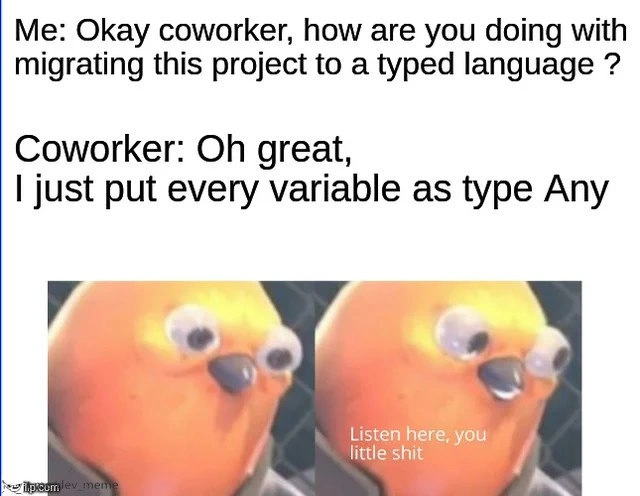
The meme’s image amplifies this scenario with humor. The format is an angry bird reaction meme: a close-up of a bright orange cartoon bird (known from an online video/meme) with bulging eyes, looking absolutely done with the situation. It’s paired with the caption “Listen here, you little shit,” which is a comedic way of showing the senior developer’s internal reaction when the coworker cheerfully announces they used any everywhere. Of course, in real life a professional wouldn’t (or shouldn’t) use those words to a colleague, but the exaggerated caption communicates that feeling of outrage and disbelief. The senior dev expected an improvement, but got a coworker_shortcut that makes things just as bad as before. The categories of Languages and TechDebt come into play: this is about a programming language feature (any in TypeScript) being misused in a way that adds technical debt. In plainer terms, the coworker’s quick fix is making more work and trouble for the team down the line.

So, to sum up in straightforward terms: the meme is funny to developers because it points out a really silly way to defeat the purpose of using a typed language. It’s as if someone found a loophole and completely abused it, leaving the person who cared about doing things right (the one asking “How’s the migration going?”) tearing their hair out. The DeveloperHumor here is all about that contrast between what was supposed to happen (carefully adding types to improve the code) and what actually happened (using any like a cheat code to avoid real work, thus no improvement at all). Even if you’re new to programming, you can understand it as: we switched to a safer way of coding, but my coworker basically turned off the safety and claimed victory – and that’s why I’m mad.

Level 3: Type Safety Betrayed

This meme strikes a nerve for any senior developer who has fought for better code quality. We’ve all seen that one coworker who finds a pernicious shortcut, turning a well-intentioned migration into fresh technical debt. The scenario: you task someone with migrating a large JavaScript project to a language like TypeScript (which offers static typing for better type safety). Initially, everyone’s excited – static types catch bugs early, make refactoring safer, and improve documentation. But then this coworker proudly reports, “Oh great, I just put every variable as type any.” Cue the record scratch and instant rage. They’ve effectively bypassed static typing entirely – a classic static_type_bypass. Instead of thoughtfully defining types (string, number, custom interfaces, etc.), they slapped any on every variable, which is basically telling the compiler, “Don’t worry about it, I got this (I don’t got this).” It’s the any_everywhere anti-pattern.

Why is this so infuriating? Because it undermines the whole point of the migration. It’s like spending weeks convincing the team to adopt safer practices, only to discover someone maliciously complied in the laziest way possible. The code still “works,” but now it wears a thin veneer of types that provide zero protection. It’s basically JavaScript in a fake mustache pretending to be TypeScript. You’ve gained none of the promised benefits of static typing – you might as well not have migrated at all. In fact, it’s worse: now future maintainers might be lulled into a false sense of security, thinking the code is type-checked when in reality it’s a wild west of any types. A variable typed as any is a black box – it could be a string today, a number tomorrow, an object next week – and the compiler won’t warn you. Imagine another dev sees function getUser(id: any) in a supposedly TypeScript codebase; they might scratch their head or, worse, assume id can be treated arbitrarily and introduce a subtle bug. The CodeQuality hasn’t improved at all; we just have a new kind of mess.

This kind of type_any_abuse is painfully common in rushed migrations. Under tight deadlines or lacking experience with static types, some developers go for the path of least resistance: “just make it compile.” If the compiler complains their function isn’t returning the right type or a variable’s type is unclear, they silence it by declaring everything any. It’s essentially the “I don’t have time to do it right” approach. In the short term, they get a ✅ from the build system – hooray, it compiles! – but in the long term, they’ve created a maintenance nightmare. All those any declarations are technical debt that someone (likely the irritated senior in the meme) now has to pay off by painstakingly adding proper types later. Until then, any bug stemming from type mismatches will rear its ugly head at runtime, potentially crashing production just like in the bad old days of untyped JavaScript.

The humor here comes from the shared facepalm moment. The conversation in the meme is practically an office trope:

  • Me (the senior): “How’s the TypeScript migration going? Are we getting those sweet type checks?”
  • Coworker: “Doing great! I fixed all the errors by making every type any.”

It’s both absurd and infuriating. The senior knows this is pure TechnicalDebt creation, not debt payoff. The large text reply from the coworker in the meme reads exactly: “Oh great, I just put every variable as type Any” – you can almost hear the clueless enthusiasm. This juxtaposed with the senior’s internal reaction, embodied by the bright orange bird with bulging, bloodshot eyes, is comedic gold for developers. The bird image (a popular angry_bird_reaction_meme template) has a little caption, “Listen here, you little shit,” which is exactly what the senior really wants to say in that moment of simmering fury. It’s an exaggerated, cartoonish way to show just how angry and incredulous the senior feels. That bird’s crazed stare is basically my soul leaving my body upon hearing such nonsense.

From an experienced engineer’s perspective, this situation encapsulates why we can’t have nice things in software teams. It highlights the gap between adopting a tool and using it correctly. Sure, the project now uses a “typed language”, but only in name. The coworker took a coworker_shortcuts approach: technically fulfill the assignment (the codebase is now in TypeScript), but undermine its spirit (it’s as loosely typed as before). It’s reminiscent of painting over mold in a wall – a cosmetic fix that does nothing to solve the underlying problem. StaticTyping is supposed to improve reliability; using any everywhere is like leaving all those type-related bugs in place, just with a fresh coat of TypeScript syntax. No wonder the senior is livid – they probably championed this migration to prevent the 3 AM production failures, and now those bugs are simply hiding behind a bunch of : any annotations.

In real-life teams, code reviews or linting rules often catch this kind of thing (noExplicitAny rule, anyone?). Seasoned devs know that sprinkling any is code smell. One or two any types might be necessary evils (integration with an untyped library or truly polymorphic behavior), but an entire codebase of any is a red flag that someone didn’t actually do the work. It means a future refactor, more debugging, and possibly severe production issues that static typing was meant to prevent. Essentially, the coworker traded short-term ease for long-term pain, and the senior developer can see the train wreck coming from a mile away. The humor has a cathartic edge: we laugh because otherwise we’d cry. As grizzled veterans of DeveloperHumor, we’ve seen this movie before. And like the orange bird, all we can do is glare and mutter “Listen here, you little…” — hopefully followed by a diplomatic code review comment explaining why any-ing everything is not okay.

Level 4: The Top Type Trap

In TypeScript (and type theory in general), any is essentially the top type – the one type to which all other types can implicitly convert. This makes it a powerful escape hatch in a static type system, but also a dangerous one. By declaring every variable as type any, our hapless coworker has effectively collapsed the type lattice to its top element. In practical terms, the compiler throws its hands up and says, "Okay, do whatever you want – I won’t check." From a theoretical standpoint, this is what language designers call unsound. The whole point of static typing is to catch type mismatches (like calling a string method on a number) at compile time. But any short-circuits that: no compile-time guarantees, just like a dynamic language.

This design isn’t an accident: TypeScript’s creators introduced any to support gradual typing, easing migration from dynamic JavaScript. It’s a pragmatic concession. Academically, it’s known that gradually typed languages allow mixing untyped and typed code. In theory, you’re supposed to incrementally replace any with real types – a bit like training wheels you eventually remove. But here our coworker never takes the training wheels off; they’ve bolted them permanently onto the bike. The result? The project remains as dynamically typed as ever, yet now with an illusion of static typing. It’s the worst of both worlds – type safety promised, then immediately betrayed. Type theorists might dryly note this as a degenerate case of gradual typing, where the static type checker is effectively nullified. In plainer terms, the code’s safety net has a giant hole cut in the middle.

Historically, seasoned developers have seen similar "loopholes" in other languages. In C you could cast everything to a void* (a pointer to anything) and lose type info, or in early Java you’d cast objects to Object or use raw types to circumvent the generic type checks. These were known foot-guns that could introduce runtime errors – but they were sometimes abused under pressure. The modern equivalent in a TypeScript codebase is plastering any everywhere. It’s the 2020s flavor of weak typing: we invented fancy static analysis only for someone to hit the off-switch. As an expert might quip, the code’s type system went from Sound to Silent. The meme captures this absurd irony: we’re supposedly in a static-typed language now, but thanks to any abuse, we might as well be back in vanilla JavaScript, praying nothing blows up at runtime.

Description

A two-part meme about the pitfalls of migrating to a statically-typed language. The top section contains a dialogue: 'Me: Okay coworker, how are you doing with migrating this project to a typed language?' followed by the coworker's cheerful reply, 'Oh great, I just put every variable as type Any'. The bottom section features the 'Listen here, you little shit' meme format, which shows two zoomed-in images of a bird puppet with googly eyes staring intently and menacingly. The right-hand image includes the caption. The humor comes from the complete misunderstanding or deliberate misuse of the purpose of a typed language. Migrating a codebase (e.g., from JavaScript to TypeScript) is done to gain type safety and prevent bugs. Using the 'Any' type is a universal escape hatch that opts out of type checking for a variable, effectively making it dynamically typed again. The coworker's action nullifies the entire benefit of the migration, turning it into a pointless exercise and a source of extreme frustration for any developer who understands the value of static analysis


Comments

7
Anonymous ★ Top Pick Claiming you've migrated to TypeScript by using 'any' everywhere is like saying you've switched to a healthy diet by ordering a Diet Coke with your three large pizzas
  1. Anonymous ★ Top Pick

    Claiming you've migrated to TypeScript by using 'any' everywhere is like saying you've switched to a healthy diet by ordering a Diet Coke with your three large pizzas

  2. Anonymous

    Migrating to TypeScript by slapping ‘any’ on every variable is the typing equivalent of deploying docker-compose inside a single pod - yes, the compiler shuts up, but your pager just got tenure

  3. Anonymous

    Successfully migrated to TypeScript with 100% type coverage and zero compiler errors - the same metrics we'll show the board when they ask why production is still breaking in ways we thought we left behind in 2015

  4. Anonymous

    Ah yes, the classic 'TypeScript migration' where every variable becomes `any` - effectively turning your strongly-typed language into JavaScript with extra steps and a false sense of accomplishment. It's like buying a Ferrari and only driving it in first gear because 'shifting is hard.' The real tragedy? This passes CI because technically the types compile, but you've just traded runtime errors for a codebase that screams 'I was forced to use TypeScript by management.' At least with plain JavaScript, you're honest about the chaos

  5. Anonymous

    Typing everything “any” in a migration is like moving to Kubernetes and naming every pod “default” - you just relocated the entropy with more tooling

  6. Anonymous

    Our 'TypeScript migration' was just setting strict:false and noImplicitAny:false - converting the compiler into a JSON validator with better branding

  7. Anonymous

    TypeScript's 'any': static typing for devs who miss JavaScript's 'undefined is not a function' charm

Use J and K for navigation