Academic ML Rigor vs. LinkedIn 'Data Science Ninja'
Why is this AI ML meme funny?
Level 1: Cheaters vs. Honest Students
Imagine a school science fair where one kid, let’s call him Arthur, spent weeks learning and doing his project the right way. He read big science textbooks, followed all the experiment rules, and made sure to test his invention properly to prove it works. Now, another kid, let’s call him Benny, shows up and braggingly says, “Look, I got a perfect result instantly!” But here’s the thing: Benny didn’t really do the project himself. He just bought a ready-made gadget from a store and used the answer key from last year’s fair. Then he runs around telling everyone he’s a genius because his project scored 100% in the demo, even though he never tried it on a new challenge or built anything on his own.
Arthur, the hardworking student, is really upset. He yells, “No! You can’t just use a ready-made solution and claim it’s perfect without actually testing if it really works on new problems! That’s cheating and it’s not fair to those of us who did the real work!” But Benny just smirks and goes, “haha, gadget go brrrr,” which is basically him saying “hehe, I pressed a button and it worked, who cares how!” while not even getting the name of the gadget right.
In this simple story:
- Arthur is like the academic ML expert – the kid who followed the rules and cares about doing things properly.
- Benny is like the LinkedIn show-off – the kid who shortcuts the work, doesn’t really understand it, but loves to brag and soak up praise.
It’s funny in the way any tale of a cheater bragging can be funny, especially when the cheater doesn’t even realize what they did wrong. But it also feels unfair, right? Arthur’s feelings of “this isn’t right!” are justified, just like real experts feel when someone boasts about an AI being perfect without actually proving it. The meme is basically that school fair scene in cartoon form, with Arthur shouting about fairness and Benny going “hehe, whatever, I got a prize!”
Level 2: Hype vs. Science
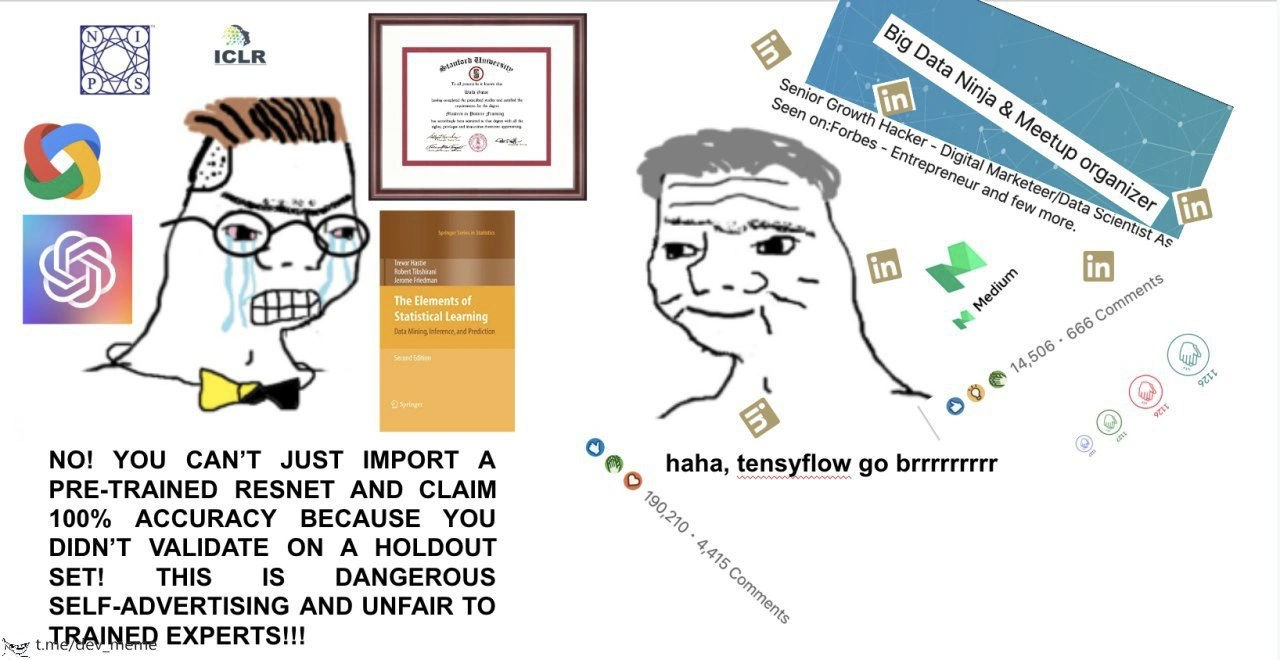
Let’s break down the meme’s elements in simpler terms. On the left side is an academic machine learning purist — basically a very trained ML expert. We can tell by the clues: he wears glasses and a bow tie (the “nerd” look), has a diploma on the wall from a university, conference logos like NeurIPS and ICLR floating around (those are famous academic AI conferences), and even the book “The Elements of Statistical Learning.” That book is a well-known, advanced textbook on machine learning; having it in the scene tells us this guy values theory and proper methods. There are also icons for ChatGPT/OpenAI (indicating he’s into real AI tech, likely up-to-date with serious research). All these hints say: “This person really knows his stuff and follows the proper scientific approach.”
Now, what is he yelling about? The text under him says:
“NO! YOU CAN’T JUST IMPORT A PRE-TRAINED RESNET AND CLAIM 100% ACCURACY BECAUSE YOU DIDN’T VALIDATE ON A HOLDOUT SET! THIS IS DANGEROUS SELF-ADVERTISING AND UNFAIR TO TRAINED EXPERTS!!!”
Let’s unpack that. A pre-trained ResNet is referring to a specific machine learning model. ResNet stands for Residual Network, a type of deep neural network famous in image recognition. “Pre-trained” means someone else already trained this network on a large dataset (like millions of images). So you can literally import it ready-made using a library like TensorFlow or PyTorch, instead of coding or training it from scratch. It’s like buying a ready-to-eat meal instead of cooking. Nothing wrong with that in itself – in fact, using pre-trained models (also called transfer learning) is common and powerful.
The issue is in claiming 100% accuracy without validation on a holdout set. In machine learning, after you train a model, you’re supposed to test it on a holdout set, which is a portion of data you kept aside (not used in training) to see how well the model does on new, unseen data. This is crucial to avoid overfitting – a term that means the model just memorized the training examples and won’t actually perform well on fresh data. When the academic says “you didn’t validate on a holdout set,” he’s accusing the other guy of not doing this essential test. In simpler terms, it’s like saying, “You only practiced the exact questions for the quiz and then took the same quiz – of course you got all the answers right, but that doesn’t prove you’re good at the subject in general!” So the academic is angry because claiming 100% accuracy without a fair test is misleading. It’s self-advertising (showing off) in a way that’s “dangerous” – dangerous here meaning it gives people the wrong idea about how good the model really is, and it’s “unfair to experts” who do things properly and might not get such flashy results because they’re honest about the difficulty.
Now, the right side is basically the target of the academic’s ire: a LinkedIn “big-data ninja” type. This character is drawn as a smug Wojak with a smooth head (often in memes a “smooth brain” implies not a lot of deep thinking going on). Around him we see the LinkedIn logo multiple times and a banner that reads “Big Data Ninja & Meetup organizer – Senior Growth Hacker – Digital Marketer/Data Scientist – Seen on: Forbes – Entrepreneur and few more.” This is poking fun at those over-the-top LinkedIn headlines some people have, where they stuff every buzzword and accolade into their title. It’s the kind of profile you might see from someone trying to brand themselves as an all-in-one tech/business guru. For context:
- Growth Hacker is a trendy term for someone who rapidly experiments to grow a business (usually in marketing).
- Big Data Ninja is a fanciful way to say they handle big datasets (often just hypey slang).
- Meetup organizer suggests they organize tech meetups (networking events), so they’re socially active.
- Listing “Seen on: Forbes, Entrepreneur…” implies they’ve been featured or have articles on those platforms – again, self-promotion to sound important.
We also see a Medium logo, which hints that this guy writes articles on Medium (a popular blogging platform) – likely posts bragging about his data science feats. And below him are social media engagement icons like a big number of likes (14,506) and comments (666). Those indicate he’s getting a ton of attention online. To someone newer in tech, it might look like “Wow, this person must be doing something amazing.” But to those in the know, it often just means he’s great at hyping things up.
Now his speech: “haha, tensyflow go brrrrrrrr”. This line is deliberately silly. First, “tensyflow” is a misspelling of TensorFlow, which is one of the most popular machine learning libraries (created by Google, used a lot for building neural networks). The red squiggly underline in the image shows it’s a typo detected by spell-check. The fact that he spells it wrong is a humorous detail – it suggests he’s maybe not as knowledgeable as he pretends (like he can’t even spell the tool he’s supposedly an expert in).
The phrase “X go brrr” is internet slang/meme speak. It basically means “I use X and stuff just happens, haha!” It originated from a meme where a money-printing machine goes “brrr” (the sound of it running) implying someone’s solution to anything is just “print more money.” Now people say “ go brrr” to joke that a complex system is being used in a dumb, simplistic way. So when he says “TensorFlow go brrr”, he’s essentially bragging: “I just run TensorFlow (maybe a pre-built model) and boom, results! 😎.” It’s a very carefree, non-scientific attitude.
To recap the dynamic in this simpler perspective: The left side is the careful scientist saying “You can’t do that! You need to follow the proper method (like using a test set). What you’re doing is misleading and not fair to those of us who actually do the hard work properly.” The right side is the flashy influencer saying “Lol, I just click a few buttons in TensorFlow and get amazing results, who cares how! Look at all the likes I’m getting.”
It’s highlighting a hype vs reality problem in AI/ML:
- Reality (science): Real data science requires rigorous validation, honest reporting of accuracy, acknowledging if a result might be too good to be true (like 100% is usually a red flag!). Experts often cringe when they see someone skip these steps. Proper practice means splitting your data, perhaps using something called train/test split or cross-validation. For example, an expert would take their dataset, use perhaps 80% to train the model, and keep 20% unseen for testing. Only after training would they run the model on that 20% to get a fair accuracy. If the model gets, say, 85% on the test data, that’s the number you report. If someone reports 100% without mentioning a test set, an expert immediately suspects they just tested on the training data or a very easy scenario – essentially overfitting or even cheating (intentionally or unintentionally).
- Hype (social media): Some newcomers or self-promoters might not follow these steps, possibly because they don’t know or because they’re chasing attention. They might just run a pre-trained model on some data, get an impressive-looking number, and post about it to build their personal brand. Social platforms like LinkedIn can reward that behavior with visibility (lots of likes, comments, applause), even if the work is questionable. This can lead to a kind of feedback loop where people exaggerate or oversimplify for clout – hence the term linkedin_clout_chasing in the tags.
This meme is in AIHumor/DataScienceHumor territory because it humorously exaggerates a real friction point. Beginners learning MachineLearning might not immediately realize why the left guy is so angry. But once you learn about overfitting and the importance of test sets, you see the issue: claiming 100% accuracy is extremely rare in real-world tasks (almost suspicious), and usually it means something’s fishy, like the evaluation was done wrong. It’s like if someone said, “I solved world hunger with one line of code, trust me!” - professionals would raise an eyebrow. Here, “import a pre-trained ResNet” is that one line of code, and “100% accuracy” is the too-good-to-be-true claim.
So if you’re a junior dev or new data scientist, the takeaway is:
- Always validate your models on data they haven’t seen to know if they actually work. This is the essence of a holdout set or test set.
- Pretrained models like ResNet are powerful tools, but using them doesn’t automatically make you a seasoned data scientist. It’s how you use them and evaluate them that counts.
- Don’t believe every boast on social media at face value – sometimes people inflate their results or skip crucial steps to sound impressive. As the meme shows, it’s a known issue in the field, enough that it’s joked about.
- There’s a bit of a culture clash: academic types prioritize correctness and fairness, while “growth hacker” types prioritize quick wins and publicity. In reality, a good data scientist finds a balance: using convenient tools (sure, import that model) but also doing things properly (e.g., checking on a holdout set, being honest about accuracy).
In summary, this meme uses a funny cartoon format to teach an important lesson: AI hype vs. reality. The academic’s rant might sound over-the-top, but he’s basically right from a technical standpoint. The LinkedIn guy’s phrase is goofy, but it represents a kind of over-simplified approach that’s all too common. Understanding both sides helps new developers see why proper validation is stressed so much in any ML course or job.
Level 3: Overfitting for Clout
Zooming out slightly, this meme perfectly captures an industry trend: the rise of hype-driven “data science ninjas” versus the careful practitioners of MachineLearning. An experienced ML engineer or researcher will immediately recognize the scenario. On the left, we have the stereotypical academic ML purist (the crying Wojak in bow tie and glasses). He’s surrounded by symbols of genuine expertise: the NeurIPS and ICLR logos (prestigious AI research conferences where real breakthroughs are vetted), an official-looking diploma on the wall (formal training, maybe a PhD in computer science or statistics), the OpenAI/ChatGPT icon (signaling familiarity with cutting-edge models), and the famous textbook “The Elements of Statistical Learning.” His furious all-caps rant boils down to: “You’re breaking the sacred rules of model validation!”
Specifically, he shouts about pretrained_resnet and the lack of a holdout validation set. For seasoned folks, this hits a nerve: we’ve all seen LinkedIn posts or Medium articles where someone boasts “99-100% accuracy!” on some task but buries the fact that they evaluated on the training data or a trivially small sample. The meme text “NO! YOU CAN’T JUST IMPORT A PRE-TRAINED RESNET AND CLAIM 100% ACCURACY...” is exactly the kind of exasperated reaction an expert has when they see a naive post touting miraculous results without proper methodology. It’s too real. We know ResNet is a powerful pretrained model (originally trained on ImageNet, a large dataset). Importing it via tensorflow or torchvision is literally a one-liner – great for transfer learning, but it doesn’t make you a wizard. Yet the LinkedIn clout chaser on the right is doing just that: grabbing an off-the-shelf model, possibly running it on the same data it was trained on or on some easy dataset, and then bragging about achieving “100% accuracy” to wow his audience.
On the right side, the smooth-headed smug Wojak represents the self-proclaimed “Big Data Ninja & Meetup Organizer – Senior Growth Hacker – Digital Marketer/Data Scientist” type. The absurdly long title full of buzzwords is something senior developers chuckle at – it screams “jack of all trades, master of none, but great at self-promotion.” He’s decorated with LinkedIn logos and a Medium icon because that’s his arena: posting hype articles and network-building rather than actual model-building. The social metric bubbles (e.g. 14,506 likes • 666 Comments) show he’s getting massive engagement. To an experienced dev, that detail is hilarious and painful: quality of content isn’t always proportional to the number of claps it gets. We’ve seen shallow “AI guru” posts go viral while more substantive work gets ignored – a classic AIHypeVsReality scenario.
The quote “haha, tensyflow go brrrrrrrr” encapsulates the carefree ignorance. It’s a play on the “X go brrr” meme (originating from a money printer meme, now widely used to joke about using a tool without concern for how it works). Here “tensyflow” is obviously a misspelling of TensorFlow (notice the squiggly red underline indicating a spell-check fail). That’s a witty touch by the meme creator: it implies the LinkedIn guy is such a poser he can’t even spell the technology he’s using – yet he doesn’t care, and his audience either doesn’t notice or doesn’t mind. From a senior perspective, this is both comical and frustrating. It’s comical because it’s exaggerated (few would be that blatantly clueless), but frustrating because it’s poking fun at a genuine issue: some people do treat complex ML libraries as black boxes, then overstate their own contribution.
The academic vs marketer contrast here also reflects a culture clash. The academic is worried about “dangerous self-advertising and unfair to trained experts”. That line suggests that by shortcutting proper procedure, the LinkedIn guy is not only misleading non-experts but also undermining the value of real expertise. For example, a trained data scientist might take weeks to carefully preprocess data, train a model, fine-tune it, avoid overfitting models, perform statistical validation, and only then report, say, 85% accuracy on a tough problem. Meanwhile, the hype-chaser might swoop in, use a pre-trained model on a cherry-picked dataset, claim “near 100% accuracy, solved!,” and bask in hundreds of clap emojis. To a veteran, this feels unjust – it’s like years of DataScience rigor being overshadowed by a quick flashy demo. It resonates with many of us who’ve seen corporate higher-ups get excited by a slick demo that doesn’t actually hold up under scrutiny.
This meme’s humor is AIHumor that cuts deep: it satirizes the AI_ML industry’s tendency for hype. Terms like “Growth Hacker” and “Big Data Ninja” were trendy around the late 2010s, often self-assigned by folks trying to pivot into the booming data field. A TechHistorian might note how during the big data craze and deep learning gold rush, LinkedIn and Medium were flooded with posts like “I built an AI in 5 minutes!” or “Achieved 99% accuracy with [library].” These often glossed over essential details like data leakage or train-test split. Senior developers have likely encountered coworkers or interview candidates who talk the talk (fancy terms, namedropping TensorFlow and PyTorch) but then reveal gaps in fundamental knowledge (like not knowing what a holdout validation set is). It’s a collective facepalm moment in the industry, which this meme exaggerates for effect. The left Wojak’s rage is the voice of all the mentors and professors who emphasize, “Always test on unseen data! Don’t claim results you haven’t validated!” While the right Wojak’s meme-speak is the embodiment of, “Chill, dude. It just works, and I’m getting likes – who cares about the fine print?”
In real-world terms, what the bold text under the left panel warns about is overfitting and dishonest representation. If you don’t separate a holdout test set, you’re basically grading your homework with the answer key in hand. It’s unfair not only to experts but also to clients or stakeholders who might be misled into thinking the model is a silver bullet. There have been instances where hype leads companies to deploy models that then fail spectacularly because the evaluation was flawed – exactly what proper validation is meant to prevent. So the stakes behind the humor are real: ignoring best practices for the sake of linkedin_clout_chasing or quick results is “dangerous” professionally (failed projects, lost trust) and even ethically (if people trust a bogus 100% accurate model in healthcare or finance, imagine the harm).
Overall, the senior perspective sees this meme as a sharp commentary on DataScienceHumor: it’s funny because it’s true. The dichotomy of “Academic ML Purist” vs “LinkedIn AI Influencer” is an archetype now. And as cynical as the scenario is, it reminds experienced folks of the importance of continuing to advocate for sound practices in the AI_ML field – even if the hype train (“tensyflow go brrr”) is running at full speed on social media.
Level 4: No Free Lunch Theorem
At the extreme technical end, this meme highlights a fundamental machine learning principle: a model’s performance must be validated on unseen data to mean anything. The left panel’s academic Wojak is basically invoking statistical learning theory. In formal terms, he's upset that the right panel’s "ninja" is conflating training accuracy with generalization performance. The academic likely knows that without a holdout validation set, any claim of “100% accuracy” is scientifically void. It violates the No Free Lunch theorem of ML – without testing on new data, you have no idea if the model actually learned underlying patterns or just memorized answers. In formulas, if $\hat{f}$ is our model and the data $(X, y)$ was used to fit it, then reporting $\text{Accuracy}_{train} = 100%$ tells us:
$$\mathbb{E}_{(x,y)\sim \text{train}}[\mathbf{1}{\hat{f}(x) = y}] = 1.0,$$
but what we care about is the true error on novel data $\mathbb{E}_{(x,y)\sim \text{test}}[\mathbf{1}{\hat{f}(x) = y}]$, which remains unknown without a holdout set. Essentially, the influencer measured zero training error (an overfit model can achieve that easily, especially a high-capacity deep network), and then boastfully implied it equals perfect real-world performance.
This touches on core concepts from The Elements of Statistical Learning (that big yellow book hovering by the academic). That textbook dives deep into model assessment techniques like cross-validation, regularization, and the bias–variance tradeoff to prevent exactly this kind of overfitting. Overfitting happens when a model (like a heavy ResNet with millions of parameters) is so flexible it can memorize the training set, outputting correct labels for every training example but potentially failing on new examples. A pre-trained ResNet-50 is a convolutional neural network with ~25 million parameters, originally trained to categorize images into 1000 classes. If you import a pre-trained ResNet, feed it data from its training distribution (or worse, the exact same images it’s seen), it might indeed go “💯% accuracy” on that data. But academically, that result is meaningless – it’s like claiming you aced a test when you had all the answers beforehand. The ICLR and NeurIPS logos behind the academic indicate top ML conferences where reviewers would tear apart a paper if it claimed results without proper train-test split or statistical significance analyses. These venues demand rigorous proof that a model generalizes beyond its training set.
On the right, the smug LinkedIn charlatan’s “haha, tensyflow go brrrrrrrr” is basically a mockery of how some self-proclaimed data gurus reduce complex ML to a push-button exercise. It parodies the attitude of “I just run TensorFlow and magic happens.” The typo “tensyflow” with a red spell-check underline is a cheeky detail – it implies he can’t even spell TensorFlow correctly, yet he’s bragging about using it. This hints at Dunning-Kruger-esque overconfidence: minimal understanding but maximum self-advertising. The academic purist is infuriated because this behavior flouts the norms of scientific integrity and might even spread misinformation. In research, reproducibility and honest reporting are paramount; claiming AI model perfection without validation is a cardinal sin that erodes trust. In fact, the entire AI_ML community frets about hype damaging its credibility (we’ve seen AI boom-and-bust cycles or “AI winters” triggered by unmet hype before).
This highest level of analysis connects the meme’s humor to deep ML concepts: the necessity of holdout validation, the dangers of overfitting models, and the contrasting mindsets of rigorous academic science vs. hype-driven marketing. It’s a clash between adherence to statistical principles and the neglect of them for social media clout. The meme exaggerates to make a point, but underlying it is a real tension in the DataScience field: results should be trustworthy, not just AIHypeVsReality fodder on LinkedIn. In short, the academic is defending the “truth” defined by decades of ML theory, while the LinkedIn “big-data ninja” is operating in a world with no peer review, governed only by likes and shares – a world where, alarmingly, importing ResNet50 and spitting out impressive-sounding metrics can bamboozle a non-expert audience.
Description
A Wojak 'go brrrrrrrr' meme contrasting two archetypes in the machine learning field. On the left is a crying, bow-tied Wojak representing an academic purist, surrounded by logos of prestigious conferences (NIPS, ICLR), a Stanford degree, the 'Elements of Statistical Learning' textbook, and AI lab logos (Google, OpenAI). He yells, 'NO! YOU CAN'T JUST IMPORT A PRE-TRAINED RESNET AND CLAIM 100% ACCURACY BECAUSE YOU DIDN'T VALIDATE ON A HOLDOUT SET! THIS IS DANGEROUS SELF-ADVERTISING AND UNFAIR TO TRAINED EXPERTS!!!' On the right is a smug, older Wojak, representing a hype-driven practitioner, surrounded by LinkedIn and Medium logos, social media engagement stats, and a flashy title 'Big Data Ninja & Meetup organizer'. He calmly retorts, 'haha, tensyflow go brrrrrrrr'. The meme satirizes the deep cultural divide between the meticulous, theory-grounded approach of academic data science and the buzzword-heavy, results-at-any-cost marketing prevalent on professional social media. It mocks those who use powerful tools like TensorFlow and pre-trained models without understanding or respecting the scientific rigor required for valid results

Comments
7Comment deleted
One gets a paper rejected from NeurIPS for a minor flaw in their proofs, the other gets 10,000 likes on LinkedIn for 'democratizing AI' by deploying a Jupyter notebook that misclassifies a hot dog
The hottest optimizer in 2023 isn’t Adam or RMSProp - it’s LinkedIn’s title updater: one screenshot of “import ResNet50, 100 % accuracy” and it converges your job label to “Thought Leader” in a single epoch, hold-out set gracefully dropped by early stopping
The same person who got 100% accuracy on their training set is now teaching a $2,997 masterclass on "How I Achieved State-of-the-Art Results Without Reading Any Papers Published After 2012"
The eternal ML engineering paradox: spend six months implementing cross-validation, hyperparameter tuning, and proper train-test splits to achieve 94% accuracy, or spend six hours fine-tuning a pre-trained ResNet-50 to hit 96% on your specific dataset and ship it to production. The academic in you screams about data leakage and overfitting, but the PM already scheduled the launch party based on your 'preliminary results' that you casually mentioned in Slack. Meanwhile, someone on LinkedIn just got 50k impressions claiming they 'built an AI' by calling `model.fit()` three times
Importing ResNet and bragging 100% on the training set is shipping marketing, not ML; call me when your cross‑validation beats a stratified baseline and your LinkedIn endorsements handle concept drift
Pre-trained imports: skipping months of gradient descent pain to 'validate' 100% accuracy on a holdout suspiciously identical to your training set
Import ResNet, skip the holdout, publish to Medium - congrats, you’ve shipped LinkedInOps; the only thing that generalizes is your personal brand