Static Typing Purist vs. Pragmatic JavaScript Dev
Why is this Languages meme funny?
Level 1: All Rules vs No Rules
Imagine two friends playing together. One friend is very strict about rules — everything has to be done in a certain way. The other friend is super easy-going and playful — they just do things their own way and have fun with it. For example, the strict friend might say, “No, you can’t pretend that banana is a telephone! Phones don’t work like that, you have to use a real toy phone or nothing.” He’s basically following a rulebook in his head about how to play correctly. But the easy-going friend just smiles, holds the banana to their ear and says, “Haha, banana phone, hello!” 😄. The strict friend is tearing his hair out, shouting “You’re doing it wrong!” while the relaxed friend is totally unbothered, enjoying the silly game.
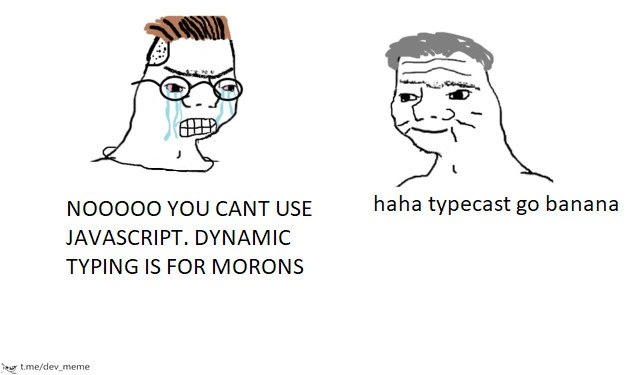
In the meme, the angry character on the left is like that strict friend, insisting on doing things by the book (the “rules” of programming types). The happy character on the right is like the playful friend, using a banana as a phone and not caring what the rules say. It’s funny because we have one person going “Nooooo, you must follow the rules exactly!” and the other person going “Haha, I do what I want, it still works, this is fun!”. The huge contrast between someone who is very serious and someone who is very carefree is what makes us laugh. We’re basically laughing at how silly both extremes can be: the first person is overreacting, and the second person is being cheeky and absurd on purpose. It’s a classic serious vs. silly showdown — and in this case, the silly side wins just by not getting upset at all.
Level 2: Going Bananas Over Types
Let’s break down what’s happening in this meme in simpler terms. It’s essentially about programming languages and their approach to typing (how they handle different kinds of data like numbers, text, etc.). On the left, the upset character is a fan of statically typed languages. Static typing means that when you write code, you have to specify the type of each variable (like whether it’s a number, a string of text, a boolean true/false, etc.), and the computer checks these types before running the program. If you try to do something that doesn’t make sense type-wise, a statically typed language will refuse to run your code. Imagine a rule like: “You told me age is a number, so you can’t suddenly treat age like a sentence.” For example, in a static language like Java, you might write:
int age = 30;
String name = "Alice";
// age = "Bob"; // This would be a compile error in Java, can't assign a string to an int
The program won’t even compile (translate to machine code) because "Bob" is not a number. The static typing purist in the meme loves this strictness. He believes it prevents mistakes – and he’s right that it can catch a lot of errors early. That’s why he’s yelling “YOU CAN’T USE JAVASCRIPT. DYNAMIC TYPING IS FOR MORONS.” He’s basically saying, “Using a language without these strict type rules is a dumb idea.” (Harsh words – definitely a form of javascript_gatekeeping and language snobbery on display.)
On the right, the chill character represents a dynamically typed language user, specifically a JavaScript developer (JavaScript is a popular dynamically typed language). Dynamic typing means you don’t have to declare types explicitly; the language figures out the type of data at runtime (while the program is running). A variable in JavaScript can hold a number one moment and then hold a string the next, and the language won’t complain upfront. The trade-off is that type errors (like treating a number as a string by mistake) only show up when the program is actually running, not beforehand. For instance:
let x = 42; // x is now a number (42)
x = "forty-two"; // x is now a string ("forty-two")
// JavaScript is fine with this reassignment at runtime. A static language would have rejected this.
The dynamically typed approach is very flexible. It’s great for writing code quickly because you don’t have to fuss with type definitions everywhere. However, it relies on the programmer to not make mistakes, or to write tests to catch them, since the language won’t catch a type mix-up until it possibly causes a runtime error.
Now, what’s up with the phrase “haha typecast go banana”? This line is intentionally goofy. Let’s explain the words first: typecast (or type casting) means forcing a piece of data to be treated as another type. For example, converting a number that’s stored as text "5" into an actual numeric 5 is a typecast. In JavaScript, a lot of type casting happens automatically (that’s called implicit casting or coercion). If you do "5" - "2", JavaScript will coerce those strings into numbers and give you 3. If you do "5" + 2, JavaScript will coerce the 2 into a string and give you "52" (concatenation). Sometimes the results are a bit wacky: if you try something that doesn’t logically work, like multiplying a string by a number, JavaScript will give a special NaN value (meaning “Not a Number”). It doesn’t crash immediately; it just produces NaN and keeps going. To a static typing enthusiast, that’s like black magic – they expect an error to halt everything. But JavaScript’s philosophy is more like, “I’ll try to make sense of this, and if I can’t, I’ll just give you a NaN and move on.”
So, the Chad’s silly statement “typecast go banana” is a playful way to illustrate this permissiveness. It’s as if he’s saying: “Haha, I can cast types to anything I want, even a banana, and my code will still run.” Now, JavaScript doesn’t literally have a “banana” type — “go banana” is a meme-y nonsensical phrase (possibly referencing a funny line from pop culture, but here just chosen for its absurdity). The point is to show how carefree the JavaScript guy is. While the left side is crying out that “Dynamic typing is for morons”, the right side just responds with a carefree joke, effectively saying “I don’t care, I’ll do something wild like treat a value as a banana type, and I’ll still be happy.” This highlights the pragmatic vs purist mindset: the purist (static typing fan) is very concerned about doing things “the right way” and following strict rules, whereas the pragmatic JavaScript dev is focused on getting a result, even if it involves some ridiculous hack or casting trick. The humor comes from the exaggeration in both: obviously dynamic typing isn’t really for morons, and obviously no one is literally typecasting things to bananas in code — but it feels that way to each side when they look at each other’s world.
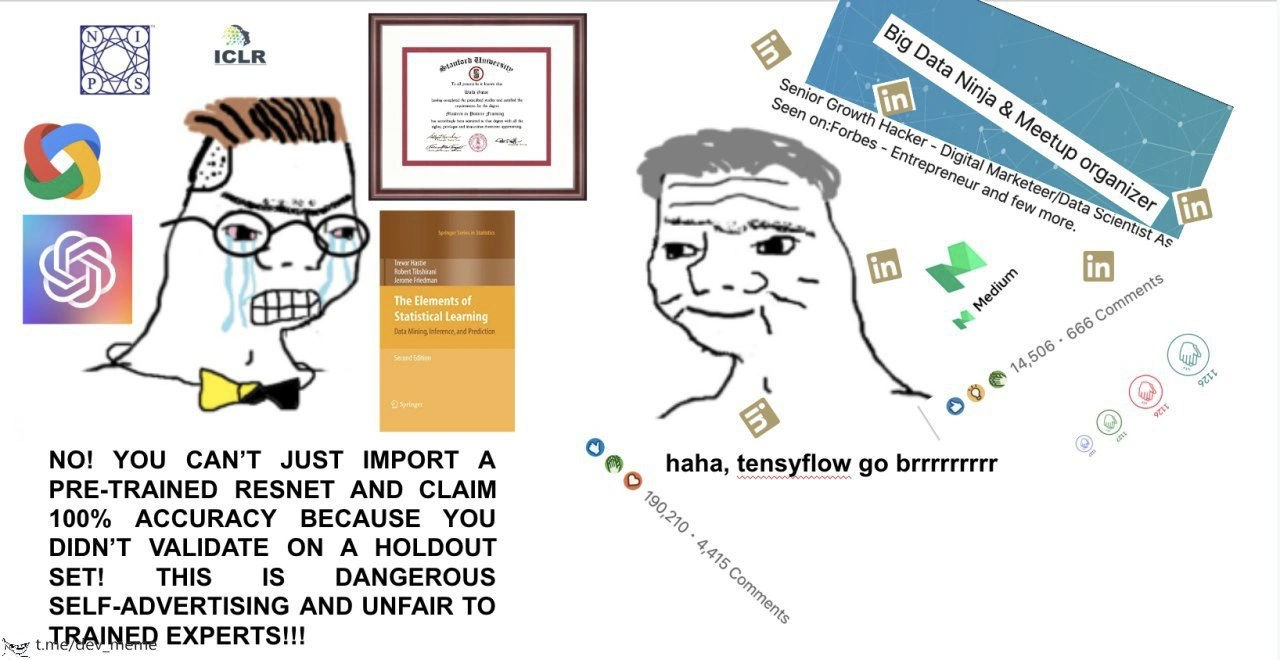
The meme uses a well-known format often called “Chad vs. Virgin” or here specifically a variant with Wojak characters (soyjak format). The left character with tears and an undercut haircut is the “Virgin” or soyjak, depicted as whiny, overly emotional, and neurotic. The text in all caps “NOOOOOO YOU CAN’T ...” is a common way these memes portray someone who is upset and nitpicking. In contrast, the right character, the “Chad,” is drawn with a confident smirk and minimal detail. He speaks in short, lowercase phrases like a cool catchphrase. This format is used to humorously compare two attitudes: one is losing composure over something trivial, and the other is totally unbothered and maybe a bit smug. In our case, the trivial thing is dynamic_vs_static_typing in programming. So, the left side is essentially a caricature of a strict programming teacher or a Reddit commenter who insists “You must use a statically typed language or you’re dumb.” The right side is the chill developer who’s possibly saying a meme catchphrase (like “typecast go banana”) to poke fun at that rigidity.
For context, JavaScript is often the punching bag in these jokes because it’s dynamically typed and has some famously quirky behaviors (as we saw with the type coercion examples). There’s even a joke among developers: “JavaScript is the language where [] + {} = "[object Object]" and {} + [] = 0.” Those are actual things! (Don’t worry if that makes no sense — that’s exactly the reaction static-typing folks have, too: it’s considered absurd). This meme’s text is a simpler parody of that kind of JavaScript quirkiness with the phrase “go banana.” It’s essentially saying: “Haha, I can do something in JavaScript that would sound crazy to you, and I’ll still smile.”
To a junior developer or someone just learning, the key takeaway is: static typing vs dynamic typing is a big difference in programming languages that people love to argue about. Some people feel very strongly that one approach is better. Static typing is like having a strict safety net (the program won’t run if you mix up types), while dynamic typing is more like free-form play (it will try to run, even with mixed types, but might throw an error or a weird result at runtime if you mess up). Each side has its fan club. The meme humorously shows an extreme static fan (basically calling anyone who uses dynamic languages a moron — not nice!) and an extreme dynamic fan (who responds with a joke, basically not taking the criticism seriously at all). The result is a funny LanguageComparison snapshot: if you’ve ever felt anxious about messing up types, you might sympathize with the left guy; if you’ve ever just winged it in a script and it turned out fine, you might grin with the right guy. And if you’re learning, well, now you know there’s this running joking feud in developer culture about JavaScript and type systems! It’s all part of that relatable humor in the programming world — we like to poke fun at our tools and ourselves.
Oh, and one more nugget for context: the phrase “typecast go banana” has another layer of tongue-in-cheek reference. It mimics the style of an internet meme where people say something like “X go brrrr” to imply X just works quickly or blindly. For example, when money printing was a hot topic, people joked “money printer go brrrr” (with brrrr being the sound of a machine). Here “go banana” is a silly twist on that format, which makes it even more absurd. It’s like the JavaScript dev is saying “lol, I just cast types and code go brrrr… or banana… whatever 😜.” Combining that with the Chad character makes the whole right side the embodiment of not taking things too seriously.
Lastly, it’s worth noting that today there are languages that try to give you the best of both worlds. TypeScript is essentially JavaScript with static typing sprinkled on top; it catches many errors before you run the code, which might have prevented some “go banana” errors while still letting you write in the flexible JavaScript style. Python, another dynamic language, introduced optional type hints for similar reasons (to help big projects manage types without forcing it on everyone). These are signs that the industry learned from both sides: static typing can increase reliability, and dynamic typing can increase agility. But, of course, hardcore purists on either end might have opinions even about these hybrid solutions. And thus, the debates — and the memes — go on!
Level 3: Strong Opinions, Loosely Typed
This meme strikes a chord with experienced developers because it satirizes the long-standing language wars between typing philosophies. We have the archetype of the “static typing purist” (the left, crying Wojak) facing off against the laid-back “JavaScript Chad” (the right, smug Wojak). Why is this combination so hilarious? Because many of us have witnessed some version of this confrontation in real life: a programmer with very strong opinions about type safety practically foaming at the mouth whenever someone suggests using a dynamically typed language like JavaScript, versus the chill pragmatist who just wants to get things done (and maybe enjoys poking fun at the uptight attitude). The over-the-top contrast — one screaming in all-caps “NOOOOOO YOU CAN’T USE JAVASCRIPT” and calling people morons, while the other responds with a meme-ish one-liner “haha typecast go banana” — perfectly captures the absurdity of these arguments. It’s depicting the Holy War of Types as a petty shouting match.
From a senior developer perspective, this hits on a cultural truth: debates about StaticTyping vs DynamicTyping often generate more heat than light. The static-typing side is portrayed here almost as a gatekeeping elitist, someone who might label dynamic languages as “toy languages” or dismiss their users as “script kiddies.” That’s an exaggerated version of language snobbery we’ve seen in many tech communities (hence tags like javascript_gatekeeping and language_snobbery). How many times have we heard, “Serious applications should be written in , not that JavaScript/Python nonsense!”? The meme cranks that attitude up to 11 for comedic effect: the Wojak literally says “DYNAMIC TYPING IS FOR MORONS,” which is an obviously rude and hyperbolic statement, yet it parodies real sentiments that occasionally bubble up in forums and code reviews. It’s the kind of tirade a rigid C++ or Java veteran might launch on seeing a large codebase in JavaScript: genuine frustration mixed with a dash of superiority complex.
The JavaScript Chad on the right represents the flip side: the developer who’s completely comfortable with dynamic typing and maybe even revels in its quirks. He replies with a cryptic, lowercase phrase: “haha typecast go banana.” This line is intentionally nonsensical, echoing a popular meme format (“X go brrrr” became a trend, where going brrr implies something operating quickly or without restraint – here it’s twisted to go banana for extra silliness). What’s he actually saying? He’s basically shrugging off the purist’s rant with humor. Typecasting is the act of converting a value from one type to another. In a rigid static language, typecasting is a careful, explicit operation (often with compiler-checked rules). In JavaScript, type conversions can happen implicitly and sometimes absurdly: the language might convert a string "5" into a number 5 if you try to subtract, or convert a non-number into NaN (“Not a Number”) if you do something crazy like multiply a word by 10. The Chad’s quip “go banana” implies that he can take an object of one type, cast it to something completely different (maybe even something as outlandish as a Banana type!), and just roll with it — all while saying “haha” as if it’s no big deal. It’s a comedic exaggeration of the pragmatic mindset dynamic-language developers often have: if it works, it works. No need to cry about theoretical purity. In fact, the Chad’s indifference (“haha…”) shows he’s not even engaging in the argument logically; he’s just memeing, implying the debate isn’t worth a serious response. This is a classic Chad vs. Virgin (soyjak) dynamic: one side overthinks and frets, the other side effortlessly one-liners their way through life.
Technically speaking, the humor also draws on real JavaScript oddities that drive static-typing folks crazy. For example, consider JavaScript’s loose type coercion:
console.log("5" - "2"); // 3 (both strings "5" and "2" are implicitly cast to numbers)
console.log("5" + 2); // "52" (the number 2 is cast to a string, resulting in concatenation)
console.log("banana" * 10); // NaN (Not a Number, JavaScript tried to treat "banana" as number)
A static-typing purist looks at those and cringes: “This would never even compile in my language! How can you possibly trust a system where "banana" * 10 doesn’t throw an error until runtime?” To them, dynamic typing feels like a wild ride without seatbelts, where a program might cheerfully typecast something into a banana (or into NaN) and keep running. That’s precisely the nightmare fueling the left Wojak’s tears. He’s probably recalling 3 AM production bugs caused by a trivial type mistake that no compiler was there to catch. Seasoned devs have been there: maybe a Python script crashed because someone passed an integer where a string was expected, or a JavaScript app threw undefined is not a function because a value was mis-typed. Those are painful memories that static typing advocates use as ammunition, arguing “if only we had a type system, we’d have caught this earlier!” It’s almost PTSD for some (cue the “it’s always types” refrain).
On the flip side, experienced dynamic language users might counter that static types can be a straitjacket. They recall times where writing in Java or C# meant wrestling with the compiler for hours over types, instead of solving the actual problem. It’s the classic trade-off: would you rather argue with a compiler up front or chase bugs in production later? The meme’s Chad character clearly opts for the latter philosophy (with a grin). He’d say something like, “I can prototype faster in JavaScript; if something breaks, I’ll add a quick fix or a test. Why are you so upset?” This highlights an industry reality: dynamic languages often thrive in environments where speed and flexibility are paramount (startups, scripting tasks, web development), whereas static languages dominate where reliability and maintainability at scale are critical (large systems, financial software, etc.).
The humor also lies in how overblown the static typist’s reaction is. By screaming "NOOOOOO" and using an insult, the meme mocks the hysterical gatekeeping that sometimes happens. It’s as if using JavaScript is a forbidden act of heresy in the Church of Static Typing. The Chad’s silly response “typecast go banana” reduces that grand conflict to playground antics: he basically says “I’m fine doing this dumb-sounding thing, and I’m not even going to dignify your insult with a real argument.” This indifference can be interpreted as supreme confidence — or supreme trolling. Seasoned developers recognize this scenario: sometimes the best way to defuse a pointless argument is to not take the bait, maybe even respond with humor. The JavaScript developer here is effectively trolling the type purist by not getting upset at all. It’s reminiscent of real online threads where one person writes a 10-paragraph rant about type safety and another replies with a one-liner meme, ending the debate with laughter.
Historically, this meme taps into decades of language war lore. Back in the day, fights raged between compiled languages (like C/C++ with explicit types) and scripting languages (like Perl, Tcl, and later JavaScript). JavaScript in particular has been a lightning rod for such arguments: invented in the mid-90s as a simple browser scripting tool, it was long dismissed by “serious” programmers. But over time, JavaScript ate the world (web frontends, then Node.js on servers, and so on), leaving some old-school folks perpetually grumpy about its dynamic nature. Meanwhile, dynamic language enthusiasts point out that pragmatism often wins: if JavaScript runs everywhere and gets the job done, why not use it? They might cheekily quote the Chad meme in real life: “Haha, TypeScript or typecast, go banana — whatever, as long as it works!” In fact, this tension even gave birth to TypeScript (a statically typed superset of JavaScript), which can be viewed as a peace treaty offering type safety to the JavaScript world. Yet, true purists might snub TypeScript too (“it’s not real static typing like Rust or Haskell!”), while true dynamic fans might only grudgingly use it (“fine, I’ll add types but only so you stop yelling”). The meme perfectly encapsulates that stalemate through humor.
Ultimately, every senior dev knows that both approaches have merits and pitfalls, and the loudest arguments often gloss over nuance. That’s why the meme is relatable humor: it exaggerates the lack of nuance. The static side in reality would have arguments about maintainability, performance (no type checks needed at runtime), and catching errors early. The dynamic side would argue about developer productivity, simplicity, and flexibility. But instead of a reasoned debate, the meme portrays it as an emotional meltdown vs a meme reply. We laugh because we’ve seen how quickly these discussions devolve in our communities. It’s a bit of communal therapy for developers: by laughing at these caricatures, we acknowledge the silliness in ourselves when we get too dogmatic about whether JavaScript or some statically typed language is superior. After all, as the saying goes, “The best language is the one that solves your problem” — a statement our Chad might drop with a smirk while the purist is still busy typing a 5-paragraph forum reply. 😏
Level 4: Curry-Howard Cage Match
In the realm of programming language theory, the battle between static typing and dynamic typing is almost philosophical. Static typing advocates often invoke formal principles from type theory — for instance, the idea that “well-typed programs can’t go wrong” (a classic mantra by computer scientist Robin Milner). In theory, a statically typed language is backed by proofs: the compiler acts like a stern mathematician, verifying that every operation meets a rigorous type rule before the code runs. This is akin to constructing a formal proof that your program won’t, say, try to add a number to a banana at runtime. The left side of the meme — the enraged Wojak screaming “DYNAMIC TYPING IS FOR MORONS” — embodies this purist mindset. He’s essentially defending the type soundness theorem in comic form, arguing that without compile-time checks, your program is just waiting to blow up.
On the other side of this cage match, we have the dynamic typing “Chad” embracing the chaos of untyped (or latently typed) computation. In academic terms, dynamic languages resemble the untyped λ-calculus – a theoretical model where functions can be fed any kind of data without upfront restrictions. This makes dynamic languages highly flexible (you can make a value go banana by changing types on the fly), but it sacrifices the compile-time guarantees that static systems provide. From a type theory perspective, the Chad’s goofy phrase “haha typecast go banana” is a tongue-in-cheek nod to how dynamic languages permit almost any type conversion or operation at runtime. It’s like he’s wielding the Y-combinator of informality – a term from lambda calculus that enables recursion even in untyped form, something that wouldn’t type-check under strict rules. The static typist sees such freedom as unsound madness, but there’s a sly truth in the Chad’s carefree attitude: in practice, many dynamic languages implement runtime type checks or conversions to keep the program running (even if it results in a quirky outcome like NaN or "undefined"). The meme humorously alludes to the Church of Static Typing versus the Cult of Dynamic Freedom. One side prizes mathematical proof of correctness (static types, Curry-Howard correspondence equating types to logical propositions), while the other side prizes Turing-complete expressiveness and rapid iteration (dynamic typing, where anything goes until an error actually happens). In this theoretical light, the meme isn’t just a joke – it’s a caricature of a deep computability trade-off: ensuring correctness a priori versus exploring what’s possible when you don’t fence in your bananas.
Description
A Wojak meme format contrasting two developer stereotypes. On the left, a crying and angry Wojak with glasses, representing a rigid advocate for static typing, yells, 'NOOOOO YOU CANT USE JAVASCRIPT. DYNAMIC TYPING IS FOR MORONS'. On the right, a calm, experienced-looking Wojak, representing a seasoned JavaScript developer, retorts with a smirk, 'haha typecast go banana'. The meme humorously pits the dogmatic arguments for type safety against the pragmatic, and sometimes absurd, reality of working with JavaScript. The phrase 'typecast go banana' is a clever in-joke referring to the infamous JavaScript type coercion behavior where the expression ('b' + 'a' + + 'a' + 'a').toLowerCase() evaluates to 'banana'. It perfectly encapsulates the chaotic yet functional nature of the language that senior developers have learned to navigate, much to the horror of developers who prefer stricter, statically-typed languages
Comments
7Comment deleted
The difference is simple: one developer spends their time building complex type hierarchies to prevent errors, the other spends their time shipping features and occasionally debugging why `typeof null` is 'object'
Fifteen years of papers on gradual typing, three rewrite cycles to TypeScript, plus runtime Zod validators - and prod still goes down on “Cannot read property ‘length’ of undefined.” But hey, typecast go banana
The same developers who insist on TypeScript for "type safety" will happily npm install 47 dependencies that haven't been audited since 2019 and trust their entire build pipeline to a package maintained by someone named xXcoolDev2005Xx
The real irony? Both developers will spend the next hour debugging why `'5' + 3` equals `'53'` in JavaScript while TypeScript's compiler smugly points out it told you so three builds ago - yet somehow the JS code still ships to production first because the TypeScript project is stuck resolving a dependency conflict between @types packages that haven't been updated since 2019
Static typing rejects "banana" at compile time; JavaScript turns it into NaN, your SLO calc quietly drops it, and leadership congratulates you on 100%
After two quarters of "strong typing," the postmortem blamed one 'as any' at the JSON boundary -- turns out the runtime is the only type checker that never lies
TS zealots preaching type safety, yet their tsconfig.json begs for 'noImplicitAny: false' mercy