Skip to content
DevMeme
2319 of 7435
Global Scope, Literally Interpreted
Languages Post #2578, on Jan 11, 2021 in TG

Global Scope, Literally Interpreted

Why is this Languages meme funny?

Level 1: Taking It Literally

Imagine you hear someone say “global scope” and you have no idea they’re talking about coding. You might picture a scope that can see the whole world! 😅 This meme is funny because that’s exactly what happened: someone took a technical phrase and interpreted it literally. It’s like if a friend heard you talk about “spaghetti code” and they thought you meant code written with actual spaghetti noodles. Or if you say “the computer has a virus” and they imagine a tiny germ inside the laptop. Here, “global scope” in programming means a variable that all parts of a program can use. But a non-programmer just hears the word “scope” (like a telescope or sniper scope) and “global” (the whole world) and ends up bolting a real scope onto a globe! It’s a goofy mix-up, kind of like a child mishearing a phrase and coming up with a crazy image. The humor comes from how literal and wrong that interpretation is. We laugh because we know the real meaning, and it’s amusing to see it misunderstood in such an over-the-top, physical way. Essentially, the joke shows that technical words can sound like everyday things – and when you mix those up, you get a pretty silly picture (literally!).

Level 2: Not That Kind of Scope

Let’s break down what “global scope” actually means in programming (it’s not about attaching scopes to globes, we promise!). In coding, a variable is like a labeled container that holds some value (a number, text, etc.). Scope is basically the region of the code where that container is accessible or visible. There are usually two broad kinds of scope you encounter early on:

  • Local scope: a variable is only visible inside a particular function or block of code. It’s like a secret note passed in class – only the intended function (or code block) knows about it.
  • Global scope: a variable is visible everywhere in your program. It’s like pinning a note on the school’s main bulletin board – everyone can see and use it.

So a global variable is defined in a place (often at the top of your code file or outside any function) such that all parts of the program can access it. For example, consider this simple JavaScript-style pseudocode:

let worldMessage = "Hello, World!";  // global variable defined at the top level

function greet() {
    console.log(worldMessage);      // this function can see the global variable
}

function setMessage(newMsg) {
    worldMessage = newMsg;          // this function can modify the global variable
}

greet();              // prints "Hello, World!"
setMessage("Hola, Mundo");
greet();              // prints "Hola, Mundo"

In this snippet, worldMessage is in the global scope. Both greet() and setMessage() can access it freely. When setMessage changes worldMessage, that change is seen by greet and every part of the program. This illustrates how a global variable is a single shared piece of data. If this were a large codebase, any function could potentially change worldMessage at any time. That’s powerful but also dangerous, right? It’s like having one big whiteboard in an office: everyone can write or erase something on it. If something goes wrong – say the message on the board is wrong – you have to figure out who changed it, among possibly dozens of people (or in code, dozens of functions).

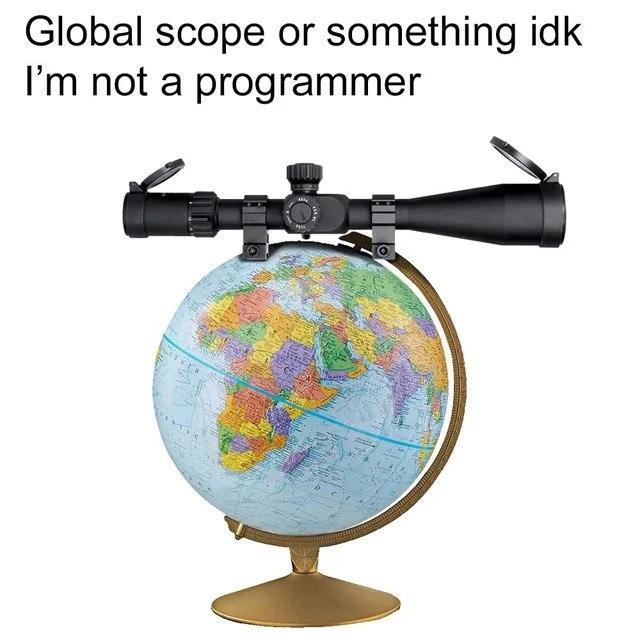
Now the meme’s joke is that a non-programmer heard “global scope” and thought of a scope that is global in the everyday sense – as in a scope you attach to a globe to perhaps see the whole world. The picture literally shows a rifle scope mounted on a world globe. In reality, in coding, “global” means “throughout the program” and “scope” means “range of visibility”, nothing to do with rifles or telescopes. It’s a silly mix-up: the term scope in programming has nothing to do with the scope you might mount on a camera or a rifle. We find it funny because it’s a basic term used in every programming language, yet when taken out of context, it sounds like something completely different. This is a prime example of wordplay_on_scope – using the two meanings of “scope” to create confusion for comedic effect.

From a CodeQuality perspective, beginners are often warned: “avoid too many globals.” Why? A variable in the global scope can turn into a free-for-all. If your whole program can tweak one piece of data, it’s easy to make a mistake that has app-wide consequences. This is why overusing global variables is considered a global_variables_anti_pattern. It tends to make bugs global too – a mistake in one corner of the code shows up everywhere. As you learn programming, you’ll encounter best practices like keeping data local to where it’s used, and passing it around explicitly (for example, via function parameters) instead of relying on global state. This makes programs easier to understand and maintain.

In summary, global scope in code = a variable available everywhere (cool but risky), whereas global scope in this meme = someone completely misunderstanding that concept and imagining a gadget for world-wide aiming 😄. By highlighting this mix-up, the meme also gently ribs the complexity of programming terminology. It’s a lighthearted reminder that what’s obvious technical lingo to us can sound like total nonsense to others. If you’ve ever tried explaining something like “I need to refactor the recursive algorithm because of exponential time complexity” to a non-dev friend and gotten a blank stare – this is that scenario in a nutshell. Here, the term happens to be simple (“global scope”), but the misunderstanding is just as real (and funny).

Level 3: One Scope to Rule Them All

In the kingdom of code, global scope is like a single variable wearing the one ring: it can influence everything. The meme plays on a double meaning of the word "scope" – in programming, scope defines where a variable or function is visible (accessible), whereas in everyday language a “scope” is a telescopic sight (like on a rifle). Here someone literally bolted a rifle scope onto a globe of the Earth, creating a worldwide scope. It’s ridiculously literal – and that’s exactly why developers smirk. The caption “global scope or something idk I’m not a programmer” is the non-dev admitting “I have no idea what you meant, so I did this silly thing.” It pokes fun at how technical jargon in CS_Fundamentals can zoom way over outsiders’ heads. We have a visual wordplay on scope that highlights the gap between a programmer’s understanding and a non-programmer’s misunderstanding, all wrapped in a bit of DeveloperHumor.

For veteran developers, the phrase “global scope” also brings up a notorious code smell. In almost every programming language, a global variable is one defined in the outermost scope of a program, making it accessible from any function or module. That might sound convenient (one variable to rule them all!), but it’s usually an anti-pattern. Why? Because global variables can be read or modified by any part of the code at any time, which often leads to spooky action at a distance. One function updates a global value and suddenly another far-off part of the program behaves differently – debugging becomes like chasing a ghost through a maze. Seasoned devs have been burned by this: imagine a long night tracing a weird bug, only to find out some module you never suspected changed a global config value. Global scope effectively makes a variable a shared resource, and if multiple pieces of code accidentally treat it as their own, you get unpredictable interactions. It’s a classic case of “works on my machine” until someone else’s code (or thread, or use case) touches that same global and everything breaks. In code quality terms, rampant use of global variables is a code quality issue because it undermines modular design and encapsulation. There’s even a saying among developers: global state is like world-wide mutable data – it creates world-wide headaches.

This meme strikes a chord because it humorously exaggerates that global part of global scope. The rifle scope mounted on a globe is an absurd literal interpretation – as if someone thought a “global variable” required aiming at the entire globe! It satirizes how non-tech folks might take technical terms at face value. For us devs, there’s an extra layer of irony: global variables have a bit of a villainous reputation in coding lore, but here it’s the non-dev who looks like the goofball for misunderstanding scope. The image reminds us of other times jargon caused confusion – like someone hearing about a “memory leak” and picturing water pouring out of a computer, or discussing the “cloud” and them glancing at the sky. 😂 Under the laughter, there’s a nod to the importance of context: in programming, words like scope have precise meanings. We chuckle because we’ve all either been the confused outsider at one point, or we’ve tried explaining something like variable scope to a non-programmer and watched their eyes glaze over. This meme blends CodingHumor with a bit of an inside joke about educating others (and the pitfalls therein). It’s a fun reminder that what’s obvious to us – like the concept of global scope – can sound like total gibberish to the uninitiated, leading to hilarious mental images. And honestly, seeing a globe with a sniper scope might also subconsciously echo how dangerous a global variable can feel in a large codebase: one wrong move, and Bang! – you’ve shot yourself (or your app) in the foot globally.

Description

A visual pun meme playing on the programming term 'global scope.' The image displays a standard desktop world globe with a large, black telescopic rifle scope mounted on top of it. The text above the image reads, 'Global scope or something idk I'm not a programmer.' The joke works on multiple levels: it literally combines a 'globe' with a 'scope,' and it uses the 'idk I'm not a...' meme format to feign ignorance about a niche technical term. For developers, this is a relatable pun on the concept of global variable scope, where a variable is accessible from any part of the program, which, much like having a scope on a globe, can be powerful but also lead to unforeseen consequences and a lack of precision

Comments

12
Anonymous ★ Top Pick The problem with global scope isn't just that everyone can see the variable; it's that anyone can modify it, turning your application's state into a geopolitical crisis
  1. Anonymous ★ Top Pick

    The problem with global scope isn't just that everyone can see the variable; it's that anyone can modify it, turning your application's state into a geopolitical crisis

  2. Anonymous

    Global scope: one mutable struct, eight billion unintended consumers, and a race condition visible from orbit

  3. Anonymous

    This is exactly how product managers explain variable scope to the new offshore team after the third production incident this month

  4. Anonymous

    When junior devs ask 'what's global scope?' and you realize explaining closure chains, lexical environments, and the prototype chain might be overkill - so you just tell them 'it's like putting your variables where everyone can shoot them.' Turns out, that's more accurate than intended: global scope is indeed where your carefully crafted state goes to get sniped by some random third-party script you imported three years ago

  5. Anonymous

    Global state is the service locator of variables - convenient until the ricochet hits concurrency, test isolation, and your weekend

  6. Anonymous

    Globals: the sniper rifle of codebases - perfect visibility into every module's worst secrets

  7. Anonymous

    Global scope: setLocale('en_US') in a unit test, and payments in São Paulo stop - ask me how I know

  8. @sylfn 5y

    didn't you know that earth is flat?

  9. @FLIPFL0P_T 5y

    Heh, classic

  10. @NiKryukov 5y

    Flat earth community all over the globe

    1. @sylfn 5y

      they just cant be all over the globe because globe is illegal

      1. @NiKryukov 5y

        so that's what i'm joking about

Use J and K for navigation