Skip to content
DevMeme
286 of 7435
The Universal 'Two Weeks' Software Development Estimate
ProjectManagement Post #343, on Apr 27, 2019 in TG

The Universal 'Two Weeks' Software Development Estimate

Why is this ProjectManagement meme funny?

Level 1: The Mom Look

Imagine you tell your mom you’ll clean your very messy room in just 10 minutes. You’re super confident and say, “Yeah, it’ll be done really soon, no problem!” Now picture your mom just standing at the door, arms crossed, giving you that Mom look – you know the one – that skeptical stare that says, “Really? I’ll believe it when I see it.”

This meme is just like that, but in a workplace. The developer (like the kid) is saying the job will be done super fast (“two weeks”), and the project manager (like the mom) is silently giving a stare that says, “I doubt it.” It’s funny because we’ve all been in a situation where we promise something quickly and the person hearing it just doesn’t buy it. The humor comes from that awkward pause and the look of disbelief. It’s the playful clash between “I’ve got this, no worries!” and “Hmm, I’ve heard that before...” Everyone can understand that feeling – whether it’s cleaning your room, doing homework, or finishing a big project, saying it’s easy and quick often makes others raise an eyebrow. The meme makes us laugh because we recognize the truth behind it: talk is easy, but getting it done on time is the real challenge, and the skeptical stare is something we’ve all seen (or given) when a promise sounds too good to be true.

Level 2: Why Two Weeks?

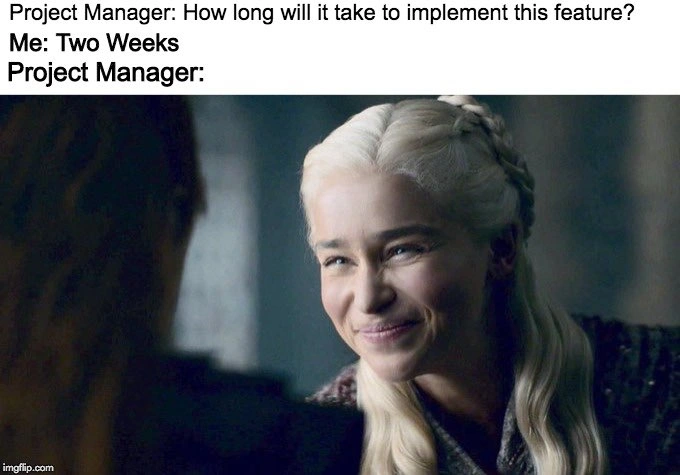
In this meme, a software developer tells their Project Manager that a new feature will only take “two weeks” to implement. The top text shows the PM asking for a timeline, and the dev immediately answering two weeks. The bottom image (a scene from Game of Thrones with a skeptical queen, Daenerys Targaryen) represents the PM’s reaction: a cold, doubtful stare. The humor comes from the fact that “two weeks” is a notorious answer in the tech world – it’s almost a cliché timeline that developers give for nearly any feature or fix. It’s short enough to sound reasonable, but specific enough to seem like an estimate.

Why do devs always say “two weeks”? Often, it’s because of DeadlinePressure and a bit of wishful thinking. Two weeks is roughly the length of an Agile sprint (a common 2-week development cycle in Scrum methodology), so it feels like a natural chunk of time to get something done. It’s also a safe, default answer when you’re put on the spot. If a developer doesn’t fully know the complexity of a task (which is pretty common), they might blurt out “two weeks” to satisfy the immediate question and hope for the best. There’s even a running joke that no matter what you ask a software engineer – whether it’s “How long to fix this bug?” or “When can we launch the new feature?” – the reflex answer is two weeks.

The Project Manager in this scenario has likely heard “two weeks” many times before and knows it often stretches into much longer. This is where MisalignedExpectations come in. The developer might genuinely think it’s doable quickly or just want to avoid argument, while the PM is responsible for schedules and has to be skeptical. Project managers have a job of handling UnrealisticDeadlines and making sure things stay on track, so they’ve developed a sort of sixth sense for when an estimate is overly optimistic. The PM’s stare in the meme shows that she doesn’t really believe “two weeks” is realistic. It’s a friendly way of saying, “Really? Only two weeks? Are you sure about that?” without using words.

This tension is common in software teams: developers are optimistic or sometimes over-confident in their timelines, and managers have to question those timelines to avoid unpleasant surprises later. The meme falls under both ManagementHumor and DeveloperHumor because it pokes fun at both roles: the dev who always underestimates and the manager who always doubts. It also references a game_of_thrones_reference with the image – using a pop culture icon (Daenerys, who is powerful and not easily fooled) to represent the PM makes the joke more vivid. If you know the show, you know Daenerys’s penetrating stare means “I’m not buying it.” Even if you don’t know the show, you can tell from the image that the manager character is silently skeptical.

Key terms explained:

  • Feature: A piece of functionality or an enhancement that needs to be added to the software. Here, the PM is asking about implementing a new feature.
  • Estimate: A rough calculation of how long a task will take. Developers often have to give time estimates to PMs. Two weeks is the estimate in question.
  • Scope Creep: This refers to the situation where a project’s requirements keep growing over time. If the dev says two weeks assuming a small scope, but then new ideas or changes get added (creeping in), those two weeks won’t be enough.
  • Deadline: The due date or final time by which the feature must be completed. If a developer underestimates, the deadline might be missed, which is why PMs worry about accuracy.
  • Optimistic Bias (or Estimation Fallacy): A common tendency of people (not just developers) to underestimate how long tasks will take, assuming best-case scenarios. Developers often fall victim to this – thinking everything will go smoothly, they give a shortest-case estimate.

So, basically, the meme highlights a common communication gap in software projects. The developer, perhaps sincerely, claims the work will be done quickly (“just two weeks!”). The project manager, drawing on experience, doubts that rosy estimate. It’s funny because it’s true – in real projects, “two weeks” has a habit of turning into “well, actually it took a month (or more).” The stare is a universal symbol of “I don’t believe you, but I’ll let you realize it.” For a junior developer, this meme is a lighthearted warning: be careful with quick promises and remember that experienced PMs have heard it all before.

Level 3: The Two-Week Myth

Ah, the classic “two weeks” estimate – the universal developer answer to any timeline question. This meme nails a piece of ProjectManagementHumor that senior engineers know all too well. The Project Manager (PM) asks how long a new feature will take. The developer, perhaps jaded or just cornered, reflexively replies “Two Weeks.” And then comes the PM’s silent, icy stare (captured hilariously via a platinum-blonde queen’s disbelieving profile). Why is this so funny to experienced devs? Because we’ve all been there: UnrealisticDeadlines meet optimistic estimates, and both sides know it’s a farce.

In the industry, “two weeks” has practically become a running joke. It’s often the length of an Agile sprint, and conveniently, it sounds short enough to please Management but not so short as to seem impossible. Seasoned devs have whispered about the estimation fallacy and the planning bias for ages – tasks always feel like they could be done in a neat 14-day package. But as any battle-scarred coder will tell you, that number is usually a fantasy. Unexpected bugs, integration woes, ScopeCreep (when extra requirements sneak in), and testing delays have a cruel habit of turning “two weeks” into six or eight. The humor here is darkly relatable: it’s developer optimism crashing into ManagerExpectations.

The PM’s reaction image (featuring a certain dragon queen from Game of Thrones) adds a perfect dramatic flair. It’s like Daenerys giving you the side-eye when you promise the impossible. Deadlines in software tend to slip, and both the dev and PM know that “two weeks” is often code for “I have no idea, but I'll say something safe.” The PM’s stare says, “I’ve heard that one before.” This silent exchange highlights MisalignedExpectations: the dev is either bluffing or hoping for a miracle, and the PM is already mentally doubling the timeline. It’s a little dance of optimism vs. reality, an inside joke among tech teams that fuels countless memes in DeveloperHumor circles.

From a senior perspective, the meme also hints at deeper truths studied in project management theory. There’s Hofstadter’s Law“It always takes longer than you expect, even when you take into account Hofstadter’s Law.” In practice, even if we consciously pad our time estimation, we still undershoot. Then there’s Parkinson’s Law“Work expands to fill the time available.” If by some miracle we do get a generous timeline, tasks and polish will expand until that time (or more) is used up anyway. Together, these laws explain why the innocent two-week promise so often fails. We laugh because the developer’s two_weeks_estimate is almost proverbially false hope, and the PM’s grim acceptance of this fact is both comical and painfully true. This scenario is basically a rite of passage in software teams: the optimistic timeline that meets the manager’s Game-of-Thrones-level stare of skepticism. Everyone in engineering and Project Management has lived this, which is why it hits home so perfectly. The meme is a gentle roast of our industry’s chronic time_estimation_bias – a reminder that when a dev cheerfully says “it’ll be done in two weeks,” even the Mother of Dragons herself would raise an eyebrow.

Description

A popular meme format featuring a dialogue at the top followed by a reaction image. The text reads: 'Project Manager: How long will it take to implement this feature? Me: Two Weeks. Project Manager:'. Below this text is a still image of Daenerys Targaryen from the TV series Game of Thrones. She has long, braided, platinum-blonde hair and is looking slightly upwards at someone off-screen with a tight-lipped, knowing, and deeply skeptical smile. The humor is derived from the shared understanding in the tech industry that 'two weeks' is a notoriously common, often wildly inaccurate, placeholder estimate for any task of moderate complexity. The project manager's expression perfectly captures the seasoned veteran's reaction to this trope: a mix of feigned acceptance and deep-seated doubt, born from years of hearing the same optimistic timeline that rarely accounts for unforeseen complexities, bugs, or scope creep


Comments

8
Anonymous ★ Top Pick In software, 'two weeks' is the atomic unit of work estimation. It's indivisible, universally understood to be fiction, and has a half-life of about three days
  1. Anonymous ★ Top Pick

    In software, 'two weeks' is the atomic unit of work estimation. It's indivisible, universally understood to be fiction, and has a half-life of about three days

  2. Anonymous

    I’ve started calling “two weeks” the developer’s Dracarys - utter it, the PM falls silent, and by sprint three the cone of uncertainty is just charred rubble

  3. Anonymous

    The PM's already mentally calculating how many "two weeks" iterations it'll take before we discover the API we're integrating with uses SOAP, the data model requires a complete refactor, and half the team will be pulled into a P0 incident from the last "two week" estimate

  4. Anonymous

    'Two weeks' is the TCP of estimates: everyone sends it, nobody believes it arrives intact, and the retransmission happens at the next standup

  5. Anonymous

    Ah yes, the classic 'two weeks' estimate - the developer's equivalent of 'famous last words.' That smile? That's the PM mentally multiplying by π, adding the Fibonacci sequence, and already scheduling the retrospective where we'll discuss why it actually took six sprints. They've seen your Git history; they know about your 47 open browser tabs of Stack Overflow, and they're already preparing the 'just one small change' that will turn your elegant microservice into a distributed monolith. Two weeks? Sure, if we're only counting the time you're actually coding and not the three days lost to dependency hell, the surprise database migration, and that one legacy module nobody mentioned that's written in a dialect of JavaScript so ancient it predates JSON

  6. Anonymous

    Two weeks: the only estimate unit where PMs get precision and architects get plausible deniability for the inevitable monolith refactor

  7. Anonymous

    “Two weeks” is Schrödinger’s estimate - engineering means one sprint with discovery, refactors, schema migrations, and a CAB sign‑off; PM hears “Friday.”

  8. Anonymous

    Two weeks is a unit‑test estimate - green on my laptop, red in integration, instantly promoted to an SLA

Use J and K for navigation