Skip to content
DevMeme
287 of 7435
The Senior's Smirk at a Junior's Hubris
LegacySystems Post #344, on Apr 29, 2019 in TG

The Senior's Smirk at a Junior's Hubris

Why is this LegacySystems meme funny?

Level 1: Easier Said Than Done

Imagine a young chef just starting in a restaurant. On his first day, he tastes a soup from an old family recipe and says, “Ugh, this is bland – I can cook a much better soup!” He’s so confident he could make it taste amazing if they let him. Now picture the head chef, who’s been running this kitchen for years, giving a small, knowing smile. The new chef doesn’t realize that the soup is made that way for good reasons – maybe it’s mild because some loyal customers can’t handle spicy food, or it’s been perfected over decades to suit many palates. The head chef knows if you change that recipe too much, regular customers might be upset or some ingredients might not work well together. The young chef boasting he can easily improve it is like a kid saying he can rebuild a car engine just because he’s built a toy model. The experienced chef isn’t angry; she’s just seen this confidence before and knows making a “better” soup isn’t as simple as it sounds. In the end, it’s a bit funny – the new guy thinks he has all the answers, while the old pro quietly knows there’s a lot more to the story than meets the eye.

Level 2: Tech Debt Dragons

So what’s actually going on here? Imagine you’re a junior developer fresh on the job. You open the code repository and find a thousand-line function with weird variable names like foo1 and tempData, comments from 2008, and no tests in sight. 🤢 “What is this legacy code? It’s bad!” you think. This meme highlights that exact moment of new hire overconfidence. Legacy code means code that’s been around a long time (written maybe by folks who left years ago). It might use older styles or have known code smells (things in code that hint at deeper problems, like super long functions or duplicate logic). New developers often assume anything not following the latest best practices or shiny frameworks is poor quality. They say things like “Who wrote this garbage? I could refactor it in a week!”

But the seasoned developers on the team know something the newcomer doesn’t: this “garbage” code is running the business. It’s the foundation that handles real customers, real data, and has survived real incidents. Over years, it probably accumulated lots of technical debt. Technical debt is like shortcuts or quick fixes made in code to solve immediate problems, which you “borrow” time from future maintainers to clean up later. Think of it as duct tape fixes that should eventually be replaced properly. Yes, the code isn’t pretty – it might have global variables or outdated APIs – but it also has many critical bug fixes and enhancements layered in. Each weird bit of logic often exists for a reason (even if that reason is “the CEO needed a custom rule the night before launch”). The new hire only sees the ugly tape; the senior devs remember why that tape is there.

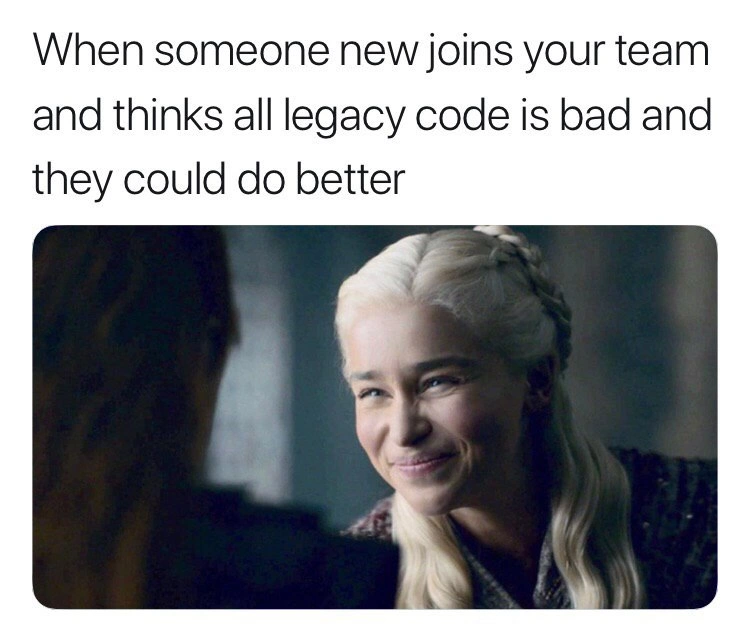
In the image, the experienced dev (the character with the white braided hair from a fantasy show) is giving a tight smile. That’s the face of someone who’s heard “let’s just rewrite it” way too many times. Why the ominous vibe between the seniors? Because they know rewriting a legacy system from scratch is a huge undertaking. It’s not just about coding it cleaner; it’s about re-learning every little requirement and quirk that the old code already handles. Often, new folks don’t realize the old system has years of domain knowledge embedded in it. For example, a legacy payroll system might have special cases for every weird tax rule or leap year bug that was discovered. A junior saying “we can do better” might not even know those cases exist until their shiny new replacement fails on them.

Let’s break down some key terms and ideas here:

  • Legacy System: In simple terms, an old but important system. It might be written in an older language (like COBOL, or just an outdated version of Java/Python) and has been in use for a long time. Companies often still rely on it daily (for example, a bank’s main account ledger software from the 90s). New hires often find legacy systems scary or outdated because the code isn’t what they saw in school or bootcamp. It might not use modern libraries or might reinvent the wheel. But it’s working and usually nobody wants to touch it too much because it’s critical (and fragile).

  • Overconfidence Bias: This is when someone is more confident than they should be given their knowledge level. A new developer who’s had a couple of successes might think they can handle anything – for instance, “I learned this cool new framework, so rewriting this old app with it will be easy!” It’s a common early-career mindset. You don’t know what you don’t know. This meme’s humor stems a lot from that Dunning-Kruger effect vibe: beginners often don’t realize the complexity of a problem, so it looks easy to them. The seasoned devs have been bitten by that complexity before, so they’re quietly smirking or shaking their heads.

  • Technical Debt (TechDebt): A metaphor comparing messy code to financial debt. If developers take shortcuts (like skipping tests, using a quick hack, or copying and pasting code), they “borrow” time – the software ships faster today, but the codebase becomes a bit harder to work with. Over years, these shortcuts accumulate “interest”: each change becomes slower or riskier because of the messy foundation. Legacy code often has a lot of this debt. A new dev sees the ugly shortcuts and is appalled (“Why is everything so convoluted?!”). To them, the obvious answer is “let’s start fresh and do it right this time.” But seasoned devs know paying off tech debt is tricky. It’s like a house full of rickety add-ons: tearing it all down at once leaves you with no house at all until you finish rebuilding – and that can take much longer than expected.

  • Refactoring vs Rewriting: These are two ways to deal with messy code. Refactoring means improving the existing code gradually without changing what it does. Think of it like renovating one room at a time in an old house – you upgrade the plumbing in the kitchen this week, the wiring in the living room next week, all while still living in the house. Rewriting means throwing the old code away and writing a new system from scratch (building a brand new house next door and then moving in). New devs often advocate a full rewrite because it sounds easier (“why try to understand this spaghetti? let’s just start fresh”). But rewrites are high risk – it’s easy to underestimate features and break functionality that users rely on. Refactoring is safer but can be slow and not as “glamorous.” In the meme scenario, the new hire is basically saying “Let’s tear down this house and build a mansion,” while the seniors know that the old house, however creaky, still shelters everyone right now.

  • Code Quality and Context: The phrase “all legacy code is bad” is an over-generalization. Yes, legacy code can violate a lot of modern code quality ideals (like clear naming, modular design, having tests). It might indeed have many code smells (indicators of potential issues, e.g., a function that’s 1000 lines long is usually a smell). But context matters. Maybe that 1000-line function was written quickly to patch a critical bug before a major client demo – and it stayed because it worked. Maybe no one ever had time to refactor it because new features kept being more urgent. Seasoned devs sometimes grimly joke, “If it ain’t broke, don’t fix it,” especially when touching old code could introduce new bugs. The new hire’s instinct is to clean up (a good instinct in moderation), but doing so blindly can be dangerous.

The meme’s image is from a fantasy drama (notice the medieval-style clothes and the character’s icy blonde braided hair). The senior devs are represented by that character’s expression – a forced polite smile, as if saying, “Oh, you sweet summer child...” In the show, that kind of look often comes right before something ominous happens (like dragons being unleashed 😅). It’s a playful way to dramatize the tension between junior vs senior mindsets. The juniors are enthusiastic and unconstrained by past failures; the seniors are cautious, maybe even a bit jaded, but for good reason. They’ve lived through deployments that went horribly wrong, or “simple” fixes that downed servers. Their ominous look is basically a kindly warning: You have no idea what’s lurking in that old code.

For a junior developer reading this, the take-home is: legacy systems might seem like a mess at first glance, but approach them with humility. There are likely dragons (hidden complexities) in that code. Those ominous looks from seniors? They’re not to mock you, but because they remember being in your shoes and learning the hard way. It’s great to want to improve things (and legacy code certainly can often be improved!), but claiming it’s “all bad” and you can redo it easily is risky. Usually, the best path is to listen to the folks who’ve been in those trenches, understand why the code evolved that way, and then improve it step by step. As the saying goes in software teams: “One day, this shiny new code you write will be the next person’s legacy code.” 😄 So a bit of respect (and caution) for what came before can save you and your team a world of pain.

Level 3: Rewrites & Regrets

The scene: a new hire strolls in, bold as a dragon, declaring all your Legacy Code is junk and confidently promising to rebuild the whole system from scratch in a week. Cue the seasoned devs exchanging that ominous look – a mix of amusement, PTSD, and “here we go again.” This meme nails a classic tech trope: overconfidence bias in juniors versus the hard-won wisdom of seniors. The humor bites because every experienced developer has watched some bright-eyed newcomer underestimate a gnarly old codebase, thinking “How hard could it be? I just learned a cleaner framework last week.” Meanwhile, the veterans know that ripping out working legacy systems often invites disaster (and many a late-night hotfix).

Why is this so relatable? Let’s unpack the layers:

  • Tech Debt Hauntings: That code the newbie calls “garbage” is running in production for a reason. Sure, it’s full of //TODO comments, weird naming, maybe even a global variable or five. But it’s also battle-tested, handling countless edge cases and weird business rules. Seasoned devs know a rewrite isn’t a magic fix; it’s trading known bugs for unknown bugs. They’ve seen the specter of technical debt: shortcuts and hacks made under deadline that accrue “interest” in the form of complexity. The newcomer sees only the messy implementation, not the years of incremental bug fixes keeping the app afloat. The meme’s darkly comedic edge comes from that disconnect – the summer child unaware that under those ugly hacks lie dragon eggs of knowledge (and potential chaos if disturbed).

  • “Better” Is Harder Than It Looks: The new hire’s bravado (“we can do better!”) brushes off the sheer architectural complexity lurking in legacy systems. Often that old code was built around constraints that no longer appear obvious. Maybe it’s full of seemingly obtuse checks and odd math because it handles conditions that bit the team before. The veterans remember those war stories – they wrote those odd conditions at 3 AM after an outage. It’s why they cringe when someone says “just throw it all away”. They know a full rewrite means re-discovering all those edge cases from scratch (likely the hard way). Real-life example: Netscape in the 90s famously decided to rewrite their browser from scratch – it was a legendary fiasco that left them years behind. Joel Spolsky’s old but gold essay “Things You Should Never Do” specifically warns: “the single worst strategic mistake is to rewrite code from scratch.” Every graybeard dev has that slogan tattooed on their soul.

  • Shared Trauma and Eye-Rolls: The meme taps into the shared trauma of maintaining legacy systems and dealing with naive suggestions to nuke them. The image (a fantasy queen’s thin smile from Game of Thrones) perfectly captures the veteran’s restrained response. In their head, they might be screaming, “Dracarys!” (dragon-fire) at the idea of casually torching their painstakingly patched code. But externally, they manage a polite smile and a “let’s talk about this.” It’s a silent “Oh dear, you have no idea what darkness sleeps in that code.” They’ve seen promising refactors become project death marches, and clean new architectures devolve into the same old spaghetti once reality hits. That weary glare is basically saying, “You know nothing, newbie Snow.”

  • Context is King: The newcomer judges the code purely by modern standards (perhaps it lacks the latest async/await syntax or has some deprecated battle-tested frameworks). But seasoned devs think in context: that code might have been written under insane deadlines, by developers working around hardware limits or an API that no longer exists. It might be supporting customers who still use IE11 or carrying decades of business logic sediment. Simply yanking it out could break legacy data or upstream systems in ways the new dev hasn’t imagined. The humor here is that the junior truly believes they’re the hero to slay the “ugly code” dragon, while the seniors exchange glances like villagers who know that dragon is the only thing keeping an even bigger monster at bay.

Consider a tiny example: imagine a mysterious snippet deep in the old codebase – a special case that looks silly at first glance:

// Legacy code snippet:
if (user.id === 42) {
    enableLegacyMode(user);
}
// New hire: "This is so random. User 42? Let's delete this nonsense."
// Senior dev: *coughs* "Better not... that 'random' ID is our oldest client with a custom contract."

That one magic number 42 might look like a dumb hardcoded hack, but maybe user #42 is a million-dollar customer on a grandfathered plan. Delete that and at 2 AM your pager (and the senior’s) will be ablaze. 😬 Legacy code often has these hidden landmines, planted by history. The new devs don’t even know the map, but the seniors remember where each trap is (often because they fell into them before). This dynamic – the naïve confidence vs the seasoned caution – is exactly what the meme lampoons.

In sum, the meme lands with senior engineers because it’s too real: we’ve all heard a junior proclaim “rebuild it better” without knowing the full story. That knowing look exchanged? It’s half “oh boy, seen this movie before,” and half “should we tell them, or let them learn the hard way?” It’s a comedic encapsulation of Junior vs Senior culture: the fearless enthusiasm running head-first into the brick wall of real-world complexity. And as every cynic in a legacy codebase will tell you, watching that collision is equally painful and priceless.

Description

A popular meme format featuring a still image of Daenerys Targaryen from the TV series Game of Thrones. She has a knowing, condescending, and slightly amused smirk on her face. The text above the image reads, 'When someone new joins your team and thinks all legacy code is bad and they could do better'. The meme humorously captures a rite of passage in the software development world. It depicts the reaction of seasoned senior engineers to the naive overconfidence of a new team member, often a junior developer, who criticizes an existing codebase without understanding its history, constraints, or the complex business logic it handles. The smirk represents the seniors' unspoken thought: 'Oh, you sweet summer child, you have no idea what horrors this code prevents.' It's a commentary on Chesterton's Fence - the principle that one should not tear down a fence without first understanding why it was put up
Comments

8
Anonymous ★ Top Pick The new dev wants to rewrite the legacy system. We call that 'The Dunning-Kruger-to-Imposter-Syndrome Pipeline.' The project starts with 'I can do this in a weekend!' and ends six months later with 'Why does this one function need to know the current phase of the moon?'
  1. Anonymous ★ Top Pick

    The new dev wants to rewrite the legacy system. We call that 'The Dunning-Kruger-to-Imposter-Syndrome Pipeline.' The project starts with 'I can do this in a weekend!' and ends six months later with 'Why does this one function need to know the current phase of the moon?'

  2. Anonymous

    Sure, hotshot - rewrite it all you like, as long as the leap-second COBOL batch, the 2008 VAT edge case, and the CEO’s nephew’s Excel macro still line up; otherwise production burns like King’s Landing

  3. Anonymous

    Wait until they discover the singleton that's actually load-bearing for three different payment gateways, each added two acquisitions ago by teams that no longer exist

  4. Anonymous

    Sure, rewrite it. The legacy code will enjoy watching you rediscover, one outage at a time, why every weird if-statement exists

  5. Anonymous

    Ah yes, the classic Dunning-Kruger onboarding phase: 'This 10-year-old codebase that handles $10M in daily transactions and survived three acquisitions? I could rewrite it in a weekend with the latest framework.' Meanwhile, the senior engineers exchange knowing glances, remembering their own youthful hubris and the production incident that taught them why that 'ugly' error handling exists. Give it three months and one midnight page about the edge case documented only in a 2015 commit message - they'll understand why we don't just 'do it better.'

  6. Anonymous

    New joiner energy: calling the revenue engine “legacy” and proposing a rewrite - aka a multi-quarter outage with prettier abstractions

  7. Anonymous

    That smirk: 'Go ahead, rewrite it - I'll be sipping coffee while your microservices summon the pager dragons at peak load.'

  8. Anonymous

    Greenfield bravado evaporates when the “terrible” class is the only thing keeping a 2007 SOAP gateway, PCI scope, and five SLAs from waking PagerDuty

Use J and K for navigation