JavaScript as the 'College Experiment' of Programming
Why is this Languages meme funny?
Level 1: Trying New Things
Imagine you once tried something completely new just to see what it was like, and then later you went back to what you usually do. For example, say when you were younger you tasted a really strange flavor of ice cream, just one time at a school party. Maybe it was a wild combination like pickle-flavored ice cream! 😮 You were curious and thought, “Well, people talk about this flavor, I might as well try it once.” You took a lick and decided, “Hmm, not really for me.” Years later, you’re laughing with friends and you say, “Oh yeah, I tried pickle ice cream once back in school!” You mention it almost as a funny little memory of something experimental you did when you were younger.
This meme is doing the same thing, but with coding. It’s saying that writing code in JavaScript was that “pickle ice cream” for some people — something they tried once in college just to see what it’s like. The joke is that people talk about using that programming language as if it were a whimsically daring thing from their past. It’s funny because we usually don’t think of programming choices as youthful experiments, so hearing it described that way is silly and playful. Basically, the meme is joking: “Haha, remember that one time I played around with JavaScript? Yeah, that was just a one-time thing, just for fun.” Even if you don’t know JavaScript, you can understand it as someone reflecting on a single try at something in their younger days. It’s a light-hearted way to say everyone tries new things (whether it’s a weird ice cream or a coding language) and it’s okay to laugh about those little experiments later on!
Level 2: Just a Phase
On the surface, this meme is comparing programming in JavaScript to “experimenting with your sexuality” during college. That might sound odd at first, but let’s break it down into simpler terms. The key idea is trying something out once when you’re young and then not continuing with it. The tweet jokingly says people talk about JavaScript like it was just a one-time college experiment: “I tried it once in college.” This is a phrase people often use to describe a brief, youthful exploration — for example, someone might say they tried a certain food, activity, or even kissed someone of a gender they don’t usually date once in college. It implies “I was curious, I gave it a go, but it was just that one time.”
So how does that relate to JavaScript, a programming language? In the tech world, JavaScript is a very common language, especially for web development. It’s the language that runs in web browsers to make websites interactive. If you click a button and a menu pops out or a form checks your input in real time, that’s probably powered by JavaScript. Because of its importance on the web, many computer science students encounter JavaScript at least briefly during their studies. For instance, you might have a class project to make a small website or a personal portfolio, and you use HTML, CSS, and a bit of JavaScript to add a cool interactive feature. This could happen during college (or even high school).
However, not everyone sticks with JavaScript as their main programming tool after that. Maybe you took that web project class, dabbled with some document.querySelector and console.log() in your browser, and then your next courses were all about Java, C++, or Python. In that case, JavaScript was just a temporary fling for you — a quick introduction, then you moved on. In developer lingo, you “experimented with JavaScript” but didn’t become a full-time JavaScript developer. The tweet is making fun of how casual and almost sheepish people sound when they admit that: “Oh yeah, I wrote JavaScript… but just that one time, you know, during school.” It’s as if using JavaScript were something a bit wild or out-of-character that you only do when you’re young and curious.
Why JavaScript specifically? JavaScript has a bit of a dual image. On one hand, it’s everywhere – every web browser understands it, and modern websites (and many apps) rely on it. On the other hand, JavaScript can be quite unconventional compared to languages traditionally taught in computer science programs. For example, JavaScript is dynamically typed, meaning you don’t have to declare the type of data (number, string, etc.) up front, and it will try to figure things out on the fly. This is very different from, say, Java (not to be confused with JavaScript despite the similar name!) where you must specify types strictly. JavaScript also has some famously odd behaviors (like how == can behave unexpectedly due to type coercion). A student who's used to more structured languages might find JavaScript a bit confusing or even frustrating at first. They might say “whoa, that was weird, not sure I want to deal with that regularly.” So it’s easy to imagine a developer chuckling that they only toyed with JavaScript briefly back in school, much like a person might chuckle about a phase in college when they tried something out of the ordinary.
The meme’s humor comes from this direct comparison: talking about a programming language in the same tone people use for a personal life experiment. It’s a form of developer insider joke. If you’ve hung around programming communities, you’ve probably heard lighthearted LanguageWars or debates: “Ugh, JavaScript, I avoid it,” or “Everyone writes some JavaScript eventually; it’s like a rite of passage.” Many developers will relate to having that one language or technology they only touched once. It might not actually be JavaScript for everyone (for some, it could be something like Haskell or Ruby that they tried only in a specific class), but JavaScript is a common example because of its ubiquity and unique characteristics.
So, to sum up in simpler terms: The tweet (and the meme) joke that using JavaScript was just a phase I went through when I was in college. It treats programming in JavaScript as if it were something experimental or even a bit risqué, which is funny because we don’t usually talk about coding in that way! It’s mixing a non-technical, personal growth concept (college experiments) with a technical topic (coding in JavaScript) to create a humorous analogy. Developers find it funny and relatable because it’s true that many of us tried a bunch of different programming languages in school, and we like to tease about the ones that didn’t become our main focus.
Level 3: The Old College Try...Catch
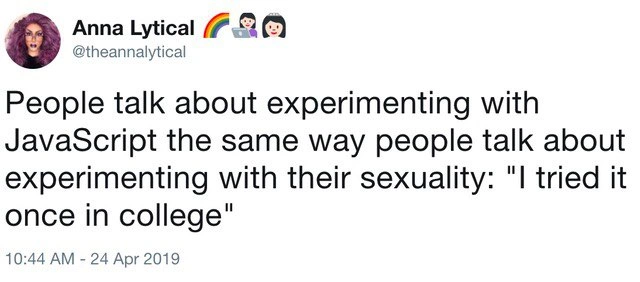
This meme presents as a tweet screenshot from developer personality Anna Lytical (complete with a rainbow emoji flair in her name). At first glance it’s a bit of tech humor that got a lot of retweets, but it’s actually a clever commentary on how programmers talk about programming languages — specifically JavaScript — in almost biographical terms. The tweet text riffs on a familiar trope:
“People talk about experimenting with JavaScript the same way people talk about experimenting with their sexuality: 'I tried it once in college.'”
For seasoned devs, this line hits a sweet spot of relatable humor. It humorously equates writing code in JavaScript to a kind of youthful experiment or “phase” one goes through. Why is this funny? Because in the world of software, there’s a long-running inside joke that JavaScript is the language you might dabble in briefly — perhaps in a school project or a quick hack — but not something you’d proudly claim as your long-term coding identity. It’s poking fun at the way developers sometimes talk about technology choices with the same awkward, half-embarrassed tone people use to recount a fleeting college fling.
This humor is grounded in real industry attitudes. Historically, JavaScript had a bit of a reputation: older engineers (especially those raised on Java, C++, or other "serious" languages) often saw JavaScript as that quirky, untyped scripting language you only used for spicing up web pages. In the late 90s and early 2000s, JS was mainly for little browser tricks — form validation, image rollovers — not the heavy lifting. Colleges taught Java or C++ in core courses, while JavaScript might show up only in a web development elective or during a late-night hackathon. So a lot of devs first encountered JS in school as a side assignment. They “tried it once in college,” exactly as the meme jokes, possibly with a mix of fascination and horror at its language quirks. After graduation, many went off to jobs writing in C#, Java, Python, etc., leaving JavaScript as just a fond (or frightening) memory. This tweet taps directly into that shared narrative: “Oh yeah, I played around with JavaScript back then... but I’m okay now.” 😜
The analogy to experimenting with sexuality amplifies the comedic effect by borrowing a well-known cultural script and mapping it onto tech. Just like someone might say “I kissed a person of that gender once in college, it was just a phase,” developers might say “I built a web app with JavaScript once in college, but I’m not really a JavaScript person.” The joke lands because in developer culture we half-jokingly treat programming languages almost like personal identities or orientations. Are you a “JavaScript person”? A “Java dev”? A “Python guru”? It can sound oddly like defining your identity. Here, JavaScript is cast as the edgy, experimental choice — the one your more straight-laced future self might look back on with a chuckle. The tweet’s author cleverly plays on this parallel, and every coder who’s had a one-time fling with a trendy or weird technology nods knowingly.
LanguageWars aside, the meme also winks at JavaScript’s distinctive reputation. JS is incredibly popular (practically unavoidable for web development), yet it’s infamous for being a bit wild and unorthodox. A senior developer reading the tweet remembers why JavaScript might have felt like a crazy college experiment. For example, its dynamic typing and oddball type coercion rules can lead to funky situations:
console.log("5" + 5); // "55" (string concatenation)
console.log("5" - 5); // 0 (string converted to number)
console.log(0 == []); // true (empty array becomes 0 in comparison)
console.log(0 === []); // false (strict type check, different types)
These are the kinds of quirky outcomes that prompt many a confused “WTF?” from a first-time JavaScript experimenter. If you came from a Java or C background where types are strict and predictable, encountering JavaScript’s loosey-goosey conversions and prototypal inheritance model might feel as disorienting (and thrilling) as a wild night out in freshman year. LanguageQuirks like the ones above often become the butt of jokes. Seasoned devs trade war stories of how null and undefined tripped them up, or how they debugged why NaN !== NaN. So when someone quips that they “experimented with JavaScript in college,” it evokes all those WTF moments and the relief of surviving them. It implies, tongue-in-cheek, “Yeah, I went down that rabbit hole once, but I’ve moved on to safer territory now.”
This humor also hides a bit of truth about evolving developer tastes. In college (or early in one’s career), you’re encouraged to try everything: different paradigms, new frameworks — every language is like an interesting club on campus. JavaScript might have been that crazy club that was open all night, blasting strange music (the callback hell of early Node.js, perhaps). You had fun with it once, but maybe you didn’t make it your regular hangout. Meanwhile, some of your friends did fall in love with JavaScript and proudly call themselves “JavaScript developers” now — akin to friends who found themselves during those college experiments. The meme plays on the stereotype that a “real developer” (especially an older one) might dismiss JavaScript as something frivolous they only toyed with under youthful curiosity. It’s extra funny because today JavaScript is actually massively important and mainstream — it went from “just a phase” to dominating the programming world. In fact, many who tried it in college probably ended up using it seriously later. This irony isn’t lost on experienced devs, which adds an extra chuckle: we joke about JS like it’s a silly fling, even though it runs literally everything in the browser now.
Finally, the format of the meme being a tweet adds to its punch. Tweets are short, witty, and rely on cultural references, perfect for a quick laugh. The screenshot shows the timestamp (April 24, 2019 at 10:44 AM) and even the rainbow emoji in Anna’s name — a nod to LGBTQ pride — underlining the sexuality metaphor in a playful, positive way. It’s a great example of TechHumor blending with a bit of real world humor. Seeing this, a veteran engineer might smirk and think: “Heh, I remember my little ‘JavaScript phase’... and all the funky code I wrote. Good times.” The meme resonates because it captures a common developer path (dabbling in a new language under low-stakes conditions) with the exact phrasing people use for youthful self-discovery. It’s a perfect storm of geeky and cheeky.
Description
A screenshot of a tweet from the user Anna Lytical (@theannalytical). The profile picture shows a person with voluminous curly purple hair and dramatic makeup. The tweet, dated 10:44 AM - 24 Apr 2019, reads: 'People talk about experimenting with JavaScript the same way people talk about experimenting with their sexuality: "I tried it once in college"'. The humor comes from comparing the often-chaotic, experimental phase of learning JavaScript to a common euphemism for youthful exploration. For experienced developers, this resonates deeply. It evokes memories of early career struggles with browser inconsistencies, callback hell, and the language's quirks before the modern ecosystem of frameworks and tools brought more structure. The phrase 'tried it once in college' perfectly captures the feeling of a rite of passage that many endured but few would willingly repeat without the safety of modern abstractions
Comments
8Comment deleted
Some of us tried JavaScript in college. The rest of us were forced into a committed relationship with it by the browser DOM, and now we're just making the best of it with frameworks as marriage counseling
“I swore JavaScript was just a college fling - two decades later I’m explaining to auditors why our core banking ledger depends on a 12-year-old npm package named ‘left-pad.’”
Twenty years later, you're maintaining a React codebase, arguing about TypeScript configs, and explaining to your therapist why you have strong opinions about bundler performance
Everyone 'tried JavaScript once in college' - and like most experiments, it's now in production, load-bearing, and nobody will admit ownership
The comparison is apt: both JavaScript and college experimentation involve questionable decisions made under peer pressure, a lot of confusion about what's actually happening, and the lingering question of 'why did I think `this` binding would work that way?' Years later, senior engineers either embrace it fully (TypeScript counts as therapy), or they mention it only when explaining why they're now strictly typed and functional
JS: that college fling where you tried prototypal inheritance once, then architected your career around sane types ever since
“I tried JavaScript once” - now prod is a microfrontend parliament where CommonJS, ESM, and TypeScript argue about imports while 80k transitive deps vote by breaking CI
We call JS a college phase; a decade later prod still dials it through transitive dependencies - so we only see it under TypeScript, for closure