The 'This is Fine' Approach to Exception Handling
Why is this Bugs meme funny?
Level 1: Ignoring the Fire
Imagine you’re at home and a fire breaks out in the kitchen. Instead of reacting – like shouting for help or grabbing a fire extinguisher – you just sit at the table, sip your coffee, and calmly say, “This is fine.” Sounds ridiculous, right? That’s exactly the joke here. In the picture, a little cartoon dog is surrounded by blazing fire, but he’s acting like nothing’s wrong, cheerfully saying “THIS IS FINE.” It’s funny because we all know it’s definitely not fine! The huge contrast between the disaster happening (the room burning down) and the dog’s total denial is what makes it humorous.
This meme is basically poking fun at the idea of ignoring a big problem and pretending everything’s okay. It’s like if you broke a window and then just sat in front of it so no one notices the draft, insisting, “All good, nothing happened.” People laugh at the “This is fine” dog because sometimes we encounter situations where things are going wrong, yet someone in charge acts overly calm or clueless, insisting everything is under control. The dog in the burning room is a silly, exaggerated example of that feeling. We find it funny (and a bit relatable) because sometimes admitting a problem is hard, and the absurdity of saying everything’s fine when you’re literally on fire makes us laugh. In simple terms, the meme is a cartoon way of saying: sticking your head in the sand doesn’t make the danger go away – but it can be pretty comical to watch!
Level 2: The Exception Black Hole
Let’s break down the joke in simpler terms. In programming, an exception is what we call an error or unexpected event that occurs during program execution. Many languages (Java, C#, JavaScript, etc.) use a try { ... } catch { ... } structure for ExceptionHandling. Here’s how it works: you try to run some code that might throw an error. If an error happens, the code jumps to the catch block, where you’re supposed to handle the situation. Handling an exception could mean fixing a problem, or at least logging an error message so you know something went wrong. For example:
try {
// Attempt something risky
connectToDatabase();
readImportantData();
} catch (Exception e) {
// Oops, something went wrong.
// But this catch does nothing to handle it:
// (swallowing the exception and pretending all is well)
}
In a good program, that catch block would not be empty – it might log an error like System.err.println("Database connection failed: " + e); or maybe recover by using a default value. The key is: catching an exception should at least acknowledge the error. Silently ignoring it (like in the code above) is considered a very poor practice in software development. We often call this “swallowing the exception.” It’s as if the error happened, but the program gulped it down without a trace – no log, no alert, nothing. That’s why we can liken it to an exception black hole: once an error goes in, no information comes out.
Now, think about what that means when you run the software. The program tries to do something in the try block (say, read from a file or fetch data from a server). If everything goes fine, great. But if an error actually occurs (file not found, server down, etc.), the program jumps to the catch. In our meme’s scenario, the catch block basically goes, “Alright, an error happened… but I’ll do absolutely nothing and act like it’s all okay.” The program continues running as if no problem occurred. From the outside, you get no immediate indication anything went wrong. But internally, you might now be missing data or have an incomplete operation. It’s like a quiet failure. The room (your program’s state) is catching on fire, but the code says “This is fine” and carries on.
The reason developers find this meme so spot-on is because ignoring errors leads to bugs that are really hard to find. If there’s no error message or log, how do you even know something failed? You might only see weird behavior later on and have to play detective to figure out an error was hidden. This turns Debugging & Troubleshooting into a nightmare. For example, suppose a function was supposed to save a file, but an exception happened and got swallowed. The program doesn’t crash and doesn’t report anything – it just never saved the file. Later, you’re wondering, “Where’s my data?” and there’s no error trail – the program acted “fine” even though it failed silently.
From a CodeQuality perspective, this is a big no-no. Good code should handle exceptions in a way that either fixes the issue or at least makes it visible. That often means logging the error (writing a message to a log file or console) or propagating the error up so that something/someone else can deal with it. Simply doing nothing in a catch block is almost always a bad idea because it hides problems. It’s akin to covering up a warning light on your car dashboard – the issue doesn’t vanish, you just won’t see it. New developers sometimes make this mistake unintentionally, perhaps thinking, “I caught the exception, so I prevented a crash – job done.” But if you don’t at least log it, you’ve essentially swept the problem under the rug. Sooner or later, that hidden problem can cause bigger failures (the fire spreads).
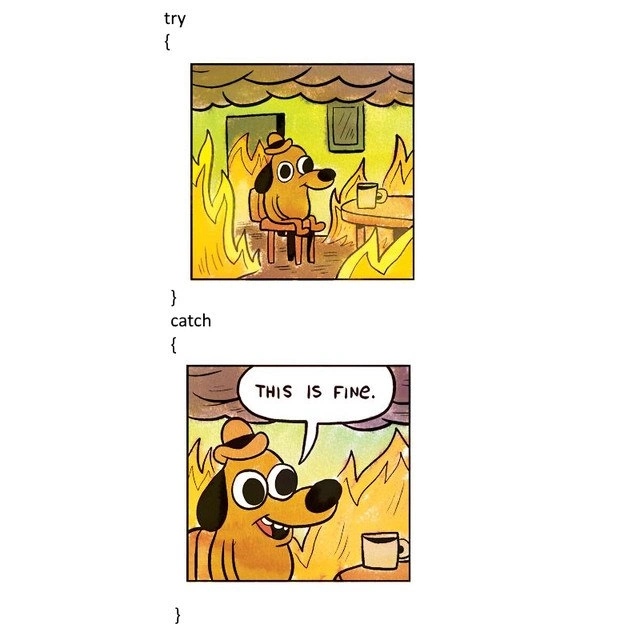
In the meme, the famous “This Is Fine” dog comic is used to perfectly illustrate this concept. The dog sits in a burning room and says “This is fine.” In code terms, that’s exactly what an empty catch block is doing: the software encounters a burning issue (flames everywhere), but the only response is a smile and a thumbs up. Developers find it funny because it’s a hyperbolic, cartoonish version of a very real RelatableDevExperience. We’ve all seen code that effectively says “Everything’s okay!” when, under the hood, everything is breaking. The meme is a lighthearted reminder (or warning) that pretending the error didn’t happen doesn’t make the consequences go away.
Level 3: Catching Fire
At the most technical layer, this meme is calling out a classic anti-pattern in programming: silently swallowing exceptions. In the code world of ErrorHandling, a try { ... } catch { ... } block is meant to catch and handle errors (exceptions) when something goes wrong. But here the catch block does basically nothing – it just smiles and says “This is fine.” The meme literally frames the famous “this is fine” dog inside a try/catch code snippet. The first panel (inside try { }) shows our dog calmly sipping coffee in a burning room – representing some operation that’s failing spectacularly (the system is literally on fire). Then the catch { } panel shows the dog cheerfully declaring “THIS IS FINE.” This is exactly what bad error handling looks like: the code catches an exception and pretends everything is okay, even as flames engulf the room.
For seasoned developers, this scenario induces both a chuckle and a cringe. It’s dark coding humor born from painful experience. We’ve all seen code that enters a catch(Exception e) and then does nothing or logs a useless “all good” message. That catch block becomes an exception black hole – all information about the error disappears into it. The program keeps running with a smile on its face while internal state is corrupted or important operations failed. In real life production, this is how you get a system “on fire” (figuratively) with no alarms going off. The logs stay quiet, monitoring shows green, yet behind the scenes everything is broken. It’s the kind of ProductionIssue that turns a simple bug into an all-night debugging session. Imagine being on-call at 3 AM, everything is crashing, but no error is reported because some genius decided to catch and ignore the exception. Debugging that is an exercise in insanity – you know something’s wrong but the software insists “Nope, all good!”
This meme’s humor hits hard because it exposes that gap between best practice and reality. Proper exception handling means you either fix the problem, or at least loudly log it and fail fast. But in crappy legacy code (or rushed hotfixes), you often find these empty catch blocks acting like nothing happened. It’s a CodeQuality nightmare: the system is allowed to continue in an unknown state, which can lead to even more bizarre bugs down the line. The dog surrounded by flames is a perfect visual metaphor for that relatable dev experience – everything’s breaking, but the software’s just whistling innocently. Veteran engineers have a sarcastic saying for this: “It’s not a bug, it’s a feature!” Here the “feature” is that our app ignores errors by design. What could possibly go wrong? (Spoiler: everything, but you won’t see it in the logs.)
In a broader context, swallowing exceptions is considered such a bad practice that many teams outright ban empty catches in code reviews. Static analyzers will warn about it. It’s like turning off a smoke alarm to avoid hearing the beeping — it might be quiet now, but your house is still on fire. Historically, languages like Java enforced checked exceptions to pressure developers into handling errors properly (so you couldn’t just ignore them). Yet even then, people would lazily do catch(Exception e) { /* ignore */ }. Other languages and frameworks preach “fail fast” — if an error happens, let it bubble up and crash loudly rather than corrupt state silently. But despite all the best practices, these “this is fine” catch blocks still sneak into real-world code. The result? DebuggingFrustration for whoever inherits that code. This meme nails that truth: catching an exception only to do nothing about it is literally like saying “This is fine” in a burning room. Every experienced dev seeing this image nods knowingly (and maybe cries a little inside).
Description
This meme creatively combines a classic programming structure with the iconic 'This is Fine' comic. The image is structured as a try-catch block, a common construct for error handling in many programming languages. Inside the 'try' block, the first panel of the comic is shown: a cartoon dog sitting calmly in a room engulfed in flames. This represents a piece of code where a critical error - the fire - has occurred. The code then enters the 'catch' block, which is meant to handle the error. Inside this block is the second panel, where the dog, now smiling despite the fire, says, 'THIS IS FINE.' This perfectly satirizes a notorious anti-pattern in software development: writing empty or useless catch blocks that 'swallow' exceptions. Instead of properly logging, handling, or escalating the error, the code pretends everything is normal, leading to silent failures and making debugging a nightmare. It's a deeply relatable joke for senior developers who have witnessed the catastrophic downstream effects of ignoring problems at their source

Comments
17Comment deleted
The empty catch block: a junior dev's solution to an exception, and a senior dev's source of a week-long production outage
Why pay for Chaos Engineering when the whole monolith already runs inside try { … } catch(Exception) { return 200 OK; } - Grafana shows five-nines while the users smell smoke
After 20 years in the industry, I've learned that an empty catch block is just a deferred resignation letter - you're not fixing the problem, you're scheduling a 3am incident where you'll explain to the CTO why 'silently continuing' seemed like a good architectural decision at the time
The classic empty catch block: where exceptions go to die quietly while your production environment burns. Senior engineers know this pattern well - it's the architectural equivalent of putting a smoke detector in a soundproof box. Sure, your code 'handles' the error, but much like our canine friend here, you're just sitting in denial while the stack traces pile up in logs nobody reads. The real tragedy? This meme is less funny when you're the one getting paged at 3 AM because someone caught and ignored a database connection failure six months ago
The CAP theorem of exception handling: Consistency optional, Availability of denial guaranteed
Our incident response plan is basically try deploy, catch Exception, log.debug('this is fine'), return 200 - SLOs burn while the dashboard stays green
Global exception handler in prod: try { everything } catch(Exception) { return 200; logger.info("this is fine"); }
Yeah, thank you for noting Comment deleted
Like most memes around there, you know) Comment deleted
Yup 👍 Comment deleted
Great work anyways ⭐ Comment deleted
CS students be like Comment deleted
Herpbl Comment deleted
You will not receive any error message if you write the whole code at try...catch statement Comment deleted
Compile Error Comment deleted
Well exatly it will occur if syntax is incorrect Comment deleted
It depends. I think only exceptions on the same thread will be catched. Don't quote me on that Comment deleted