Skip to content
DevMeme
2980 of 7435
The '20-Minute' Meeting That Becomes a Hostage Situation
Meetings Post #3290, on Jun 19, 2021 in TG

The '20-Minute' Meeting That Becomes a Hostage Situation

Why is this Meetings meme funny?

Level 1: Trapped in a Meeting

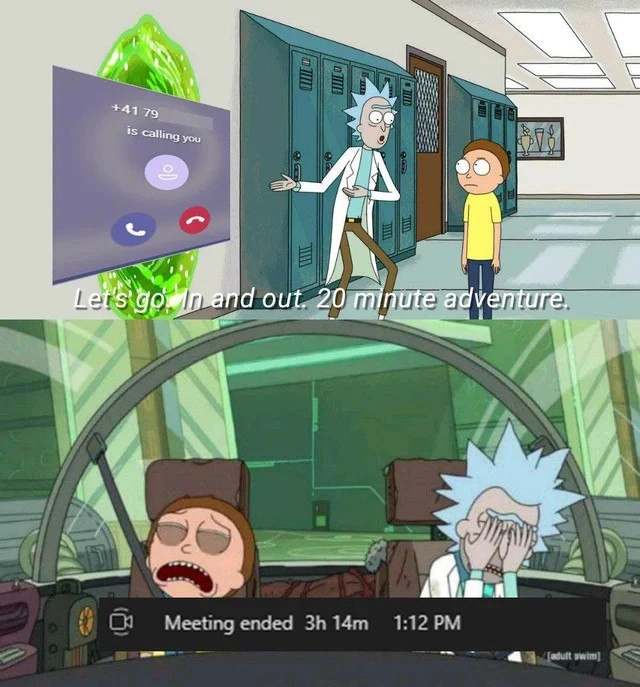
Imagine your friend says, “Come on, this will be really quick – just a 5-minute chat.” You agree, thinking you’ll be done almost immediately. But then, that chat keeps going…and going…and going. Suddenly, hours have passed and you’re both tired and cranky. This meme is joking about that exact feeling, but at work. The picture shows a character (Rick) telling his nervous friend (Morty) that a task will only take 20 minutes, like when a teacher says a lesson will be short. They step through a magic door (like starting a quick phone or video call). But in the next scene, we see them much later: the short task turned into a very long one – over three hours! Morty is slumped over, exhausted, and Rick is holding his face in his hand like, “Oh no, what have we done?” It’s funny because we’ve all been in a situation like that: someone promised it would be fast, but it felt never-ending. The joke is basically saying: those “super quick” meetings or chores can surprise you and last way, way longer than anyone said. Even though it’s annoying in real life, seeing it happen to cartoon characters makes us laugh.

Level 2: The 20-Minute Trap

At its core, this meme jokes about meeting overload using a scene from Rick and Morty. Rick and Morty are characters from a popular sci-fi cartoon often referenced in tech humor. In the top image, Rick (the scientist with spiky blue hair) tells Morty (the kid) confidently: “Let’s go, in and out, 20 minute adventure.” In the actual show, that line is famous because every time Rick says an adventure will be quick, it ends up being wildly complicated – and that’s exactly the comparison being made to meetings. The meme creator has added a fake video call invitation next to Rick, with a phone number and little accept/decline icons (just like a real-life incoming call from Zoom or Microsoft Teams). The green portal Rick opened represents jumping into a virtual meeting. Morty is the cautious one, like an engineer thinking, “Hmm, have we thought this through?” The subtitle on the image explicitly says that line about a 20-minute adventure, setting the expectation that this online meeting will be super short and easy.

Now, the bottom image reveals the punchline: Rick and Morty are back from the so-called adventure, and they’re completely worn out. They’re seated in Rick’s space cruiser (a flying car spaceship from the show) looking defeated. Morty’s mouth is open like he’s groaning or sighing in exhaustion, and Rick has his hand covering his face – a universal facepalm gesture showing regret or embarrassment. On the screen, we see a black bar (a UI element mimicking video call software) that says “Meeting ended – 3h 14m – 1:12 PM.” In plain terms, they just got off a video call that lasted 3 hours and 14 minutes, ending at 1:12 in the afternoon. It’s a far cry from the promised 20 minutes! The contrast is huge and that’s where the humor is: the meme shows expectation vs. reality. The expectation was a short, 20-minute call (like Rick’s quick trip idea), but the reality was an hours-long marathon meeting that left them feeling dead tired. It’s funny in that “ugh, I’ve been there” way. Anyone who’s worked in a team setting, especially remotely, has seen a “quick catch-up” turn into a multi-hour slog.

Let’s break down why this happens in real life (and why it’s so relatable to developers and office workers). In many companies, having lots of meetings is just part of the WorkplaceCulture. People often say things like “let’s hop on a quick call” or “it’ll just be a 15-minute sync.” A stand-up meeting, for example, is a daily team meeting meant to be very short – roughly 15 minutes where everyone literally might stand up and quickly share what they’re working on. The whole point is to keep it brief. But if the team isn’t disciplined, even a stand-up can run long. Someone might bring up a complicated issue, or two people start discussing a detail that interests the whole group, and suddenly that stand-up stretches to 30 minutes or more. This meme exaggerates that idea: a “20-minute” meeting expands almost tenfold! In project management terms, this is akin to scope creep – originally, you planned to cover just one or two simple things (the original scope), but new topics and problems creep in. Here the “scope” of conversation kept growing. Perhaps what started as a check-in (“Did you deploy that update?”) turned into a deep-dive debug session, then morphed into a design discussion for a new feature, all in one call. Each participant might be adding “just one more thing,” and nobody stops the meeting. That’s why instead of wrapping up in 20 minutes, it just keeps going. It’s like pulling a loose thread on a sweater; suddenly you unravel the whole thing. In a meeting, once you open up a complex topic, time flies (not in a fun way) and before you know it, hours have passed.

Now, consider the remote work angle. When everyone is working from home (or different locations), virtually all communication is through video conferencing tools or chats. If this were an office, Rick might have just popped by Morty’s desk for a “20-minute” chat. Ironically, that might actually stay short because standing in a hallway or at someone’s desk naturally ends when someone has to get back to work or another meeting. But in a virtual call, you’re in a dedicated session with both parties (or the whole team) locked in. There’s a tendency to “might as well sort everything out now, since we’re all here.” Also, when remote, you lack visual cues that people are getting restless or have other things to do (you can’t see folks glancing at the door or shuffling papers as a hint to wrap up). So remote VirtualMeetings often inadvertently encourage longer discussions. Everyone is already in front of their computer, and unless someone has a hard stop, the meeting can keep extending. Plus, some people schedule these calls back-to-back, leading to a culture of constant calls. Meeting overload becomes common: employees spend a big chunk of their day in virtual meetings, sometimes even discussing things that could have been resolved in a quick email. Meeting fatigue then sets in, where you feel mentally worn out from all the video calls. The meme shows exactly that fatigue – Morty’s thousand-yard stare and Rick’s facepalm are basically saying, “I am so done with this.” It exaggerates to make a point: what was supposed to be a short, efficient meeting became a draining three-hour marathon meeting. And this joke lands so well among developers because they frequently experience this mismatch between the planned time and actual time of meetings.

For someone early in their career (or anyone new to this experience), a few terms here might be new. “Meeting culture” refers to how a company or team tends to handle meetings – some cultures have a meeting for everything and they often run long, whereas others try to minimize meetings. “Scope creep” is a term from project management meaning the work or topic keeps expanding beyond what was originally planned (like a project that keeps getting new features added – or a meeting that keeps getting new agenda items spur-of-the-moment). Context switching is a productivity concept: it’s when you switch from one task to another. Developers mention it because going from coding (a focus-intensive task) to a meeting (a discussion) and back to coding is hard. Your brain has to dump a bunch of programming context, talk about other stuff, then later reload that programming context – and that takes extra time. So if a meeting is much longer than expected, the disruption is bigger. That’s why after a long call, a developer might struggle to get back into coding quickly. This is one reason why unplanned long meetings are seen as harmful to developer productivity. Also, note the little detail: the banner “Meeting ended 3h 14m 1:12 PM” looks a lot like the interface of Microsoft Teams (a popular work video call app) which often shows a summary like that when a call ends. It makes the meme extra realistic – you can almost hear the Windows “call ended” sound. And seeing “3h 14m” on a meeting timer is both absurd and comically relatable. It basically screams, “Yep, we’ve all been stuck on that kind of call.”

In summary, this meme is a piece of workplace humor that uses a bit of pop culture. It’s telling a simple story: the promised short meeting that became a long one. Even if you didn’t know Rick and Morty, you can relate to the exhausted faces and the ridiculous meeting length on the screen. For a junior developer or anyone new to remote work, it’s a humorous caution: always be prepared that a “quick call” might not be quick at all. It’s okay to laugh at it – we’ve all clicked “Accept” on that invite thinking it’s no big deal, and later realized we basically signed up for a half-day, brain-draining conference. The meme exaggerates it with a sci-fi adventure twist, but the punchline hits home because of how common this scenario is. Next time someone like Rick says a meeting will be “in and out,” you’ll remember Morty’s face and maybe set a timer (or at least bring an extra cup of coffee)!

Level 3: The Meeting Event Horizon

Every battle-hardened developer knows the myth of the “quick call.” This meme nails that painful truth with a Rick and Morty reference. In the top panel, mad scientist Rick opens a glowing green portal (his interdimensional gateway) and proclaims, "Let’s go, in and out, 20 minute adventure." A floating video-call UI (incoming call screen with accept/decline buttons) hovers by the portal, labeled with a generic number as if someone’s calling on Zoom or Teams. Morty stands by, unsure. This setup screams RemoteWork life: someone (like Rick, possibly a confident manager or tech lead) suggests a brief video meeting to solve a problem. The expectation? Jump in, handle it fast, jump out. But the bottom panel delivers the punchline: Rick and Morty are now slumped in their spaceship exhausted after the “adventure.” A banner on-screen reads “Meeting ended – 3h 14m – 1:12 PM,” showing the call lasted an epic 3 hours 14 minutes. (Side note: 3h14m is roughly 3.14 hours, a sly π reference – fitting, since such meetings feel as endless as an irrational number.) Rick is facepalming (hand over face in frustration) and Morty looks completely drained. In other words: that 20-minute mission turned into a 3-hour ordeal.

This scenario is hilariously familiar in modern MeetingCulture. It satirizes how a supposed quick sync can spiral out of control. In many agile teams, a daily stand-up meeting is intended to be 15 minutes of updates – people even call it a stand-up because you shouldn’t sit down and get comfortable. But here, metaphorically, Rick and Morty ended up sitting (in a spaceship cockpit!) for over three hours. Why does this happen? Often because there’s no strict agenda or cutoff. In a physical office, social cues or room bookings might naturally limit a meeting’s length (everyone sees the time, someone else needs the conference room at 10:30, etc.). But in VirtualMeetings, those cues vanish – nobody’s waiting outside your Zoom room. Especially with RemoteWorkCulture, every discussion big or small becomes a scheduled video call. People say “just 20 minutes” to make it sound painless, but once everyone’s in the call, topics keep branching. It’s like crossing the event horizon of a black hole: you get sucked in deeper with each minute. One innocuous status update leads to debugging a major issue live, then morphs into a design debate, and so on. The meme captures this meeting time dilation perfectly – Rick’s portal was supposed to be a shortcut, but it delivered them to a realm where time (and your morning) gets devoured.

From a senior developer’s perspective, this is both funny and painfully real because of the impact on productivity. Developers treasure focus time – those stretches of uninterrupted work when you can get “in the zone” or achieve a flow state writing code. An unplanned three-hour meeting is like a grenade in your calendar that shatters your focus for the day. It’s not just the 3 hours lost; there’s also the context switching cost. In tech, context switching means dropping what you were doing (say, coding a new feature) to do something else (like join a meeting), then trying to resume the original task later. After 3+ hours of screen-sharing, status discussions, and maybe firefighting production issues on the call, your brain is mush. Picking up where you left off in code is exponentially harder. The meme’s second panel (Morty slumped, Rick facepalming) is exactly how a developer feels at 1:12 PM when a marathon meeting ends – mentally fried, maybe caffeinated but drained, and dismayed that half the day vanished. MeetingFatigue is real: video calls demand constant attention (staring at Brady Bunch boxes of coworkers, trying not to talk over someone due to lag), which is cognitively exhausting. So after 3 hours, you’re not just behind schedule; you’re wiped out. As a result, this “20-minute” detour utterly drains developer productivity – a truth that elicits a knowing, if grim, chuckle from experienced engineers. (Because who doesn’t love watching their entire morning disappear into a “quick sync,” right? cue eye-roll)

The humor also lies in the universal truth of estimation it highlights. In software, we have joking "laws" about how nothing ever stays within its estimated bounds. This meme is a textbook example of Hofstadter’s Law at work: “It always takes longer than you expect, even when you account for Hofstadter’s Law.” Rick promised a 20-minute adventure, but even if he anticipated overruns, three hours still blows past that. Likewise, Parkinson’s Law (“work expands to fill the time available”) shows up in meeting form: if nobody forces the meeting to end, it will expand and expand, consuming all available time (and then some). In fact, there’s an unwritten rule among veteran devs that “15-minute meeting” means at least an hour, and a 30-minute meeting might as well block off your whole morning. Here, a 20-minute call inflated to 194 minutes! We essentially got a 10x multiplier – a bit of dark humor for those of us who’ve seen a one-item agenda explode into a full-on strategy session. The meme uses Rick and Morty’s over-the-top adventure as an analogy: what starts as a simple mission snowballs into a complicated saga. The “portal” was supposed to shortcut to the solution, but instead it led to new dimensions of discussion. By the time you finally emerge (meeting ends at 1:12 PM!), you’re left facepalming like Rick, thinking, “That escalated quickly.” It’s funny because it’s true – we laugh to keep from crying about all those lost hours. And maybe, just maybe, it’s a reminder to set a real timer on that next “quick call.”

Description

This is a two-panel meme using the '20 Minute Adventure' format from the animated show 'Rick and Morty'. In the top panel, Rick Sanchez confidently tells Morty Smith, 'Let's go. In and out. 20 minute adventure.' An incoming call notification from a '+41 79...' number is superimposed, suggesting the start of a meeting. The bottom panel shows the aftermath: Rick and Morty are completely drained, traumatized, and exhausted inside Rick's spaceship. Overlaid on this scene is a meeting summary notification, likely from Microsoft Teams, that reads 'Meeting ended 3h 14m 1:12 PM'. The meme perfectly captures the all-too-common corporate experience of a meeting scheduled for a short duration spiraling into a multi-hour ordeal. It humorously contrasts the optimistic expectation of a quick 'adventure' with the soul-crushing reality of a poorly managed, marathon-long meeting, a pain point deeply familiar to developers whose productivity is often derailed by such events
Comments

11
Anonymous ★ Top Pick A 'quick 20-minute sync' is the project manager's equivalent of a while(true) loop with no break condition defined in the requirements
  1. Anonymous ★ Top Pick

    A 'quick 20-minute sync' is the project manager's equivalent of a while(true) loop with no break condition defined in the requirements

  2. Anonymous

    That “quick 20-minute sync” is just a distributed transaction with no commit path - once you dial in, you’re stuck in 2PC limbo until someone finally times out three hours later

  3. Anonymous

    The only thing more optimistic than a recruiter's '20 minute call' estimate is a PM's sprint velocity calculation after discovering 'just one small change' to the requirements on day 13 of a 14-day sprint

  4. Anonymous

    Every senior engineer knows the universal constant: multiply any production incident estimate by 10, add two hours for the cascading failures you didn't anticipate, and another hour for the post-mortem where you'll explain why 'it worked in staging.' The +41 country code suggests this poor soul is dealing with Swiss banking systems - where 'quick fix' is measured in geological time scales and every change requires three approvals, two rollback plans, and a sacrifice to the legacy COBOL gods

  5. Anonymous

    “Quick 20‑min sync” is a consensus algorithm with no leader - P50 is 20 minutes, P99 is 3h14m, and the final state is “let’s take this offline.”

  6. Anonymous

    Meetings: 20 promised minutes expand to π hours via inevitable tangent theorem

  7. Anonymous

    The 20‑minute 'quick sync' operates on tail latency - by 3h14m we’ve re‑litigated the PRD, bikeshedded an RFC, and left with zero decisions and nine Jira tickets

  8. @kirillov06 5y

    stolen!

    1. @affirvega 5y

      most memes here come from reddit, so yeah

  9. @nuntikov 5y

    Жиза For real

  10. @azizhakberdiev 5y

    What if you wrote AM. Would be more interesting

Use J and K for navigation