Game Dev vs. The Friendly Neighborhood Pen Testers
Why is this Security meme funny?
Level 1: When Friends Attack
Imagine you’re building a cool sandcastle at the beach. You’re not even done with it yet — you’re still carefully stacking the sand towers. But then your goofy friend runs over and starts jumping on it to see if he can smash it. 😅 You’d be like, “Hey! I’m not finished!”
That’s exactly the joke here, but with a computer twist. You (the developer) are building a fun online game, piece by piece, just like that sandcastle. Meanwhile, your friends can’t resist trying to wreck it while you’re still building it. They’re poking and prodding your game’s database (the part of the game that holds all the important information, like scores and accounts) to find any weak spot, kind of like jumping on the sandcastle to find a weak tower. It’s funny because your friends aren’t trying to play the game normally – they’re treating it like a challenge to break. It’s as if you invented a new toy and instead of playing nicely, they immediately try to tear it apart to see what happens!
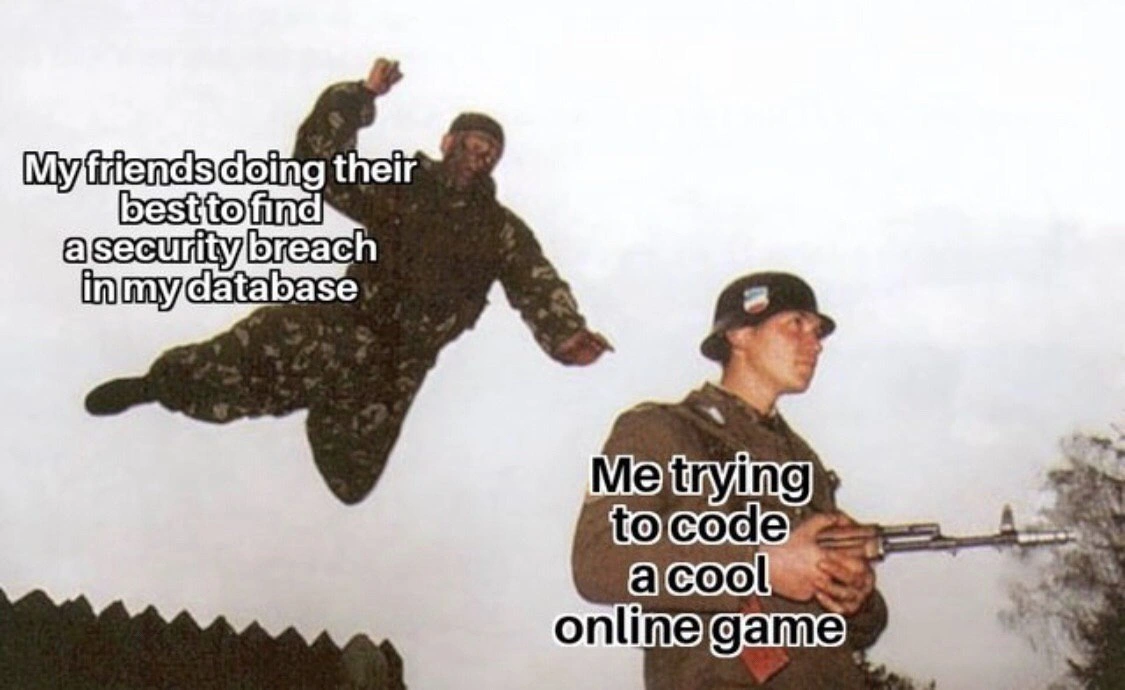
So the meme is showing a soldier calmly holding a gun (that’s you writing code), and another soldier flying through the air ready to kick him (that’s your friend aggressively testing your game). It exaggerates how intense it feels when someone tries to break your project unexpectedly. In simple words: you’re busy creating something cool, and your friend is already trying to knock it down. It’s all in good humor though – because sometimes that crazy friend actually helps you find problems early. But in the moment, it feels like, “Whoa, let me finish building before you try to crash it!” That’s why developers find this meme so funny – it’s a silly way to say “my friends keep trying to hack my unfinished game!”
Level 2: But Did You Secure It?
This meme highlights a common scenario in programming: friends_breaking_my_code as soon as they get a chance to try it. On the right, we have “Me trying to code a cool online game” – a developer working on a new multiplayer game, which likely involves a database (a system that stores game data like player accounts, scores, items, etc.). On the left, we see “My friends doing their best to find a security breach in my database.” In simpler terms, the developer’s friends are stress-testing the game’s backend, looking for any security vulnerability or bug they can find. It’s as if the friends have suddenly become hackers or QA testers, actively trying to break the game or access things they shouldn’t.
Let’s break down the technical parts: an online game typically has a server with a database. The database stores information (for example, user profiles, game progress, inventory). A security breach in this context means the friends are trying to exploit weaknesses to get unauthorized access to that data or mess up the game. This could mean trying something like a SQL injection attack. SQL (Structured Query Language) is how you talk to databases. An injection attack is when someone sends unexpected input to trick the database into running unintended commands. For instance, consider a simple game login code:
// Pseudocode for a login query (this is NOT secure!)
let username = getInput("Enter username:");
let password = getInput("Enter password:");
// Building an SQL query string directly from user input
let query = "SELECT * FROM users WHERE name = '" + username + "' AND pass = '" + password + "'";
// Now imagine if username or password contains a malicious string...
database.execute(query);
If a friend as a “tester” enters something wild like this for the username:
'; DROP TABLE users;--
and leaves the password blank, the query string becomes:
SELECT * FROM users WHERE name = ''; DROP TABLE users;--' AND pass = '';
The part '; DROP TABLE users;-- is an attempt to end the first query and add a new command to drop (delete) the users table! The -- is SQL comment syntax to ignore the rest. In a poorly secured system, this kind of input could literally delete your user database. 😮 This famous example is known as the "Little Bobby Tables" joke from XKCD, illustrating why input validation is crucial.
Now, in a proper setup, developers prevent this by using prepared statements or escaping special characters, and by not directly concatenating user input into queries. But if you’re a beginner or rushing to get things working, you might not have added those protections yet. That’s where friends testing your game come in: they’ll often do the craziest things you never expected. They might type in super long names, use weird symbols, create 1000 accounts in a minute, or try to peek at data they shouldn’t see. Essentially, they’re performing penetration testing (often called pen testing for short) on your project. Penetration testing means evaluating the security of a system by simulating an attack.
So why would your friends do this? Possibly because it’s fun for them to play “hacker”, and also they probably want to help you make your game better by finding weaknesses now, before a real malicious person finds them. It’s a bit of a game in itself: can they crash the server or find a secret admin page? In the meme, the friend is mid-air like they’re jumping in to attack, which perfectly represents how sudden and forceful these tests can feel to an unprepared developer. One moment you’re writing code, the next moment a friend’s like, “Oops, I just found all the player data with a simple trick!”
This scenario is very common in GameDevelopment and any hobby project with an online component. New developers quickly learn that security isn’t just for big companies; even a simple game needs some basic protection. It highlights the balance new devs have to manage: feature_vs_hardening_balance. You want to add cool features (new levels, weapons, gameplay mechanics), but you also have to make sure the back-end (like the database and server logic) is secure and can’t be easily broken. It can be surprising how creative users (or friends acting as testers) can be in finding bugs.
In summary, the meme uses a funny dramatic image to show a very real coding lesson: while the developer is peacefully building the game, the friends are aggressively testing its limits. The caption “Friends doing their best to find a security breach in my database” is basically saying: my friends are trying really hard to hack or break my game’s data. And the developer’s caption “Me trying to code a cool online game” suggests: I’m just trying to make a fun game here! The contrast is the joke — one is building, the others are breaking, all at the same time. It stresses why thinking about security vulnerabilities early on (like validating inputs, securing your database credentials, limiting what users can do) is so important, even if it’s not the fun part of development. Otherwise, your first play-test can turn into a hacker showdown, courtesy of your enthusiastic friends.
Level 3: Friendly Fire Drill
In this meme’s epic database warzone, the unsuspecting developer is calmly implementing game features while an overzealous friend launches a full-on penetration testing ambush. It’s a classic case of feature vs hardening: the dev is focused on coding a cool online game, and the friend is focused on breaking it. The humor hits home for seasoned developers because we’ve all seen what happens when security is an afterthought. One minute you’re tweaking character stats, the next you’re frantically patching a security vulnerability your buddy just exploited for fun. The meme text labels make it crystal clear:
Me trying to code a cool online game – (standing guard, oblivious)
My friends doing their best to find a security breach in my database – (flying kick of chaos)
The friend in camo is basically performing unsolicited penetration testing (the “friendly fire” of QA). They’re dunking on your half-built server with the enthusiasm of a hacker at DEF CON. This exaggeration feels too real in indie dev circles: you spin up a basic backend for your game, and your pals immediately turn into hackers “quality assurance”. They’ll try everything from spamming invalid game actions to sending weird inputs hoping to trigger a data breach. Did you hardcode an admin password? Leave a /debug endpoint open? Use a simple SELECT * query with user input unsanitized? Your friends will find it. It’s practically a law of GameDev: given any new online game project, at least one friend will attempt to “Little Bobby Tables” your database on day one.
Why is this so funny and relatable? Because it exposes the dual reality of hobby programming: building new features is exciting, but security is that looming chore we often postpone. In theory, every developer knows you should secure your database and validate inputs. In practice, you’re rushing to show off a playable demo, thinking “it’s just friends testing.” Famous last words! Those friends proceed to behave like a horde of bug bounty hunters on energy drinks. They’ll input '; DROP TABLE Users;-- as their username just to see if your code is naive enough to execute it. They attempt SQL injection, race conditions, or any sneaky trick to crash the game or expose data, effectively doing database_security_testing by brute force. It’s hilarious when it’s not your project – and mildly heart-attack-inducing when it is.
From an experienced perspective, the scene highlights the importance of balancing features vs. fortifications. We chuckle because the developer’s stance (focused but unprepared, like the soldier casually holding a rifle) is exactly how many of us felt before our first security incident. And the friend’s dramatic flying kick represents reality kicking down the door: if you don’t actively defend your app, someone (even a well-meaning friend) will barge in. Seasoned devs have learned (often the hard way) that no code survives first contact with users – especially if those users have a hacker mindset. The meme exaggerates it to a comedic extreme with a literal surprise attack, but it underscores a real lesson in Security: stress-testing isn’t optional. Whether it’s QA engineers or just mischievous friends, someone will test your creation’s limits. You can either be prepared, or you can be that stunned dev scrambling under a barrage of "WTH, how did you even find that exploit?" messages at 1 AM.
In short, this meme is a humorous homage to indie_online_game_dev life: your buddies become your adversarial testers, turning your development process into an impromptu war game. It’s funny because their enthusiasm to break things matches your enthusiasm to build – and if you’re wise, you’ll channel that into making your app bulletproof before the real bad guys show up. After all, it’s better to fix a hole discovered by a friend than to learn about it from a front-page news breach.
Description
This is a two-person object-labeling meme using a dynamic photo of two soldiers. In the foreground, a soldier wearing a helmet holds a rifle, looking focused and unaware of his surroundings; he is labeled, 'Me trying to code a cool online game'. In the background, another soldier in camouflage is captured mid-air, executing a powerful flying kick towards the first soldier. This airborne attacker is labeled, 'My friends doing their best to find a security breach in my database'. The image humorously captures the classic conflict between a developer focused on building features and the ever-present, often aggressive, reality of security testing. It personifies penetration testing or ethical hacking as a surprise attack from one's own peers, a common experience for developers whose friends delight in finding vulnerabilities in their side projects. The joke resonates with anyone who has built a public-facing application, especially in the gaming world where exploits and database breaches are a constant threat
Comments
22Comment deleted
Feature development is like building a castle. Security testing is when your friends show up with a trebuchet to 'check the structural integrity of the login page'
Invited friends to beta-test my shooter; five minutes in the real meta is a DROP TABLE speedrun - guess row-level security ships before hitboxes
Nothing says "production-ready" quite like your friends discovering SQL injection vulnerabilities through the chat system while you're still hardcoding player spawn points
When your security-conscious friend is running SQLMap against your hobby project's database while you're deep in the zone implementing procedural terrain generation - because obviously, parameterized queries can wait until after you've nailed the perfect Perlin noise algorithm. Classic case of 'I'll add input validation in the next sprint' meeting 'I found 47 injection vectors in your login form.' At least when your game gets pwned, the leaderboard manipulation will be impressively creative
Open 0.0.0.0:5432 for a 'quick leaderboard' and your playtesters become a free red team with sqlmap
Me wiring up WebSockets for real-time PvP, friends dropping UNION SELECTs for their own high-score exfil
Shipped a “cool online game” and tuned the tick rate; my friends speedran the OWASP Top 10 via /submitScore - apparently the leaderboard doubles as an RDS admin console
>cool online game >крестики нолики Comment deleted
you meant Tic-Tac-Toe. No Russian withou translation! Comment deleted
yeap Comment deleted
Put away your flamethrower, pal. Comment deleted
he's right though Comment deleted
He's about as right as if I were to start telling you to use English, because your punctuation sucks. Or in the case of the person before, apparently the vocabulary. The person clearly did its best but someone had to come and smack her nonetheless. Comment deleted
there was no translation, it was a quote and then the joke in russian Comment deleted
a proper translation would've been something along the lines of: > cool online game > крестики нолики (tic-tac-toe) Comment deleted
I don't follow: It was not posted in the actual chatting group where the rule applies, as far as I am concerned. And in the comments, there are no such rules. Comment deleted
> And in the comments, there are no such rules. yes there are Comment deleted
That's literally all I see. No rules. No rules in the channel with just the memes either. Comment deleted
that's why we tell people the rules before banning them, jesus. Comment deleted
It's way more effective than having them in the sidebar or group description, which nobody reads anyway Comment deleted
Actually, if it's in the sidebar it's visible from comments Comment deleted
cool thread guys, keep it up!👀 Comment deleted