Adding New Features While Drowning in Technical Debt
Why is this TechDebt meme funny?
Level 1: Clean Up First
Imagine you have a big mess in your room – toys and clothes are scattered everywhere on the floor. It’s so messy that you can barely walk without stepping on something. Now, instead of cleaning up that mess, picture yourself asking for even more toys and dumping them onto the floor. That sounds pretty silly, right? The room is already a disaster, and adding more toys just makes it worse. This meme is funny for the same reason: it shows someone doing something obviously backwards. Just like you would shake your head if a friend did that with their messy room, developers laugh (and groan a little) because they've seen people do the same thing with software projects. The idea is simple: clean up your mess first (fix the bugs) before you bring in new toys (add features). Otherwise, you’ll just end up with a flooded, messy situation that nobody wants.
Level 2: Features over Fixes
Let's break down what this meme is showing in simpler terms. In software, a bug (or "defect") is a mistake or problem in the code that causes the program to not work correctly. A feature is a new piece of functionality or capability added to the software (like adding a cool new button or a new screen that does something useful for the user).
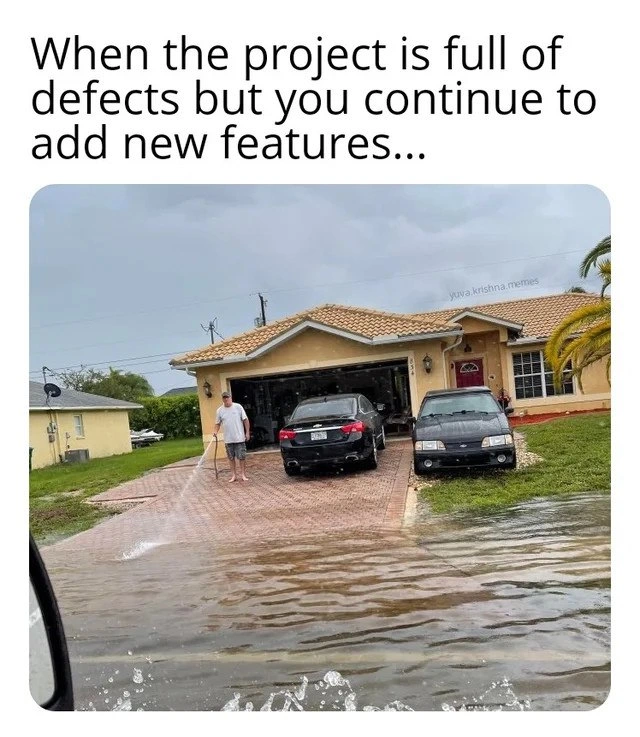
In the picture, the whole street and yard are flooded with water. Think of that flood as a huge number of bugs in the project – a big mess of things that are broken or not working right (basically, a flood of bugs). Now, the man is standing there watering the driveway with a hose even though everything is already soaked. This is like a development team continuing to add new features to the software even though the project is already "soaked" with problems. He’s ignoring the flood (the existing bugs) and just continuing with a normal task (adding water, which represents adding features).
Why would anyone do that in real life? In software projects, teams often face pressure to keep delivering new features – maybe from bosses or clients who want more shiny things to show off to customers. Meanwhile, fixing bugs (which is sometimes called improving code quality or reducing technical debt) doesn't get the same glory, because it's not as visible or exciting to non-developers. Technical debt is a term we use to describe the situation when we take shortcuts or postpone fixing problems in the code. It's like borrowing time: you get to move faster now by not cleaning up or not writing tests, but you "owe" those fixes later. If you don't pay back this debt by fixing bugs and cleaning up the code, the problems build up over time. That makes it harder and slower to add anything in the future (just like interest piling up on a loan).
This meme is a funny (and a bit sad) illustration of the feature vs. bug prioritization problem. That's when teams have to choose between working on new features or fixing existing issues. Here, the choice was to keep adding features and ignore the issues — which is why the picture shows a man calmly doing something that looks absurd (watering a flooded area). It’s pointing out that the priorities are upside-down. Most new developers eventually encounter this situation. For example, you might notice some part of your app is glitchy or users keep reporting errors, but the plan for the week is to release a new feature instead of addressing those bugs. It can feel bizarre — like, shouldn't we fix the leaking roof before painting the house?
Feature creep is another concept hinted at here: that’s when a project keeps getting more and more features added beyond the original plan. If you keep piling on new features without fixing the foundation, the software can become unstable and harder to use or develop. Just like adding more water to an already flooded driveway, more features on a buggy codebase can lead to even more bugs or make the existing problems worse (new code can introduce new bugs on top of the old ones).
So, in plain terms: the meme is comparing a flooded codebase (a project full of bugs) to a flooded yard, and the act of adding new features to the act of hosing down that already waterlogged driveway. It's a humorous way to say, "Hey, maybe we should fix the big mess first (drain the water) before focusing on extra stuff (watering the driveway)." Many developers find this funny (and painfully relatable) because they've been in that situation. They've seen projects where people keep pushing for new stuff while ignoring the growing pile of problems, and they know that usually ends up as a disaster later.
Level 3: Deluge of Defects
"When the project is full of defects but you continue to add new features..."
Welcome to the flooded driveway scenario of software development. In this meme, a man is calmly hosing down an already flooded driveway while the water from the street almost engulfs his front yard. This absurd visual is a spot-on metaphor for a team drowning in bugs but still dutifully pumping out new features.
It's highlighting a classic case of technical debt run amok, combined with extreme feature creep. Technical debt refers to all those bugs, messy code hacks, and neglected refactors that accumulate over time — like water pooling deeper and deeper because no one fixed the plumbing. Every new feature poured onto this swampy codebase is like adding more water to an already flooded yard. Instead of solving root problems (like draining the flood or patching the leaks), the team is focused on superficial shine. The result? A precarious situation where the garage (our production environment) is inches away from disaster.
For seasoned developers, this scenario is painfully familiar (and darkly hilarious). We shake our heads because we've seen it: the feature vs. bug prioritization debate where management insists "just one more shiny feature" will save the day, even as the system buckles under unresolved defects. It's like rearranging deck chairs on the Titanic — polishing things on the surface while the hull is taking on water. The cars in the open garage represent valuable assets (like customer data or critical functionality) at risk, but here we are cheerfully spraying the driveway as if more water will fix the flood. Spoiler: It won't.
This meme resonates as developer humor because it captures a universal developer nightmare. The coding frustration is real: every senior engineer has battled a situation where higher-ups prioritize new features over stability. There’s an implicit irony here: new features are flashy and please stakeholders, but unfixed bugs and crashes are what drive users away (or wake you up at 3 AM on on-call duty). Continuing to add features without fixing foundational issues is like ignoring a growing crack in a dam. Eventually, the technical debt interest comes due: those ignored bugs become production outages, emergency hotfixes, or massive rewrites later. And yet, the cycle repeats in many teams — frankly, it’s almost a rite of passage in software projects.
In short, the meme humorously calls out the folly of ignoring a flood of defects to chase "shiny new things." It's a visual TechDebt cautionary tale. Seasoned devs laugh (perhaps a bit bitterly) because we know the flood will catch up to you, and someone (probably us) will be left barefoot in the water, trying to clean up the mess.
Description
The image displays a meme with the caption: 'When the project is full of defects but you continue to add new features...'. Below the text is a photograph of a suburban house during what appears to be a flood or heavy rainstorm. The street and the home's driveway are submerged in water. Despite this, a man is standing barefoot on the flooded driveway, holding a garden hose and spraying more water onto the already soaked ground. This action is absurd and counterproductive, serving as a powerful visual metaphor. For developers, this image perfectly encapsulates the frustrating and all-too-common scenario where management or product teams push for new feature development on a project that is already unstable and riddled with bugs (technical debt). Instead of addressing the foundational issues (the 'flood'), the team is forced to add more complexity (the 'hose water'), likely worsening the project's overall health and maintainability
Comments
8Comment deleted
Product Owner: 'I see you're working on the foundational water-layer refactoring.' Engineer: 'No, this is the new 'enhanced moisture' feature from the last sprint planning.'
Prod’s waist-deep in Sev-1s, but the roadmap KPI is “new surfaces of delight,” so I’m here plumbing a garden-hose microservice called DarkMode
Just like this homeowner confidently parking their luxury cars in a flooded driveway, we've all worked on that one project where the PM insists on shipping the AI-powered recommendation engine while the authentication system still stores passwords in plaintext and the database connection pool leaks like a sieve during peak hours
This is the software equivalent of deploying to production on Friday while your monitoring dashboard looks like a Christmas tree and your error budget expired three sprints ago. Sure, the garage is underwater and the foundation is compromised, but stakeholders want that new dashboard widget by EOD, so we'll just park another feature on top of the flood and call it 'iterative development.' The real kicker? In six months, when the entire codebase finally collapses under its own weight, management will wonder why the 'simple refactor' you proposed takes three quarters to complete
Hose-Driven Development: SLOs below sea level, error budget blown, yet we keep spraying new features because the OKR tracks velocity, not water level
Adding features to a leaky abstraction because velocity metrics don't measure sinking ships
Executive OKR: +30% feature velocity; reality: SLIs submerged and error budget blown, so we spin up another microservice to spray the driveway
How much money was spent for this entire river? Comment deleted