Skip to content
DevMeme
2327 of 7435
The Tech Mandate That Finally Got Trump Banned
Languages Post #2586, on Jan 12, 2021 in TG

The Tech Mandate That Finally Got Trump Banned

Why is this Languages meme funny?

Level 1: Time-out for Big Demands

Imagine your friend insists that the school tear down every classroom and rebuild them using a brand new unbreakable material – and he won’t take “no” for an answer. He shouts, “We must rebuild the whole school or else!” 🙄 That’s a huge, crazy demand, right? In real life, if someone kept acting that extreme, they might get in trouble or be sent to time-out. This meme is doing the same thing, but in the computer world. Someone on the internet loudly insisted that a giant, complicated computer program (the brain of millions of devices) be completely redone using a new tool – a demand so over-the-top that the internet “kicked him out” (that’s the account suspended part). It’s funny because it’s like watching a kid throw a fit saying “Replace everything now!!!” and the teacher (or in this case, Twitter) immediately responds, “That’s enough – you’re out.” The big joke is how fast and hard the overreaching request gets punished, almost like a cartoon: yell something wild, and POOF! you disappear. Even if you don’t know about Linux or Rust, you can giggle at the idea of someone asking for something impossibly big and instantly getting a time-out for it.

Level 2: Linux in Rust?

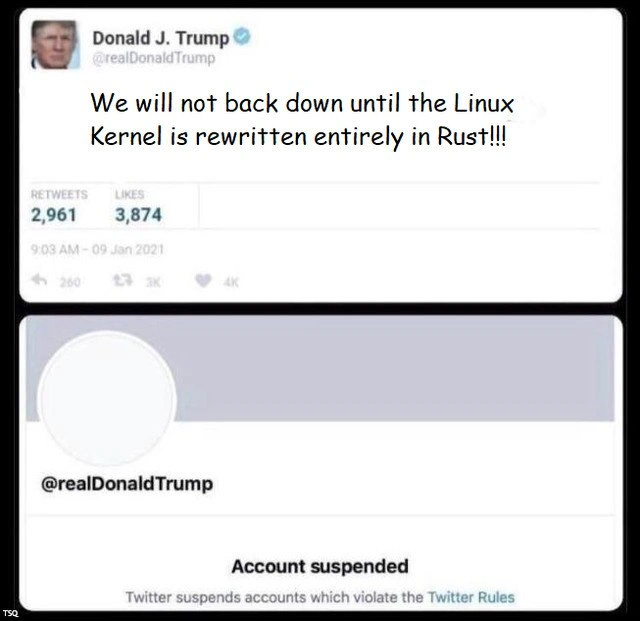
Okay, let’s break down what’s going on here. The meme shows a fake Twitter post where someone (impersonating former U.S. President Donald Trump’s style) declares, “We will not back down until the Linux Kernel is rewritten entirely in Rust!!!” Then the next image shows that user’s account suspended by Twitter. This is funny to developers for a couple of reasons rooted in tech concepts:

Linux Kernel – This is the core part of the Linux operating system. Think of it as the master program that talks directly to the computer’s hardware (CPU, memory, disks, etc.) and manages everything. It’s written mostly in the C programming language (which has been around since the 1970s). The kernel’s code is huge and has been developed by thousands of contributors over decades. It’s complex, but it’s what lets your apps talk to hardware securely and efficiently.

Rust – Rust is a newer programming language (first released in 2010s) that has become super popular in systems programming (which is coding close to hardware, like operating systems or device drivers). Why do people love Rust? Because it’s designed to avoid a lot of common bugs that C has. For instance, in C you manage memory manually – if you’re not careful, you can have memory leaks (not freeing memory), buffer overflows (writing data beyond the allowed memory – a big security issue), or null pointer dereferences (trying to use memory that isn’t there – causing crashes). Rust was built to prevent these errors by design. It has something called a borrow checker in its compiler that makes sure you handle memory safely. If your Rust code might create a memory safety issue, it simply won’t compile until you fix it. This is a big deal for writing reliable low-level code. So there’s been a buzz in the tech community about using Rust for safer LowLevelProgramming tasks that C traditionally handles.

Rewrite in Rust? – Now, rewriting something means discarding the old code and writing a new version from scratch, likely in a different language. People sometimes joke “we should rewrite that in [new language]” when an old software has problems. But rewriting the entire Linux kernel in Rust would be an enormous undertaking. Imagine trying to re-create a skyscraper, piece by piece, using a new kind of material – all while people are still using the building! The Linux kernel isn’t just a small app; it’s the foundation for every Linux system (servers, Android phones, TVs, supercomputers…). It supports an incredible range of hardware. Rewriting all of that would be a monumental multi-year (or multi-decade) project, with lots of chances to go wrong. That’s why the demand in the meme is purposely over-the-top. In reality, what’s happening (as of around 2021) is that Linux developers are cautiously starting to add support for writing new parts of the kernel in Rust (for example, new device drivers could be written in Rust to take advantage of its safety features). But nobody serious is saying throw out all the existing C code and redo everything immediately – that would be like trying to replace the engines on a flying airplane. The meme takes that idea to the extreme for comedic effect.

Account suspended – This is the message Twitter shows when it bans someone’s account for breaking the rules. In early January 2021, the real Donald Trump’s Twitter account was permanently suspended by Twitter after they determined some of his tweets and behavior violated their policies (this was big news at the time). The meme plays on that event by jokingly suggesting that making such a wild tech proclamation (rewriting Linux in Rust) was the final straw that got the account suspended. Of course, in reality, Twitter doesn’t ban people for nerdy programming opinions 😜. But the dramatic pairing of this fake tweet with an immediate suspension is like a punchline. It implies, “This statement was so outrageous or caused so much chaos that the platform insta-banned him.” It’s a form of tech humor to emphasize how absurd the demand is: even Twitter’s algorithms or moderators couldn’t handle it.

Why it’s funny to devs: There’s a running joke in TechHumor and DeveloperHumor circles about overzealous tech opinions. “Rewrite it in Rust” has become a meme on its own, because Rust is the hot new thing and some fans jokingly (or seriously) suggest rewriting all older software in Rust to fix bugs. It’s kinda like a kid saying, “Let’s rebuild our old car into a rocket ship because rocket ships are cooler!” Developers who have experience know that big rewrites are risky and expensive, so it’s funny when someone treats it as non-negotiable. By putting those bold words in a Trump-style tweet (“We will not back down!” sounds like one of his strong proclamations) and then slamming it with a ban hammer, the meme mixes tech silliness with real-world social media drama. It’s a mashup of OperatingSystems geekiness (Linux and Rust talk) with TechTwitter culture (tweets and bans), creating a scenario so ridiculous that you can’t help but laugh.

Level 3: Make Kernels Great Again

For seasoned developers, this meme hits multiple nerves at once. First, it satirizes the perennial Rust vs C debate in low-level programming. In recent years, tech circles have echoed with rallying cries of “rewrite it in Rust!” whenever a C/C++ project shows a security flaw or a crash. It’s become a tongue-in-cheek mantra — a bit like the silver bullet solution people half-jokingly throw around. Everyone knows the Linux kernel is a bastion of C code (with bits of assembly) that’s been hardened over 30 years. So hearing a bombastic demand to rewrite the entire Linux kernel in Rust sounds hilariously naïve and extreme. It’s the kind of thing a junior enthusiast might blurt out on Twitter after reading about Rust’s memory safety, only for senior engineers to collectively facepalm. In reality, kernel maintainers have been cautiously exploring Rust in limited parts of Linux (like writing new drivers) – a far cry from ripping out all C. The meme cranks this discussion up to 11 by invoking an authoritative voice (“Donald J. Trump” in the spoof tweet) declaring “We will not back down…”. This over-the-top confidence resembles the style of a political ultimatum, which is absurdly out of place in a technical debate about programming languages. That contrast is pure developer humor gold: picturing a non-technical public figure barging into a highly technical KernelDevelopment argument with chest-thumping bravado.

Now, the kicker: the bottom panel shows @realDonaldTrump’s account suspended, which is a direct nod to real events in January 2021. In real life, Twitter permanently banned the actual Donald Trump account for violating rules (nothing to do with tech – it was about incitement and policy violations right after a certain historic incident). By tying the suspension to this ridiculous Rust ultimatum, the meme wryly implies Twitter’s moderators couldn’t handle such a blasphemous tech opinion 😅. It’s a one-two punch of humor: the initial absurd demand followed immediately by swift cosmic justice – “Nope, we’re not tolerating that, account gone.” Developers who remember the drama of that week will smirk at how a serious political banning is repurposed here as if it happened due to an outrageous programming take. It also jokingly flatters Rust aficionados: rewriting Linux in Rust is such a grandiose idea that maybe only an overzealous crusader (or someone with nothing to lose) would tweet it. The senior-perspective joke is also a wink at the futility of big rewrites. Seasoned engineers have war stories of ambitious rewrites gone wrong – entire systems thrown out and rewritten, only to end up late, buggy, or canceled. There’s a saying: “the only thing worse than rewriting your codebase… is not rewriting it”, spoken with irony. We recognize that sometimes huge rewrites are proposed as panaceas by people who haven’t maintained the old system’s countless edge cases. So a brash promise “We will not back down!” triggers that knowing grin: we’ve heard managers or architects vow sweeping tech changes that never quite pan out. This meme encapsulates that with a tongue-in-cheek scenario: a bold proclamation to rebuild one of the most complex software projects on earth from scratch (because Rust will supposedly solve all problems), met with an immediate smackdown (the suspension). It’s basically the developer-world equivalent of getting kicked off stage for saying something too outrageous. And of course, the choice of persona in the tweet parody — a recently banned big-name account — is the comedic cherry on top. It merges TechTwitter culture with a real-world twist: if you tweet something this extreme, even jokingly, don’t be surprised if you get metaphorically (or literally, in the meme) escorted out. In summary, experienced devs laugh because it’s a perfect storm of hype vs reality: the hyperbole of Rust evangelism, the impracticality of rewriting huge legacy systems, and the immediate karmic consequence played out in a familiar Twitter format. It’s a sly commentary on both our industry’s fascination with shiny new tech and the real-world smackdown that often awaits grandiose plans.

Level 4: From Segfaults to Safety

At the cutting edge of Operating Systems research, there's an almost holy grail: combining low-level control with memory safety. The Linux kernel, a sprawling 27+ million lines of C code, has historically accepted the occasional segmentation fault (crash from invalid memory access) as an occupational hazard of being close to the metal. C gives kernel developers raw power over memory and hardware, but with great power comes great responsibility (and countless ways to shoot yourself in the foot with a stray pointer). Enter Rust, a modern systems language that promises fearless concurrency and compile-time guarantees to prevent those very memory errors. Rust’s compiler enforces borrowing rules so strict that entire classes of bugs (buffer overflows, use-after-free, data races) are eliminated before the code even runs. In theory, rewriting the entire Linux kernel in Rust could exorcise memory demons that have haunted system code for decades. No more mysterious segfaults at 3 AM due to a dangling pointer—Rust wouldn’t let that code compile in the first place. But here’s the rub: a kernel isn’t just any program; it's a living, breathing ecosystem of architecture-specific optimizations, assembly routines, and device drivers for everything from your SSD to your USB coffee warmer. A full rewrite means re-engineering all those pieces, likely introducing new quirks and performance trade-offs. Historically, kernel development has favored evolution over revolution: Linux grew from Linus Torvalds’ 1991 hobby project in C into a global OS by incremental patches, not by sudden language swaps. Academic projects have toyed with safer kernels (Microsoft’s Singularity in managed code, the seL4 microkernel with formal verification, or the Rust-based experimental Redox OS), but none had to carry the vast legacy baggage of Linux. Rust’s borrow checker is brilliant but would be a strict schoolmaster for kernel devs used to C’s wild west; even calling low-level hardware interrupts or managing page tables might require dipping into unsafe Rust code blocks (basically escaping Rust’s safety rails for the hard stuff). So the theoretical demand to purge all C and “rewrite the Linux Kernel entirely in Rust” bumps against both technical reality and decades of engineering lore. It’s a bit like demanding a zero-bug utopia overnight. The meme’s over-the-top insistence hints at a fundamental tension in CS: we can design safer systems (mathematically, we know many memory bugs are avoidable), but rewriting a production-grade monolithic kernel from scratch is a herculean task. It’s the difference between formally proven ideals and the messy practical world of drivers, legacy hardware, and human time constraints. In short, the idea is an enticing thought experiment in software correctness — pushing from a world of segfault-prone C into the promised land of Rust safety — but proposing to actually do it in one grand sweep is audacious to the point of absurdity. And as the meme jokes, calling for such a memory-safety revolution so forcefully might just get you “suspended” from more than one type of forum!

Description

A two-panel meme juxtaposing a fake tweet with a real consequence. The top panel displays a screenshot of a tweet from Donald J. Trump's former account (@realDonaldTrump), dated 9:03 AM on January 9, 2021. The tweet's text, which is clearly edited for comedic effect, reads, 'We will not back down until the Linux Kernel is rewritten entirely in Rust!!!' The bottom panel shows a screenshot of the same Twitter profile, but this time it is defunct, with the message 'Account suspended' and the explanation, 'Twitter suspends accounts which violate the Twitter Rules.' The humor is derived from the absurd suggestion that this niche, highly technical, and politically irrelevant demand was the final straw that led to his historical deplatforming, which in reality occurred around the same time for entirely different reasons. It's a satirical take that merges a significant political event with the 'rewrite it in Rust' meme prevalent in the software development community
Comments

11
Anonymous ★ Top Pick Some say the borrow checker is too restrictive, but apparently, it's more lenient than Twitter's policy team in January 2021
  1. Anonymous ★ Top Pick

    Some say the borrow checker is too restrictive, but apparently, it's more lenient than Twitter's policy team in January 2021

  2. Anonymous

    Pro tip: try to move 30 million lines of kernel C into Rust in one tweet and the only borrow checker that fires is Twitter’s - “account suspended: value moved here.”

  3. Anonymous

    The real reason for the suspension wasn't violating Twitter Rules - it was suggesting a complete kernel rewrite instead of gradual Rust integration, triggering every maintainer's PTSD from the last 'let's rewrite everything' project that died after 6 months

  4. Anonymous

    The irony here is exquisite: while the Linux kernel maintainers are actually, painstakingly, incrementally introducing Rust for new drivers and subsystems after years of RFC debates and careful consideration of ABI stability, this meme imagines the most impulsive possible approach - a complete rewrite mandate from an unexpected source. Any senior systems engineer knows that rewriting millions of lines of battle-tested C code would be the ultimate 'second system effect' disaster, yet the 'Rewrite It In Rust' meme persists as both genuine advocacy and self-aware parody in our community

  5. Anonymous

    Propose a full Linux-in-Rust rewrite and you’ll meet two safety models: the borrow checker, and the platform’s account revoker

  6. Anonymous

    Trump's Rust kernel pledge: bolder than a 30MLOC rewrite, but still crashes on Twitter's borrow checker

  7. Anonymous

    Propose rewriting the Linux kernel entirely in Rust and you’ll meet two governance models: LKML replies NACK; Twitter replies SIGKILL

  8. Deleted Account 5y

    Why in rust lol

  9. Deleted Account 5y

    OOH NOO Comic Sans MS

  10. @doodguy1991 5y

    Based

  11. @nuntikov 5y

    Finally someone who gets it

Use J and K for navigation