The Rude Awakening of a Computer Science Student
Why is this CS Fundamentals meme funny?
Level 1: Big Dreams, Big Ouch
Imagine a kid who really, really wants to build the coolest treehouse ever. He’s super excited about painting it, hanging out inside, maybe putting up a flag on top. That’s the fun part he can’t wait to do. But the next thing he knows, his parent hands him a big book about tools and measuring. Before he can even hammer one nail, he’s got to learn how to use a tape measure and do some math to figure out how much wood he needs. The kid is like, “Whoa, I just wanted to make a treehouse, why am I doing math?!” It’s a bit like getting the wind knocked out of you – a big ouch. He feels surprised and a little hurt that something not-so-fun popped up before he could start the fun stuff.
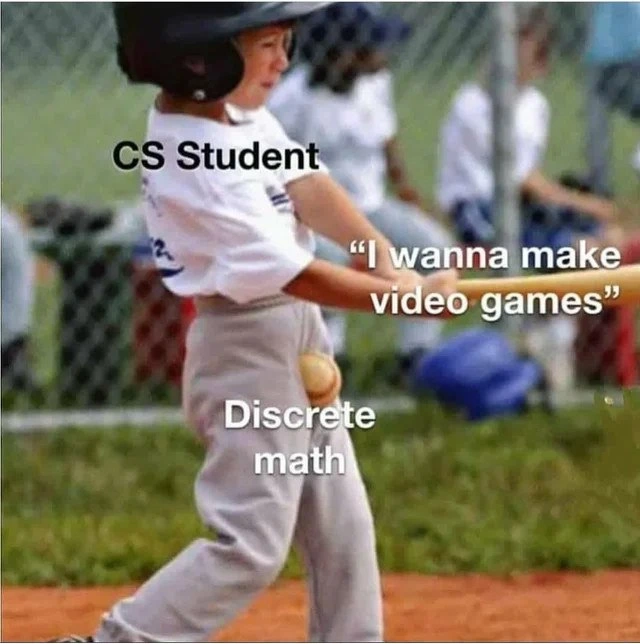
This meme is funny in the same way. The student is the kid with the big dream (making video games, like building the treehouse). The discrete math class is like that heavy how-to book or maybe like a baseball that suddenly hits him – an unexpected hard thing he has to deal with. It’s showing that sometimes, when you want to do something really cool, you first get hit with a tough lesson or a challenge you didn’t see coming. It might hurt or feel frustrating at first (like crashing your bike when you’re learning to ride because you tried to go too fast too soon). But it’s a part of learning. The reason we smile or giggle at this picture is because we’ve all been that person at some point: super excited to do something fun and then “ouch!” – surprised by the difficult stuff we have to learn along the way. It’s a funny way to say, “Hang in there, the hard part comes first, but it helps you reach your dream in the end!”
Level 2: Math Hits Hard
In simple terms, this meme is pointing out how Computer Science students often get caught off-guard by Discrete Mathematics when they start their studies. A student might enroll in a CS program thinking, “I love video games, I can’t wait to make games for a living!” This is the cs_student_expectations phase – excitement about creating the next big game. “I wanna make video games,” as the meme’s bat says, represents those game_dev_dreams that drive many folks to study CS or game development.
However, very early on, reality throws a curveball: universities require foundational courses, and Discrete Math is almost always one of them. Discrete mathematics is essentially the study of things that are countable, distinct, or separate. Unlike calculus (which deals with continuous change), discrete math deals with pieces: whole numbers, logical statements (true/false), discrete structures like networks, and so on. It covers topics such as:
- Logic: the rules of reasoning (e.g. understanding statements like “if A then B” and whether they’re true or false). In a CS context, logic underpins every
ifstatement and condition in code. Game rules and AI decisions are built on logic – e.g., if a player’s health hits zero, then game over. Discrete math teaches how to think about these conditions clearly (often with truth tables that map out all possibilities). - Sets and combinatorics: ways to group things and count combinations or arrangements. For example, combinatorics can answer questions like “How many different ways can these 5 game characters be arranged in a lineup?” or “How many possible loot drop combinations can occur from a treasure chest?” It’s basically counting on steroids, and it shows why certain numbers blow up really fast. This is key in computing because it warns you when something might have too many possibilities to handle by brute force.
- Graph theory: the study of networks of points and connections between them (graphs). Think of a graph as a collection of nodes (points) and edges (lines connecting points). In gaming, a classic example of a graph is a game map or grid: each location can be a node, and paths between locations are edges. Graph theory lets you solve problems like “What’s the shortest path from point A to point B?” which is crucial for character pathfinding in games (so your NPCs can navigate the world). It’s also used for things like skill trees (where each skill is a node and dependencies are edges) or social networks in multiplayer games.
- Proof techniques (like induction): ways to prove that something is true in general, not just in one case. Induction is kind of like falling dominoes – you show something works for a basic case, and then prove that if it works for one case, it works for the next, and so on for all cases. In CS, this is used to prove properties about algorithms or data structures. While making games, you might not write formal proofs, but the problem-solving mindset it builds is super useful. It’s like practicing how to break down a big problem (like coding a whole game engine) into smaller steps and reasoning that each step works.
Now, in the meme’s image, each element symbolizes part of this story:
- The kid in baseball gear labeled “CS Student” is the newcomer to the computer science field – enthusiastic, maybe a bit naive.
- The bat swinging with the text “I wanna make video games” represents the student’s effort and passion. They’re “swinging” for their dream, i.e., diving into a CS program hoping to develop games.
- The baseball (a hardball) labeled “Discrete math” is that tough course/content being “thrown” at the student. It’s coming in fast – much like how discrete math often appears early in the college curriculum – and it’s solid and unforgiving (math can be tough!).
- The fact that the ball is hitting the student in the groin (ouch!) is a comedic way to say this encounter is painful and shocking. It’s a sports_injury_metaphor: a physical pain used to represent an emotional/mental challenge. The student didn’t expect their first big challenge in pursuing game development to come from a math class, so it hits them “below the belt,” catching them off guard.
This juxtaposition is funny to those in the know because it’s so common and relatable. Almost every software engineer or game developer has a story about a class that unexpectedly knocked the wind out of their sails. LearningCurve is a term that fits well here: it refers to how much someone has to learn when they start something new. Discrete math is a steep part of the learning curve for CS. It “hits hard” because it’s often quite different from the fun coding projects students imagine. One day you’re printing “Hello World” or making a simple 2D game in Python, and the next you’re asked to prove why there are 2n possible subsets of an n-sized set. It can be jarring!
The meme is a form of DeveloperHumor because it takes this very real scenario and exaggerates it with slapstick. It reminds us that beneath every cool video game, there’s a lot of unglamorous work and knowledge. To actually create collision physics, game AI, or even just a scoring system, you need those core CS_fundamentals like math and logic. The “CS Student vs. Discrete Math” matchup shown in the picture is like saying: student’s expectations, meet the necessary reality. And the reason developers chuckle at this is because we’ve all been that kid metaphorically – really excited to swing for a dream, only to be knocked back by something we didn’t anticipate.
So, for a junior or someone just starting out:
- Discrete Mathematics may sound scary or abstract, but it’s basically the toolkit for reasoning about anything that involves separate steps or counts – which is exactly what computers do (they step through instructions, they count and compare things, etc.). It’s a prerequisite because it trains you to think like a computer scientist.
- Making video games isn’t just about creativity and coding graphics; it also involves solving puzzles (in code) that are inherently mathematical. The meme says: you can’t escape this math, it’s coming for you whether you like it or not! But once you learn it, you’ll use it in ways you might not even realize when you’re actually building that game.
In summary at this level: The eager student wants to jump straight into fun game development, but the education system throws a hard reality check in the form of a tough math class. It’s a comedic portrayal of the learning curve in CS – that moment when theory hits practice and it literally hurts.
Level 3: Learning Curveball
For anyone who’s survived a CS program, this meme hits a little too close to home. It captures a classic academic reality check: the moment a hopeful CS student with big game_dev_dreams realizes that making video games isn’t all about brainstorming cool levels or whipping up graphics – there’s a heavy dose of theory and math prerequisites lurking in the curriculum. The image of the poor kid taking a fastball to the gut is a spot-on metaphor for how it feels when your fun plans collide with cold, hard academia. Discrete Mathematics is infamous as one of those early weed-out courses in a CS degree. You enroll thinking, “I’ll code the next Halo or Fortnite!”, and a few weeks in you’re knee-deep in set notation, proofs by induction, and combinatorial identities. It’s a rite of passage that many developers remember with a mix of laughter and PTSD: one day you’re drawing game art in your notebook, the next you’re proving that the sum of the first $n$ odd numbers is $n^2$ by induction. Ouch.
The humor here is that nearly every developer has had that moment of “Wait… what did I sign up for?” In game development especially, newcomers often underestimate the fundamentals. It’s easy to idolize the game industry and imagine immediately building epic 3D worlds. Universities know this, so they serve up courses like discrete math early — a curveball straight to the ego — to ensure students grasp CS_fundamentals before the fun stuff. The little-league baseball analogy nails it: a young player (the freshman student) steps up enthusiastically to swing for a home run (“I wanna make video games!”), only to get blindsided by an unexpected pitch (a mandatory math course). It’s funny now because it’s relatable humor: so many of us recall that painful shock. DeveloperHumor often exaggerates these academic trials, and here the sports_injury_metaphor makes the memory of that shock laugh-out-loud absurd. After all, who hasn’t felt academically “kicked where it hurts” at least once?
From a senior developer perspective, the meme also highlights why those tough courses exist. Game dev isn’t just playing with code; it’s solving complex problems under the hood. That discrete math fastball might leave a bruise in college, but later on, you’re glad you learned to “catch” it. Consider real-world scenarios this meme alludes to:
- Pathfinding algorithms: When you code an AI to move through a map, you’re essentially using graph theory. If you didn’t pay attention when they taught BFS or Dijkstra’s algorithm, you’ll feel lost implementing enemy movement or network routing in multiplayer games.
- Game logic and state: Designing a game’s rules often means using boolean logic and state machines. Ever wonder why that boss enemy transitions perfectly from one phase to another? That’s a state machine in action – straight out of automata theory. Without understanding logical conditions (e.g., using truth tables or implications), you might introduce bugs or paradoxical rules that break the game.
- Combinatorial game design: Balancing game mechanics can become a combinatorial nightmare. How many item combinations are possible? How do we ensure a puzzle has exactly one solution? If you skipped those Pigeonhole Principle lectures, you might miss clever ways to guarantee or count outcomes. Smart level designers often apply combinatorics (perhaps unknowingly) to ensure a game is challenging but not impossible.
- Complexity and optimization: Games must run in real-time, so algorithms have to be efficient. Remember learning Big-O notation and thinking it was abstract nonsense? Fast-forward to optimizing a rendering loop or collision detection – suddenly those lessons on $O(n \log n)$ vs $O(n^2)$ make very practical sense. Avoiding an exponential-time algorithm can be the difference between a smooth 60 FPS game and a stuttering mess.
Seasoned devs can chuckle now because we know the punchline: those frustrating math exercises became our toolkit. The meme’s comedy lies in dramatizing that initial mismatch of expectations. It’s the learning curve embodied – or shall we say, a learning curveball. You can almost hear the collective groan of all former students watching that scene: “Yep, been there… thought I was gonna build the next Minecraft, ended up grappling with truth tables instead.” We laugh because we survived it and eventually got it. In hindsight, we even appreciate it (though we might not admit that to our Discrete Math professor!). Much like the way that little baseball player will learn to adjust his swing after a painful miss, CS students learn to buckle down and absorb the fundamentals after encountering these academic gut-checks. It’s a mix of schadenfreude and solidarity – we’ve all seen that overeager newbie (or been them) faceplant into the reality of math prerequisites.
To illustrate the contrast this meme is poking fun at, consider a quick comparison of expectations vs reality in game development education:
| What the CS Student Imagines | What the Curriculum Delivers | Reaction |
|---|---|---|
| Designing epic game levels and characters from Day 1 | Mandatory Discrete Math 101 with proofs and logic problems | “Is this even relevant?!” |
| Writing AI for the final boss to act super smart | Graph theory and shortest path algorithms on abstract graphs | “Wait, how does this connect?” |
| Instantly building a cool game engine in code | Combinatorics exercises counting bit strings or poker hands | “I just want to make games…” |
| Polishing graphics and special effects | Boolean logic and truth tables for circuit design | “This feels like pure math!” |
In the moment, it’s bewildering. The student might not see how counting combinations or proving statements relates to shiny game graphics. But as experienced devs, we nod knowingly. All those concepts do come into play later – just indirectly and often years later. The punchline is that making video games isn’t just about creative ideas; it’s also a science that rests on these formal foundations. The meme uses slapstick visuals to exaggerate that disconnect: it’s basically saying, “bet you didn’t see this coming when you said you wanted to code games!” And for everyone who’s been through it, that exaggerated groin shot perfectly captures the mix of pain and surprise we felt.
Ultimately, the meme resonates because it’s a shared origin story for many in tech: game_dev_dreams meeting academic_reality_check. Today we laugh, and maybe wince a little, remembering that discrete math fastball we all took in the gut – an initiation into real computer science. It’s a funny reminder that before you can hit a home run, you have to learn how to handle the curveballs.
Level 4: Graph Theory Curveball
At the cutting edge of game development lies a surprising amount of pure math. The meme’s “Discrete math” fastball represents the deep theoretical groundwork underpinning flashy graphics and gameplay. In computer science theory, discrete mathematics encompasses graph theory, combinatorics, boolean logic, and more – the very tools needed to model complex game worlds and algorithms. A wide-eyed student dreaming of rendering 3D heroes might not realize that navigating those heroes through a dungeon is essentially a graph traversal problem. Every game level can be represented as a graph: rooms or waypoints as vertices and connections or pathways as edges. Finding the shortest path for an NPC (non-player character) to chase the player? That’s basically running Dijkstra’s or A* search on a graph – a concept straight out of discrete math. Those enemy AI that patrol or switch states from “alert” to “search” to “attack” are often designed with finite state machines, a concept from automata theory (a close cousin of discrete math). In other words, beneath the hood of that game engine, discrete structures are hard at work.
The “fastball” hits hard because combinatorial complexity grows fast and can blindside the unprepared. Combinatorics teaches how to count possibilities and understand explosive growth rates – for instance, how many ways can ten game items be arranged? (10! = 3,628,800 ways – a number that balloons factorially). This matters in game design: something as seemingly simple as shuffling cards or generating procedural level layouts can explode into astronomical possibilities if not constrained. Graph theory reveals that some seemingly straightforward tasks (like finding an optimal route to visit all objectives) map to notorious NP-hard problems. Pathfinding with one goal is manageable, but ask “what’s the best route to visit all 10 quest locations?” and you’ve formulated the Traveling Salesman Problem, which is NP-hard – essentially infeasible to brute-force for large numbers. Game developers, often unknowingly, wrestle with these theoretical limits by using heuristics and approximations (like guiding the player on a reasonable path rather than the absolute best one – because computing the perfect route might take eons). The student in the meme doesn’t see it yet, but discrete math is the language for reasoning about such complexity.
Even logic and set theory make a stealthy appearance in games. Game code is full of logical conditions (if, else, AND, OR), which mirror the boolean algebra taught in discrete math. Consistency in game rules and event triggers often boils down to logical reasoning: ensuring there’s no paradox like an item that is both present and not present (a contradiction in terms that logic class trains you to avoid). The dreaded truth tables and logical equivalences from class actually help prevent bugs in game logic. And those proof techniques (like induction) that felt like academic hazing? They’re building your ability to reason rigorously about algorithms – say, proving why your collision detection always terminates, or why a sorting method for game assets will work for any number of items.
In short, discrete math provides the theoretical underpinnings for many algorithms and structures that power modern games. It’s the unglamorous science that makes the on-screen magic possible. The humor of the meme comes from that stark contrast: the student expects to jump into designing dragons and epic quests, but first gets a masterclass in combinatorial proofs and graph connectivity. Yet this “academic fastball” is no random obstacle – it’s training camp for the mind. The same way a curveball trains a batter’s reflexes, grappling with discrete math conditions a developer to think in the abstract, systematic ways that optimizations and complex game systems demand. It’s a painful surprise, but one that ultimately levels up the player (the student) in the game of computer science. And as any seasoned coder knows, those foundational theories eventually become a secret weapon: they might not be flashy on their own, but they enable every flashy thing your code can do.
Description
This meme uses the 'Kid Hit by Baseball' format to illustrate a common experience for computer science students. The image shows a young boy in a baseball uniform at bat, getting hit in the groin by a baseball. The boy is labeled 'CS Student,' the bat he's swinging is labeled '"I wanna make video games"', and the baseball hitting him is labeled 'Discrete math.' The meme humorously captures the harsh reality many students face when their passion for a fun, creative field like game development collides with the difficult, abstract, and mandatory theoretical coursework required for a CS degree. It's a classic expectation vs. reality joke, relatable to anyone who found the academic fundamentals to be a painful hurdle on the way to their dream job
Comments
18Comment deleted
The fastest way to turn a bright-eyed game dev hopeful into a backend engineer is a single semester of combinatorics and graph theory
I hand this meme to every intern who says they’re “here for game dev, not math,” then assign them the ECS scheduler’s topological-sort - discrete math always lands the hit for me
The real boss battle in game development isn't implementing the physics engine or optimizing render pipelines - it's proving by induction that your loot drop algorithm terminates while your professor asks why you didn't consider the edge case where n=0
Every CS freshman enters wanting to build the next Unreal Engine, only to discover that before you can render a single polygon, you need to prove why graph coloring is NP-complete and understand why your pathfinding algorithm's time complexity matters more than your artistic vision. Discrete math isn't just a prerequisite - it's the compiler error that won't let your dreams build until you've satisfied all its dependencies
Every “I wanna make games” roadmap starts with the real boss fight: prove by induction that you still want to do this
Discrete math: proving CS students' game dev dreams and reality are disjoint sets long before their first merge conflict
Every “I wanna make games” hits the discrete boss: reduce it to SAT, A* the navmesh, color the render DAG - then explain to PM why “fun” is NP-hard
using int instaed of long double leads to this Comment deleted
long double does too, just in another way Comment deleted
oh yes i must write english in russian memes channel Comment deleted
Belorussian channel Comment deleted
So, we all talking belarusian now? Comment deleted
yes Comment deleted
Yes Comment deleted
Yep Comment deleted
*Times new roman 14p Annoys every day Comment deleted
Discrete math was easy though. Much easier than calculus or differential equations. Comment deleted
But discrete math is part of college course... Comment deleted