Skip to content
DevMeme
4290 of 7435
Agile in Theory vs. Agile in Practice
Agile Post #4687, on Jul 23, 2022 in TG

Agile in Theory vs. Agile in Practice

Why is this Agile meme funny?

Level 1: Don’t Wait to Help

Imagine you’re playing outside and you see a friend about to trip over a big rock on the ground. You know if they keep running, they’ll fall and hurt themselves. Now, you could easily warn them or move the rock out of the way. But instead of doing that, you stand there thinking, “Hmm, I haven’t read a book or seen proof that moving rocks stops people from tripping. Maybe I should wait until a teacher does a study on this.” While you wait, boom – your friend trips on the rock and gets hurt. Clearly, that would be a very silly thing to do, right? You already knew helping would be good, but you overthought it and your friend got hurt.

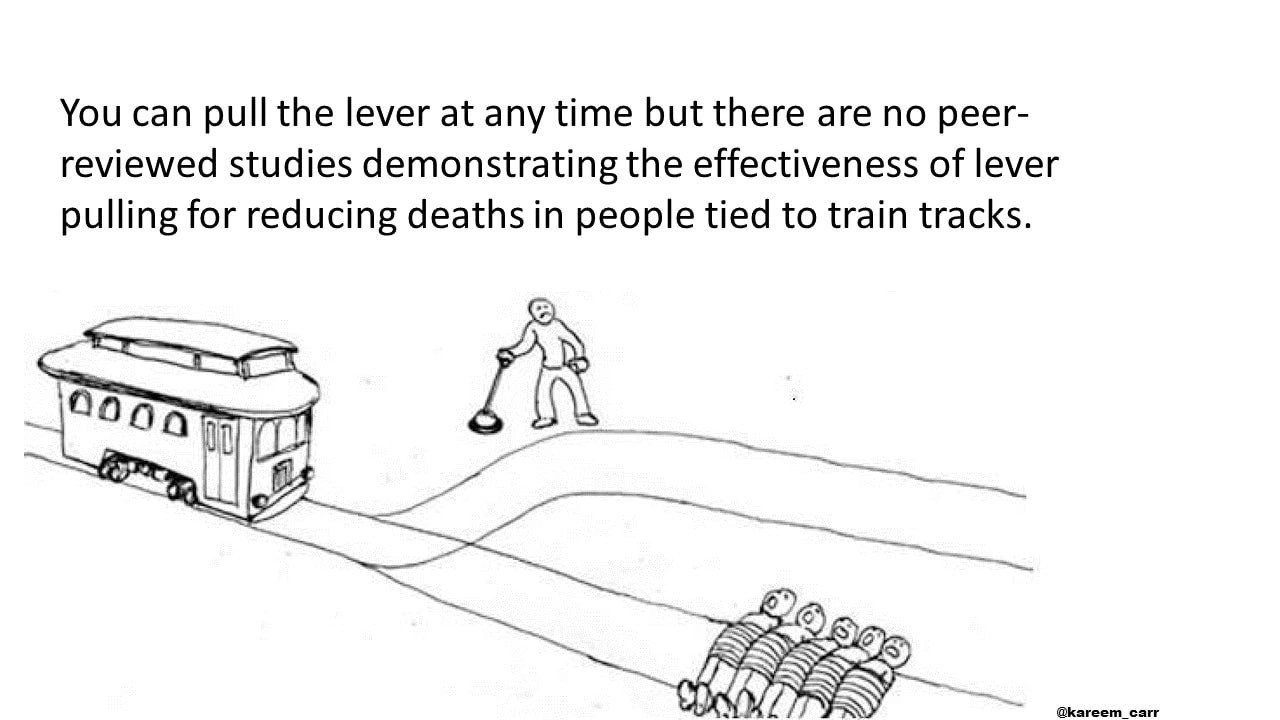
This meme is joking about exactly that kind of silly overthinking. The picture shows a man by a lever who can save people from getting hit by a train. But he’s acting like he’s not sure if he should pull it because he hasn’t seen an official report saying “pulling the lever will save people.” It’s funny because it’s obvious to everyone that pulling the lever will help. The joke is highlighting how sometimes grown-ups (like people in companies or scientists) can get so caught up in wanting proof or permission that they delay doing something obviously good. It’s like someone not eating a meal in front of them until a recipe book confirms that the food will stop their hunger. Silly, right? The meme makes us laugh because the man’s hesitation is ridiculous – we all know he should just pull the lever and help! The big message in simple terms: don’t overthink doing the right thing, especially when someone needs help right away.

Level 2: Analysis Paralysis

At this level, let’s break down what’s happening in simpler terms and clarify the jargon. The picture shows the famous trolley problem: a little cart on a railway is headed toward five people tied up on the tracks. One person is next to a track switch lever. If they pull the lever, the trolley will go onto a different track, where only one person is tied up. So the basic dilemma is: do you do nothing and let five people get hit, or do you intervene by pulling the lever which will cause one person to get hit instead? It’s a classic thought experiment about ethical decision-making – choosing between two bad outcomes, usually taught in philosophy or ethics classes.

Now, the twist in the meme is that the person by the lever is hesitant to pull it because “there are no peer-reviewed studies demonstrating the effectiveness of lever pulling for reducing deaths in people tied to train tracks.” This is a ridiculous statement on purpose – obviously pulling the lever will save lives (5 people survive instead of 5 getting killed). But the character is parodying someone who refuses to act without formal proof. They want a peer-reviewed study first.

Let’s clarify: a peer-reviewed study is research that has been checked and critiqued by independent experts before publication. It’s the gold standard in science to ensure something is valid. And Randomized Controlled Trials (RCTs) are a type of study often used in medicine or social science: you randomly divide subjects into groups, apply different treatments, and see which works better. For example, to test a new drug, you’d give it to one group, give a placebo to another, and compare outcomes. It’s a very careful way to get evidence that a cause actually has an effect. In data science and tech companies, an equivalent concept is an A/B test (also known as a split test). An A/B test is like a mini RCT on your users: you show one version of a feature to some users and a different version to others, and see which group had better results (like higher clicks or fewer errors). The idea is to be data-driven: making decisions based on measured evidence rather than gut feeling.

So why is that mentality funny or problematic here? Because the situation in the meme is urgent and clear-cut. It’s an emergency: five people will die if you do nothing. The obvious action is to pull the lever and save five lives at the cost of one life. But the joke is that the person is overthinking – they’re stuck in what we call analysis paralysis. Analysis paralysis means you’re so busy analyzing or wanting more data that you never actually decide or act, even when action is needed. In an engineering or corporate context, this happens when teams keep hesitating to make a decision because they want more data, more reports, or someone else to sign off. It’s like if a team refuses to fix a bug in production because they haven’t seen a formal report proving which line of code is definitely the cause, and meanwhile the app keeps crashing.

This meme specifically targets data scientists and managers who might insist on always having rigorous proof. It’s common in modern tech companies for managers to say “we are a data-driven organization” or “we only make decisions backed by data”. That’s generally a good principle – we don’t want to make random decisions without evidence. However, taken to an extreme, it can lead to absurd situations, like what’s depicted. Imagine if your house is on fire and the fire department refuses to act because they haven’t done a controlled experiment on whether water actually reduces house fires. That sounds silly, right? But in a less extreme form, you might have seen something similar at work:

  • DeadlinePressure: Suppose a project is clearly going to miss the deadline because of a new feature causing problems. The obvious solution is to disable that feature temporarily to meet the deadline. But the project manager might say, “Do we have data on how disabling it will impact user engagement? Let’s wait for the data science team to run an analysis.” By the time the analysis is done (if ever), the deadline has passed (like the five people on the track getting hit).
  • DataScienceHumor: Data scientists love experiments and evidence. Perhaps on your team, a data analyst might joke, “Oh, you think this UI change is better? Where’s your peer-reviewed study!” Usually that’s tongue-in-cheek to encourage testing assumptions. But here it’s turned into a dark joke: the data scientist literally wants a peer-reviewed study for something painfully obvious.
  • ManagementHumor: Managers sometimes hesitate to give a “go” decision without higher approval or proof, because they fear being wrong. This can frustrate engineers who feel, “Why are we waiting? It’s clearly the right move.” The meme highlights this by an extreme case: waiting for academic proof when immediate action is needed.

In simpler terms, the meme shows a person who won’t help because they want official proof first – which is clearly the wrong call in this scenario. It’s poking fun at how in some organizations, people act overly cautious and bureaucratic, even when common sense is screaming at them to do something. The trolley_problem context makes it funny and dramatic: lives are at stake, yet the person is acting like a clumsy bureaucrat citing lack of scientific evidence.

For someone early in their career, this might also be a gentle warning. When you’re new, you might feel you should always defer to data or seniors before acting. And certainly, you shouldn’t make reckless decisions. But sometimes, especially in emergencies or high-pressure deadlines, you have to trust basic reasoning and act quickly. The experienced folks find this meme funny because they know the pain of waiting for endless approvals or data that confirm what they already knew needed to be done. It’s exaggerating to teach a lesson: don’t let over-analysis make you fail to do the right thing.

So, to sum up Level 2: The meme is using a famous moral puzzle to illustrate analysis paralysis in tech. It’s saying “look how silly it is if someone refuses to take obvious action just because there’s no official study.” It reflects real situations in engineering teams where people delay fixes or decisions because they want more data or higher-up approval, even when it’s pretty clear what needs to happen. That’s why it’s tagged with things like DecisionMaking and DeadlinePressure – it’s about making decisions under pressure and how wrong it can go if you wait too long debating.

Level 3: Peer-Reviewed Paralysis

In this meme, data science purism collides with a classic ethical dilemma to lampoon corporate analysis-paralysis. The cartoon shows the trolley problem – a runaway trolley will kill five people on the main track unless a lone figure pulls a lever to divert it to a side track (where it would kill one person). Normally, the trolley problem is a moral puzzle about decisive action vs. tragic outcome. Here it’s twisted into a tech satire: the text says “You can pull the lever at any time but there are no peer-reviewed studies demonstrating the effectiveness of lever pulling for reducing deaths in people tied to train tracks.” This riff brilliantly skewers the data-driven decision-making culture run amok. It’s as if a data scientist or risk-averse manager is so obsessed with evidence and Randomized Controlled Trials (RCTs) that they freeze up instead of doing the obvious right thing. In real engineering terms, it’s like production servers are on fire, but leadership insists on an A/B test or formal research before using the fire extinguisher. The humor cuts deep for engineers who’ve seen teams delay critical hot-fixes or rollbacks waiting on more metrics, approvals, or a “peer review” of the solution. We recognize this absurd scenario: lives (or system uptime, or a project deadline) are at stake, yet someone in authority drones, “Do we have statistically significant proof this action will solve the problem?”

This meme exaggerates a real anti-pattern where decision-making by committee and over-reliance on data can lead to dangerous hesitation. Many senior developers and project managers (PMs) have war stories of screamingly obvious bugs that went unfixed because someone demanded exhaustive analytics first. Think of a major feature flag gone wrong in production: users are furious, five alarms ringing, but the management says, “We can’t just turn it off without data – where’s the experiment proving turning it off helps user engagement?” Meanwhile, the damage grows – just like the trolley racing toward five hapless victims. It’s dark humor because in tech, the “victims” of waiting are users, revenue, or on-call engineers’ sanity.

By referencing peer-reviewed studies and RCTs, the meme nails the peculiar mindset of some data science teams and academic-minded stakeholders who treat every change like a research publication. In scientific research, you demand rigorous evidence – e.g. you wouldn’t claim a new medicine works without an RCT proving efficacy. That’s fine for medicine, but in a fast-moving production emergency, it’s comically impractical. The lever here is a metaphor for an urgent solution (like a kill-switch, rollback, or patch) that common sense says will reduce harm. Yet the fictitious “data-driven” responder is frozen: no Jira ticket with peer review, no p-value < 0.05, so no action. It’s a paralysis by analysis.

This resonates strongly with experienced developers because we’ve seen how stakeholder expectations and a fear of making unproven decisions can derail projects. Teams become so risk-averse and metrics-obsessed that they’d rather let a bad situation continue than act without a full report. It’s a satire of companies that boast “evidence-based everything” or “data-driven culture” to the point of absurdity. In real life, waiting for perfect certainty can itself be a huge risk. The meme’s absurd logic is basically: “Sure, five people might die (or five servers might crash), but let’s not pull the lever (or hit rollback) until a peer-reviewed journal article confirms it’s effective.” This exaggeration makes us laugh and cringe because it rings true about organizational bureaucracy.

To a senior engineer, the drawing’s lever operator is that one person with power to fix the issue, much like an on-call DevOps engineer by the deploy switch. They’re hesitating not because the fix is hard, but because the process or the culture around them won’t allow acting without formal validation. The watermark “@kareem_carr” identifies the creator – a statistician known for satirical takes on data science culture – so it’s a pointed joke from within the data community. It highlights the irony that demanding perfect evidence in a crisis is itself an ethical failing: sometimes not acting is worse. Every seasoned dev understands that gut feeling when you know you should intervene, but some manager or process holds you back until it’s almost too late.

In short, the meme is darkly funny because it’s so true: in some orgs, saving the day requires navigating more red tape and “proof of effectiveness” than the urgency of the problem would seem to allow. It mocks that CYA (“cover your ass”) corporate mentality where no one wants to pull the metaphorical lever without a stack of data and peer approval in case things go wrong. After all, if pulling the lever (implementing the fix) somehow had side effects, the person who acted might get blamed – so the risk-averse strategy is to demand peer-reviewed evidence to transfer accountability. The experienced folks reading this are nodding (or facepalming) because they’ve seen things like:

Manager: “The site is crashing due to that new feature rollout.”
Engineer: “Let’s roll it back immediately.”
Data Science Lead: “But we don’t have a controlled study proving rollback will improve things. Let’s gather more data first.”

That hypothetical dialogue is essentially the meme in a nutshell, just swapping train tracks for servers. It’s the same mind-numbing frustration: watching preventable harm unfold while higher-ups wring their hands for proof. The DeadlinePressure tag is spot on – deadlines or critical outages don’t wait for academic certainty. The trolley won’t slow down while you write a conference paper about lever efficiency. This meme screams: “Do something already!**”, a sentiment every overruled engineer can relate to.

On a technical note, we can even joke in pseudo-code about this scenario:

def handle_trolley_scenario(peer_reviewed_study_available):
    if not peer_reviewed_study_available:
        # No vetted evidence yet, so we hesitate
        print("Awaiting further analysis... Can't pull lever without proven study.")
    else:
        # Evidence in hand, finally take action
        pull_lever()
        print("Lever pulled to save lives!")

In reality, by the time that peer_reviewed_study_available becomes True, it might be after the catastrophe. Analysis paralysis like this is a well-known trap in engineering management. The code above is tongue-in-cheek, but it reflects real incidents where teams delayed deploying a fix, saying “we need more data to be sure” until damage was done.

Ultimately, Level 3 readers (seasoned devs, tech leads, data scientists) appreciate this meme’s layered critique. It’s not just poking fun at data scientists in a vacuum; it’s highlighting a culture clash in tech teams: academic rigor vs. engineering pragmatism. The meme exaggerates it to a life-and-death absurdity, which is why it’s hilarious. We laugh, perhaps a bit bitterly, because we’ve all sat in that meeting where doing the blatantly right thing got delayed by someone mumbling, “But do we have enough data to justify it?”

Description

This is a two-panel meme comparing the ideal of a high-functioning Agile team with the chaotic reality. The top panel features the iconic black and red van of 'The A-Team', a symbol of a hyper-competent, well-oiled machine, with the caption: 'The cross-functional, self-organizing team described in the Agile handbook.' The bottom panel shows the cast of 'It's Always Sunny in Philadelphia', a group known for their dysfunctional, self-serving, and chaotic schemes, with the caption: 'My team arguing about story points for a button color change.' The meme humorously captures the chasm between the textbook definition of Agile and the often-messy, personality-driven reality of daily stand-ups and sprint planning sessions. It's a relatable sentiment for anyone who has seen Agile ceremonies devolve into unproductive arguments over trivial details
Comments

10
Anonymous ★ Top Pick Our team is so Agile, we've gone full circle and are back to the waterfall method, but we call it a 'sprint cascade' and use Jira to track the tickets
  1. Anonymous ★ Top Pick

    Our team is so Agile, we've gone full circle and are back to the waterfall method, but we call it a 'sprint cascade' and use Jira to track the tickets

  2. Anonymous

    PagerDuty’s melting down, five microservices are tied to the main track, and the data science guild still wants an A/B test before I flip the feature flag - apparently p-values outrank the error budget

  3. Anonymous

    This is every architecture review meeting where someone asks 'but do we have data showing that microservices actually reduce system failures?' while the monolith is actively on fire and five production services are down

  4. Anonymous

    This perfectly captures that architect who insists on a three-sprint POC, comprehensive A/B testing framework, and full observability stack before fixing the SQL injection vulnerability that's actively being exploited in production. Sometimes the lever just needs pulling, and the post-mortem can document why trains and people don't mix well - no randomized controlled trial required

  5. Anonymous

    Prod melting down? Can't hotfix without an RCT proving it reduces MTTR

  6. Anonymous

    Data‑driven org life: Ops wants to pull the failover lever; Data Science says no RCT proves lever‑pulling reduces P0s - so PM scheduled an A/B test with the control group on the main track

  7. Anonymous

    Insist on a peer‑reviewed RCT before toggling the kill switch and you’ve just converted incident response into an unauthorized human‑subjects experiment

  8. dev_meme 3y

    Can someone explain this one? I don't get it 😅

    1. @kimbasan 3y

      This is a joke about anti-vaxers. You can do something that can maybe save some lives or you can do nothing. But there is no cons to this so why you would not? Because there are no studies. This says a lot about society 👆

  9. @mpolovnev 3y

    There are no peer-reviewed studies demonstrating that explaining things in comments in the Internet makes sense.

Use J and K for navigation