Choose Your Blame Target
Why is this Communication meme funny?
Level 1: Picking A Villain
This is funny because the character is angry no matter what and just keeps choosing a different thing to blame. It is like breaking a vase and immediately yelling that it must be your sibling's fault, then the table's fault, then the floor's fault, without ever looking at what actually happened. The simple joke is that blaming feels easier than understanding.
Level 2: Blame Before Evidence
Root-cause analysis, often shortened to RCA, is the process of figuring out why a problem happened. In software, that might mean checking logs, deployment history, monitoring alerts, code changes, feature flags, database load, and communication gaps. The point is to trace the chain of causes instead of stopping at the first person or group that looks convenient.
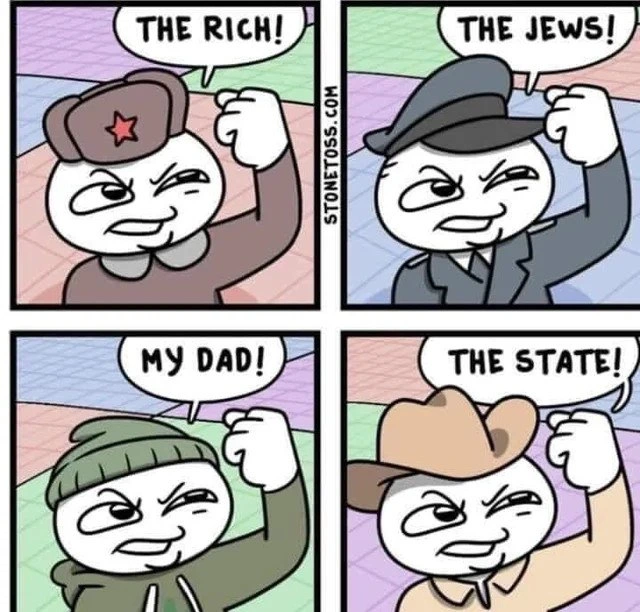
The meme shows the opposite. Each panel has the same angry expression and the same raised fist, but the costume and target change. That makes the character look less like someone discovering a cause and more like someone shopping for a cause that matches their worldview.
Blameless culture does not mean nobody is responsible. It means the team tries to learn before punishing. For newer developers, this distinction matters. If every bug hunt turns into a hunt for a culprit, people hide mistakes, delay reporting problems, and avoid risky but necessary work. If the team focuses on systems and incentives, people are more likely to surface issues early.
Level 3: Dropdown Root Cause
The four panels show the same angry character raising a fist while changing costumes and blame targets:
THE RICH! THE JEWS! MY DAD! THE STATE!
One panel uses antisemitic scapegoating, which is exactly why the comic's structure needs to be handled carefully: the visible pattern is not evidence-gathering, it is identity-first blame selection. In a developer meme corpus, the useful technical reading is root-cause analysis gone backwards. Instead of starting from symptoms, logs, timelines, and system behavior, the character starts with a preferred villain and dresses the argument around it.
That maps cleanly to bad incident culture. When production breaks, weak organizations often reach for a familiar target before the facts are assembled: "the backend team," "the vendor," "the junior dev," "the migration," "the PM changed scope," or the immortal classic, "who approved this?" This feels satisfying because blame creates a simple story. It is also how teams preserve the conditions that caused the incident in the first place.
Good blameless postmortems are designed to resist exactly this reflex. They ask what signals were missed, what safeguards failed, what incentives pushed the risky decision, and why the system allowed one mistake to become an outage. The comic's repeated face and fist make the anti-pattern obvious: the emotional posture never changes, only the label in the speech bubble does. That is not accountability; it is a dropdown menu for resentment.
The joke is uncomfortable because software organizations are full of smart people who know better and still do this under pressure. Root-cause work is slow, ambiguous, and politically inconvenient. Scapegoating is instant, emotionally cheap, and produces a meeting where everyone can pretend a lesson was learned. Somewhere, a postmortem template is weeping into its "Action Items" section.
Description
A four-panel Stonetoss-style comic shows the same angry, squinting character in different costumes, each raising a fist and shouting a different target. The top-left panel shows a Soviet-style hat with a red star and the speech bubble "THE RICH!"; the top-right shows a dark military-style cap and the speech bubble "THE JEWS!"; the bottom-left shows a green hoodie and beanie with "MY DAD!"; and the bottom-right shows a cowboy hat with "THE STATE!". The image has no code, tools, software UI, or direct developer reference. In a software-engineering corpus, its closest technical reading is about blame assignment as an anti-pattern: picking a preferred scapegoat before doing any real root-cause analysis.
Comments
25Comment deleted
It is root cause analysis where the root cause is selected from a dropdown before the incident begins.
*the state machine Comment deleted
Ew, stonetoss Comment deleted
But rich jews are the state! Comment deleted
And you're their son Comment deleted
I wish I was Comment deleted
Oh no stonetoss, cringe. Comment deleted
Haha woke devs mad over stonetoss, keep making him richer, amogus! Comment deleted
He is funny, he keeps growing every single day, you lost. Comment deleted
troll alert! this is a troll you just replied to. u mad bro? cause that's what he wants Comment deleted
what's wrong with stonetoss Comment deleted
a lot, but besides that… man literally went "woke devs mad", "keep making him richer", "you lost" obvious troll behaviour Comment deleted
don't care about the troll Comment deleted
right, stonetoss doesn't have morals or values, he just lives off of controversy and that irks me. Also the one thing he stands for is anti-trans stuff, so another negative right there. Comment deleted
based Comment deleted
Let me guess, you are trans Comment deleted
no, white straight dude with morals. Comment deleted
I forgot that existed Comment deleted
didn't know about the nft stuff, but I'm looking at some stonetoss comics, and there's zero consistency in messaging Comment deleted
peculiar Comment deleted
lmao Comment deleted
I am a troll, I wasn't trolling in those messages though. Stonetoss always has a point even when I don't agree with it. Comment deleted
You are all poor devs wasting time here lol Comment deleted
Man stonetoss used to be funny before becoming famous and going full cryptobro mode Comment deleted
absolute banger Comment deleted