Skip to content
DevMeme
4291 of 7435
The Faustian Bargain of Modern Web Frameworks
Frameworks Post #4688, on Jul 24, 2022 in TG

The Faustian Bargain of Modern Web Frameworks

Why is this Frameworks meme funny?

Level 1: When Tech Comes First

Imagine you have a magic genie who can grant you three wishes – you could ask for anything in the world! Now, picture a man whose wife is very sick in the hospital. He rushes in, super excited, and says, “Honey, I got three wishes from a magic genie!” The wife is happy and asks, “Did you wish for a cure for my illness??” That would be the normal thing to wish for, right? But here’s the funny twist: instead of wishing for a cure, the man used all his wishes to fix his computer problems. He comes back proudly holding papers that show what he asked for: basically some special computer upgrades for his favorite operating system (Linux). The wife is just staring, probably thinking “Are you serious?!”. It’s like if someone could wish for world peace or to save a life, but instead they wished for a new video game and a better phone and maybe an old toy they liked. It’s completely the wrong choice from a normal point of view, which is why it’s so silly and funny. The joke is showing how this guy cares more about his tech gadgets and computer software than something really important. In simple terms, his priorities are all mixed up – and that absurd mix-up is what makes us laugh (and maybe shake our heads). Even a child can see that saving someone’s life is more important than fixing a computer, and that obvious truth is exactly why the man’s wishes are such a ridiculous (but humorous) mistake.

Level 2: Linux Wish List

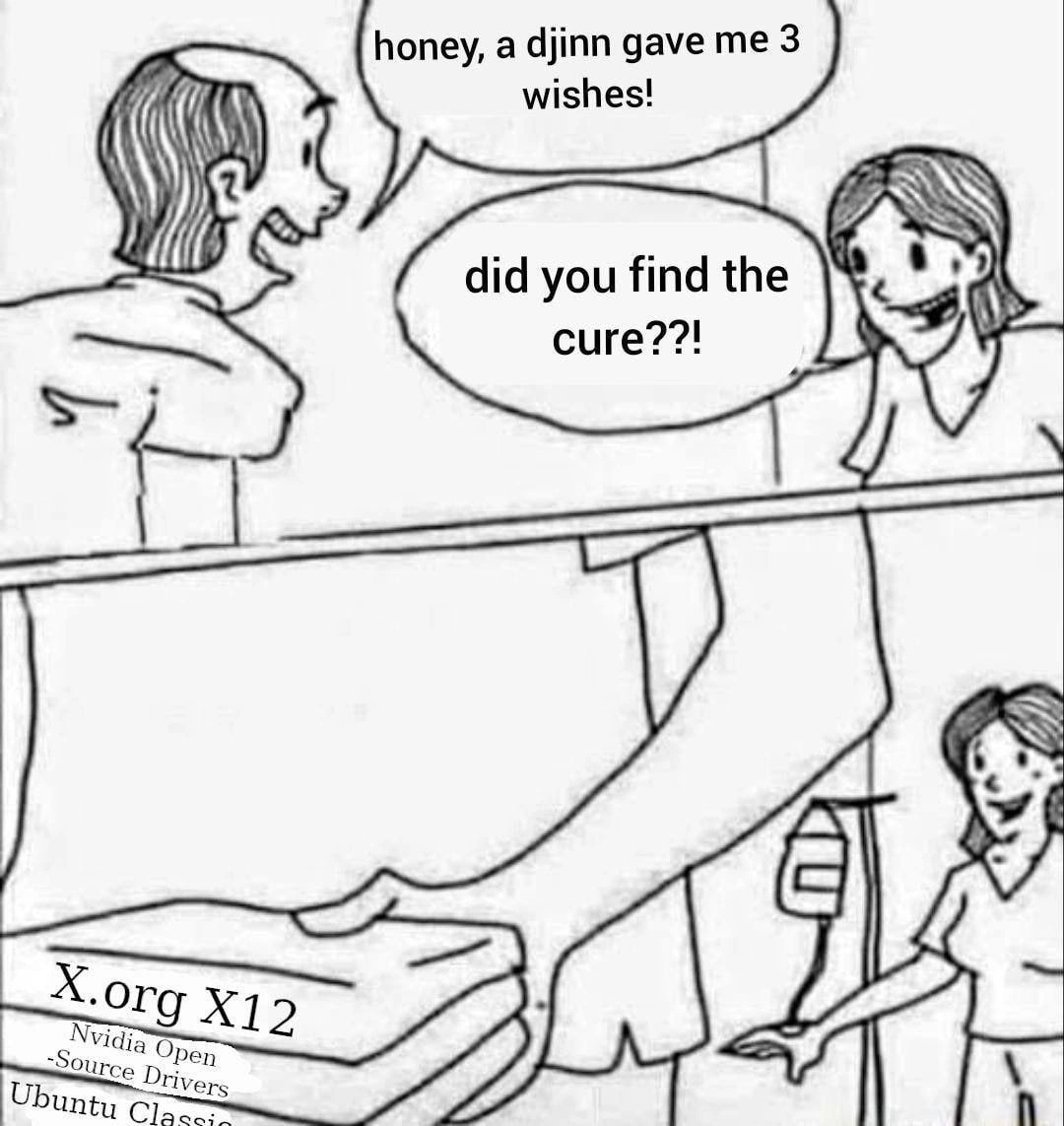
Let’s break down what’s happening in the comic and the tech terms involved. The meme is a simple three-panel comic in black-and-white, and it uses a classic setup from folklore: a genie (or djinn) granting three wishes. Here’s the scene:

  • Panel 1: An excited, balding engineer bursts into his wife’s hospital room exclaiming, “Honey, a djinn gave me 3 wishes!” A djinn is essentially a genie – a magical being that can grant wishes. Right away, the setting is emotional: his wife is in a hospital bed, connected to an IV drip. We can guess she’s very sick. The husband’s excitement implies he’s got a miraculous chance to fix everything.
  • Panel 2: His wife, looking hopeful and desperate, asks, “Did you find the cure??!” This question makes it clear she’s battling an illness, and her immediate thought is that he used one of the wishes to get a cure for her condition (like a miracle drug or healing). This is what anyone would logically expect – if your loved one had three wishes, the top priority would be to make you healthy again. The hope in her eyes is palpable: maybe their nightmare is over.
  • Panel 3: The punchline: instead of sharing a life-saving cure, the husband is proudly walking away holding a neatly folded stack of papers. Each page in this bundle has a title printed on it: “X.org X12”, “Nvidia Open-Source Drivers”, and “Ubuntu Classic”. The wife is left speechless (or just staring) as he leaves. We realize none of his three wishes went towards curing her. He spent all of them on technical projects related to his Linux computer!

Now, if you’re not familiar with these terms, let’s explain what each of those magical papers represents and why they matter to the husband (the engineer):

  • X.org X12: This refers to the X Window System, commonly just called “X” or XorgServer on Linux. X is the fundamental software that displays graphical user interfaces on Linux and UNIX systems (like showing windows, menus, cursors on your screen). The current version that everyone uses is X11 (version 11) – and it’s been that way for decades. There is no X12 in reality (at least not at the time of this meme). “X.org X12” implies a wish for a new version of this display software, something better than X11. Why would anyone care? Well, X11 is really old and has some limitations and bugs that have annoyed users for years (like things related to multi-monitor support, or how it handles high-resolution displays, or just its age showing in weird glitches). The tech world’s answer to fixing X11 has been a completely new system called Wayland, but Wayland’s adoption has been slow and not without issues (some apps didn’t work well with it initially, etc.). So, some developers half-jokingly say, “I wish X11 could just get a big upgrade instead of having to switch everything to Wayland.” X.org X12 is basically that wish – it’s like saying “I want the next generation of our display system, now.” It represents solving a big annoyance in one swoop.
  • Nvidia Open-Source Drivers: This one is about the driver software for Nvidia graphics cards (GPUs). A GPU is the part of your computer that handles graphics and displays – think of it as the engine behind all the visuals, from your desktop animations to playing videos and games. Nvidia is a major GPU manufacturer, and almost every Linux user with an Nvidia card has dealt with the driver dilemma. See, to make the GPU work well, you need to install Nvidia’s driver. But historically, Nvidia’s official drivers on Linux were closed-source (proprietary), meaning regular users and developers couldn’t see the code or modify it; only Nvidia maintained it. This is unusual in the Linux world, which is very OpenSource-oriented (Linux itself is open-source!). Using a closed driver can be problematic: if something goes wrong, the community can’t fix it; you have to wait for Nvidia. And sometimes the closed driver doesn’t play nice with the rest of the system (for example, a new Linux kernel update might not be immediately supported, causing headaches). So for years, Linux enthusiasts have wanted open-source Nvidia drivers – drivers that either Nvidia releases openly or that the community writes, so that they can be improved by everyone and included by default in Linux distributions. In fact, there is a community-made open driver called Nouveau, but it doesn’t perform as well as Nvidia’s own driver and often lacks new features. Long story short: “Nvidia Open-Source Drivers” is the wish that Nvidia’s super-important graphics software would be free for all to use, fix, and improve. That would mean fewer compatibility problems and a big philosophical win for the open-source community. For a Linux dev, this is a huge deal – it’s been a pain point for ages.
  • Ubuntu Classic: Ubuntu is one of the most popular Linux distributions (think of a distribution as a flavor of Linux – Ubuntu, Fedora, Debian, etc., each package the Linux OS with different defaults and tools). Over time, Ubuntu has introduced various changes to its user interface and system. For example, about a decade ago Ubuntu moved away from the traditional Windows-like GNOME 2 desktop and created its own interface called Unity, which not everyone liked. Later they switched back to GNOME (a newer version) and also started using Snap packages (a new way to package apps) which some people find slower or less convenient than the old method. “Ubuntu Classic” isn’t an official product (at least not at the time); it sounds like a wish for Ubuntu to go back to an earlier form – basically the classic Ubuntu experience that some long-time users fondly remember. This could mean the old desktop layout and behavior, or older ways of doing things that were changed in newer Ubuntu releases. It’s like saying “I want the old Ubuntu back, the one I’m comfortable with, without all the recent changes I dislike.” Clearly, the engineer in the meme had something he really missed about the older Ubuntu and felt it was worth a whole genie wish to get it again!

So, why are these wishes funny in context? Because each one of them addresses a technical gripe that mainly developers or hardcore Linux users care about:

  • X11 vs X12/Wayland – that’s a debate you’ll see in Linux forums and developer chats, not so much among average folks.
  • Nvidia drivers being open-source – again, that’s a concern for tech enthusiasts; most regular users don’t even know what drivers are, since on other operating systems they just silently install.
  • Ubuntu Classic – sounds like something only a long-time Ubuntu user would even understand (new users wouldn’t know the difference).

In other words, this guy used all three magical wishes on very narrow, nerdy, computer-related improvements. From the wife’s (and any ordinary person’s) perspective, those wishes are totally out of left field. She was expecting a miraculous medical cure – something truly life-changing and immediate. Instead, he returns with what are basically three IT solutions. Imagine explaining to her: “Uh, well, I didn’t cure your illness, but hey, at least we won’t have screen-tearing on Linux anymore and I got the latest Ubuntu to behave like it did 10 years ago!” It’s comical because it’s such a mismatch of priorities.

This highlights a common joke in the tech community about how developers or engineers can sometimes prioritize their tools and software issues over, say, social or personal issues. It’s an exaggeration, of course. No one would actually value a software update over a loved one’s life. But that exaggeration is what makes it funny. It’s taking the stereotype of the nerdy, tech-obsessed geek to an absurd extreme. We laugh because it’s absurd, and maybe because it scratches a truth: tech folks do get extremely passionate about seemingly trivial computer problems. You might hear developers rant for hours about a frustrating driver bug or a new update that broke their workflow, while outsiders think, “Why does that even matter so much?” This meme takes that and multiplies it by a thousand – to the point where even genie wishes are spent on those gripes. That’s the joke: the engineer’s wish list is completely out of whack compared to a normal wish list.

Another thing to note – “three wishes” memes are a little trend in online humor. They set up an expectation (usually the first wish or two are sensible or you assume they would be), and then subvert it with a ridiculous or comedic third wish (or in this case, all three are the ridiculous-but-in-a-different-way ones). Here, the format subverts our expectation immediately in panel 3. We don’t actually see him explicitly state the wishes; instead, we see the results in his hands – which is a nice visual way to reveal the gag. The neat stack of documents labeled with each wish makes it crystal clear: he confidently used each wish on these tech items. The wife’s stunned silence says it all: “I can’t believe you did that.”

From a learning perspective, this meme also casually references the ongoing evolution in Linux and open-source:

  • It hints at the transition from X11 to Wayland, a real technological shift happening in Linux desktops.
  • It references the push for open-source hardware support (like the drivers issue).
  • It touches on the idea of software forking or nostalgia for old versions (Ubuntu Classic, akin to folks preferring “classic mode” of something).

All of these are real things a junior developer might encounter as they get deeper into using Linux or participating in open-source communities. For instance, a newcomer might wonder why their Ubuntu has “Wayland” vs “Xorg” option at login, or why people complain about Nvidia on Linux, or what older Ubuntu looked like – and this meme bundles those topics into one joke. So if you’re new: yes, Linux people really do argue about display servers and drivers a lot! And as you now know, X.org, Wayland, drivers, Ubuntu – these are all parts of that ecosystem. The meme exaggerates how important they feel to those deeply involved.

In summary, at this level we see the meme as a play-by-play:

  • A husband gets a miraculous chance (3 wishes).
  • The wife expects a sensible, loving use of it (cure the illness).
  • The husband instead fixes three long-standing computer issues that have been bugging him as a developer.
  • The humor comes from understanding what those issues are and recognizing how ridiculously misplaced his priorities are. It’s a clash between real-life importance and geeky developer priorities. The term prioritization_fail tagged with the meme perfectly encapsulates it – it’s a failure to prioritize correctly, turned into a joke.

Level 3: The Prioritization Paradox

Every seasoned developer can recognize the Prioritization Fail being lampooned here. The meme humorously captures that paradoxical tendency of engineers to obsess over niche tech problems while neglecting obvious real-world needs. At its core, it’s poking fun at how our DeveloperExperience_DX wish-list can overshadow everything else – even something as critical as a medical cure for a loved one. This contrast is what makes the scenario so darkly funny and relatable within tech circles. We’ve all seen (or been) that engineer who, when faced with a genie’s three wishes, would ignore fame and fortune and instead blurt out a bug-fix or a software release they’ve been dying to see.

The three specific wishes chosen are essentially the Linux power-user’s fantasy changelog: long-awaited fixes for pain points that have caused untold frustration. To someone steeped in DeveloperHumor, each item is a wink to well-known community gripes:

  • X.org X12: This is the ultimate “what if?” for those frustrated with the state of graphical display on Linux. For years, developers have complained about X11’s kludges (screen tearing, DPI scaling issues, the complexity of Xorg.conf configuration, etc.) while also complaining about the rough edges of its would-be replacement, Wayland (like lack of mature remote desktop or issues with certain GPU drivers). The wish for “X.org X12” is basically saying: “I wish we could skip all these half-fixes and debates and just have a perfect new X server now.” It’s a wistful dream that acknowledges how slow-moving and contentious progress in the display server realm has been. Long-time Linux users recall things like manually editing /etc/X11/xorg.conf with fingers crossed, or encountering the dreaded “black screen” after a graphics driver update. This wish being first shows just how pressing these display headaches feel to the engineer – he’d literally rank that above everything. Seasoned devs chuckle (and maybe wince) at this because messing with the display server or GPU drivers at 2 AM is a rite of passage. It’s a source of war stories: “I updated my Nvidia driver and X wouldn’t start, spent the whole night in TTY fixing it.” No wonder the meme’s hero uses wish #1 to banish those demons for good.
  • Nvidia Open-Source Drivers: This is a direct nod to a saga in the OpenSourceSoftware world. Anyone who’s maintained a Linux system with an Nvidia GPU knows the drama: the proprietary nvidia driver offers performance but can be a headache – kernel updates that break it, license incompatibilities, lack of insight into what it’s doing, and the philosophical unease of tainting your open-source system with a closed blob. The community’s yearning for open-source Nvidia drivers has been so strong that it often felt like wishful thinking. People joke on forums, “Maybe we need a djinn to get Nvidia to open their drivers.” Well, here it is literally! Experienced devs laugh because it rings true: it did take ages and a lot of pressure for Nvidia to even start open-sourcing parts of their driver (a milestone that actually happened around the time of this meme, to collective astonishment – truly a “ pinch me, am I dreaming?” moment in open source culture). By using a precious wish on this, the meme underscores how big of a deal it is for Linux folks. It’s as if to say, we’d sacrifice a miracle cure if it meant never having to deal with proprietary driver pain again. That’s an absurd trade-off, but if you’ve ever been stuck on a blank screen after a botched driver install while your deadline looms, you almost understand the sentiment. This is the driver_hell many Linux devs joke about: like a never-ending boss battle with GPU firmware and module incompatibilities.
  • Ubuntu Classic: To a senior dev, this phrase evokes a nostalgia-laden chuckle. It hints at “the good old days” of Ubuntu, reflecting a common trope in tech where veterans yearn for the simpler, more stable setups of yesteryear. Maybe it’s Ubuntu before Unity and Snap packages – when GNOME 2 (“classic” GNOME) was default and everything felt more predictable. It’s the sort of thing an old-school sysadmin might sigh about: “Back in my day, Ubuntu just worked differently… I wish we could have that back.” There’s irony here: Ubuntu, known for trying to be user-friendly, stirred quite a few controversies with its changes (remember the Unity desktop that no one asked for, or the recent push of Snap which some find cumbersome?). The wish for “Ubuntu Classic” shows that this engineer not only cares about big systemic fixes (like graphics drivers and servers) but also about the finer details of his daily environment – his distro’s look and feel. It’s a comfort wish, the tech equivalent of “I want my blankie back.” Senior devs see themselves in this too. We all have a technology or tool we adored which later got revamped or killed off, leaving us grumbling. Maybe it was a beloved text editor plugin, a command-line tool, or an entire OS interface. The meme captures that curmudgeonly streak in seasoned developers: if only we could wish away the new quirks and get our familiar setup again!

Now, the comedic genius of this meme is how it subverts expectations using the classic “three wishes” setup. In fairy tales, a genie’s three wishes are synonymous with ultimate opportunity – curing illnesses, ending war, becoming rich beyond measure. The second panel even voices the audience’s expectation: “did you find the cure??!” – the ailing wife assumes (quite reasonably!) that her engineer husband would use such limitless power to wish for her health. That hopeful question represents the normal world’s priorities. But the punchline (panel 3) delivers the punch: the husband proudly walks away with solutions to tech problems instead, completely oblivious to the shocked (or utterly disappointed) expression of his wife still lying in the hospital bed. This mismatch is hilarious to those of us in the know because it’s a caricature of a truth: developers can be so tunnel-visioned on technical issues that they lose sight of the “big picture.” It exaggerates that stereotype to an absurd extreme. The OpenSourceCulture enthusiast in him couldn’t resist fixing Linux over fixing life.

There’s also a bittersweet truth under the humor that seasoned devs might appreciate: sometimes engineers focus on what they know how to solve rather than what really needs solving. In real life, a software developer might not have a clue how to directly cure an illness (that’s outside his domain), but he does know how to address software problems. Give him unlimited power, and he tackles what’s familiar – even if it’s the wrong priority. It’s a satirical reflection on our tendency to treat everything as a nail because all we have is a hammer (or in this case, treat everything as a code problem because all we have is code). The meme exaggerates this to the max: a life-threatening issue is right there, but hey, those GPU drivers were such a nightmare that they felt just as urgent in his mind! It’s dark comedy, sure, but it resonates with developers who have caught themselves fixing a server config at 3 AM while ignoring sleep, health, or social life. Priorities get weird in crunch time or passion projects – and here it’s depicted in the most extreme, face-palming way possible.

Another inside joke is how hyper-specific the wishes are. This isn’t just “make Linux better” in a vague sense; it’s three line items that read like a nerdy Christmas list. Only devs would immediately appreciate why each of those is gold. In a way, the husband did cure something – he cured long-standing bugs and headaches in his computing world. That’s the paradox: from a purely tech viewpoint, he used the genie wisely to achieve miracles of software development. He basically made three miracle pull requests to reality. But from any broader human perspective, it’s an outrageous misuse of genie-given omnipotence. This disconnect generates a mix of laughter and an “OMG, that’s so wrong” feeling – a hallmark of good developer humor. We laugh because it’s a caricature of ourselves – we know we sometimes care too much about the tech minutiae.

Lastly, consider the timing: posted in mid-2022, when the Linux community actually was buzzed about Nvidia’s surprising move to open source their drivers (something many thought would never happen). So the meme tapped into that real-world context – one of these “wishes” had partially come true, which made the other two feel even more tantalizing. X11 was (and is) still around, Ubuntu had just turned 18 years old with many changes over its life – so the meme’s wish list felt current and cathartic. It’s as if the meme is saying, “We got one wish in real life, imagine if we had two more!” This layered understanding – technical history, community dreams, and the absurd priority swap – is what senior devs chuckle at. We find it funny because it’s painfully true that engineers might dream of a world with perfect drivers and display servers, sometimes more vividly than dreaming of world peace. The meme holds up a mirror, and with a grin and a wince, we recognize the reflection.

Level 4: X Window Wizardry

At the deepest technical layer, this meme summons the ghosts of the Linux display stack – an arcane corner of OperatingSystems engineering that many have battled. The mention of X.org X12 hints at a mythical successor to the venerable X Window System (currently at X11). X11 has been the core graphical server on UNIX and Linux since 1987, providing the network-transparent, client-server GUI infrastructure underlying desktops. But X11 is ancient in tech terms – loaded with decades of extensions and quirks. A true X12 would imply a ground-up modernization of X11’s architecture (perhaps cleaning up inefficiencies, security issues, and outdated concepts) while preserving its powerful features. In reality, no X12 was ever released – instead, the Linux world placed its bets on Wayland, a completely new display protocol aimed at replacing X. Wayland simplifies many of X’s legacy complexities (eliminating the need for a separate X server and reducing round-trip latency by letting apps talk to the compositor more directly). Yet here our engineer wishes for “X.org X12,” implying a wish to bypass Wayland and directly evolve X11 into a new version. It’s almost like wishing for a magical fork of the display server that fixes all of X11’s problems without the growing pains of switching to Wayland. This is deep Linux wizardry: it touches on graphical subsystem design, protocol vs. implementation, and the tension between backward compatibility and innovation. The joke digs into that Wayland vs XorgServer debate in the OpenSource community – some devs half-jokingly dream that a genie could deliver a perfect X12 so they wouldn’t have to wrestle with Wayland’s niggling incompatibilities or X11’s aging design.

Another layer of technical wishcraft here is the Nvidia open-source drivers. This has been a holy grail in OpenSourceCulture for years. Modern GPUs are incredibly complex hardware, and their drivers (the software that lets the operating system talk to the graphics card) have two halves: a kernel-space part (managing memory, scheduling GPU tasks via the kernel’s Direct Rendering Manager (DRM)) and a user-space part (the OpenGL/Vulkan implementation, shader compiler, etc.). Nvidia’s official Linux driver historically is a proprietary binary blob that plugs into the kernel – a closed source module not maintained by the community, often leading to kernel update headaches and a philosophical rift with Linux’s open ethos. There is an open-source community driver called Nouveau, but it’s developed via reverse-engineering and lacks performance and feature parity (think limited power management, or being perpetually behind on supporting new GPU models). The wish for open-source Nvidia drivers imagines an alternate reality where Nvidia fully opens their driver code. This would be like unlocking a treasure chest of GPU internals: allowing integration directly into the Linux kernel source tree, enabling the community to fix bugs, optimize performance, and inspect exactly how the hardware is managed (no more black-box magic). It’s an enormously complex wish – akin to rewriting or releasing tens of millions of lines of highly optimized, hardware-specific code. Such a move would involve not just technical feats but legal and business hurdles (Nvidia’s drivers contain patented tech and secrets). In fact, the call for open-source Nvidia drivers has been a rallying cry in forums and bug trackers for over a decade. It was long thought so unlikely that jokingly, only a genie’s wish could achieve it. (Amusingly, around mid-2022, reality inched closer: Nvidia did begin open-sourcing parts of their driver – perhaps the genie was listening after all!)

Finally, Ubuntu Classic is the third magically granted item – a bit less about hardcore theory and more about developer comfort and nostalgia. Ubuntu is a popular Linux distribution, and over the years it has changed quite a few things that some developers weren’t thrilled about. “Classic” likely alludes to an earlier era of Ubuntu that many veteran users romanticize. This could mean the return of the old GNOME 2 desktop environment (from before Ubuntu switched to the Unity interface in 2011 or later to GNOME 3), or doing away with newer packaging systems (like Snap) in favor of the traditional apt repositories. Essentially, it’s a wish to restore familiar simplicity and stability – the feeling of the “good old days” of Ubuntu. On a technical level, such a wish hints at reversing or forking significant design decisions: imagine reintroducing a full old desktop stack or maintaining a parallel “classic” edition with older tech. It digs into the challenges of DeveloperExperience_DX and user interface design: sometimes new isn’t always welcome in the developer community, especially if it complicates workflows or performance. Ubuntu Classic could also imply the resurrection of deprecated components that are considered more reliable or lightweight by some (for example, Xorg instead of Wayland on Ubuntu, or older init systems, etc.). There’s deep technical context here in how operating systems evolve: every new generation (like Unity, Wayland, Snap packages) can leave a faction of power-users missing the previous generation’s behavior. A genie granting “Ubuntu Classic” suggests circumventing all the modern changes and officially supporting a throwback edition — a massive undertaking considering the maintenance of an entire distro fork. It’s the kind of desire that stems from real technical friction: for instance, some devs still prefer MATE desktop (a continuation of GNOME 2) for its responsiveness, or avoid Snap packages due to performance/compatibility concerns.

In summary, Level 4 reveals that each “wish” corresponds to resolving a longstanding, non-trivial technical problem in the Linux world:

  • X.org X12 would be a monumental project to overhaul fundamental graphics infrastructure (or a wish to magically have it done without the sweat).
  • Open-source Nvidia drivers break open a complex proprietary ecosystem for community benefit, a feat half-technical, half-political in nature.
  • Ubuntu Classic undoes years of OS evolution to return to a beloved baseline, touching on software forking and maintenance at scale.

From an advanced perspective, the humor comes from the sheer nerdiness and ambition of these wishes. Each one represents a deep rabbit hole of design trade-offs and historical baggage in computing. They’re the kind of changes that engineers discuss in manifesto-like blog posts or endless forum threads. Seeing them neatly solved by genie magic is both absurd and alluring. It satirizes how in tech, some problems feel so stubborn that we joke only supernatural intervention could fix them. The meme’s genie isn’t summoning fun toys or trivial hacks – he’s granting resolution to decade-spanning open-source challenges. This is wish-fulfillment at the architecture level. And ironically, to a hardcore Linux dev, these might genuinely seem more exciting (or at least more achievable!) than, say, instantly curing a disease – which is exactly the comedic disconnect the meme exploits.

Description

This meme uses the 'Trade Offer' format, where a well-dressed man offers a deal. The offer is structured in two parts. Under 'I receive:', the text says, 'You don't have to write SQL by hand.' Under 'You receive:', it says, 'A 1,200-page documentation, a byzantine query abstraction layer, and N+1 query problems.' The meme humorously captures the trade-offs involved in using complex abstractions like ORMs (Object-Relational Mappers). While they promise to simplify database interactions, they often introduce their own layers of complexity, performance issues, and a steep learning curve. It's a relatable sentiment for experienced developers who have been burned by the 'magic' of such tools and appreciate the simplicity and control of writing raw SQL
Comments

25
Anonymous ★ Top Pick The ORM is great for getting started. But eventually, you'll find yourself spending three days trying to convince the abstraction to generate a simple SQL query that you could have written in three minutes
  1. Anonymous ★ Top Pick

    The ORM is great for getting started. But eventually, you'll find yourself spending three days trying to convince the abstraction to generate a simple SQL query that you could have written in three minutes

  2. Anonymous

    After two decades of Xrandr roulette, my backlog says an open-source NVIDIA driver and a sane X12 are P0s - curing cancer is still labeled “nice to have.”

  3. Anonymous

    After 20 years in the industry, I've debugged distributed systems at scale, migrated petabytes of data, and survived three major rewrites... but getting NVIDIA Optimus to work properly on Linux? That's when I seriously consider if those three wishes should just be 'make X11 forward compatible', 'stable proprietary drivers', and 'Wayland that actually works with everything'

  4. Anonymous

    After 20 years in the industry, I've learned that successfully configuring Nvidia drivers on X.org is less about technical skill and more about ritual sacrifice. The djinn clearly understood that 'finding the cure' for Linux graphics configuration would require divine intervention - because no amount of modprobe blacklisting, xorg.conf tweaking, or kernel parameter incantations has ever made it 'just work.' The real tragedy? By the time Wayland becomes universal, we'll have a whole new generation of driver nightmares to wish away

  5. Anonymous

    Three wishes? X.org X12, NVIDIA open‑source drivers, and Ubuntu Classic - because after two decades of Linux, curing mortality sounds easier than getting Wayland to play nice with a proprietary GPU blob

  6. Anonymous

    Three wishes? Nah, just one NVIDIA driver install on Ubuntu summons kernel panics that'd make a COBOL mainframe blush

  7. Anonymous

    Give me three wishes and I’ll spend them on X.org X12, NVIDIA drivers that upstream GBM instead of EGLStreams, and an Ubuntu Classic LTS - because stabilizing desktop Linux graphics ABI politics is harder than most medical miracles

  8. @AmirhosseinDotZip 3y

    ooooh harsh

  9. @s2504s 3y

    Great)

  10. @feedable 3y

    Wayland is X12

  11. @UQuark 3y

    Krita gang 💪

    1. @sylfn 3y

      they should've told about it...

  12. @SamsonovAnton 3y

    Nvidia drivers and much more are open-source for some time already — thanks to a hacker leak.

  13. @SamsonovAnton 3y

    He knew how to draw a circle in GIMP, didn't he? So why did he break and cry?

  14. @MrZarei 3y

    djinn 😂😂

  15. @glatavento 3y

    so what is ubuntu classic?

    1. Deleted Account 3y

      me too🥲

    2. @RiedleroD 3y

      maybe Ubuntu before all the modern bloat? (snap, flatpak, electron system apps, js cursor movement…)

      1. @NevermindExpress 3y

        js cursor? wtf!?!?

        1. @RiedleroD 3y

          They've said it in some changelog between 19.04 and 20.04 where they fixed a lot of other performance issues, but I can't find it anymore…

          1. @zefirfox91 3y

            That's because JavaScript cursor was in Gnome3

      2. @chupasaurus 3y

        It's called Debian

  16. @glatavento 3y

    never heard of that before

  17. Deleted Account 3y

    metacity maybe?

  18. 𝙳𝚖𝚢𝚝𝚛𝚘 𝙼𝚒𝚗𝚝𝚎𝚗𝚔𝚘 3y

    everyone who liked this is a Ukrainian (like me)

Use J and K for navigation