Graph theory's greatest nemesis
Why is this CS Fundamentals meme funny?
Level 1: When the Impossible Happens
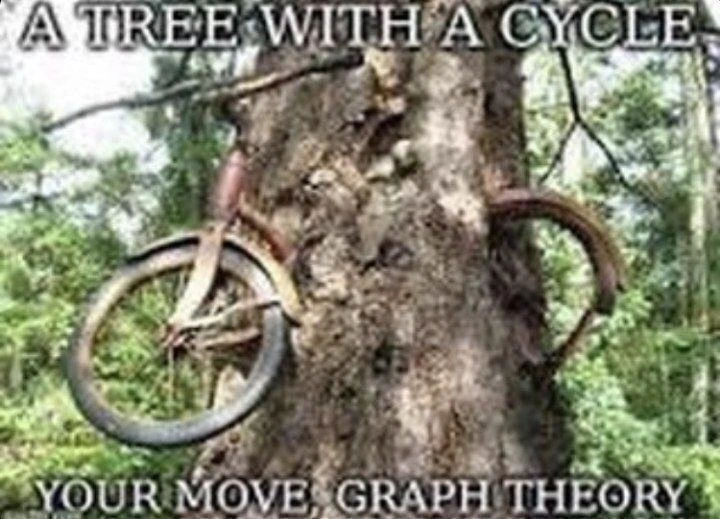
Imagine your teacher says, “By definition, a fire can’t be wet.” Everyone agrees – fire is the opposite of wet. Now picture a campfire that someone somehow made wet (which should be impossible) and then saying to the science teacher, “Your move, science.” 😄 This meme is doing the same kind of thing but with computer science words. A tree in everyday life is a plant, and a cycle is short for bicycle. Normally, trees don’t contain bicycles (that’d be pretty silly, right?). In computer science, a “tree” is a structure that, by rule, has no loops, and a “cycle” means a loop. So saying “a tree with a cycle” is like saying “a never-looping thing with a loop in it” – it just can’t happen by definition. That impossibility is exactly why it’s funny. It’s like seeing a dog that meows or a bird that swims underwater with gills – it breaks the expectations in a playful way. The text in the picture basically jokes, “Okay, smarty-pants rule-makers, explain this one!” Of course, it’s just a visual pun (the tree grew around a bike over time), but it makes us laugh because it’s a goofy mix-up of concepts. You don’t need to know hard math to get the chuckle: it’s funny because it shows something that shouldn’t exist, yet here it is in front of your eyes, being cheeky with the laws of computer science.
Level 2: Trees & Cycles 101
Let’s break down the joke in simpler terms. In computer science fundamentals, a graph is a way to represent things and their connections – think of a social network (people as nodes, friendships as edges) or a map (cities and roads). A tree is a special kind of graph structure that looks like a hierarchy: it has one root node at the top, and branches out with no loops or backtracking. For example, your family tree or the folder directory on your computer are tree-structured – there’s a strict parent/child relationship, and nothing circles back. In graph terms, acyclic means “no cycles,” i.e., no way to start at one point, follow connections, and return to where you began without retracing steps. A cycle in graph theory is basically a loop – like if Friend A knows Friend B, Friend B knows Friend C, and Friend C knows Friend A, you’ve made a cycle. Normally, a tree can’t have a cycle; if it does, it’s no longer called a tree but just a “graph” (or a messed-up tree!).
Now, the meme shows a huge real-life tree (the kind that grows in a forest) and it has an old bicycle literally stuck through its trunk. The top text says “A TREE WITH A CYCLE.” This is a play on words: “cycle” refers to the bicycle, but in computer science a cycle also means a loop in a graph. So they’ve created an impossible scenario: a tree (which should have no cycles) that has a cycle. The bottom caption “YOUR MOVE, GRAPH THEORY” is basically taunting the rules of computer science: “Hey math gurus, explain THIS!” Of course, graph theory doesn’t actually get stumped by a bike in a tree – it’s just a silly visual pun. But if you’ve learned about data structures like linked lists, trees, and graphs, you probably did an exercise or two on cycle detection (for instance, finding a loop in a linked list or avoiding infinite recursion in a hierarchy). That’s why this is ComputerScienceHumor gold: it takes a textbook definition from CS class and turns it into a goofy picture. Even if you’re new to these terms, you can chuckle at the absurdity: it’s like saying “I found a square circle.” It’s a lighthearted poke at how strict definitions can be subverted in a joke.
Level 3: Cycle Detected in Tree
Every seasoned developer and CS student can appreciate why this image is hilarious. It’s taking a core concept from data structures – trees are acyclic – and turning it on its head, literally sticking a cycle into a tree. In day-to-day coding, if you ever got a “cycle detected” error or an infinite loop when traversing a structure that was supposed to be a tree, you know something’s horribly wrong. Trees are meant to have a strict hierarchy (like your file system or a JSON config): no element should loop back to an earlier one. A cycle in a tree data structure is the stuff of debugging nightmares, often leading to infinite recursion or memory leaks. This meme riffs on that with tongue-in-cheek literalism. The big mossy tree trunk with a rusty bike half-embedded is Mother Nature’s little joke: an actual tree that “grew” a cycle. It’s as if the universe itself introduced a bug into the forest’s data structure. The top text shouts “A TREE WITH A CYCLE,” immediately signaling the graph theory pun. The bottom text, “YOUR MOVE, GRAPH THEORY,” is the punchline, as if challenging computer scientists to make sense of this violation of the rules. This resonates with developers because it echoes that gotcha moment when reality doesn’t match our neat theoretical models. We’ve all been there: maybe you designed a pristine class hierarchy (a tree of classes), and then some requirement forced a hack that introduced circular references. Suddenly your elegant tree became a tangled graph, and your algorithms screamed in protest. Algorithm humor often comes from these shared “oh no” scenarios – here the meme pre-empts that by showing a violation so blatant it can only be a joke. It’s a reminder that while our CS definitions are iron-clad on paper, the real world (or a crafty memer) can always find a way to bend the rules for a laugh.
Level 4: Graph Theory Loophole
In graph theory (a branch of discrete mathematics), a tree is rigorously defined as a connected, acyclic graph. Formally, that means if you have n nodes (vertices) in a tree, you’ll always have n-1 connections (edges) and absolutely no closed loops. Add just one extra edge, and you inevitably create a cycle (a round-trip path that starts and ends at the same node). This meme exploits that fundamental rule by presenting a literal tree (the kind with bark and branches) that contains a literal cycle (a bicycle). It’s a playful mathematical oxymoron: a structure that by definition cannot contain a cycle, now does. The humor clicks for those who know their CS fundamentals – it’s like encountering a proof by contradiction in visual form. Graph theorists might jokingly clutch their pearls at this sight, because a “tree with a cycle” breaks one of the simplest inviolable laws of graph theory. The text “YOUR MOVE, GRAPH THEORY” dares the laws of math to handle this absurd scenario. It’s as if someone found an edge case (pun absolutely intended) that challenges the theoretical framework. In reality, of course, no theorem is actually broken here – we just have a clever visual pun. But for the initiated, it conjures thoughts of cycle-detection algorithms throwing errors, and the ghost of Euler raising an eyebrow at this arboreal paradox.
Description
The image displays a photograph of a large, mature tree in a forest setting. Over time, the tree has grown around an old, rusty bicycle, with the front wheel visible on the left side of the trunk and the rear frame emerging from the right, making it seem as though the tree has swallowed the bike. Superimposed over the image in a pixelated, bold white font are the words: 'A TREE WITH A CYCLE' at the top, and 'YOUR MOVE, GRAPH THEORY' at the bottom. The humor is a sophisticated pun that requires knowledge of computer science or discrete mathematics. In graph theory, a 'tree' is a fundamental data structure defined as a connected graph that has no 'cycles' (a path that starts and ends at the same node). The meme playfully contradicts this strict mathematical definition by presenting a literal, biological tree that clearly contains a 'cycle' (a bicycle). The taunt 'YOUR MOVE, GRAPH THEORY' humorously challenges the formal system with a messy, real-world exception, delighting engineers who appreciate the intersection of abstract concepts and literal wordplay

Comments
7Comment deleted
This is what happens when you try to model the real world with perfect data structures. You end up with a memory leak in the form of a bicycle
Leave a “clean” dependency tree in production for a decade and you don’t just get bit-rot - you get an actual cycle, and of course it’s attached to the bikeshed
After 20 years in the industry, I've finally found the one edge case Dijkstra's algorithm can't handle: when your spanning tree literally spans a Trek mountain bike and the cycle detection takes 30 years of bark growth to complete
This is what happens when you forget to implement cycle detection in your tree traversal algorithm - nature just goes ahead and creates a literal cycle in your tree structure. Graph theorists everywhere are frantically updating their proofs to account for this edge case where a tree can indeed contain a cycle, as long as you're willing to wait 50 years and involve actual wood. Turns out the real O(n) complexity was the friends we made along the way... and the bicycle we left chained to that sapling in 1972
Basically our ‘dependency tree’ - architects call it a tree, Tarjan calls it one giant SCC
Cycle dependency in a tree structure - nature's unpruned merge conflict
A tree with a cycle - exactly how our dependency DAG looked after the temporary bidirectional call; topological sort quit and paged on-call