Software engineering: expectations vs. spaghetti
Why is this CodeQuality meme funny?
Level 1: Tangled Noodles
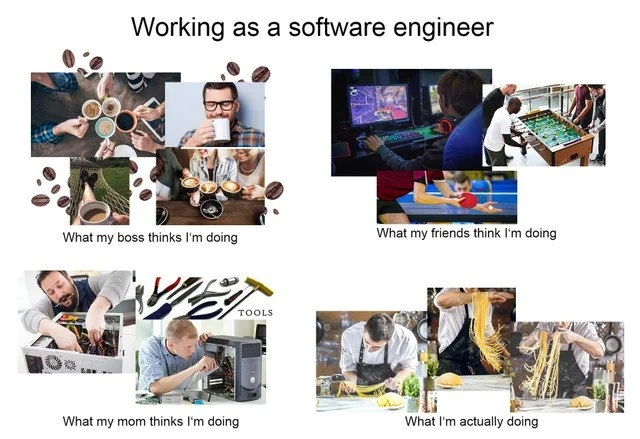
Imagine everyone thinks you’re doing something completely different from what you really do. It’s like your boss thinks you’re a fancy chef making beautiful cupcakes all day. Your friends think you’re just playing video games and ping-pong at work. Your mom thinks you spend your time fixing broken gadgets with a screwdriver. But what are you actually doing? You’re trying to untangle a giant bowl of spaghetti! In other words, your real work is super messy and confusing – like a big knot of noodles that you have to sort out – even though everyone else pictures you doing something neat, fun, or simple. That contrast between what they imagine and the messy reality is what makes it funny. It’s saying: “People think my job is easy or cool, but actually it’s a big tangled mess – and I’m the one stuck cleaning it up!”
Level 2: The Code Kitchen
Let’s break down the meme in simpler terms and clarify what’s really going on in each frame. Each picture shows what different people think a software engineer is doing, versus what the engineer is actually doing. It’s all about perception vs reality:
What my boss thinks I’m doing: The boss sees a team of baristas pouring perfect lattes with latte art. This is a metaphor for doing work elegantly and smoothly. In the boss’s mind, a software engineer’s day is spent crafting something beautiful with ease – taking requirements and quickly turning them into a polished product, kind of like making a fancy coffee drink. The scattered coffee beans and perfect foam heart symbolize creativity and high quality. In reality, bosses often expect their engineering teams to deliver features as reliably as a coffee shop delivers coffee: they request something and soon it’s ready, looking great. They’re not thinking about any messy code behind the scenes. Essentially, the boss thinks we’re performing a neat craft, painting in code with artistic flair and no mess. They imagine a well-oiled process with maybe some “secret sauce,” but mostly straightforward.
What my friends think I’m doing: Friends picture me in a fun startup environment, gaming in a dark room and playing foosball with coworkers. This comes from the stereotype of tech companies where offices have game rooms, consoles, ping-pong or foosball tables, and people sometimes play during breaks. Many non-tech friends hear about perks at companies like Google or a cool startup and assume we’re playing video games at work or lounging around. The image has a person at a PC with a game on screen and others at a foosball table. To my friends, being a programmer means a super relaxed job: coding a little, then goofing off a lot, almost like a college dorm atmosphere. They think my daily routine is essentially hanging out and having fun with a bit of typing in between. This is a common outside view of developer life – that it’s all flexible hours and office Nerf gun fights.
What my mom thinks I’m doing: My mom imagines me as a computer technician, physically fixing computers. In that image, a guy is using screwdrivers and tools to assemble or repair a desktop tower, with a bunch of hardware tools on the wall. Many parents, especially if they aren’t familiar with the tech industry, don’t really know what writing software looks like. So they assume software engineer means general computer expert. In mom’s eyes, I spend my day opening up PCs, swapping out parts, setting up equipment – basically doing IT support or hardware repair. This is a common misunderstanding: family members often ask us to fix their laptop or set up their printer, because they think our job involves making computers work. Mom might say, “You work with computers all day, so can you fix mine?” She isn’t picturing me writing code or designing systems; she pictures something tangible she understands, like fixing electronics.
What I’m actually doing: I’m writing and dealing with “spaghetti code.” The last image – chefs tangled up in long strands of pasta – is a funny metaphor for the reality of my job. “Spaghetti code” is a term programmers use to describe code that is a big mess: it’s all tangled, unorganized, and hard to understand, just like a pile of spaghetti noodles. When code is written quickly without much planning or when many people modify a project over time without cleaning up, it can turn into spaghetti code. That means if you try to follow the code, you keep running into knots and loops and surprises, like trying to pull one noodle out and getting a whole clump. In my actual daily work, I often spend time debugging, refactoring, and trying to untangle confusing code. Instead of doing something obviously cool or visually neat (like making latte art or playing games), I’m usually staring at a screen full of text (code) trying to find out why something broke or how to add a new feature without everything collapsing. It can be frustrating and not at all glamorous. The phrase technical debt comes up here: that’s when a team chose a quick-and-dirty solution in the code (to meet a deadline or because of oversight), and now we “owe” extra work to fix it properly later. Spaghetti code is basically technical debt that’s come due – a bunch of messy code we have to clean up eventually.
So, the meme is showing the misaligned expectations versus reality. My boss, friends, and mom each have a very different idea of what a software engineer does all day, and none of those ideas match what I really do. The joke is that while everyone else imagines either a very organized or very fun job, the truth is I’m often wrestling with chaotic code. It’s a relatable joke among programmers because many of us have experienced people misunderstanding our work. We chuckle at it because, well, it’s true – outsiders have these perceptions (fancy craftsman, laid-back gamer, hardware fixer), but we often feel more like a stressed chef untangling a giant bowl of pasta code. This is an example of developer humor where the punchline is “Actually, it’s spaghetti code madness in here.” Each of those first three views has a bit of truth (we do try to craft good products, sometimes there are fun moments at work, and yes we understand computers), but they’re exaggerated and mostly off-target. The reality panel is exaggerated too (we’re not literally throwing pasta), but it accurately conveys the feeling: confusion, mess, and struggle to keep code organized.
In summary, the meme uses those four images to contrast perception vs reality for a software engineer’s job: the boss expects smooth quality output, friends think it’s a fun time with gadgets, mom thinks it’s hands-on fixing computers, but in reality a lot of time we deal with messy code (spaghetti code) and have to sort it out. It’s funny to us because it’s a bit too close to the truth. We laugh, then sigh, and get back to cleaning up the codebase.
Level 3: Between Lattes and Spaghetti
This meme hits home for any seasoned developer because it highlights the hilarious (and painful) gap between stakeholder expectations and the coder’s reality. It’s structured as a classic “what people think I do vs what I really do” comparison, tailored to a software engineer’s life – a trope in developer humor that never gets old because it’s so relatable. Each of the four panels represents a different misconception about our job:
Boss’s illusion: “What my boss thinks I’m doing” – The boss imagines the dev team as a well-oiled barista crew crafting artisanal lattes. In other words, management envisions software development as a smooth, almost artistic process of delivering features. The lattes and coffee art symbolize something done with precision, creativity, and seemingly effortless flair. From a high-level corporate perspective, coding might look like a refined craft: you take quality ingredients (requirements), follow a recipe (the project plan), and voilà – you serve up a perfect product, maybe with some fancy latte art (polished UI) on top. This reflects a bit of CorporateCulture ignorance: many managers or non-technical stakeholders think implementing a new feature is as straightforward as pouring a cup of coffee, assuming every line of code we add is neatly contained like coffee in a cup. They’re not picturing the TechDebt under the hood – only the polished surface. In reality, of course, we might be scrambling behind the counter, desperately hacking around a broken espresso machine (i.e., a brittle legacy system) to get that cup out. The boss’s perception glosses over the grungy details of development; they see only the final presentation. It’s similar to how a beautifully plated dish doesn’t reveal the chaotic, sweaty kitchen that produced it. Sure boss, we’re just calmly pouring lattes over here – pay no attention to the kitchen fire in the back.
Friends’ fantasy: “What my friends think I’m doing” – Friends often believe a software engineer’s day is basically a paid gaming session in a cool startup office, punctuated by rounds of foosball. This panel shows a dark room with PC gaming and a foosball table, tapping into the stereotype that tech companies are playgrounds. Popular media and tech folklore have spread this image of programmer life: flexible hours, gaming at your desk, taking Nerf gun breaks, and chillin’ in bean bag chairs. To be fair, many modern workplaces do boast game rooms and free snacks, but the meme exaggerates it – implying our friends think we get paid to play. They might say, “Wow, your office has an Xbox and a ping-pong table? Must be nice not to do real work!” It’s misaligned expectations in a lighthearted way. The reality is that when a developer is hunched over their computer in a dark room, it’s more likely they’re debugging a nasty issue at 2 AM, not raiding in the latest RPG. (If you see a dev staring intently at a screen with bloodshot eyes, they’re probably hunting a NullPointerException, not headshotting zombies.) The foosball table might get a few minutes of use during lunch, but it doesn’t negate the stress of looming deadlines or the brain-draining complexity of coding. Our friends hear about the fun perks and think we’re in a perpetual hackathon LAN party. Meanwhile, we’re wrestling with build errors and elusive bugs. The humor here comes from that envy-inducing perception versus the far more mundane (and frustrating) reality of our daily grind. It’s coding humor 101: outsiders focus on the shiny perks, while we’re neck-deep in Jira tickets and legacy code nightmares.
Mom’s misunderstanding: “What my mom thinks I’m doing” – Ah, the classic parent misconception. The image shows someone fixing a desktop PC with a toolkit, which is exactly how many moms (or dads or uncles) visualize our job: we’re basically the on-call computer repair squad. To them, software engineering might as well be “that thing with computers,” so of course we must spend our day tinkering with hardware, replacing hard drives, plugging in cables, or installing Windows. This is a common stakeholder expectation issue for family: they don’t grasp the difference between software (writing code, designing programs) and hardware (physical computer components). So Mom thinks I’m unscrewing PCs all day, or maybe working in IT support resetting people’s passwords. If anything breaks with her home laptop or the Wi-Fi, she’ll say “Oh honey, you’re a software engineer – can you fix this?” Many of us have resignedly swapped out a router or cleaned a virus on a relative’s machine because, well, we’re “the computer person” in the family. The meme nails that with the wall of tools and the PC case open – Mom imagines her engineer child surrounded by screwdrivers, doing something very hands-on and technical in a hardware fixing stereotype way. It’s endearing but completely off-target. In reality, I might be writing Python or Java code all day and not once touch a screwdriver or a circuit board. The only tool I open is an IDE, not a physical toolbox. But from her perspective, if it involves a computer, it must involve fixing the computer physically. This panel is especially relatable humor (“My mom thinks I build computers from scratch at work”) and it’s a gentle jab at the generation gap in understanding tech jobs.
Actual reality: “What I’m actually doing” – The punchline: a visual metaphor of chefs struggling with long strands of pasta, symbolizing the infamous spaghetti code. This is where the meme gets too real for developers. The truth behind the scenes is that much of our day is spent dealing with messy codebases and technical debt. We’re not elegantly pouring latte art; we’re cleaning up spilled coffee and week-old crumbs under the espresso machine. We’re not playing games; we’re fighting fires in the code. We’re not building shiny new PCs; we’re jury-rigging fixes into an ancient codebase that’s held together by duct tape and optimism. The spaghetti imagery is perfect: spaghetti code refers to code with a tangled logic flow, where everything is interdependent and it’s nearly impossible to follow one strand without pulling on another (just like trying to pull one noodle from a pile and getting the whole clump). In the image, the chefs look frustrated, arms literally entangled in pasta – that’s basically me staring at a legacy function that’s 1000 lines long, where fixing one bug might create two more. It’s chaotic and messy, and it’s the unglamorous reality of many software projects, especially older ones. This is a core piece of DeveloperHumor and RelatableHumor because just about every programmer has dealt with a “code spaghetti incident.” Maybe it was inheriting a project with zero documentation and functions named
DoStuff1(), DoStuff2(). Maybe it’s the aftermath of too many quick patches upon patches (each one was “just a small change” – and now the code is as coherent as alphabet soup). Over time, poor CodeQuality compounds and you end up spending more time untangling existing code than writing new features. It’s exhausting, it’s far from the glamorous image outsiders have, but it’s our everyday reality. The meme is basically winking at us: everyone thinks you’re doing something cool or straightforward, but you know you’re really knee-deep in spaghetti (code). And boy, do we know it.
The humor here works on multiple levels. It’s poking fun at how misaligned expectations are between us and almost everyone else we interact with. It’s also a form of commiseration among developers: “Yep, been there, currently doing that.” Why does this scenario keep happening, one might ask? Partly because of CorporateCulture and the nature of software itself. Managers often prioritize shipping features quickly – they see the nice latte art (new features delivered) and not the messy kitchen (rushed code). So devs under pressure might write quick-and-dirty implementations. Each time we say “we’ll clean it up later” and later never comes, we add another noodle to the pile. The result is a steaming plate of technical debt that future engineers (often us, a few months down the road) have to mop up. Our friends and family, meanwhile, only see the perks or have outdated notions of what our work involves, so their expectations are off in a different way. The perception vs reality gap becomes a running joke. A lot of us have had conversations like: Friend: “So you guys must just brainstorm and play Xbox until genius strikes, huh?” Me: “Yeah, except replace ‘brainstorm and play Xbox’ with ‘debug why the server crashes on startup for 8 hours straight.’”
In real scenarios, this misperception can be frustrating – like when your boss schedules back-to-back features as if coding is just pouring another cup of coffee, oblivious to the spaghetti heap underneath that needs refactoring. Or when friends say “You’re so lucky, your job sounds so fun and chill,” and you just smile weakly, remembering last week’s all-nighter with the tangled code from hell. Or when Mom proudly tells relatives you “work with computers” and they hand you a busted printer to fix at Thanksgiving. This meme resonates because it exaggerates those misunderstandings in a funny, pictorial way. It validates the engineer’s plight: nobody really knows what we do, and if they did, they might not think it’s so glamorous. The dev community often bonds over these jokes – it’s a relief to know others also spend their days untangling code spaghetti while those around us imagine something entirely different. MisalignedExpectations become inside jokes. And let’s be honest, sometimes we cope with the absurdity of our jobs (and our TechnicalDebt nightmares) by laughing at them. Better to joke that we’re “pasta chefs” than to cry over the codebase, right? In summary, the meme humorously encapsulates a core truth of being a software engineer: everyone views our work through their own comic lens, but we’re the ones boiling in the sauce. 🍝🔥
Level 4: The Big Ball of Mud
Deep in the theory of software engineering, spaghetti code is a classic exemplar of what academics call a “Big Ball of Mud” architecture. This term comes from a 1997 paper describing the most common architecture in the real world: a hodgepodge system with no clear structure, just like a mud ball – or in our case, a tangled bowl of pasta. Spaghetti code is code so entangled and unstructured that it resembles a heap of noodles on a plate. In computer science terms, it’s code with a convoluted control flow: functions jumping in and out, variables mutated all over, modules interwoven in a knot. Early computing pioneers identified this problem decades ago – famously, Edsger Dijkstra’s 1968 letter “Go To Statement Considered Harmful” warned that unrestricted goto statements lead to logic flows as twisty as spaghetti. In modern form, we might replace literal gotos with poorly organized function calls and global state, but the result is the same: a codebase where following the logic feels like tracing a single strand in a bowl of spaghetti Bolognese. 🤏
From a complexity theory standpoint, spaghetti code has extremely high cyclomatic complexity – essentially the number of independent paths and loops in the program’s flow skyrockets. Each extra entangled path is another potential bug or unintended interaction. Mathematically, if you model a program as a graph of logic, well-structured code looks like a clean tree or layered stack (imagine a nice lasagna code with distinct layers 🧀), whereas spaghetti code looks like a densely connected graph with countless cycles – a nearly intractable maze. Verifying correctness or reaching any part of such code can become as hard as solving a complex maze (indeed, understanding an overly tangled codebase can feel NP-hard!). No surprise that formal methods and static analysis tools struggle in such cases: the explosion of possible states and paths through the code makes rigorous proof or even testing extremely challenging. The fundamental entropy of the system increases as structure decays – this is sometimes called software rot. In fact, Lehman’s Laws of Software Evolution include the law of Increasing Complexity, which observes that as software is changed, its complexity will increase unless explicit work is done to reduce it. In a spaghetti situation, every quick fix and patch feeds that complexity monster.
Technical debt is the theoretical lens that explains why spaghetti code tends to accumulate. The term was coined by Ward Cunningham: like financial debt, taking shortcuts in code (say, hacking together a feature without cleaning up) incurs a “debt” that must be paid off later with interest (the interest being extra difficulty in future maintenance). If you keep skipping refactoring and code reviews – perhaps due to tight deadlines or pressure from above – the “interest” compounds. Over time the code becomes harder to change without breaking something. This meme’s “What I’m actually doing” frame (chefs wrestling unwieldy pasta) humorously captures that compounding complexity: the developers are literally wrestling with a knotted heap of code. It’s a messy reality rooted in both theoretical and practical issues: quick fixes over sound design (Greene’s theorem might not formally exist in code, but Murphy’s Law certainly does – anything that can go wrong in that tangle will go wrong). The irony is almost scientific: the second law of thermodynamics applied to code quality – disorder (entropy) always increases unless you invest energy in reducing it. Without continuous refactoring and architecture, a codebase naturally deteriorates into spaghetti.
Modern software engineering practices aim to avoid this fate. Structured programming (a disciplined approach using loops and conditionals instead of arbitrary jumps) was our first tool to combat spaghetti code. Later, object-oriented design and modular architectures tried to break the big ball of mud into manageable meatballs – encapsulating functionality to prevent everything from touching everything else. We use metrics like CodeQuality scores, code linters, and design patterns to tame complexity. But despite all that, real-world pressures mean even well-intentioned projects can devolve into a spaghetti mess. The meme wryly illustrates this inevitability: while stakeholders might think we’re crafting elegant solutions (like latte art or precision hardware work), the underlying scientific reality is that large systems gravitate toward chaos. One could even say spaghetti code is a phase of matter for software: without sufficient structure (like the crystal lattice of a well-designed system), code falls into an amorphous, tangled state. And once a system is in that chaotic state, extracting order (untangling those noodles) is a problem of significant complexity – often requiring a complete rewrite or heroic refactoring efforts. In theory, developers know how to avoid a spaghetti ball-of-mud; in practice, we frequently end up with sauce on our face trying to wrestle legacy code into shape.
Description
This image uses the popular four-panel 'What people think I do / What I actually do' meme format to explore the perceptions of a software engineer's job. The main title is 'Working as a software engineer.' The top-left panel, 'What my boss thinks I'm doing,' shows a collage of people leisurely drinking coffee. The top-right panel, 'What my friends think I'm doing,' depicts people playing video games, foosball, and table tennis, highlighting the stereotypical 'fun' tech office culture. The bottom-left panel, 'What my mom thinks I'm doing,' shows men physically repairing the inside of desktop computers with tools, representing the common misconception that software engineering is IT hardware support. The final panel, 'What I'm actually doing,' delivers the punchline with a collage of a chef making fresh, long, tangled strands of pasta. This is a visual metaphor for writing 'spaghetti code' - a term experienced developers use for code that is unstructured, convoluted, and difficult to maintain. The meme humorously contrasts the glamorous, simplistic, or incorrect external perceptions of the job with the often messy and intricate reality of building and maintaining complex software systems
Comments
7Comment deleted
The only difference between my code and that pasta is that the pasta has a single, well-defined entry point
My boss imagines latte art, my friends see LAN parties, my mom sees free tech support - meanwhile I’m in the kitchen plating a 2003 monolith into bite-sized “microservices” without letting the spaghetti hit production
The real irony is that after 15 years, you realize the spaghetti in the last panel isn't just a metaphor for the codebase - it's also your actual lunch because you've been debugging the same race condition since breakfast and the cafeteria closed two hours ago
The four horsemen of software engineering perception: your boss thinks you're in endless alignment meetings achieving synergy, your friends think you're playing ping-pong between deploys, your mom thinks you're 'fixing computers' with a screwdriver, but you're actually just a human exception handler frantically catching production fires at 2 AM while your test coverage laughs at you from 47%
Everyone thinks I drink coffee and game; actually I’m a distributed pasta chef - untangling 2010’s spaghetti with compensating transactions to keep the sauce (state) eventually consistent across a monolith and seven "decoupled" services
Everyone sees coffee, esports, or PC repair; the job is untangling a decade-old pasta monolith into idempotent services without breaking the only integration test we have: production
Boss: agile standups over lattes. Reality: herding microservices in a pressure cooker while legacy spaghetti simmers on every burner