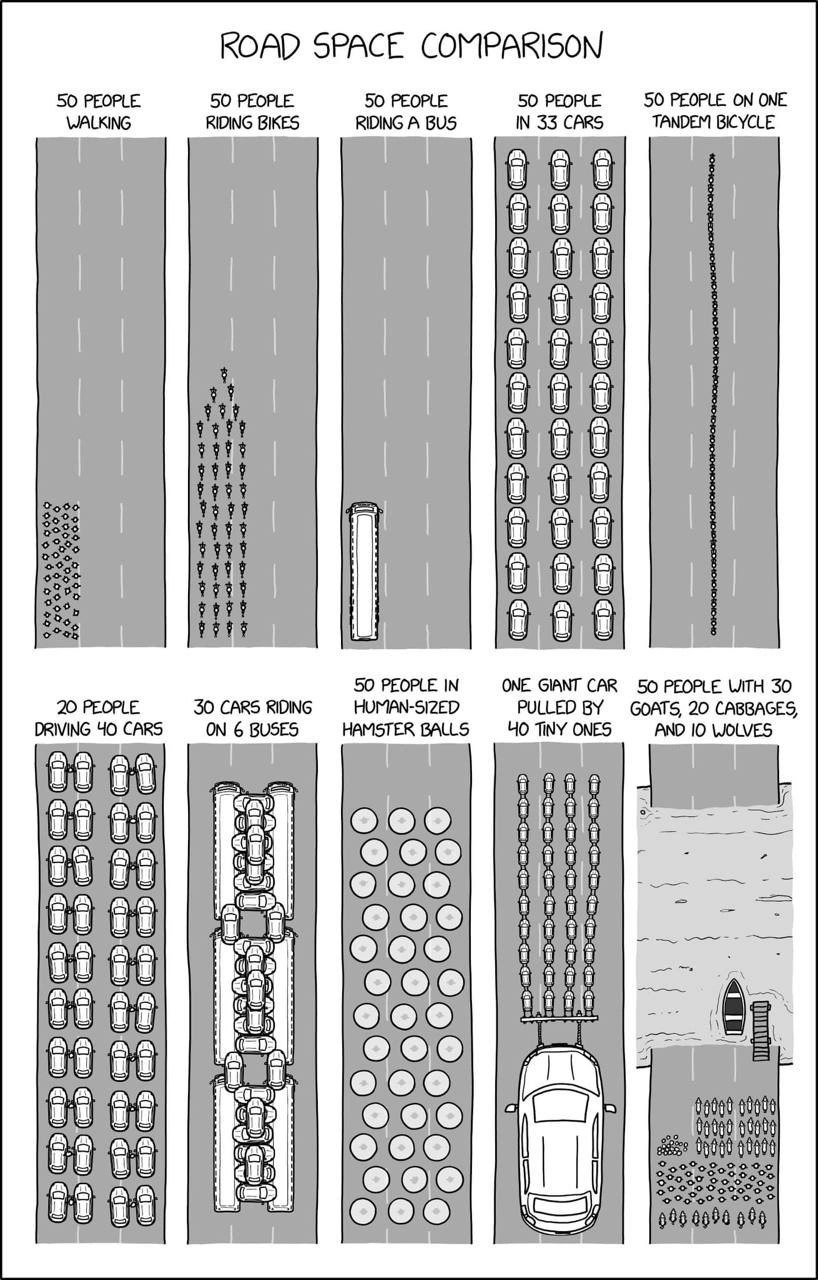
XKCD's Road Space Comparison and Logic Puzzle Escalation
Why is this DataVisualization meme funny?
Level 1: Don’t Overthink It
Imagine you and a bunch of friends (let’s say 50 friends!) need to get across town. One easy way is everyone just hops on a big bus together – simple, right? Now, picture one of your friends says, “Nah, let’s do something crazy instead!” and starts suggesting wild ideas. First they say, “What if each of us rides a bike?” Okay, that’s not too crazy – it might even be fun, though it’d take more road space than the one bus. But then another friend pipes up, “How about we build a super long bicycle that all 50 of us can pedal at once?” Now it’s getting a bit silly – that would be one wobbly, ridiculously long bike! You all laugh, but the suggestions keep coming. Someone else jokes, “What if we each get inside giant hamster balls and roll there?” Can you imagine 50 big transparent balls bumping down the street? It would be hilarious but so impractical – you’d barely fit on the road. By now it’s pure comedy: one friend yells, “Let’s connect a huge car and have lots of toy cars drag it!” and another friend tops it with, “Let’s also bring goats, cabbages, and wolves with us and make a puzzle out of it!” At this point, it’s obvious none of these wild ideas are actually about getting to the destination quickly or easily – they’re just for the sake of being over-the-top.
The reason this is funny is because the original problem was simple – just move 50 people. The normal answer is straightforward (use a bus or some cars). But some people way overthought it and came up with the most complicated, wacky plans imaginable. It’s like if you asked, “Can you pass the salt?” and your friend built a complex robot arm that flips the salt shaker across the room when simply handing it over would do. We laugh because we’ve all seen cases where a simple task gets an unnecessarily complicated solution. It’s a reminder: when you have a simple goal, you don’t need to invent a crazy scheme for it. In other words, don’t overthink it – the simplest solution is usually the best one. This meme makes us giggle by showing just how absurd things can get when someone doesn’t keep it simple.
Level 2: Simplicity vs Novelty
In plainer terms, this comic is comparing different ways to solve a problem – specifically, how to transport 50 people – and using that as an analogy for different software design approaches. It’s structured like a chart of design trade-offs, but it turns into a goofy parody of one. Initially, it presents relatively normal solutions a planner might genuinely consider (walking, biking, taking a bus, driving cars). These correspond to increasing levels of assistance and efficiency, similar to how in software you can scale up from doing nothing special to using some advanced architecture. Then, the comic gets increasingly silly: the later scenarios (like the 50-person tandem bicycle or the human-sized hamster balls) are not things any real traffic planner would suggest – they are there to poke fun at how some engineering discussions veer into the ridiculous. Each scenario can be thought of as a metaphor for a certain kind of software architecture or decision. Let’s break them down one by one and explain the joke in simple terms, relating each to computing:
50 PEOPLE WALKING: Everyone just goes on foot. No tools or vehicles, so it’s very slow but dead simple. In software terms, this is like a basic program with no optimization or special architecture – maybe every user does their task with zero assistance from fancy frameworks or extra processes. It’s not efficient (just like walking isn’t fast), but it’s straightforward and there’s basically no overhead or extra moving parts. No fuel, no engines – in computing, that’s like using minimal resources, but also giving minimal performance boost.
50 PEOPLE RIDING BIKES: Now each person has a bicycle. This is a step up: bikes make individual travel faster and use the road efficiently. In tech analogy, this is like giving each user a small boost or using a simple tool to improve performance. For instance, maybe each user’s work runs in a separate thread or lightweight process that makes things a bit quicker or easier, but everyone is still managing their own ride. It’s an individual optimization – each person (or each task) is equipped with something that makes them more efficient than walking, but they’re still all separate. There’s some extra hardware (the bikes), analogous to some extra code or library helping out each task, but it’s relatively low overhead and quite effective.
50 PEOPLE RIDING A BUS: All 50 people are now together on one bus. This is a huge win for space and efficiency: one vehicle, one engine, and it carries everyone. This is like a monolithic application or a single-server solution where all users share one big system. The bus has to be a bit bigger and stronger, but it’s only one driver and one vehicle to manage instead of 50. In computing, that might mean one program or one server handles all the workload, which can be very efficient up to its capacity. There’s a single context and shared resources, so there’s less duplication. The trade-off is if the bus breaks (or the server goes down), everyone’s affected at once – but purely in terms of resource use, the bus is super efficient (just like one well-optimized server can handle a ton of users if it’s built to scale vertically). This panel is essentially showing the best-case scenario for road space usage, analogous to the best-case scenario for resource usage in software (high utilization, low overhead). It’s no coincidence that city planners use exactly this comparison to advocate for public transit, and similarly, software architects will sometimes advocate for a simple centralized system when appropriate because it can be very efficient.
50 PEOPLE IN 33 CARS: Here, instead of one bus, we have lots of cars to move the 50 people. It specifically says 33 cars for 50 people, implying many cars aren’t full (some seats are empty, since 50/33 is about 1.5 people per car on average). This is like a distributed approach: maybe we have many servers or instances, each handling a few users. There’s more flexibility – each car can go its own route if needed, analogous to being able to distribute load – but it’s clearly less efficient in total space and fuel than the one bus. In computing, having 33 separate processes or servers to do the job of one big one means duplication of effort (33 engines instead of one, 33 drivers, etc.). This hints at how microservices or distributed systems often operate: you break things into multiple units (services, processes) for potential benefits like isolation or independent scaling, but you pay an overhead cost: each unit has its own startup cost, memory usage, and coordination needs. The image of a somewhat crowded highway lane with a grid of cars is familiar to anyone who’s seen a traffic jam – just like a web service might spawn too many processes and end up using a lot more memory than a single-process version. The key concept here is underutilization of resources — many small units not being used to full capacity, leading to waste.
50 PEOPLE ON ONE TANDEM BICYCLE: This one is delightfully absurd – a single bicycle built for 50 people, all pedaling in a line. Visually, that’d be an extremely long bike! The joke here is partly just the silly image, but technically it’s like forcing everyone into one very rigid structure. In software terms, this could be seen as an oddball architecture where all tasks are chained in a single sequence or a single pipeline. Imagine a program where 50 modules have to pass data one by one in a strict order – if any module in that chain slows down, everything backs up. A 50-person tandem requires a lot of coordination: everyone has to pedal in sync, and if one person stops pedaling or falls off, the whole bike could crash. It’s highlighting a fragile, single-threaded process that’s been stretched too long. There’s also a hint of humor at the expense of pointless optimization: someone might suggest, “Hey, what if we connect all these bikes to make one ultra-bike? That’ll save road space!” It’s true, it might save a bit of space (one long skinny bike vs 50 separate bikes), but it’s horrendously impractical. So this panel satirizes those borderline crazy ideas that technically reduce one metric (maybe it minimizes the total number of vehicles) but introduce a ton of new problems. In computing, one could liken it to an extremely long function or a data pipeline that tries to do everything in one go – sometimes done in the name of efficiency, but often just ends up being a maintenance headache.
20 PEOPLE DRIVING 40 CARS: Now things are getting into pure parody territory. 20 people with 40 cars means each person somehow is operating two cars, or perhaps switching between them? It doubles the number of vehicles while less than half the people actually have a car to themselves. This one exaggerates inefficiency: basically, a lot of vehicles are running with no drivers at a given moment. In tech, this is akin to over-provisioning or having way more resources allocated than you actually need or can utilize. Think of a scenario where a company spins up 40 servers for an application that only has 20 active users – half of those machines are sitting idle or are ridiculously underutilized. Sometimes projects do this “just in case” or due to poor planning, leading to waste. Another analogy: imagine each developer opens two identical development environments “just to be safe” but only actively uses one at a time; it’s pointless redundancy. The comic is mocking setups where the resources (cars/servers) far exceed the logical need (people/tasks), often because someone thought more hardware would automatically solve the problem. Instead, it’s just twice the clutter. This could also reflect fault-tolerance taken to an absurd extreme: maybe they gave each person two cars in case one breaks – kind of like having a backup server for every user individually. While redundancy is good, doing it at this one-to-one scale is comedic overkill, much like this image.
30 CARS RIDING ON 6 BUSES: This one paints a crazy picture: buses that are carrying cars, which presumably have people in them? It’s a logistical nightmare (like, how do you even load cars onto buses?). The underlying parody here is unnecessary layering or indirection. In real transportation, you sometimes see truck trailers carrying cars (like car transport trucks), but a bus carrying cars full of people is just convoluted. Translating to software: imagine running a bunch of applications (cars) inside a container or VM (buses), which are themselves maybe inside another host. It’s like inception for infrastructure. For a junior developer, think of it this way: instead of directly running 50 instances of something on hardware, someone decides to first put groups of 5 instances inside 6 separate virtual machines (or Docker containers), and then run those on the hardware. Now you have vehicles on vehicles – tasks on an extra layer that wasn’t needed. Each bus in this cartoon could represent an extra layer of abstraction that adds overhead without an obvious benefit. Perhaps the idea was to organize or compartmentalize (like grouping 5 cars per bus), similar to grouping services into pods or VMs by some criteria, but without a real need, it just complicates things. The meme is parodying that meta approach: “What if we combine two strategies for no good reason?” In computing, this might happen if someone combines, say, microservices with monolithic deployment units – basically, trying to get the best of both worlds but ending up with the worst of each. We chuckle because really, if you have 6 buses, why bother with the 30 cars at all? Just use the buses to carry people! Similarly, if you have a powerful host machine, you might not need to nest lots of virtualization layers – you could run the tasks directly or simplify the stack.
50 PEOPLE IN HUMAN-SIZED HAMSTER BALLS: Every person is inside a big protective bubble, taking up a ton of room. This is a playful jab at taking isolation to extremes. In software, one parallel is giving each user their own complete environment – for instance, spinning up 50 separate virtual machines or containers such that each user’s activity is totally isolated from others. Yes, it provides maximum isolation (just like a hamster ball ensures nobody touches anyone else), and it might even be kind of fun for the individual (imagine literally rolling in a hamster ball – fun but not efficient for commuting!). But from a system perspective, it’s overkill. All those copies of environments mean a lot of overhead. There’s duplication of the operating system overhead 50 times, for example, if each user got a whole VM. It’s like 50 hamster balls made of thick plastic: a lot more material than a single bus or even 50 bikes. The term microservice comes to mind here: not that microservices are inherently bad (they have their uses), but if you turn every tiny thing into its own service with full isolation without a good reason, you might end up with a situation where the “infrastructure” (the ball) around each service is heavier than the service’s actual logic (the person). The meme leverages the visual humor of giant bubbles clogging the road to make that point clear. It’s also poking fun at our obsession with sandboxing and containerizing everything: sure, you eliminate shared dependencies issues (no one in a hamster ball can catch a cold from another, analogous to no app can crash another if they’re in separate containers), but you introduce massive performance and coordination overhead.
ONE GIANT CAR PULLED BY 40 TINY ONES: This scenario is straight out of a fever dream, and it satirizes any design where many small units attempt to do the job of a big unit in a clumsy coordinated way. It’s as if the big car’s engine broke, so someone said, “No problem, let’s harness 40 toy cars to pull it!” In software, this is analogous to breaking a large, perhaps monolithic process into many micro-processes or microservices that are supposed to work together to achieve the same result. Sometimes this is done in the name of scalability or modularity. However, if the task at hand is inherently unified (the giant car, representing say a large database or an integral component that can’t really be split), then adding all those tiny cars just makes things convoluted. This can happen if, for example, you have one big database and you spawn 40 microservices to query pieces of it or maintain parts of state, and then coordinate to give a final answer that one well-optimized query could have gotten. It’s a coordination nightmare. Another spot-on analogy, as mentioned earlier, is the operating system microkernel approach: instead of one big kernel handling drivers and memory and processes, you have a tiny core and multiple small services (file system service, driver services, etc.) that must talk to each other to get anything done. It’s academically interesting and has benefits in theory (like improved fault isolation), but it often struggles with performance because the overhead of all those little services messaging one another is significant. The cartoon nails this concept visually: you just know those 40 tiny cars are going to have a heck of a time pulling that Cadillac smoothly. They’ll likely tug unevenly, maybe some will spin out, a few will break down – it’s a chaotic orchestration problem. That’s exactly what can happen in distributed software systems if they’re not designed very carefully; orchestrating many small components can be far harder than running one big component. So this panel humorously warns against over-distribution of a problem – sometimes you’re better off fixing the big engine (optimizing the monolith) than jury-rigging a swarm of mini-engines.
50 PEOPLE WITH 30 GOATS, 20 CABBAGES, AND 10 WOLVES: This final panel throws logic out the window in the funniest way. Suddenly it’s not just people that need moving, but a whole menagerie with rules (certain animals can’t be left alone together). This is referencing a well-known brainteaser, which is definitely not part of any normal traffic planning! The inclusion of this puzzle scenario is making fun of projects that accumulate bizarre requirements or constraints. In an engineering context, it’s like someone saying, “Our app needs to not only serve users, but also solve this complex scheduling problem at the same time, and ensure certain tasks never run together,” or a client tacking on an unrelated feature that has nothing to do with the main goal (“Also, can it manage an online petting zoo?”). It turns a straightforward job into an entirely different, much more complex problem. For a junior developer, the key thing to understand is that unnecessary complexity often gets introduced by trying to solve problems that don’t need to be solved (or at least not solved as part of the main project). The goats and wolves puzzle requires multiple trips across a river because you can’t leave the wrong combo alone – similarly, a software with too many constraints or extra features might have to jump through hoops (take extra steps, add more code) to accommodate those extraneous requirements. It’s funny in the comic because it’s so out-of-place – you’re expecting another transit idea and instead you get a farmyard logic puzzle. In real projects, that same feeling of “Wait, why are we dealing with THIS now?” happens when scope creep or ill-advised feature requests appear.
To sum up the chart in a simpler way: it starts with efficient solutions and ends with ridiculous solutions. It satirizes the tendency to over-think or over-engineer. The caption "ROAD SPACE COMPARISON" and the structured lanes make it look like a serious study, but by the end you’re literally dealing with wolves on a ferry. It’s comparing the performance (here, using road space as a stand-in for performance/capacity) of sensible designs versus wacky designs. For someone new to these concepts, the takeaway is: when you have a goal (like serving 50 users, or moving 50 people), you can approach it in simple, tried-and-true ways or in complex, highly novel ways. Often, simple is better. The funniest part of this meme is realizing that the only thing those outlandish methods achieve is being different, not better. It’s a good reminder in engineering: just because you can design something wild doesn’t mean you should. The best solution is usually the one that meets the requirements with the least complexity.
Level 3: Rube Goldberg Routing
From a senior developer or architect’s perspective, this meme hilariously captures the absurd extremes of system design choices that we’ve all seen proposed at one time or another. It starts grounded in reality: moving 50 people by walking, biking, or taking a bus are analogous to sensible architecture patterns with clear trade-offs (from simplest but slowest, to more efficient shared transport). These first scenarios mirror real design trade-offs – for example, a single bus for 50 people is like a monolithic architecture handling all users together efficiently, whereas 50 people in separate cars is like a distributed system with many independent parts (more flexible, but using more total space and fuel). The comic is riffing on an actual urban planning concept (often used in pro-public-transit advocacy) where they compare road space used by the same number of people in different transport modes. The top row of the comic – walking, bikes, a bus, and cars – mimics that real comparison graphic you might see in a city planner’s slideshow. It’s essentially a resource allocation chart: how do various strategies utilize a limited resource (road space or, in a software analogy, CPU/memory/network bandwidth)? So initially, we’re nodding along: “Ah yes, 50 people on a bus (one big server) is clearly more space-efficient than 50 people in 33 cars (33 servers half-empty).” This is classic optimization trade-off thinking in both city design and system architecture.
Then the XKCD-esque escalation kicks in. Each subsequent panel introduces a progressively over-engineered or outright zany solution that technically still moves 50 people, but in increasingly roundabout ways. This progression is a perfect satire of what happens in some design meetings or architecture brainstorms. We start with sound engineering principles, but inevitably someone suggests an off-the-wall idea that optimizes for novelty or niche scenarios at the expense of sanity. The meme’s subtitle joke (“drawn by XKCD’s traffic planner”) sets that expectation: we’re basically watching a Rube Goldberg machine being sketched to solve a problem that really didn’t need one. In software terms, it’s like those times when a team is deciding how to handle an application’s growth – one person suggests simply vertically scaling a server (equivalent to using a bus), another suggests horizontal scaling with more instances (cars), and then someone excitedly goes “What if we containerize each user in their own microservice... running on a blockchain... powered by AI...?” – figuratively, “50 people in human-sized hamster balls!” It’s the meeting where the phrase “what if we put the cars on buses” might actually come up, and everyone else slowly facepalms.
The humor here thrives on engineering absurdity. Take “30 cars riding on 6 buses”: that scenario makes one think of stacking solutions on top of each other unnecessarily. It’s reminiscent of real-world anti-patterns like running a virtual machine for each microservice container, or creating multilayered architectures where simplicity would do. We’ve seen systems where services call other services, which invoke yet another service – akin to putting cars on a bus on a truck on a ship, a long chain of indirection that’s supposed to be “clever” but just adds latency and points of failure. The comic exaggerates this layering literally: cars piggybacking on buses (why?!), making us laugh because we recognize the over-complication. Similarly, “50 people in human-sized hamster balls” is a direct jab at needless isolation and overkill safety. Sure, each person is perfectly isolated (no one can possibly bump into each other, much like each microservice or each user in a separate container can’t interfere in memory), but the cost is ridiculous — these huge bubbles clog the entire road. This lampoons architectures that go overboard with sandboxing or per-user VMs “for security” when a simpler multi-tenant approach would be fine. It’s the software equivalent of wrapping every single object in bubble wrap and duct tape until nothing fits through the door. Secure? Maybe. Efficient? Not at all.
Then we get to “one giant car pulled by 40 tiny ones”, which resonates with anyone who’s dealt with a distributed monolith or an overly granular system trying to haul a legacy component. This feels like a nod to the classic microservices gone wrong scenario or even the OS design debate of microkernel vs monolithic kernel. In a microkernel-style OS, you break core functionalities into many small services (drivers, servers, etc.) that coordinate to run the system – theoretically safer and modular. But as experienced engineers know, if those pieces have to constantly communicate (sending messages back and forth, much like tiny cars all towing and steering a big trailer), the performance can tank. It happened with early microkernels (like Mach): the overhead of messaging between all the mini-services made them slower than a traditional monolithic kernel. The comic’s depiction captures that folly in one image – a huge sedan (the “main” thing that actually needs moving) incapacitated on its own, being dragged by a swarm of little carlets. It’s both hilarious and a bit painful, because it’s so true that sometimes breaking a problem into 40 pieces and orchestrating them yields a worse result than just tackling it in one piece. Every senior dev has seen a project where “we’ll just split this into lots of microservices” resulted in a nightmare of orchestration, network calls, and debugging hell – the system architecture equivalent of a conga line of tiny cars pulling a behemoth.
Finally, the pièce de résistance: “50 people with 30 goats, 20 cabbages, and 10 wolves.” This one just screams, “Some stakeholder decided to add a completely irrelevant requirement to our project.” It’s a reference to the old river crossing puzzle where a farmer must transport wolves, goats, and cabbages without anyone eating anyone else. In an architectural discussion, this is that moment when a non-technical VP chimes in with, “Can we also make it handle [insert random complex feature]?” or when an engineer with a wild tangent idea complicates the design far beyond the original scope. The meme is satirizing how scope creep or gratuitous novelty turns a reasonable plan into a convoluted mess. You start with the goal of serving 50 users (the people to move), and end up designing around goat-cabbage-wolf compatibility issues – i.e., solving a problem that was never originally part of the goal. It highlights the temptation to over-engineer: we might incorporate a trendy but unnecessary technology (the proverbial goats and wolves) just because it’s cool, even if it doesn’t actually optimize our primary objective (moving the people). Senior engineers find this funny because we’ve lived it: the project that suddenly had to support an extra use-case or a “genius idea” that derailed the simplicity of the solution. It’s both humorous and cathartic to see it drawn so literally.
Throughout all these panels, the underlying satire is about design trade-offs and how we sometimes lose sight of the real metrics that matter. The meme explicitly falls under DesignPatterns_Architecture and Performance because it’s critiquing how architects balance (or fail to balance) efficiency, complexity, and novelty. Every added element – whether it’s an extra car, an extra layer of buses, or a herd of goats – is a trade-off. More cars gave independence but cost road space; more layers gave some theoretical modularity but cost a ton in overhead; more goats... gave nothing useful but certainly cost sanity! The cartoon is a visual parody of architectural decision diagrams, where instead of plotting numbers on a graph, it draws ridiculously literal illustrations. It resonates with engineers because it reveals a truth: the simplest solution is often the best for performance and maintenance, and when we deviate, we should do so for real reasons, not just for the sake of over-engineering or “cool factor.” Yet, as this meme jokes, people do propose the craziest things in real life. And when they do, those of us who’ve been around the block (or the road) can’t help but think of a giant car being lugged by toy cars or a software project now dealing with goats and wolves. It’s tech humor with a bite of reality – we laugh, perhaps a bit nervously, because we recognize how easily a simple plan can spiral into a circus. The message to any architect reading is clear: Keep it simple (remember the KISS principle) and beware of solutions that “optimize nothing but novelty,” or you’ll end up with a system that, while very impressive-sounding, just moves the same 50 users with a lot more headache.
Level 4: NP-Complete Commute
At the most theoretical level, this meme highlights how adding excessive constraints and components to a system can transform a straightforward optimization into an intractable problem. The final panel’s scenario with “50 people with 30 goats, 20 cabbages, and 10 wolves” hints at a classic river-crossing puzzle – a small-scale example of a state-space search problem. In computational complexity terms, introducing such constraints (e.g. ensuring wolves don’t eat goats unless a human is present) explodes the number of possible states to consider. What began as a simple task of moving 50 units from A to B (a problem solvable in linear time relative to the number of people) becomes something akin to an NP-complete problem, where the solution might require exploring combinatorial possibilities. Each added rule (the goats and wolves) is like another clause in a boolean satisfiability problem, dramatically increasing complexity. It’s a parody of resource allocation turning into constraint satisfaction: the system’s behavior can no longer be predicted or optimized easily with a formula – you’d need brute-force search or clever heuristics to plan the trips. This is a fundamental principle in computer science and optimization: more constraints = more computational complexity, often exponentially so.
The comic also illustrates core truths of scalability math and performance theory. Notice how efficiency plummets in the absurd scenarios: e.g. “50 people in human-sized hamster balls” has way more total surface area on the road than “50 people on one bus.” The bus is essentially the optimal packing of humans into one container, minimizing overhead, whereas individual hamster balls represent extreme overhead per person. In computing terms, this is analogous to threads or tasks sharing one process (minimal overhead) versus isolating each task in its own heavy container or VM. There’s a theoretical limit here: an optimal solution tends to maximize useful work while minimizing per-unit overhead. If we denote by o the overhead per isolated unit (like a hamster ball or a container) and by w the useful work per unit (moving a person), then the total effort E for N units is E = N*(w + o). As N increases, if o is not negligible, it dominates the workload. This is why a system of 50 isolated micro-tasks can end up using far more resources than one coordinated task handling all 50 users’ work, especially when o (context switching, interprocess calls, etc.) is large relative to w. The meme visualizes that overhead: dozens of redundant car engines or hamster enclosures taking up space, analogous to redundant memory footprints and runtime overhead in software.
There’s also a hint of Amdahl’s Law in the absurd “one giant car pulled by 40 tiny ones.” Amdahl’s Law tells us that adding parallel units yields diminishing returns when there’s an inherently serial part of the workload. Here, the “giant car” is like the serial portion of a task that can’t be divided – it must be pulled along as one piece. No matter how many tiny cars (parallel helpers) you add, the convoy can only go as fast as the coordination of all those tiny engines allows. The overhead of synchronizing 40 tow-cars (ensuring they all pull in unison without tangling) can nullify the benefit of having many of them. This is analogous to a heavy monolithic component being broken into microservices that then spend much of their time communicating: beyond a point, more parallelism just adds overhead and contention. In extreme cases, piling on more “helper” processes or threads can even degrade performance (just as 40 little cars might actually slow down the transport of one big car due to friction and chaos). The microkernel analogy lives here too: operating system theory shows that splitting a kernel into many small services (for modularity and safety) incurs inter-process communication cost. The meme’s giant-car chain lampoons that concept – the elegant theory of microservices or microkernels meets the messy reality of coordination complexity.
In summary, at this deep technical level, the comic is a satirical thesis on optimization theory: it visualizes how over-engineering can violate fundamental laws of performance. Whether it’s the exponential combinatorial explosion from needless constraints (goats and wolves) or the diminishing returns from piling on layers and micro-units (cars on buses, tiny tow-cars), the underlying message aligns with computer science fundamentals. The simplest solution (a single bus, in this case) often corresponds to a more optimal algorithm or design, achieving the required result with minimal extra baggage. In contrast, the wackier solutions illustrate how quickly theoretical efficiency is lost when one strays from that optimal path. It’s a reminder that in engineering, every additional component or rule has a cost – sometimes turning a polynomial-time problem into an exponential nightmare or turning linear scalability into logistical spaghetti. The humor lands because these theoretical downsides are illustrated in such a literal, absurd way that any seasoned engineer can chuckle at how true it is under the surface.
Description
A ten-panel comic strip from the webcomic XKCD, titled 'ROAD SPACE COMPARISON'. The comic is drawn in a minimalist black-and-white style. The first few panels present a seemingly serious data visualization comparing the road space occupied by 50 people using different modes of transport: walking, bikes, a bus, and cars, illustrating the efficiency of public transport. The comic quickly descends into absurdity with scenarios like '50 PEOPLE ON ONE TANDEM BICYCLE', '50 PEOPLE IN HUMAN-SIZED HAMSTER BALLS', and 'ONE GIANT CAR PULLED BY 40 TINY ONES'. The final panel abandons the road theme entirely, showing a river with a boat and depicting the classic river crossing puzzle with '50 PEOPLE WITH 30 GOATS, 20 CABBAGES, AND 10 WOLVES'. The humor lies in the bait-and-switch, starting with a familiar urban planning infographic and escalating to a well-known logic problem, a nod to the audience's familiarity with such puzzles in computer science and mathematics

Comments
7Comment deleted
This is a perfect visualization of a project estimate. It starts with a clear comparison of known solutions, but by the end, you're just trying to figure out how to get the legacy database, the new framework, and the stakeholder's nephew across the deployment pipeline without anything eating anything else
That moment in the architecture review when the PM skips past buses, bikes, and batching, and insists our latency SLA will be met by ‘one giant monolith pulled by 40 tiny microservices’ - and somehow it still makes it into the slide deck
This is exactly how our microservices architecture started: "Let's optimize resource allocation!" we said, and somehow ended up with 50 containers orchestrating 30 databases, 20 message queues, and 10 load balancers just to serve a contact form
This is essentially a visual proof that O(n) space complexity matters in the real world - except the last three panels demonstrate what happens when your architect lets junior devs design the transportation layer after reading too many Medium articles about 'innovative solutions.' The hamster balls are clearly a microservices approach: maximum isolation, maximum overhead, and someone's going to have a really bad time during rush hour deployments
Architecture review: the spec said “use a bus”; we shipped 33 microservices with sidecars, a service mesh convoy, and a dependency graph involving goats, cabbages, and wolves
Our platform roadmap in one image: ship the bus, panic into 33 microservice cars, wrap each in a hamster‑ball sidecar, then “solve networking” with a giant car dragged by 40 tiny ones
Microservices teams seeing this: 'Challenge accepted - hamster balls for every endpoint.'