The Ultimate Guide to an Interruption-Free Zoom Call
Why is this RemoteWork meme funny?
Level 1: Quiet Please!
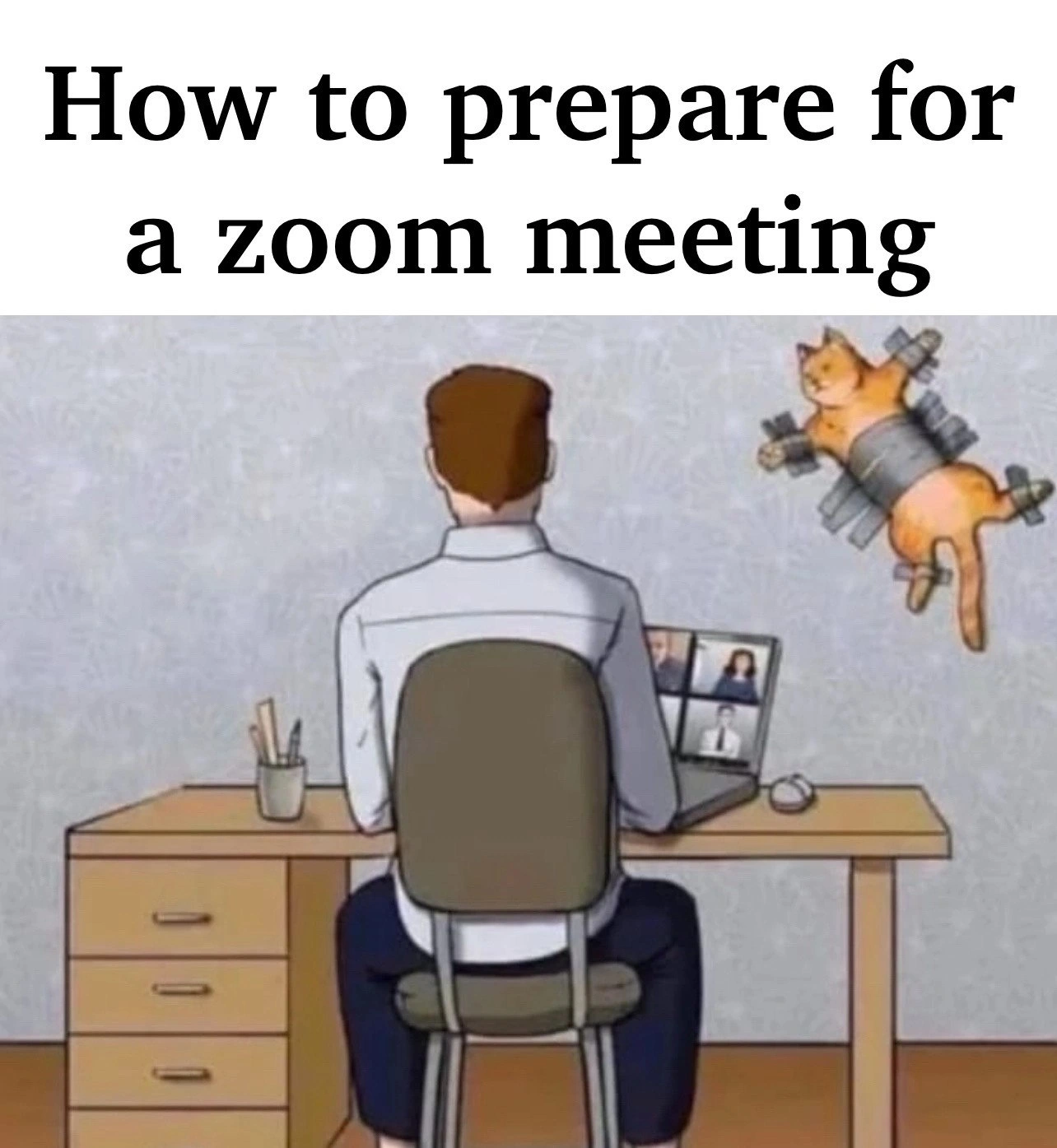
Imagine you’re about to talk with your friends or teacher on a video call, and your silly cat keeps jumping in front of the screen and meowing loudly. You really need quiet for a few minutes. What do you do? In this funny picture, the man found a wild solution: he actually taped his cat to the wall so it wouldn’t bother him during his meeting! 😮 Of course, it’s just a joke and nobody would really do that to their pet. The reason it’s so funny is because we all know how hard it can be to keep things calm at home when we need to focus. It’s like when you’re on an important phone call and your little brother starts singing at the top of his lungs – you might wish you could just stick him somewhere silent for a bit. Here, the cat is that noisy little troublemaker, and the tape is a silly pretend way to instantly get some peace and quiet. The big message is simple: working or talking from home can be chaotic, and people will laugh at how far we feel like going just to get a moment of silence. In other words: “Please be quiet, I’m in a meeting!”
Level 2: Remote Meeting Reality
Now let’s break down what’s happening in simpler terms. The image humorously addresses the challenges of working from home and having to be on Zoom meetings. A daily stand-up is a short team meeting (often done via video call in remote teams) where everyone talks about their work progress. People usually share what they did yesterday, what they’re doing today, and if they have any blockers – a “blocker” meaning anything preventing them from getting work done. Here the joke is that the person’s blocker is their cat creating chaos! In real remote work life, pets and kids can indeed interrupt our meetings. We’ve all seen funny videos of cats walking in front of webcams or hitting the mute button at the worst time. It’s a common WorkFromHome problem: you’re trying to look professional on a call, but your cat might decide now is the perfect time to knock over a plant or start meowing loudly at a ghost only it can see.
To prepare, people often try simple pet distraction mitigation steps before important calls. That might be feeding your cat or playing with it so it naps during your meeting. Some folks will keep pets out of the room, or give them a toy to occupy them. And of course, the quick tech solution is to use the mute button generously – keep yourself muted on Zoom except when speaking, so if Fluffy starts yowling, your coworkers won’t hear it. Modern video conferencing apps like Zoom, Microsoft Teams, etc., also have background noise suppression settings. These can automatically reduce or mute sounds that aren’t your voice, like typing, doorbells, or pet noises. It’s not perfect, but it helps. For example, Zoom can often tell the difference between you speaking and a dog barking, and it will try to filter out the bark. But a loud, sharp meow might still sneak through if it’s very close to the mic or if the software thinks it might be you speaking.
In the meme’s picture, the developer has taken a very extreme and humorous approach: he actually taped his cat to the wall so it can’t pounce on the keyboard or meow into the microphone during his stand-up meeting. The cat is spread-eagle on the wall with wide eyes, looking totally startled. This is of course a joke – no one would really do this (and no cats were harmed in the making of this meme!). The exaggerated visual makes it instantly clear that the poor cat has been physically restrained to prevent it from causing a ruckus. It’s playing on the phrase “How to prepare for a Zoom meeting,” suggesting one wild tip is “Make sure the cat can’t interrupt.”
This is a form of tech humor because it mixes a real work scenario with a silly, over-the-top solution. The communication challenge here is keeping your Zoom call professional and uninterrupted. Many remote workers will relate to the struggle of maintaining a quiet, distraction-free background – whether it’s pets, children, roommates, or construction outside. We’ve learned some etiquette and tricks: like using virtual backgrounds to hide the mess behind you, or using headphones so feedback loops don’t happen, and definitely the golden rule, “You’re on mute,” to remind us when we forget. In team calls, everyone has funny stories of a cat appearing on screen or a dog barking at the mailman mid-meeting. It’s become a new norm to sometimes pause a meeting and say, “Haha sorry, my cat just tried to type an email.” So this meme takes that common situation and blows it up to cartoon-level absurdity for a laugh.
Let’s also clarify the Agile jargon: a “blocker” in a stand-up is typically something like “I can’t finish my code because I’m waiting for credentials,” or “I’m blocked by a bug in the API.” It’s basically anything stopping your progress. The meme’s title “When the cat is your biggest blocker during Zoom stand-ups” is a playful way to say the cat is literally preventing him from having a smooth meeting or getting work done. It humanizes (or shall we say, pet-izes) the blocker concept. Instead of a software or task issue, it’s an adorable but disruptive animal. This makes the situation instantly understandable and funny: even if you don’t know the term “blocker,” you can see that the cat is causing trouble and the developer had to deal with it in order to focus on his meeting.
In summary, the meme shows a work-from-home developer doing something crazy (taping his cat to the wall) to avoid live ZoomMeeting interruptions. It highlights a real aspect of remote work life (pets causing distractions) in a witty way. The image is clean and exaggerated so you can’t miss the joke: the cat has essentially been put in a “timeout” so Dad can work. Anyone who has tried to talk seriously on a video call while their cat decides to sing the song of its people in the background will chuckle at this. It’s MeetingHumor meets pet owner humor, perfectly capturing the juggling act of remote work and home life.
Level 3: Stand-up Blockers IRL
Stepping down to a senior developer’s perspective, the meme lands as a perfect exaggeration of daily RemoteWork challenges. In agile teams, a stand-up meeting (often on Zoom in a WorkFromHome setup) is a quick daily sync where each dev shares what they did, what they’ll do, and if anything is blocking their progress. Here the joke is that the “biggest blocker” is literally the developer’s cat! 🐈 In real life, a “blocker” means some impediment like “waiting on code review” or “the test server is down.” But this meme hilariously turns a common MeetingHumor trope on its head: the cat wandering into your video call, meowing or flipping your mute button at the worst time, is preventing work from getting done. It’s an IRL (in-real-life) blocker during a stand-up, a scenario so many of us find too relatable after years of remote meetings.
The image shows our developer friend in semi-professional attire (classic Zoom mullet: business on top, casual or even barefoot below camera view) facing a laptop with colleagues’ faces in the familiar Brady Bunch grid. Everything looks neat and controlled – except for the orange cat comically duct-taped to the wall beside him, paws splayed out. This sight gag is funny because it’s an absurdly over-the-top solution to a familiar Communication hiccup. Anyone who’s been in a virtual meeting has experienced some form of pet_distraction_mitigation strategy, though usually it’s just bribing the cat with treats or shutting the door. Here, the developer’s approach escalated to a cartoonish extreme, as if saying: “Desperate times call for desperate measures – I had to contain the chaos!” It’s a play on the idea of keeping a professional front (clean desk, collared shirt, polite smile on Zoom) while literally wrangling chaos off-camera.
This resonates with seasoned remote workers because we’ve seen it all on Zoom: cats tailing across webcams, dogs barking at delivery trucks mid-presentation, toddlers bursting into the room demanding attention (remember the viral BBC interview?). We’ve learned to adapt with quick fixes. Some are technical – like using Zoom’s Mute All button liberally, or enabling background noise suppression so coworkers don’t hear your Siamese demanding second breakfast. Some are improvised – holding a squirmy pet in your lap just out of camera frame, or scheduling around the neighbor’s lawn-mowing. The meme uses dark humor to exaggerate one of those improvised fixes: literally plastering the pet to the wall so you can get through one damn stand-up. It takes the phrase “blocking issue” and makes it physical.
The developer’s calm posture at the desk versus the cat’s ridiculous predicament creates a contrast that’s comedic gold. It implies a story: maybe this poor guy had one too many stand-ups ruined by surprise feline cameos. Perhaps every time it’s his turn to speak, his cat decides to yowl or parade across the keyboard (because of course, kitty believes it’s the real Scrum Master 😼). Today, he came prepared – he’s enacted the ultimate zoom_background_containment_strategy for his furry friend. In a software context, it’s like deploying a hotfix under pressure. Duct tape, both literally and metaphorically, represents a quick-and-dirty solution you implement when there’s no time for an elegant fix. Experienced devs chuckle because “duct-tape fixes” are all too familiar in coding and infrastructure (“temporarily patched that null-pointer bug with a try-catch just to get prod stable”). Here the “duct tape fix” is managing home life: the cat has been temporarily patched to the wall so the production (the meeting) stays up with 99.99% uptime (no interruptions).
There’s also an underlying wink to tech culture in how the meme is captioned as a pseudo-tutorial: “How to prepare for a zoom meeting.” The implication is that pet owners must have a pre-meeting checklist: dress appropriately, check mic and camera, and oh, ensure the cat is contained. It satirizes the pressure to appear professional and undistracted during remote calls. We’ve developed unwritten protocols for video meetings – e.g., warn family members, mute notifications, find a quiet corner. When those fail, some resort to humorously drastic measures (maybe not duct tape, but perhaps locking the cat out of the room even if it means enduring sorrowful meows in the hallway). This comic scenario also nods to how home and work boundaries blur in WorkFromHome life: you’re essentially your own IT and office manager, responsible for troubleshooting everything from wifi routers to feline “server” outages. Seasoned devs might even jokingly refer to rambunctious pets as features or microservices of the home office that need monitoring.
In fact, the meme description calling the cat “a mischievous microservice taken out of rotation” is a total geeky gem. It equates the cat to a microservice in a larger system (your workday or meeting being the system). Just as SREs will take a flakey service instance out of the load balancer to restore stability, our dev has taken the cat out of the meeting equation. This is pet management by way of system design thinking. It’s funny because it dramatizes a mundane problem with the grandiosity of an engineering solution. It’s also a bit cathartic: how many times have we wished we had a mute button or kill-switch for sudden background chaos? The cat-on-the-wall gag is basically that wish fulfillment in cartoon form. And though we (obviously!) don’t condone actually duct-taping animals, the ridiculousness makes the message clear – having a pet around during Zoom calls can feel like managing an unpredictable service that might go down (or rather, go off) at any moment. The seasoned developer inside us all can’t help but laugh at how true that feels on some days. This blend of Agile ceremony (stand-ups and blockers), DevOps quick fixes (duct tape deployments), and RemoteWork absurdity hits all the right notes of TechHumor for anyone who’s been there.
Level 4: Circuit Breaker for Cats
At the highest technical level, this meme humorously parallels fault-tolerance in distributed systems with remote work life. In a microservices architecture, when one service misbehaves (spams errors, hogs resources, or makes too much “noise”), engineers often remove it from rotation – essentially cutting it off from the load balancer so it stops impacting the whole system. This is akin to applying a circuit breaker pattern: the system trips a breaker to isolate the faulty component, preventing a cascade of failures. Here, the orange cat is that noisy, misbehaving “service,” and the developer has literally taken it out of service by duct-taping it to the wall. It’s an absurd, physical implementation of a quarantine protocol for a “pet service” that’s causing interference.
In DevOps there’s a saying: “If it moves and it shouldn’t, use duct tape; if it doesn’t move and it should, use WD-40.”
🐱 Status: Cat has been taken out of rotation.
This extreme pet_distraction_mitigation strategy also evokes how we handle noise in signal processing. Video call software like Zoom includes advanced noise suppression algorithms – essentially a digital circuit breaker for audio disturbances. Zoom’s machine learning models analyze your microphone input to filter out non-human sounds (like a cat’s meow or keyboard clatter) while preserving voice communication. Under the hood, it’s doing real-time audio spectral analysis, gating thresholds, maybe even using deep learning to distinguish meows from human “hello’s. It’s high-tech magic that usually spares us from hearing each other’s barking dogs or clattering dishes during a stand-up. But these algorithms aren’t foolproof; a sudden loud meow can slip through if it’s within voice-like frequencies or if the system mistakes it for speech. In distributed computing terms, that’s analogous to a failure in noise isolation – the “faulty node” (cat noise) still impacts the call because the software filter didn’t catch it.
Rather than rely solely on software, the meme shows a hardware fix: physically isolating the noise source. It’s as if the developer implemented a custom Zoom background containment strategy outside the software stack entirely! This duality of solutions – software vs. hardware, algorithmic filtering vs. literal duct tape – highlights a core truth in engineering: sometimes the most straightforward “brute force” solution (no matter how ridiculous) can be more immediately effective than elegant automated approaches. The cat taped to the wall is essentially a manual fail-safe, a tongue-in-cheek circuit breaker for cats ensuring the “system” (the Zoom meeting audio/channel) stays clean and uninterrupted. It’s a hilarious crossover of tech humor and real-life problem solving, showing that concepts from scalable system design (like isolating a bad actor to protect overall performance) can be metaphorically – and in this case, almost literally – applied to everyday RemoteWork annoyances.
To drive the parallel home, consider this comparison between software architecture and our work-from-home scenario:
| Misbehaving Component | Tech Remedy (Software) | WFH Remedy (Meme) |
|---|---|---|
| Noisy, error-spamming microservice | Trip a circuit breaker or remove from load balancer (take out of rotation) | Tape the cat to the wall (remove it from the workspace) |
| Background process causing interference in system | Isolate the process or throttle it to protect overall performance | Isolate the pet so its meows and antics won’t disrupt the Zoom meeting |
| Goal: maintain system stability for users | Goal: maintain meeting communication clarity for teammates |
In essence, the meme leverages a software-engineering inside joke: using a literal duct tape solution to maintain uptime – or in this case, keep the stand-up meeting running smoothly. It’s a playful nod that even in high-tech environments with fancy algorithms, sometimes our inner “site reliability engineer” resorts to primitive but effective measures to achieve fault tolerance. After all, whether it’s a rogue server or a rowdy cat, the rest of the system (or team) shouldn’t suffer from one component’s chaos!
Description
A meme with the caption 'How to prepare for a zoom meeting'. The image depicts a person sitting at a desk from behind, engaged in a video conference on a laptop. To the right, in a comical and absurd display, an orange cat is duct-taped to the wall, spread-eagled, to prevent it from interrupting the meeting. This meme is a humorous exaggeration of the struggles of working from home, particularly the challenge of managing unpredictable pets during professional video calls. It speaks to the shared experience of remote workers trying to maintain a professional appearance amidst the chaos of a home environment. The joke lands with anyone who's ever had a pet or child unexpectedly join a critical meeting

Comments
7Comment deleted
That's not just a cat, it's a daemon process. If you don't properly contain it, it'll fork bomb your entire presentation
Sandboxing the cat with duct tape: because even senior engineers know that isolating the noisy process is faster than debugging its side-effects mid-retro
The same meticulous planning we put into distributed system failover scenarios, except the single point of failure is a 12-pound tabby with perfect timing for architectural decision records
Ah yes, the classic pre-standup ritual: disable notifications, mute Slack, close all tabs with embarrassing Stack Overflow questions, and implement aggressive pet containment strategies. Because nothing says 'I'm a senior architect' quite like your cat's rear end becoming the most memorable part of your system design review. At least with the cat taped to the wall, you've achieved O(1) lookup time for 'where's the cat' queries - though the space complexity of your credibility just went to O(n²)
Duct tape: the SRE's first resort for quarantining noisy 'services' before stakeholder syncs
Implemented a pet_mutex to meet the Zoom SLO - mutual exclusion on the mic, zero retries
WFH lesson learned: if you don’t register a feline interrupt handler before standup, you’ll end up shipping a duct‑tape mutex and paying infinite moral and technical debt