Skip to content
DevMeme
5146 of 7435
Beware of Aggressive Emotional Support Dog
MentalHealth Post #5627, on Nov 3, 2023 in TG

Beware of Aggressive Emotional Support Dog

Why is this MentalHealth meme funny?

Level 1: “I Know You’re Hurting”

Imagine you have a friend who hasn’t slept well and is feeling really upset, but when you ask them how they are, they say, “I’m okay.” You can tell they’re not actually okay – maybe their eyes look sad or they’re walking slowly because they’re so tired. This meme is like that situation, but shown in a funny way with a talking dog. The picture has a big dog behind a fence, and the dog is yelling things like “Don’t tell me you’re ok! You’re NOT ok! … Talk to me!” at a man walking by who looks exhausted. It’s called an “emotional support dog” as a joke. Usually, a sign saying “Beware of Dog” means a dog might bite you. But here it says “Beware of Emotional Support Dog,” meaning this dog might overwhelm you with love and concern! :smile:

Why is this funny and what does it mean? It’s showing us that sometimes our friends can sense when something is wrong, even if we say we’re fine. Just like a real dog might come cuddle you if you’re sad (even if you don’t say anything), a good friend will know you’re hurting inside. In the meme, the dog is basically a friend who isn’t fooled at all when the guy says he’s okay. The dog literally says he can smell the hurt – of course that’s silly (dogs can’t actually sniff out sadness like a hidden treat), but it’s a goofy way to say “I can tell you’re upset, even if you won’t admit it.” The dog is so worried that he’s almost begging the guy to stop and talk about his problems instead of just walking away silently.

In everyday terms, think about if you fell and scraped your knee, and you tried not to cry. A good friend might see you holding back tears and say, “Hey, I know that hurt, it’s okay to cry. Let’s get you a bandage.” That friend isn’t being mean – they’re showing they care by not letting you pretend everything’s fine when it isn’t. That’s what the emotional support dog is doing in the meme: it’s a funny cartoon way of saying “Real friends know when you’re not ok, and they will try really hard to help you, even if you say you don’t need it.” It makes us laugh because the dog is so over-the-top and desperate to help (which is unexpected), but it also feels warm and reassuring. The heart of the joke is that sometimes we all act like the tired guy, telling everyone “I’m fine,” and it’s kind of a relief (and a little funny) when a friend basically barks back, “No you’re not! Let me help you.”

Level 2: Buddy vs Metrics

If you’re a newer developer or not familiar with on-call life, let’s break down the scenario. In tech teams, being on-call means you’re responsible for handling issues with systems outside normal hours. Think of it like a firefighter’s pager for software: if a server crashes at 2 AM on Saturday, the on-call engineer’s phone rings, and they jump online to fix it. Teams often use monitoring tools (like Prometheus) to automatically detect problems. Prometheus is a popular open-source monitoring system that keeps track of numbers (called metrics) such as how much CPU a server is using, how much memory is free, or how many errors are happening. If those numbers look bad (say CPU usage hits 100% or a website is returning a ton of errors), Prometheus can send an alert (via something like an Alertmanager) to notify the on-call person: essentially, “Hey, wake up! Server X is in trouble.”

Now, the meme title says: “When your on-call buddy detects stealth burnout before Prometheus does.” The joke here is that burnout is not something Prometheus (or any monitoring tool) can detect. Burnout in a developer context means a state of extreme physical and mental exhaustion caused by chronic stress. DeveloperBurnout often happens after long periods of working too hard, being constantly on-call (imagine weeks of late-night emergencies), or feeling lots of pressure with not enough rest. People who are burnt out feel DeveloperExhaustion – they’re tired, cynical, less efficient, and often feel detached or depressed about their work. It’s called “stealth” burnout because developers sometimes hide it or don’t realize it’s happening. They might say “I’m fine” and keep working, even though inside they’re really not fine.

An on-call buddy usually means a teammate who shares the on-call duty or at least supports you while you’re on-call. Some teams pair up engineers so you’re not alone: for example, if you’re dealing with a severe outage at 3 AM, your buddy might jump on the call to assist, or the next morning they’ll check in and take over so you can rest. In this meme, the on-call buddy is behaving like an emotional support friend. Instead of asking about a server metric, they’re essentially checking the “human metric” – are you, the human, doing okay? The phrase “detects stealth burnout” means this friend notices the subtle signs that you’re burning out, even though you haven’t said anything outright. Maybe they notice you’ve been working 12-hour days all week, or that you look really drained and have dark circles from lack of sleep (SleepDeprivation). They might catch that you’re quieter than usual or that you sigh every time a new bug comes in. These are hints someone is struggling, kind of like how a canary in a coal mine shows trouble before anyone else knows.

Saying the buddy detects burnout “before Prometheus does” is a tongue-in-cheek way to highlight that no automated tool was ever going to alert “BurnoutAlert: Alice hasn’t slept in 3 days.” Prometheus monitors machines and applications, not people. There’s no built-in metric for frustration level or happiness. (At best, a company might use occasional HR surveys or questionnaire tools to gauge morale, but those are infrequent and often too late.) So the buddy noticing “before Prometheus” really means human empathy can catch problems that software can’t. It emphasizes the value of a caring teammate in a high-stress tech job. And it’s a bit of gentle satire: we rely on fancy monitoring for everything in tech, yet it still takes a real friend to notice when a developer is at a breaking point.

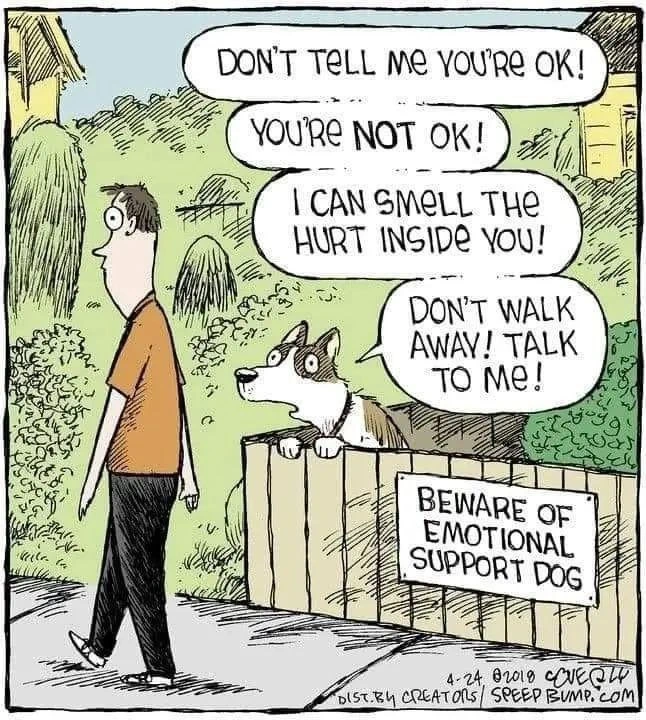
The cartoon itself illustrates this in a funny way. We have a tired-looking developer (probably the on-call engineer who’s been up all night) walking past a yard. A dog pops up over a fence – this dog represents the on-call buddy. The dog is almost shouting in panic: “DON’T TELL ME YOU’RE OK! YOU’RE NOT OK! I CAN SMELL THE HURT INSIDE YOU! DON’T WALK AWAY! TALK TO ME!” It’s exaggerated (dogs don’t actually talk, and “smell the hurt” is a silly phrase) which makes it humorous. But it’s basically portraying a friend who refuses to accept the fake “I’m okay” answer. How many times in tech (or anywhere) do people ask, “You doing all right?” and we automatically respond, “Yeah, I’m fine,” even if we’re struggling? Here, the buddy (the dog) immediately calls that out: “You’re not okay, I know you too well!” It’s funny and heartwarming at the same time. The dog’s big concerned eyes and frantic expression are cartoon ways to show intense empathy. It’s like a friend practically jumping in front of you waving their arms because they’re that worried about you.

The sign on the fence says “BEWARE OF EMOTIONAL SUPPORT DOG.” This is a clever twist on the common sign “Beware of Dog.” An Emotional Support Dog is usually a real-life term for a pet that provides comfort to someone (often used to help with anxiety or other mental health issues). Those dogs are super gentle – the opposite of something to beware of! By saying “beware,” the comic is joking that this dog isn’t dangerous in a biting sense, but dangerous in the sense that it will bombard you with concern and feelings. :laughing: In other words, “Watch out: this dog will make you talk about your feelings!” For a stressed developer who’s trying to bottle up their anxiety, a friend like that might feel as startling as a barking guard dog, except instead of biting your leg they’re biting through your emotional wall. The humor lies in that role-reversal and exaggeration.

From a junior developer perspective, there are a few key takeaways: mental health in tech is important, and you’re not expected to be a robot. Communication with your team about how you feel can be as important as communication about code. This meme is saying it’s okay (and actually pretty great) when colleagues check in on each other. If you ever find yourself on-call and feeling overwhelmed, a good practice is to let someone you trust know – or conversely, if you see a teammate acting off, maybe ask if they’re doing alright. It doesn’t make you weak; it’s part of a healthy WorkLifeBalanceTips culture. The tags like DeveloperAnxiety, DeveloperExhaustion, and StressManagementInTech all point to the reality that tech jobs, especially ones with on-call duty, can be really stressful. Companies and teams combat this with things like rotation schedules (so one person isn’t on-call too often), ensuring people take vacations, or even providing MentalHealth resources (like counseling or days off). But often the first line of defense is just caring teammates – like an unofficial “mental health linter” for each other. Think of it like rubber duck debugging, but for your stress: normally, with rubber_duck_debugging, you’d talk to a toy duck to figure out a coding problem by explaining it out loud. Here, you talk to a buddy (or a dog, in the meme) to figure out a life problem or at least to vent. Sometimes just voicing “Man, I’m really tired and stressed” to a friend can be a huge relief, much like explaining a bug helps you solve it.

So, basically, the meme uses a funny cartoon scene to highlight a serious point: in the programming world, we monitor our software’s health closely, but we should monitor our developers’ health too. And often that’s done by simply being a good friend at work. If you’re new in this field, remember that burnout can sneak up on anyone. Don’t be afraid to talk about it – and if someone says they’re fine but you sense they’re not, it’s okay to gently say, “Hey, I know things have been tough, want to chat?” You don’t need to shout “I can smell the hurt!” like the cartoon dog (that’s for laughs), but checking in can make a world of difference. After all, even the best tech monitoring can’t replace a real human saying “I care about you.” :heart:

Level 3: Emotional Telemetry

In the SRE/DevOps world, we love observability – using tools like Prometheus to scrape every metric and tell us when a system’s about to blow. CPU spikes? Memory leaks? Prometheus will fire an alert in milliseconds. But here’s the rub: there’s no dashboard for human burnout. This meme nails that irony. It shows an overzealous on-call buddy (depicted as a talkative dog) detecting a colleague’s emotional meltdown well before any tool or metric ever could. In real life, your systems might have 10 dashboards and 50 alerts, but your on-call engineer’s psyche often runs unmonitored. We’ve got Grafana panels for disk I/O and 99th-percentile latency, yet not a single gauge for “emotional health remaining.”

Seasoned engineers recognize the signs of stealth burnout — the thousand-yard stare after the third 3 AM page this week, the commit messages that go from polite to Fix this #$%@ hack once and for all, or the sudden quietness of someone who’s usually vocal in stand-ups. These are the “silent burnout alerts” no pager will ever send. The meme’s dark humor is that a colleague (here, a hyper-vigilant emotional support dog) is essentially acting as a custom mental_health_linter for those signals. Just as a code linter screams about a null pointer risk before your app crashes, this buddy is flagging emotional bugs in his friend before a complete system failure (burnout breakdown) occurs. The dog leaning over the fence is urgently code-reviewing his human’s facade: “DON’T TELL ME YOU’RE OK! YOU’RE NOT OK!” he barks, calling out the classic // TODO: handle feelings that so many of us comment out and ignore. It’s funny because it’s painfully true – we often insist “I’m fine” even when we’re one query away from a core dump.

In true comic fashion, the “Beware of Emotional Support Dog” sign on the fence flips a classic warning into a tech inside-joke. Normally, “Beware of Dog” means a guard dog might take a bite out of you. Here it implies “beware: this dog will aggressively care about your well-being.” :dog: It’s a playful warning that your friendly teammate might forcibly perform a mental health intervention. The wide-eyed dog is practically throwing a Critical severity alert on his human friend’s soul. It’s as if the team set up an Alertmanager route not for high latency, but for high anxiety. We can laugh, because who expects such an in-your-face emotional alarm? Yet, many seniors have secretly wished for exactly this kind of early warning system on a project partner.

Let’s be real: corporate metrics for developer happiness (annual surveys, generic HR check-ins) are as lagging and lossy as polling an API once a year. By the time HR’s “burnout index” or a quarterly MentalHealth survey highlights an issue, the developer might already be smoldering wreckage (or gone). In contrast, an observant colleague can catch the oncall_fatigue when it’s still a slow burn. They notice the SleepDeprivation in your eyes or how you jump at Slack pings like a startled cat. A true on-call buddy will spot that “error rate” in your voice after the third incident of the week. The meme exaggerates it brilliantly: “I CAN SMELL THE HURT INSIDE YOU!” yelps the dog. It’s absurd – a dog sniffing out sadness – but technically, that’s a nod to how humans (and pets) pick up on non-verbal cues. Your teammate might not literally smell your DeveloperExhaustion, but they can sense it from your demeanor and code quality dips. It’s communication at its rawest form: alarm bells through heartfelt yelling instead of JSON alerts.

From a systems perspective, one could joke that the on-call buddy created a custom metric exporter for feelings. Imagine hooking into the engineer’s life: number of pages tonight, caffeine_intake, lines_of_code_at_4am, etc. If those metrics shoot past thresholds, boom – “BurnoutAlert: engineer_error_budget nearly exhausted!” In fact, here’s a pseudo-alert that this emotional support dog might be firing off:

# Pseudo-Prometheus alert for human burnout (just for laughs)
- alert: PotentialBurnoutDetected
  expr: caffeine_consumed{role="oncall"} > 5 and sleep_hours{role="oncall"} < 4
  for: 3d
  labels:
    severity: critical
  annotations:
    summary: "On-call buddy Alert: You're running on fumes!"
    description: "The on-call engineer has too many late nights and not enough rest. Intervention needed."

Of course, there’s no real PromQL query for emotional state, and no Grafana graph for DeveloperBurnout – a person’s mental state isn’t a time-series you can scrape. That’s why this meme hits home among experienced devs: it underscores the importance of human observability. We rely on people, not just programs, to detect issues like burnout. The dog’s over-the-top pleas (“Don’t walk away! Talk to me!”) resonate with anyone who’s had a coworker reach out with a “Hey, you okay? You seem really done in.” The comedy makes it accessible, but behind it is a battle-scarred truth only Veteran engineers know: ignoring burnout signs is as dangerous as ignoring a /var filling up – by the time the system (or person) crashes, you’ve got a real outage on your hands. Better to catch it at 70% capacity and scale down the stress, right?

In short, the meme is a satirical nod to the limits of our beloved tech monitoring and a celebration of old-fashioned compassion. The on-call buddy’s burnout_check_in beats any fancy cloud metric. It’s the ultimate reminder that even in a world of Kubernetes and chaos engineering, sometimes the most critical alert is a friend loudly telling you to take care of yourself – long before your Prometheus graphs even blip.

Description

A single-panel cartoon from the comic strip 'Speed Bump'. A man with a weary expression is walking down a sidewalk. A dog with wide, intense eyes peers over a wooden fence at him, shouting a series of unsolicited therapeutic affirmations: 'DON'T TELL ME YOU'RE OK! YOU'RE NOT OK! I CAN SMELL THE HURT INSIDE YOU! DON'T WALK AWAY! TALK TO ME!'. Attached to the fence is a sign that reads 'BEWARE OF EMOTIONAL SUPPORT DOG'. The humor is a play on the classic 'Beware of Dog' warning, subverting the expectation of a physically aggressive animal with one that is aggressively supportive. This resonates in tech culture as a metaphor for overly zealous colleagues, managers, or agile coaches who enforce 'psychological safety' or 'team wellness' with an intensity that becomes stressful in itself


Comments

7
Anonymous ★ Top Pick This dog has strong 'Agile Coach who just finished a webinar' energy. They will ensure psychological safety in this sprint, even if it causes everyone immense psychological distress
  1. Anonymous ★ Top Pick

    This dog has strong 'Agile Coach who just finished a webinar' energy. They will ensure psychological safety in this sprint, even if it causes everyone immense psychological distress

  2. Anonymous

    If only the CI pipeline had a stage that barked this loudly when we start approving 3 a.m. hotfixes without review

  3. Anonymous

    When your company's wellness app starts sending push notifications at 2 AM asking if you're okay because your git commit messages have gotten progressively darker over the past sprint

  4. Anonymous

    This is every mandatory 'wellness check-in' after a production incident at 3 AM. Yes, I'm fine. No, I don't want to talk about my feelings about the database failover. Yes, I know the postmortem is blameless. Can I just go back to fixing the actual problem? The irony is that the most emotionally exhausting part of the outage isn't the technical firefighting - it's the well-intentioned but relentless 'how are you REALLY doing?' follow-ups from management who read one article about burnout prevention

  5. Anonymous

    We finally shipped observability for people - the emotional support dog pages you when your status reads “fine” but the dashboards show three overnight deploys and six postmortems

  6. Anonymous

    This pup's got better observability into my burnout than Datadog on a flaky prod cluster

  7. Anonymous

    Like a well-tuned observability stack for humans: 'SLO breach detected - initiate blameless postmortem before burnout propagates to prod'

Use J and K for navigation