Skip to content
DevMeme
304 of 7435
When Deep Learning Bypasses Traditional Complexity
AI ML Post #362, on May 7, 2019 in TG

When Deep Learning Bypasses Traditional Complexity

Why is this AI ML meme funny?

Level 1: Magic Button vs Hard Work

Imagine you have a super hard puzzle to solve, and there are two people trying to solve it. The first person is like an old-school teacher who explains every single step of the puzzle. They’re sweating, getting frustrated, and saying “This puzzle is so tricky! We have to do this, then that, and consider all these details!” They’re working really hard and talking a lot because that’s how they handle the difficult puzzle – by carefully breaking it down so they can understand it.

Now the second person comes along with a big smile. They have a magic button (let’s say it’s a special computer app). This person just presses the magic button and ding! the puzzle is solved, just like that. They didn’t have to go through all the hard steps the first person did. The second person starts laughing, not in a mean way, but because it was so easy for them with this magic tool that all the complicated explaining by the first person seems funny now. It’s like they’re saying, “Haha, you did all that work, and I just pressed a button!”

In this story, the first person is doing things the hard but understandable way – that’s like the traditional method. The second person with the magic button is like using deep learning. Deep learning is the “magic box” that skips a lot of the tedious explaining and just gives you an answer (it’s like the magic button that somehow knows the solution). It might feel like magic because you don’t see all the steps it took inside to get there.

The reason this is funny is the contrast: one approach is all about hard work and careful thinking, and the other is just push a button and done. We often find it funny (and a bit amazing) when someone or something bypasses a struggle with an easy trick. It’s like watching someone furiously try to unscrew a jar lid for minutes, and then another person taps the jar base once and the lid pops off – the second person might chuckle while the first is like “What the... how?!”.

So, the meme is basically saying: solving really tough problems can be two very different experiences. One is like the angry, hard-working mouse (Jerry) who represents the traditional way, where you have to explain and tackle every part of the problem. The other is like the carefree laughing bird, representing deep learning, which is like a powerful tool that just figures it out without needing you to explain everything. It’s humorous because it’s true to life: sometimes new technology feels like cheating in how it simplifies tasks that used to make us pull our hair out. And just like in the cartoon, the older method can be left standing there looking a bit baffled while the new method is having a good laugh at how easy it all turned out to be.

Level 2: Black Box Magic

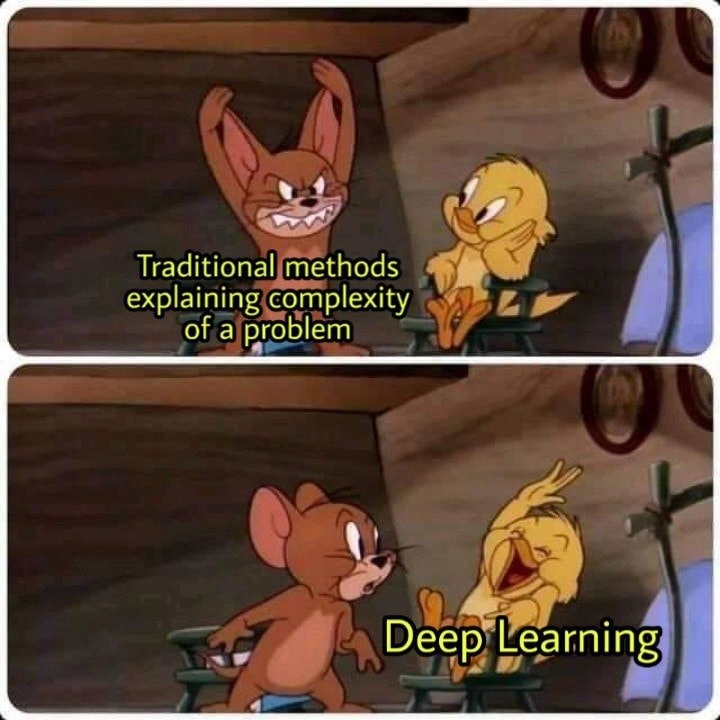
Let’s break down the meme and the concepts for someone newer to the field. We have two characters from a classic cartoon (Tom & Jerry). Jerry, the brown mouse, represents “traditional methods” in this meme. In the top image, Jerry is on a stool, looking very angry and shouting – the text over him says “Traditional methods explaining complexity of a problem.” This is a funny way of showing that older or more classical approaches to problems tend to involve a lot of careful thought and explanation. They deal with the complexity by talking about it or analyzing it deeply. For example, a traditional method in programming or math might mean you break a complex problem into smaller understandable pieces, or you derive formulas and rules for every part of the problem. If you’ve taken an algorithms class, it’s like the difference between writing a step-by-step algorithm vs. just calling a library function that does it for you – the traditional way is the step-by-step, fully understanding each step.

On the right of Jerry in that top panel is a small yellow canary. In the original cartoon, that bird is just a character, but here it’s used symbolically. At first, the canary isn’t labeled with any text; it’s just sitting relaxed and politely listening while Jerry rants. You can imagine the bird saying, “Uh-huh, I see,” while Jerry (traditional method) is going on and on about how complicated the problem is. This is like someone giving a very detailed technical explanation and the listener just nodding. The humor is already brewing here: the bird looks almost unimpressed or casual, which hints that maybe the bird has a simpler view of things.

Now, look at the bottom panel of the meme. The roles switch! Now Jerry (the mouse) is calm and maybe gesturing in a normal talking manner, and the canary on the stool is absolutely cracking up laughing. Over the laughing bird, we see the label “Deep Learning” in bold text. So the bird is now explicitly tagged as “Deep Learning.” This tells us the bird character represents the concept of modern Deep Learning techniques. The bird is laughing so hard, you can see it’s throwing its head back with its beak open – a big cartoon laugh. This visual gag suggests that Deep Learning finds something really funny or trivial about what was being said before. And what was being said before? “Explaining the complexity of a problem” by the traditional methods! So it implies that deep learning isn’t too concerned with all that complicated explanation – it’s almost laughing at it. It’s like Deep Learning is saying, “All that fuss and yelling about complexity, and I solved it without breaking a sweat, haha!”

To a newcomer: Deep Learning is a subset of machine learning and AI (Artificial Intelligence). It involves models called neural networks that are loosely inspired by the human brain. These models consist of layers of connected “neurons” (really just mathematical functions) that transform input data (like an image or a sentence) into an output (like a label or a prediction). What’s special about deep learning is that these networks can learn very complicated patterns from examples. You don’t have to program all the rules explicitly. If you give a deep learning model tons of data, it adjusts its internal settings (weights of connections) to get better and better at whatever task you want, whether that's recognizing a cat in a photo, translating a language, or driving a car. People often call these models "black box models" because, after training, we can feed in an input and get an output, but it’s hard to see inside and understand how it decided on that output. The term black_box_models literally comes from the idea of a black box: you can see what goes in and what comes out, but you can’t see the inner workings.

Now, traditional methods in AI or statistics might refer to things like linear regression, decision trees, or other techniques where the logic is more transparent. For instance, a decision tree is a flowchart-like model that might say “if feature A < 5, go left; if not, go right,” and so on – you can follow the path and understand the decision. A linear regression might give you a formula like price = 2*(size) + 3*(num_rooms) + ... and you can interpret those coefficients (2 means for each extra square foot, price increases by 2 thousand dollars, etc.). These methods require understanding the relationships in your data or assuming a certain simple form for them. They often struggle if the problem is really complex, like if the relationships aren’t linear or there are tons of factors interacting in weird ways. That’s why Jerry is shown “explaining the complexity” – typical older approaches need you (or the method) to explicitly handle the complexity. For example, you might hear a statistician say, “The model needs a term for the interaction between A and B, otherwise we can’t capture that effect,” which is very much like explicitly explaining a piece of complexity.

Deep Learning, by contrast, tends to be more like, “Throw a big neural network at the data, and it will learn those interactions by itself.” It’s powerful, but often we don’t have a neat explanation for how the network is doing it. In fact, there’s a running joke that deep learning is “AI sorcery” or “just hit run and pray” – not because there isn’t science behind it (there is a lot of science!), but because from the outside it can look like magic when it works. You feed in raw data, run a training process, and out comes a model that can do things like recognize speech or recommend movies, and you’re not always sure exactly what patterns it latched onto. That’s why in the meme, Deep Learning (the bird) is laughing — it’s almost blase about the complexity. The bird didn’t need Jerry’s angry lecture about how complicated things are. It just solved it with a black box approach, likely thinking “Psh, I got this, no need to overthink.”

To put it simply, traditional vs deep learning is like explainability vs raw performance a lot of times. Traditional models: simpler, easier to interpret, but might require a lot of human guidance and might not handle super-complicated patterns unless we hand-hold them. Deep learning models: can handle crazy complexity by themselves if given enough data, but they are hard to interpret (we often don’t get a nice explanation of why the model made a certain decision). This trade-off is a huge topic in modern AI: we want models that are both accurate and understandable, but often we end up picking one or the other.

The meme also hints at the AI_hype_cycle. Deep learning has been hyped a lot (with good reason, due to its successes). Sometimes newcomers think deep learning is literally magic. In reality, what’s happening inside (which we can’t see easily) is that the model is doing tons of multiplications and additions (millions of them!) to adjust its internal numbers to fit the data patterns. It’s like trial and error on steroids, guided by a method called gradient descent that nudges the model in the direction of better performance. Traditional methods might have more mathematically direct ways of finding a solution (or might not even be able to solve it if it’s too complex). Deep learning just kind of brute-forces the learning but in a very clever way, leveraging modern computing power.

Let’s connect this to a simple coding analogy: say you want to filter spam emails.

  • A traditional method approach: you might program explicit rules. For example, if the email contains certain "spammy" words or too many exclamation marks, mark it as spam. You could also use a more classical ML approach like a logistic regression that looks at a few specific features (word frequencies, etc.) that you chose. You or the algorithm designer is heavily involved in deciding how to look at the email.

  • A deep learning approach: you’d take a large dataset of emails labeled as spam or not spam, and feed them into a neural network. The network might learn to make spam predictions without you telling it any rules at all. It could automatically learn that certain patterns of text or metadata indicate spam. But in the end, you won’t have a list of easy-to-read rules; you’ll just have a neural network that takes in an email and outputs “spam” or “not spam”.

Here’s a pseudo-code comparison to illustrate:

# Traditional rule-based approach (simplified example)
def is_spam(email):
    score = 0
    if "WIN $$$" in email.text.upper():
        score += 1
    if email.sender in known_spammers_list:
        score += 1
    # ... (many more rules examining the email) ...
    return score > 1   # spam if score is above threshold

# Deep learning approach using a neural network
model = NeuralNetwork()  # define a neural network with some layers
model.train(training_emails, training_labels)  # learn from examples
result = model.predict(new_email)  # the model outputs a prediction without explicit rules
print("Spam?" , result)

In the first approach, we explain exactly how we determine spam (like checking for "WIN $$$"). In the second, the deep learning model just figures it out from data. But if you ask the deep model “why did you say this email is spam?”, it won’t literally tell you “because it had 3 money signs and came from [email protected]” – we’d have to do a lot of digging (with special tools) to infer that reasoning, and even then it’s not guaranteed.

To make this super clear, here’s a comparison of the two approaches in general:

Traditional Approach 🧮 Deep Learning Approach 🤖
Requires human experts to decide how to handle the problem’s complexity (features, rules). Learns patterns automatically from lots of data (features are discovered by the neural network).
Often yields a simple model (e.g. a formula or simple rules) that you can interpret. Yields a very complex model (millions of numbers) that is hard to interpret (a “black box”).
Struggles if the problem has too many factors or non-linear relationships that are hard to manually capture. Excels at capturing extremely complex patterns, given enough data and computation, even if we don’t understand those patterns.
Example: a logistic regression for spam might look at 5 key words decided by a person. Example: a deep network for spam figures out its own 1000+ subtle indicators from the raw email text.
You can explain exactly why the model made a decision (because it follows the rules or formula you set). We generally cannot pinpoint easily why the model made a particular decision (we just trust that it saw similar patterns in training).

In the meme, Jerry (traditional) is angry because from that point of view, the problem is really hard to explain and solve methodically. The bird (deep learning) is laughing because from its point of view, you don’t need to get angry; you just let the data speak. This highlights what people often call AI_hype vs reality: The reality (traditional view) is that problems can be genuinely complex and daunting. The hype (deep learning view) is that there’s an easy button – just use a neural network and don’t worry about the theory as much. Real life is a mix of the two: deep learning is powerful but you still need to be careful (it can have pitfalls like needing a lot of data, possibility of learning the wrong thing, etc.).

For a junior developer or someone just learning AI, this meme is a tongue-in-cheek reminder of how it feels to compare old-school and new-school techniques. The first time you use a deep learning model and it works, you might literally feel like that laughing canary, thinking “Wow, that’s it? I got better results and I didn’t have to manually do all that complicated stuff!” At the same time, if you come from a classical background, you might empathize with Jerry: sometimes you want to understand the problem deeply and not just have a mysterious model. The interpretability_vs_performance trade-off is something you’ll encounter: do you pick the model that’s like a clear glass box (you can see through it but maybe it’s simpler), or the one that’s a black box (opaque but super powerful)?

So in summary, the meme uses a funny cartoon scenario to capture a real phenomenon in data science and AI: classic, rigorous methods can feel overwhelmed by complex problems (and those using them can get a bit worked up trying to explain everything), whereas deep learning methods often handle the same complexity by effectively outsourcing the thinking to the data and a big model, leading to this almost smug confidence (hence the laughter). It’s AI humor at its finest because it exaggerates and personifies these approaches so we can laugh at the contrast.

Level 3: Hold My GPU

Every experienced engineer or data scientist has seen a version of this scenario. You’re in a meeting or working on a tough problem, and the person using traditional methods is practically pulling their hair out. They’re carefully explaining every tricky part of the problem – maybe it’s a data science problem where they’re accounting for dozens of variables, interactions, edge cases, and trying to derive an analytical solution or a neat statistical model. This is Jerry in the top panel: “Look how complicated this is! We have to consider X, Y, and Z, the model needs to account for all these factors!” Jerry’s angry, exaggerated expression is all of us old-school folks when confronted with a gnarly problem: we rant about how complex it is, maybe drawing equations or decision trees on a whiteboard. The little canary on the stool listening politely represents either an onlooker or the problem itself – sitting there unphased by the rant. We’ve all been Jerry at some point, explaining to our team (or rubber-duck debugging 😅) why the project’s complexity is off the charts.

Then enter Deep Learning – represented by that same yellow canary in the bottom panel, now labeled and absolutely losing it in laughter. The roles flip. Jerry the mouse is suddenly calm, maybe saying, “...and that’s how we handle it” or stepping aside, while the canary (Deep Learning) throws its head back in carefree laughter. This captures the almost comedic ease with which deep learning approaches many problems that give traditional methods a headache. It’s like the deep learning practitioner saying “Complex problem, huh? Hold my GPU!” — a play on the “hold my beer” meme where someone steps in to effortlessly outperform the struggling person. In real life, this is the data scientist who, after hearing the lengthy explanation, just quietly builds a quick neural network model using PyTorch or TensorFlow, feeds in the data, and voila – the problem is solved (or at least a surprisingly good solution is found) without explicitly addressing each sub-complexity that Jerry was anguishing over.

Why is this funny and so relatable in the AI/ML community? Because it happens a lot! Imagine a stats professor meticulously fitting a complex statistical model and a student comes along with a 10-layer neural network and gets better accuracy in half the time. It’s both awe-inspiring and a bit vexing. The humor has a pinch of “kids these days with their fancy neural nets…” in it. It reflects a real industry trend: AI_hype has led to neural networks being applied everywhere, sometimes with great success on problems we used to handle with custom methods. The green text “Traditional methods explaining complexity of a problem” versus the bold “Deep Learning” illustrates the AI_hype_vs_reality dynamic: traditional methods (reality-grounded, methodical) painstakingly wrestle with the complexity, whereas deep learning (hype-fueled optimism) just steamrolls through with a giant model, often treating that complexity as a non-issue. The canary laughing is basically saying: “All that explanation was cute, but I don’t need it – I’ll just train a network.”

This resonates especially with those who remember pre-deep-learning times. In the 2000s, if you did machine learning, you probably spent a lot of time on feature engineering: carefully selecting or crafting the right input features that capture the essence of the problem. You might use domain knowledge (like, “if I take the frequency of certain words, I can improve my spam classifier” or “the ratio of width to height might help detect this object in an image”). Each feature was like Jerry’s detailed explanation of the complexity. Then deep learning comes along with neural networks that have many layers (hence “deep”) which automatically learn hidden features and patterns. Suddenly you skip most of the feature engineering – just feed raw data (images, text, etc.) into a big model and let it figure out the important aspects. The experienced folks were stunned: these models started outperforming the old methods on complex tasks like image recognition, speech translation, etc. It really felt like the deep learning crowd was laughing as they leapfrogged years of painstaking work. This is classic AI_industry_trends material: a shift where what was hard becomes easier (at least on the surface) thanks to a new technique, leading to a mix of excitement and skepticism.

There’s also a subtle nod to the explainability_debate in AI. In the second panel, Deep Learning is laughing – one way to read that is: deep learning folks sometimes dismiss concerns about interpretability. Like, “Haha, who cares why it works, it gets 95% accuracy, ship it!” Meanwhile, the traditional methods camp is concerned (Jerry’s earlier rage) about how complicated the problem is, implying they want to really understand it. In many organizations, there’s a tug-of-war between these mindsets. For example, a bank’s risk officer (traditional approach) might demand a clear explanation for a model’s decisions, while a data scientist (deep learning approach) might argue that their complex model predicts defaults more accurately even if it’s a black box. The meme humorously casts the deep learning side as not even engaging in the hard discussion — they’re just laughing, perhaps at how over-the-top the traditional explanation seems when you can simply let a neural network do the grunt work.

The phrase “Hold my GPU” (though not explicitly written in the meme, that’s the vibe) encapsulates the senior-perspective joke. GPUs (graphics processing units) are the hardware that made training deep networks practical – they can crunch the massive computations quickly. A senior developer or ML engineer will appreciate this reference: it’s as if Deep Learning says, “Oh this complex problem is making you upset? Here, hold my GPU, let me show you how my 10-billion-parameter model eats it for breakfast.” 😎 The humor has a slight edge: it can feel a tad insulting if you’re the one who struggled with the complexity using traditional methods. But you can’t deny the results when the deep model works. Many of us have a love-hate relationship with this: we love the results deep learning gives, but we’re uneasy not fully grasping the “why” under the hood.

In sum, the senior perspective sees this meme and nods knowingly. It’s poking fun at the current state of AI_hype_cycle: deep learning is at the stage where it’s often amazingly successful (hence the smug laughter) and a bit overhyped, and classical techniques, while principled and interpretable, sometimes look stodgy and overwhelmed (the exasperated Jerry) by comparison. It’s the “adapt or get left behind” moment in tech humor form. Traditionalists might roll their eyes, deep learning enthusiasts might grin, and those of us in the middle just chuckle because we’ve seen both sides play out in real projects. The meme distills a complicated dynamic into two cartoon frames and nails the absurdity of it: one side sweats the details, the other side seemingly breezes through by trusting the NeuralNetworks — and both are simultaneously right and a little ridiculous.

Level 4: Universal Approximation, Zero Explanation

At the most theoretical level, this meme touches on deep concepts in machine learning theory. A key idea is the universal approximation theorem – which essentially says a sufficiently large neural network can approximate any function that maps inputs to outputs (within certain conditions). In other words, a deep neural network with enough layers and neurons can represent incredibly complex relationships in data, even relationships that are too complicated for us to write out with traditional equations. This is why the canary labeled Deep Learning can afford to “laugh” at the complexity: from a mathematical standpoint, the network isn’t intimidated by how intricate the problem is, because we know in theory it can contour itself to fit almost any complexity given enough data and training time.

But there's a catch: while a deep network can swallow complexity whole, it often does so as a black box. In theoretical terms, it's absorbing the problem’s complexity into millions of parameters (weights) rather than a human-comprehensible form. Think of Kolmogorov complexity (the theoretical measure of the simplest description of something): a deep network might encode the solution in a convoluted tangle of numbers which is a valid description, just not one we can easily interpret. The traditional methods (Jerry, the mouse) insist on explaining the complexity – effectively trying to write a clear, step-by-step description of the problem or find a neat closed-form solution. That's often linked to classical statistics or algorithm design, where you derive formulas or logical rules. However, as the problem complexity grows (non-linear interactions, high-dimensional data, chaos), that insistence on explicit explanation runs into walls.

This meme humorously illustrates a real academic debate: interpretability_vs_performance. Traditional statistical models (like linear models or decision trees) are interpretable – you can open them up and see which factors do what – but they might struggle with very complex patterns. Deep learning models, on the other hand, are often high-performing on complex tasks (vision, language, you name it) but come with low interpretability. In the AI research community, this leads to the explainability_debate: how do we get the best of both worlds? Researchers are asking how we can peek into that black box to understand why the deep net makes certain decisions. There’s ongoing work on techniques for this (like visualizing neural network layers or using Shapley values and other tools to approximate feature importance), but fundamentally, a large neural network remains an opaque tangle of numbers. It’s as if deep learning solved the complexity problem by moving it out of the realm of human reasoning and into the realm of high-dimensional mathematics. The result is powerful but also a bit philosophically unsettling – and that contrast is exactly what the meme is poking fun at. The traditional approach stands there, arms up, essentially saying, “We need to understand this!” and the deep learning approach just chuckles, replying, “I modeled it instead, no explanation needed.”

From a theoretical computer science perspective, it’s a bit like comparing a meticulously proven algorithm with guaranteed performance to a massive search (gradient descent) through an astronomical solution space with no guarantee except empirical success. Deep learning’s attitude is “throw more data and GPU at it”, reminiscent of a brute-force approach but guided by clever optimization. This brings to mind the No Free Lunch theorem: it tells us no single approach wins on all problems without assumptions. Deep nets implicitly assume that patterns can be learned from data in ways we can’t manually articulate; often this assumption holds true for complex real-world data, which is why they seem almost magical. The humor is that to the deep learning model, the problem’s intricacy is not a show-stopper – it’s expected – whereas to classical methods, that intricacy is something to grapple with explicitly. In summary, at this deep theoretical level, the meme highlights an almost paradoxical situation: modern AI sidesteps explicit complexity by internally managing even greater complexity, and in doing so, it often succeeds where old methods struggle. No wonder Deep Learning (the canary) is having a good laugh – it’s playing by an entirely different rulebook of mathematics.

Description

A two-panel meme using a scene from the cartoon 'Tom and Jerry'. In the top panel, Tom the cat looks angry and is gesturing aggressively at a small, unimpressed yellow duck. The text overlay reads, 'Traditional methods explaining complexity of a problem'. In the bottom panel, the duck is laughing hysterically, falling backward off its stool, while Jerry the mouse walks by looking startled. The text overlay simply says, 'Deep Learning'. The meme humorously contrasts the intense, manual effort required by traditional algorithms to model and solve complex problems with the often surprisingly effective 'black box' approach of deep learning. For experienced engineers, it's a relatable joke about the paradigm shift where complex, hand-crafted feature engineering is sometimes outperformed by large neural networks, which can feel both absurd and revolutionary

Comments

8
Anonymous ★ Top Pick A junior dev will proudly explain their model's elegant architecture. A senior dev just asks for the size of the training dataset and the AWS bill
  1. Anonymous ★ Top Pick

    A junior dev will proudly explain their model's elegant architecture. A senior dev just asks for the size of the training dataset and the AWS bill

  2. Anonymous

    My Bayesian model spent weeks deriving priors; the transformer just swallowed the entire S3 bucket, burped out 0.02 more AUC, and now we’re rewriting prod in CUDA

  3. Anonymous

    Deep learning: where we traded understanding why it works for explaining why it doesn't

  4. Anonymous

    Traditional methods spend a PhD proving the problem is NP-hard; deep learning just bills it as an AWS line item and calls the loss curve 'promising'

  5. Anonymous

    This perfectly captures the existential crisis of the classically-trained CS PhD watching their carefully proven O(n log n) algorithm with formal correctness guarantees get obliterated in production by an intern who threw 47 transformer layers at the problem, tuned hyperparameters on a weekend, and somehow achieved SOTA results that nobody can explain beyond 'the loss went down.'

  6. Anonymous

    Traditional methods: Traceable logic tree. Deep Learning: 'Emergent behavior from the activations' - said no production SRE ever

  7. Anonymous

    Traditional algos debate Big‑O; deep learning laughs, calls it O(cloud_spend), and opens another GPU quota ticket

  8. Anonymous

    Big-O says “NP-hard”; deep learning says “add 40B params and 64 H100s - ship it.”

Use J and K for navigation