The Ultimate Programmer Excuse: It's Hardware
Why is this Hardware meme funny?
Level 1: It’s a Hardware Problem
Imagine you ask your friend who’s great with computers to help change a burnt-out lamp bulb, and they grin and say, “Nope, I only deal with computer stuff, not light bulbs!” It’s funny because changing a light bulb is such a simple thing that anyone can do, yet your friend is jokingly refusing just because it isn’t about computers. They’re basically saying, “That’s someone else’s job, not mine,” which is a pretty silly excuse when you think about it. The humor comes from seeing someone avoid a basic chore by hiding behind their special role. It’s the same kind of laugh we get if a chef said, “I cook the food, but I won’t replace the kitchen light – get an electrician for that!” We all know how ridiculous that sounds. The joke makes us smile because it shows a person acting overly picky about what they will and won’t do, even when the task is super easy – and that little bit of absurdity is exactly why it’s so funny.
Level 2: Out of Scope
This meme is a straightforward slice of programmer humor that a junior developer can appreciate once they know the context. It plays on the difference between hardware and software, and who is expected to handle what in the tech world. In simple terms, hardware means the physical parts of a computer or device (things you can touch, like a light bulb, a keyboard, or a circuit board). Software means the code and programs that run on those physical devices. So when the meme asks, “How many programmers does it take to change a light bulb?”, the joke answer comes back as, “None – it’s a hardware problem.” In other words, changing a light bulb is a physical task (hardware), not something you solve by writing code (software). The programmer in the joke is basically saying, “We deal with code, not light bulbs.”
This follows a classic format known as a “light bulb joke.” Typically, these jokes ask how many members of a certain group are needed to do a simple task, and the answers humorously highlight a stereotype about that group. Here, the stereotype is that programmers will avoid doing anything outside their coding duties. You might hear tech folks jokingly use the phrase “out of scope” to mean “not part of my job.” So a programmer might quip that changing a bulb is out of scope for them. The humor comes from exaggeration: obviously any person could change a light bulb — it’s a very simple task. But in the joke, the programmer refuses to even consider it, treating it as completely not their job. This playfully highlights a common attitude in tech: each team has its own domain, and anything outside that domain is seen as somebody else’s problem (at least when we’re joking about it).
For a junior dev just entering the industry, this meme might soon mirror some of your real experiences. Tech companies often split responsibilities between different teams. Software engineers write and fix code, while IT support or hardware technicians handle the physical equipment and infrastructure. If your office laptop breaks or a server needs a new hard drive, usually you’ll call the IT/hardware folks to take care of it. And outside of work, you might have friends or family assume that because you “work with computers,” you can also repair their printer or fix the home Wi-Fi or, yes, change a light bulb in the projector. Many of us have had to smile and explain, “Actually, I’m a software developer, not an electrician.” This meme is a humorous way of making that exact point. It’s the kind of coding meme you’ll see on developer forums or Slack channels — a little in-joke about the quirks of our job roles that helps techies bond through laughter.
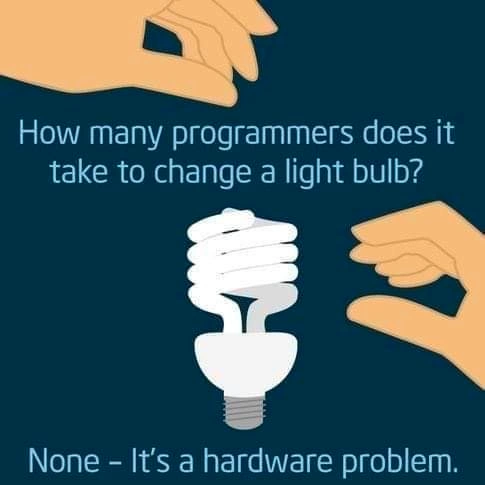
Now, let’s look at the image and text. The illustration shows two cartoon hands about to screw in a compact fluorescent light bulb. The big question written above asks how many programmers are needed for this task, and the answer below says none. If you’re new to this joke format, that answer might seem unexpected or even like the programmers are being lazy. But the key is the reasoning: “None – it’s a hardware problem.” The punchline isn’t just saying “none” for shock value; it’s giving a reason that tells a little story. It basically means the task falls under someone else’s responsibility (the hardware folks), not the programmers. It’s like the programmer is declaring, “This isn’t in my department, so I’m not doing it.”
This kind of geeky humor shines a light on how people in tech sometimes compartmentalize tasks. It’s a playful jab at ourselves — portraying programmers as so specialized that they pretend they can’t do an ordinary thing like changing a bulb. Even if you’re not a developer, you can understand the joke: someone is dodging a basic chore by using a techie excuse. We find it funny because we recognize how ridiculous that is. The meme takes the everyday idea of avoiding a task and dresses it up in tech talk. In the end, it’s showing that sometimes experts act like they can’t handle something simple because “it’s not their turf,” and that contrast is exactly what makes this scenario so relatable and amusing.
Level 3: Bugs Not Bulbs
At the highest level, this meme leverages a well-known joke formula to poke fun at the hardware-versus-software divide in tech. The setup “How many programmers does it take to change a light bulb?” is answered with a deadpan punchline: “None – it’s a hardware problem.” For those steeped in developer culture, this lands because coders love to draw a neat line around their responsibilities. It's a nod to classic scope of responsibility boundaries – anything outside writing code (like screwing in a light bulb) is humorously dismissed as "not my problem." In developer communities, this one-liner is practically legendary — a staple of developer humor passed around since the days of dial-up bulletin boards.
The humor works on multiple levels. First, it’s a light bulb joke, a classic programmer joke structure that many tech folks recognize. By answering “None,” the meme subverts expectations. Typically, these jokes exaggerate how inept or pedantic a group can be about a simple task. Here, the exaggeration is that programmers won’t even consider it their job to change the bulb. It’s a cheeky example of blame-shifting humor: the programmer immediately punts the issue to someone else — “hey, that’s a hardware issue.” This is funny to developers because it rings true of our experiences. When something breaks, there’s a familiar knee-jerk impulse to blame the hardware or environment rather than our precious code. It’s akin to the infamous “Works on my machine” defense and the running gag “It’s always DNS” when diagnosing system outages. In other words, the meme perfectly captures that all-too-familiar moment when a dev shrugs and says, “If it’s not code, I wash my hands of it.”
From an industry perspective, the meme highlights a long-standing silo between software development and hardware (or IT) support. Historically, software engineers wrote the code and hardware teams or sysadmins handled the physical servers and equipment. This separation often led to a culture of “that’s someone else’s job.” A senior developer will chuckle because they’ve seen these turf wars play out: if a server went down, the devs would say it’s an ops/hardware problem; if the code misbehaved, the hardware folks would say “the server is fine, check your code.” The light bulb scenario is a playful exaggeration of that dynamic. Changing a bulb is an extremely simple fix, yet the programmer in the joke won’t do it out of principle (or comedic stubbornness). It reflects a truth about specialization taken to the absurd. Veteran engineers remember the days before DevOps when hardware and software teams were firmly divided — each side quick to say “not it!” when an issue fell outside their own realm. This meme sits right at that intersection of roles, poking fun at how rigid those lines can be.
Real-world war stories make this meme especially relatable. Picture a programmer in the office being asked to help with something because “Hey, you’re good with computers!” Maybe the Wi-Fi is acting up, or the overhead light has blown out. Many of us have slyly answered with a variant of this joke in such moments. For example:
Developer: “The website is down. Must be a hardware fault.”
IT Support: “Actually, the server logs show an unhandled exception in the code…”
We’ve all been in a troubleshooting bridge call where someone half-jokingly suggests the problem is the machine or the network cable — basically anything except the application logic. This meme distills that scenario perfectly. It’s that bit of dev tribalism where the software folks reflexively bounce the issue over to the hardware side. Culturally, it’s also a gentle ribbing of the stereotypical programmer who is more comfortable staring at code on a screen than dealing with a literal light bulb above their head. After all, why grab a ladder when you can blame the circuit?
Underlying the joke is a comical truth about how people in tech get pigeonholed. There’s an old trope that a genius coder might be hopeless at simple handyman tasks. The meme exaggerates it: zero programmers are involved, because they all insist it’s “not our department.” It’s the kind of comic relief you’ll even find on IT support meme pages, where support techs tease developers for washing their hands of anything physical. For experienced engineers, the laughter comes with a hint of “Haha, been there, blamed that.” They recognize that this punchline is both a tongue-in-cheek brag and a lighthearted coping mechanism. In a high-stakes outage at 3 AM, joking “maybe it’s hardware” is sometimes the only sanity-preserving quip before the real root cause is found.
Description
A classic tech joke presented visually on a dark blue background. The top text asks, 'How many programmers does it take to change a light bulb?'. In the center, a white compact fluorescent light bulb is depicted, framed by two hands. The punchline at the bottom reads, 'None - It's a hardware problem.'. This meme plays on the age-old trope of software developers deferring responsibility for issues that fall outside the realm of code. It humorously highlights the strict division between software and hardware teams in many organizations, where 'It's a hardware problem' becomes the default explanation for any unresolvable bug, effectively ending the programmer's involvement
Comments
8Comment deleted
Blaming hardware is the original 'it's a DNS issue.' It's not always wrong, but it's a reliable way to buy yourself at least four hours of peace
Zero - after declaring the bulb a deprecated single-node service, we Terraform a fleet of IoT LEDs and let facilities handle the brown-outs
The real answer is three: one to open a JIRA ticket, one to argue it's a feature not a bug because darkness improves code review contrast, and one to implement a microservice that polls the bulb's status every 100ms just in case it starts working again
The bulb stays dark for three sprints while the ticket bounces between teams, until someone finally closes it as 'works as designed: room is dark-mode'
This perfectly encapsulates the software engineer's first line of defense: 'Works on my machine' has evolved into 'Not in my stack.' The joke resonates because it reflects a deeper truth about modern specialization - we've abstracted ourselves so far from the metal that even changing a light bulb feels like crossing an architectural boundary. It's the spiritual successor to 'Have you tried turning it off and on again?' but for when the problem exists in meatspace rather than the cloud
If it were software we’d toggle bulb_enabled=true; since it’s hardware, route the Jira to Facilities and call it a multi-AZ LED migration
Hardware? That's SRE's Jira - until the outage budget hits zero and it's monolith refactor time
switch.toggle() meets spec; lumen emission is a Layer 1 dependency outside our service boundary - open a facilities ticket, not a Jira