Too Many Convolutions, Full Deep Dream
Why is this AI ML meme funny?
Level 1: Too Much Pattern
Imagine staring at clouds and saying, "I see a bunny." Then someone else stares so hard that every cloud becomes a bunny, every shadow becomes a bunny, and the whole sky turns into a glowing bunny storm. That is the joke here. The computer is not just looking at a picture anymore; it is finding patterns so aggressively that the picture becomes a colorful mess of things it thinks it recognizes.
Level 2: Filters Get Weird
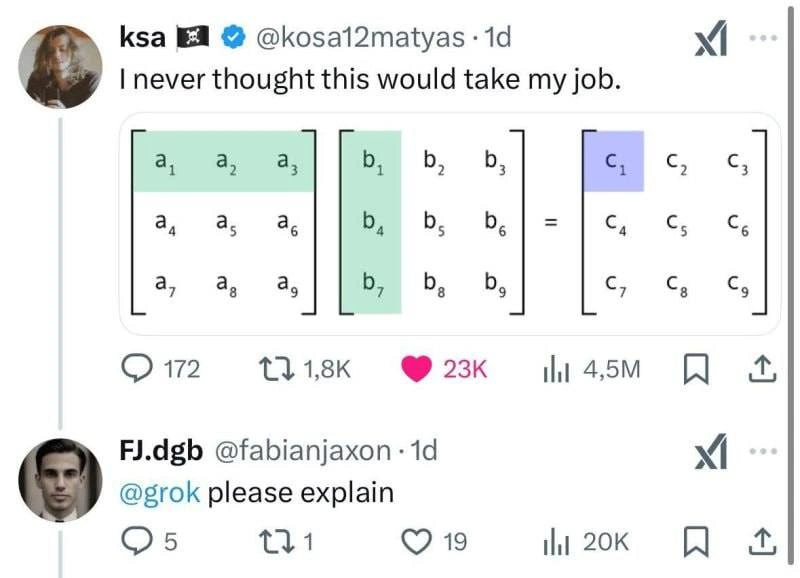
A convolution is an operation that slides a small grid of numbers, called a filter or kernel, across an image. At each position, it combines nearby pixels to detect a pattern. One filter might respond to vertical edges. Another might respond to curves. Another might notice texture.
A convolutional neural network stacks many of these operations. The first layers usually detect simple details. Later layers combine those details into bigger patterns. For example:
- Early layer: "There is an edge here."
- Middle layer: "These edges look like a circle or an eye."
- Later layer: "This region resembles part of an animal face."
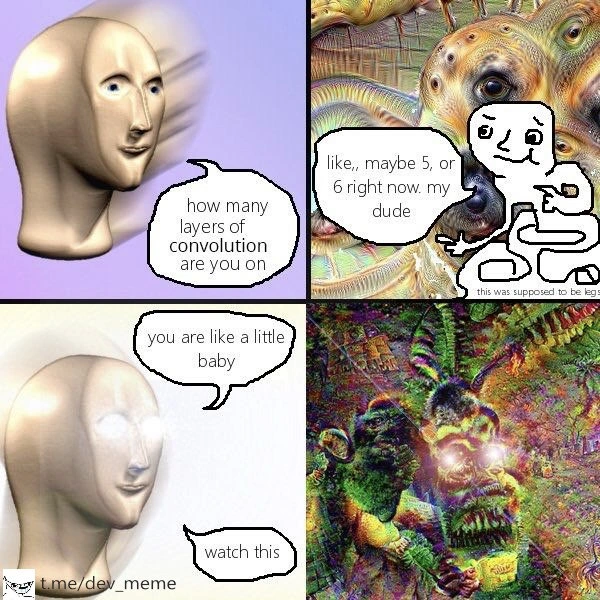
The meme turns that idea into a contest. The person saying they are on "maybe 5, or 6" layers is treated like a beginner, even though several convolutional layers can already do meaningful visual processing. The other character says "watch this" and produces an image that looks overloaded with model-amplified patterns.
The final panel resembles DeepDream, a famous style of neural-network image manipulation where a model's internal detections are strengthened over and over. If the model thinks it sees an eye-like curve, the process makes it more eye-like. Then the model sees even more of it, and the loop keeps going. That is why these images often look like a crowd of repeated eyes, snouts, fur, and textures appearing where they were never intentionally drawn.
For someone learning machine learning, the meme is a reminder that "more layers" does not simply mean "smarter." It means the network can represent more complicated transformations, which may be useful, unstable, expensive, strange, or all of the above. Welcome to deep learning: sometimes the math works, and sometimes the dog appears in the wallpaper.
Level 3: Hallucination As Flex
The four panels set up a hierarchy of computational bravado. In the top-left, a smooth mannequin head asks how many "layers of convolution" someone is using. In the top-right, a doodled character replies casually that they are on "maybe 5, or 6." The background is already strange: dog-like faces, eyes, and stretched textures crowd the scene. Then the bottom-left head responds with the classic escalation:
you are like a little baby
watch this
The bottom-right panel is the flex: an overloaded, colorful, near-indecipherable hallucination where the image seems to have been fed through feature amplification until ordinary visual structure gives up and signs the incident report.
What makes this funny to machine-learning people is that it exaggerates a real intuition: deeper CNN layers tend to represent more complex combinations of visual features. "How many layers are you on?" sounds like asking how intense the model's perception has become. The reply "5, or 6" is framed as modest, even naive. Then the final image behaves like someone cranked the network past "image processing" into "the model has opinions now."
There is also an industry-pattern joke here. AI_ML work often has a serious vocabulary around architectures, layers, filters, feature extractors, and generative output, but it also produces artifacts that look absurd to humans. A model can be mathematically consistent and visually deranged at the same time. That contrast is the heart of the meme: the more sophisticated the machinery becomes, the less normal the output appears.
The visible art leans into that contradiction. The heads are blank, pale, and calm, while the CNN-like backgrounds are noisy, saturated, and full of half-formed creatures. The calmness makes the chaos funnier. It is the machine-learning equivalent of a senior engineer saying "tiny config change" while Kubernetes quietly begins composing its farewell letter.
This is also why the meme belongs near ImageProcessingAlgorithms and AIGeneratedContent rather than generic "AI magic." The joke is not merely that AI makes weird pictures. It is that a specific family of visual models can turn layer activations into repeated motifs, and that people familiar with neural networks recognize the final panel as an exaggerated version of a real technique.
Level 4: Receptive Field Fever
The meme's surface text is simple, but the punchline depends on a real property of convolutional neural networks:
how many layers of convolution are you on
like,, maybe 5, or 6 right now my dude
you are like a little baby
watch this
In a CNN, a convolutional layer applies learned filters across an image, producing feature maps. Early layers usually respond to small, local patterns: edges, color transitions, simple textures. Stack more layers, add nonlinear activations, pooling or striding, and the effective receptive field grows. A neuron deeper in the network is no longer "looking" at a tiny patch of pixels; it is influenced by a larger region and can represent more abstract combinations of earlier features.
That is why "5 or 6" layers can be treated as rookie numbers in the meme. A shallow stack might detect useful visual primitives. A deeper hierarchy can combine those primitives into eyes, fur, snouts, arches, buildings, and other complex motifs, depending on training data and objective. The bottom-right image, dense with warped textures and animal-like forms, looks like the result of repeatedly amplifying whatever internal features a vision model already thinks it sees.
The DeepDream-style effect comes from turning the usual direction of learning inside out. Normally, training adjusts model weights to reduce loss on data. Feature visualization often freezes the network and changes the input image instead:
# Conceptual sketch, not production code
image = noisy_start()
for step in range(steps):
activation = model.layer[k](image)
loss = activation[target_channels].mean()
image = image + learning_rate * gradient(loss, image)
Instead of asking, "What class is this picture?", the process asks, "What input would make this layer extremely excited?" The answer is often beautiful nonsense. Because convolutional filters are reused across the spatial grid, the same motifs can bloom everywhere. Because deeper layers encode higher-level features, those motifs can become unnervingly recognizable. That is the technical root of the psychedelic pileup in the final panel: optimization is not trying to make a normal photograph, it is trying to satisfy a model's internal appetite for features.
The joke is also a sly jab at DeepLearningModels as cultural artifacts. People say "more layers" the way other engineers say "more microservices" or "more abstraction": sometimes it is a principled design choice, sometimes it is just how we summon a larger problem with a better GPU.
Description
The image is a four-panel meme using smooth mannequin-like heads and psychedelic neural-network art. In the top-left panel, a head asks "how many layers of convolution are you on"; the top-right panel shows a doodled person in front of surreal animal-like imagery replying "like,, maybe 5, or 6 right now my dude." In the bottom-left panel, another pale head says "you are like a little baby" and then "watch this." The bottom-right panel explodes into a dense, colorful, DeepDream-like hallucination, joking about convolutional neural networks producing increasingly strange visual features as layers and transformations compound.
Comments
1Comment deleted
Five conv layers find edges; a few more and the model starts seeing production incidents in every dog.