The Root of All Power: Linux Groot
Why is this OperatingSystems meme funny?
Level 1: Superhero in Computer
Imagine a superhero who is a talking tree and only ever says his own name. Now imagine that tree superhero climbed inside your computer and became the boss of everything in it. In the movies, this tree character (his name is Groot) always says, "I am Groot!" That’s his funny catchphrase. In a computer, the person who is the boss of the system is called “root.” So if that tree guy took over a computer, he might cleverly say, "I am root!" instead of his name. It’s like him saying, “I’m the boss now!” in computer language.
This is funny because it’s mixing two different worlds in a silly way. It’s taking something from a kid’s imagination (a friendly talking tree from a superhero movie) and putting it into the nerdy computer world where “root” means the all-powerful user. It’s a bit like if you had a favorite cartoon character who always says one thing, and suddenly you see them on your screen saying a techy version of that phrase. The first part with the therapist is like someone saying, “Don’t worry, that goofy idea isn’t real, it can’t bother you.” And then boom – we see the goofy idea is “real” inside the computer, saying "I AM ROOT" with a big tree shape made out of text. The joke is that this scenario is totally make-believe and over-the-top. Of course a tree superhero isn’t really living in your computer! But picturing it is so outlandish that it makes us laugh. It’s a playful way of showing how a computer term (root, the admin) sounds just like the superhero’s phrase. The big text "I AM ROOT" on the screen is the punchline – it’s the computer character proudly announcing itself.
In simple terms: Think of root as a special key that opens every door on a computer. And think of Groot as a funny tree hero who loves saying his name. The meme pretends Groot has that special key in a computer world. So instead of saying “I am Groot,” he changes one word and says “I am root” – meaning “I have all the keys!” It’s like hearing your favorite superhero say they’ve become the king of computers. It’s silly and that’s why it makes people who get both references smile. Even if you’re not a computer expert, you can giggle at the idea of a tree hero showing up inside a computer screen and talking like he’s the big boss. It’s all just for fun – a little nerd humor that brings a comic book laugh into the tech world.
Level 2: Root vs Groot
Let’s break down the two worlds colliding in this meme: the CLI/Linux world and the Marvel world. On the tech side, we have the term “root”. In a Linux or Unix system, root is the name of the administrator account – the user who has permission to do absolutely anything. When you’re using a Command Line Interface (CLI) on Linux, you might see a prompt like root@localhost:~# or root@localhost:~$ in your terminal, indicating you are logged in as the root user on a machine named “localhost”. Being root is like being the ultimate boss of the computer; no file is off-limits, no action is restricted. For example, a normal user might be stopped with a “Permission denied” message when trying to edit a protected system file, but root can go right ahead and edit or delete it. This power is why working as root is usually done sparingly – it’s powerful but also dangerous if you’re not careful. Many systems require you to prepend commands with sudo (which stands for “superuser do”) to temporarily assume root privileges, precisely so you don’t stay root all the time by accident.
On the other side of this meme, we have Groot – a popular character from Marvel’s Guardians of the Galaxy. Groot is an alien creature that looks like a walking, humanoid tree. He’s known for being endearing, strong, and only ever saying one phrase: “I am Groot.” No matter what he means, all that comes out in English is “I am Groot” (his friends somehow understand the subtleties). It’s a cute running joke in those movies and comics that regardless of the situation, Groot’s verbal contribution is those three words.
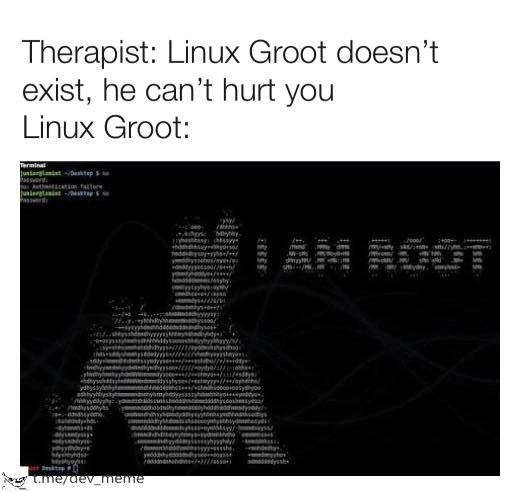
Now, the meme merges these two characters: root (the all-powerful Linux user) is being imagined as “Linux Groot”, a spoof version of Groot who exists in the command-line world. The text up top says, “Therapist: Linux Groot doesn’t exist, he can’t hurt you. Linux Groot:” and then we see the terminal screenshot of a Groot-shaped figure made of text saying “I AM ROOT”. This is essentially a play on words. Groot’s catchphrase “I am Groot” sounds an awful lot like “I am root” when you swap that one letter. For someone who’s both a Marvel fan and a Linux user, that pun is immediately clear and likely to get a grin. It’s taking the lovable tree superhero’s only line and giving it a tech twist: instead of proudly declaring his name, he’s declaring that he’s the superuser on a computer!
To appreciate the joke, you need to know a few key things:
- Linux/CLI Context: The whole image is styled like a Linux terminal. The black background with green/white monospaced text is exactly what you see when using the Linux command line (the CommandLineInterface). That little snippet
root@localhost:~$in the corner is a typical shell prompt. It tells us the username (root), the hostname of the computer (localhostmeaning this computer), and the~means the current directory (here~is shorthand for the user’s home directory). The$(or#) is just the prompt symbol. Seeingroot@localhosttells us that the user currently logged in is root, on a machine named “localhost”. So the setting is a Linux system where someone has admin access. - “root” Meaning: In everyday terms, root is just the name Linux uses for its administrator. On Windows you’d call this the “Administrator” account. On Linux, it’s “root”. If a program says “You must be root to do this” it’s saying you need to be the admin. This account is often used via the terminal for system maintenance, software installation (like using apt-get, the package manager shown in the text), and other tasks that normal users aren’t allowed to do. That explains why the silhouette is composed of package-manager output and shell commands – it’s implying that Linux Groot has been busy running updates or installations (something only root would do).
- Groot Reference: Groot is a character from the Marvel Cinematic Universe (guardians_of_the_galaxy_reference indeed!). He’s basically a big walking tree. Given that real trees have roots, the pun gets an extra layer of funny coincidence – Groot (a tree) associated with “root” (name of the superuser). But primarily, it’s about his famous line. In the movies, whenever Groot introduces himself or responds to someone, he says "I am Groot." Fans love this catchphrase because it’s simple and oddly adorable how that one line can convey so many emotions.
- The Joke Itself: So, the meme imagines if Groot were a embodiment inside a Linux system. The therapist line is a humorous setup implying someone is distressed by the thought of “Linux Groot”. The punchline visual is that “Linux Groot” would say "I AM ROOT" – exactly what you’d expect if Groot somehow got into your computer and attained admin powers. It’s a classic case of a pun where one word (Groot) is replaced with a similar-sounding tech word (root) to create a new meaning. It merges the idea of a sysadmin meme (something only IT folks would typically laugh at) with a mainstream comic character, making it accessible to techies who enjoy Marvel movies.
To make it even clearer, here’s a quick comparison between Groot and root to see why it’s funny when they swap:
| Groot (Marvel Hero) | root (Linux User) | |
|---|---|---|
| What is it? | A tree-like alien superhero from Marvel’s universe. Only ever says "I am Groot." | The name of the superuser (administrator) account on Unix/Linux systems. Has all permissions. |
| World/Context | Fictional, Guardians of the Galaxy movies/comics (fun and entertainment). | Technical, the Operating System and server world (commands, files, and permissions). |
| Power Level | Super strong, can grow, regenerate, and is basically a walking tree with a big heart. | Superuser power: can do anything on the system, from installing software to deleting critical files. (Ultimate computer boss!) |
| Personality | Gentle, loyal, and uses one simple phrase for everything. Sometimes sacrifices himself for friends. | Not a person at all – it’s a role. Whoever is logged in as root might feel a bit of god-like power, but also needs caution. (Think of it as a mode rather than a character.) |
| Famous phrase | "I am Groot!" (meaning “I’m Groot” – his name – but he uses it to express everything.) | "I am root." (meaning “I have admin access.” Not usually spoken – this meme personifies the computer saying it.) |
Reading this table, it’s easy to see the contrast and why combining them is humorous. Groot is a lovable guardian, and root is the guardian of the system (in a less cuddly way). If you’re a junior developer or just learning Linux, encountering the term “root” might confuse you at first – it sounds like something to do with plants or trees! Then you learn it’s just the name for the admin. This meme plays on that initial confusion: it literally gives you a tree named Root. 😄 It’s like someone heard “root user” and imagined a tree superhero as the user.
Also, notice those lines of text in the silhouette: those are what actual Linux commands and outputs look like. For example, when you install software using Ubuntu’s package manager APT, you see lines like “Reading package lists... Done” and “Building dependency tree... Done”. The meme’s creator took a bunch of those real lines and arranged them so that, when you look at them as a whole, they form Groot’s shape. This is a form of ASCII art (making pictures out of letters and numbers). It’s something of a tradition in programming and hacker culture – you might even have seen simple ASCII smiley faces or banners in older programs. Here it’s just done on a grander scale to silhouette a whole character. The text "I AM ROOT" is rendered in big block letters, likely using a ASCII art generator, to make sure nobody misses the joke. So not only are we reading the joke, we’re seeing it through clever text design.
For a junior techie or someone new to this:
- Don’t worry if you are not deeply familiar with Linux yet. All you need to know is root = the admin. Picture the admin account on your computer proudly saying “It’s me, I’m the boss!” That’s basically "I am root."
- Groot is just a fun character reference. If you know him, great – you’ll immediately see the parallel with the phrasing. If you don’t, just imagine a friendly tree character whose only line is introducing himself.
- The meme format (therapist saying “X isn’t real, can’t hurt you… X: [shows up]”) is a joke template. It’s saying sometimes we worry about silly imaginary scenarios, and here one comes to life. The humor is that “Linux Groot” is a totally absurd imaginary thing, so the therapist assures the patient it’s not real – and then the meme humorously suggests, well, what if it were real, right there in your terminal! The "he can’t hurt you" bit is especially funny to those who know that a root user going wild absolutely can hurt a system. It’s a playful contradiction.
This kind of meme is very popular among IT folks because it rewards those overlapping bits of knowledge – you feel “in on the joke” if you know both Linux and a bit of Marvel trivia. It’s a lighthearted way to remind everyone that even serious tech concepts (like user privileges) have a fun side when you look at them with nerdy creativity. So, if you ever hear someone say "I am root" in a joking tone, now you know they might be referencing this exact meme or pun – claiming ultimate tech power with a Groot-like flair. Just remember, in real computing life, saying "I am root" is less common than seeing it in a prompt or an error message (and it usually means you’ve got a lot of responsibility!). But in the context of this meme, it’s all about the wordplay and the joyful collision of two worlds: the command line and comic book catchphrases.
Level 3: Command Line Crossover
This meme is a brilliant mash-up of command-line culture with Marvel pop culture – a true Command Line Interface crossover. It overlays a beloved character from Guardians of the Galaxy (Groot, the tree-like alien who only ever says "I am Groot") onto a Linux terminal setting. The humor comes from an i_am_root_pun: swapping out one letter in Groot’s iconic phrase yields "I am root," which in the tech world has a totally different meaning. It’s the kind of wordplay that makes developers and sysadmins chuckle, because it connects two wildly different contexts with a single punny phrase. On one hand, you have Groot from the Marvel universe – a gentle, powerful tree alien whose vocabulary is limited to variations of "I am Groot." On the other hand, you have root, the most powerful user on a Linux system, essentially the boss of the computer. When the meme’s text says the therapist insists "Linux Groot doesn’t exist and can’t hurt you," it’s playing on a common meme format – usually used to highlight someone’s irrational tech fears or running jokes – and then the punchline reveals the fantastical thing does exist (in a humorous sense). Here that thing is "Linux Groot," imagined as a looming figure in your terminal that proudly announces "I AM ROOT." It’s implying, tongue-in-cheek, that this combination of Groot + root is some kind of scary boogeyman for geeks – perhaps because a being with root privileges could "hurt" a system if it went rogue!
For experienced Linux users, the phrase "I am root" immediately resonates. It’s what you effectively declare (to yourself) whenever you switch to the root account to perform system-critical operations. There’s a mix of excitement and caution in that moment: you have ultimate power over the machine, and you must wield it carefully. Many of us recall our first time gaining root access and that slight jolt of “Whoa, I could break everything if I’m not careful.” The meme exaggerates that feeling by giving it a comedic MCU persona. In the Marvel films, when Groot says "I am Groot", it can mean anything from a warm greeting to a battle cry, depending on tone. In the Linux world, if someone or something says "I am root", it’s definitely a battle cry – it means full system dominance. Seasoned sysadmins might jokingly equate seeing root@localhost in their prompt with hearing a superhero announce their arrival. It’s simultaneously empowering and a little ominous (just like Groot can be adorably friendly and incredibly strong).
The visual of the meme adds another layer for the tech-savvy: it’s an ASCII-art style silhouette of Groot, composed entirely of terminal text and command output. This detail shows real command-line content shaping the image: lines of Linux shell commands and package manager output (probably from something like apt-get on Ubuntu/Debian, given the context). Constructing images out of monospaced text on a terminal is an old hacker art form – literally text art. It harkens back to the days before high-res graphics, when computer enthusiasts would draw complex pictures using only the 95 printable ASCII characters. Here, the artist cleverly used actual CLI output to do it. Eagle-eyed Linux users might spot fragments like "root@localhost:~#" or familiar package manager lines such as "Reading package lists... Done" or "Building dependency tree..." in the jumble of text forming Groot. Amusingly, the phrase “Building dependency tree” often appears when installing software via APT – and what better way to build a tree (Groot!) out of text than to literally include the word "tree" repeatedly? It’s a great in-joke within the art itself. The huge block letters spelling out I AM ROOT to the right of Groot likely were generated using a command-line tool (for instance, the classic figlet utility can turn text into big ASCII banners). All these terminal details – the green prompt text, the monospaced font, the package output – firmly plant the meme in the realm of TerminalHumor. It’s the kind of nerdy Easter egg that makes people who practically live in the terminal grin with appreciation.
From a senior developer or sysadmin perspective, there’s extra irony in the therapist’s proclamation "he can’t hurt you". Anyone who has accidentally executed a destructive command as root will tell you that root certainly can hurt – it can hurt you, your system uptime, and your weekend plans! 😅 The collective experience of sysadmins includes war stories where one mistaken sudo command led to hours of recovery. So a part of this joke nods to that healthy fear of operating as root. It’s as if we jokingly personify the root account as a wild, powerful entity (here, a friendly tree monster) that we must reassure ourselves isn’t lurking in the shadows ready to wreak havoc. Of course, in reality, root isn’t sentient – but treat a production server’s root account recklessly and you might feel like some creature just clobbered your system. This is root_privilege_humor at its finest: acknowledging the incredible power of the root account, and diffusing the anxiety around it with a pop-culture laugh. It’s the same vibe as the classic saying among developers, "With great power comes great responsibility," applied to using root. In fact, that phrase (originally from Spider-Man’s lore) fits perfectly here too – Groot is from Marvel, and the root account indeed demands responsible use. One could imagine a sysadmin mentor gently warning: “Be cautious, Padawan – with great power (root) comes great responsibility,” just as Uncle Ben would advise if he were in IT 😉.
Finally, the cross-over nature of this meme highlights how developer humor loves to blend domains. It takes something mainstream and fun (a Marvel character) and blends it with something niche and technical (Linux command line). The result is a joke that feels tailor-made for those of us who straddle both worlds. It’s a guardians_of_the_galaxy_reference turned into a sysadmin_meme. And the reason it clicks is because it’s relatable: as tech folks, we often anthropomorphize our tools (ever yelled at your computer or lovingly called a server your “baby”?). So picturing Linux’s root account as “Linux Groot” is absurdly fitting. Groot’s lovable simplicity (“I am Groot”) maps to the terse simplicity of command-line outputs and user labels (“root”). The meme says, don’t worry, that crazy Linux Groot isn’t real – and then shows us a nightmare/fantasy where it is real, standing right there in your terminal. It’s a playful reminder that in the world of IT, even our nightmares have a sense of humor. We laugh because the scenario is ridiculous, yet we also appreciate how perfectly Linux lingo and Marvel lore have been fused. This is the kind of joke you’d see on a dev’s office wall or shared in a team chat: half groan-worthy dad joke, half genuinely clever. In the end, Linux Groot proclaiming "I AM ROOT" is a celebration of both our geeky fandoms and our technical insider knowledge – a crossover we never knew we needed.
# An illustration of typical apt-get output that might be woven into Groot's shape:
root@localhost:~# apt-get install guardians-of-the-galaxy
Reading package lists... Done
Building dependency tree... Done
Reading state information... Done
I AM ROOT # (imagine these words appearing as part of the ASCII art!)
Level 4: Root of All Access
At the deepest technical level, this meme plays on the concept of root privileges in a Unix-like operating system. In Linux (and other Unix-based OperatingSystems), the root user is the all-powerful superuser account. Under the hood of the OS, every process runs with a user ID, and the kernel designates user ID 0 as special. Any process running as UID 0 (i.e., as root) bypasses the usual permission checks and can access or modify virtually anything: it can read/write any file, install or remove software, start or stop system services, and more. The name "root" likely comes from the fact that this user has access to the root of the filesystem (/), the top of the directory tree. In essence, root is the source of authority on the system, the account with unrestricted power.
This design is rooted (pun intended) in the early days of multi-user Operating Systems. Back in the 1970s with original UNIX, multi-user time-sharing systems needed an ultimate administrator account to manage the system and other users. The solution was elegantly simple: one superuser who isn’t subject to normal restrictions. Historically, the superuser was often named "root" (though alternate names existed in some systems, the concept is the same) because it had complete control from the root directory on down. As a result, "root" became synonymous with absolute control over a machine. This is why gaining "root access" is the ultimate goal in many security exploits—once an attacker becomes root, they've effectively owned the system with full control.
From a kernel perspective, being root is not magic incantation but a property of the process’s credentials. When a program runs as root, system calls that would normally be restricted (like modifying system files or binding to low-numbered network ports) are allowed. The kernel checks who is making the request: if it's UID 0, it's automatically trusted. This simplistic design is powerful but also dangerous; it relies on the human operator to be very careful when wielding root powers. Modern systems introduce tools like sudo, capabilities, and privilege separation to mitigate risks, but the fundamental model remains: root can do anything.
So how does this tie into the meme? The phrase "I AM ROOT" is a bold proclamation of superuser identity. If you saw those words appearing in your terminal, it would be as if the system itself (or someone logged in with supreme privileges) is declaring unstoppable power. It's the computer equivalent of saying "I’m in charge here." The meme visualizes this literally: a silhouette in the terminal made of command output declares "I AM ROOT." It’s a cheeky nod to the awe and fear that root access commands among seasoned sysadmins. In practice, a root shell prompt often ends with # (instead of $ for normal users) and might look like root@localhost:~#. Seeing that prompt means you are in the danger zone where every command is potent. The therapist’s line "Linux Groot isn’t real, he can’t hurt you" humorously taps into the slight anxiety admins have about the havoc root can wreak. We know that with great power (root) comes great responsibility – a stray sudo rm -rf / executed as root can obliterate a system in seconds. The meme facetiously personifies that power as "Linux Groot," an imaginary creature of pure command-line omnipotence. In Unix security parlance, if "Linux Groot" existed, it would indeed be an unstoppable force: a being with root privileges could chmod, chown, or delete anything, install any program, and generally wreak delightful or terrible havoc. It’s simultaneously absurd and fitting that such a being would announce itself with exactly the kind of terse phrase you might see in a terminal log: I AM ROOT.
Description
A two-panel meme in the 'Therapist: X doesn't exist' format. The top panel has text that reads, 'Therapist: Linux Groot doesn't exist, he can't hurt you', followed by 'Linux Groot:'. The bottom panel displays a dark terminal window. In the top left, there are faint terminal commands showing a user failing to authenticate. The main part of the panel features a large ASCII art image of the Marvel character Groot, with the text 'I AM ROOT' next to him, also in ASCII art. The meme is a multi-layered pun combining Groot's famous catchphrase 'I am Groot' with the 'root' user in Linux/Unix systems, which is the superuser with unrestricted access to all commands and files. The 'hurt' aspect of the meme humorously alludes to the potential for catastrophic damage one can inflict on a system when operating as the root user. A watermark for 't.me/dev_meme' is visible in the bottom-left corner
Comments
7Comment deleted
The difference between 'I am Groot' and 'I am root' is the difference between a lovable, walking tree and accidentally deleting the entire production database with a single command
Whenever a junior suggests fixing prod perms with `chmod -R 777 /`, Linux Groot materializes from the audit logs, growls “I. AM. ROOT,” and suddenly everyone remembers why SELinux exists
When you spend three hours crafting the perfect ASCII art in your dotfiles only to realize your coworkers use VSCode's integrated terminal and it renders like garbage there
Every sysadmin knows the existential dread of accidentally running 'tree /' without depth limits on a production server - watching your terminal buffer overflow with nested directories while your SSH session hangs is the closest thing to a kernel panic for humans. At least Groot only says 'I am Groot'; this monstrosity screams every inode path from /dev/null to /proc/self/fd in an unholy ASCII cascade that makes you question your life choices and whether that '-L 2' flag was really that important
Like auditing a legacy monolith: you think auth holds, then root slips through the suid backdoor uninvited
Docker feels safe until --privileged; then Linux Groot whispers "I am root" and your blast radius is the host
Least privilege is a policy until someone SSHes as ubuntu, sudo su, and the directory tree literally says “I am root” - that’s when your blast radius becomes a forest fire