The All-Powerful GitHub Square Dispenser
Why is this DevCommunities meme funny?
Level 1: So Many Gold Stars
Imagine you’re in a classroom where every time you do your homework, you get a gold star on the board. Now, picture one kid who somehow magically hands out endless gold stars, covering the whole floor with them. The teacher says to the rest of the class, “Compared to this kid, you have no stars at all!” It sounds crazy and unfair, right? That’s basically what this joke is about. In the programmer world, doing work on code is like earning gold stars, except the stars are little green squares on your profile. This meme shows a character (the GitHub Octocat, a friendly cat mascot) pouring out tons of those green “star” squares. It then jokingly says “you are nothing” compared to that. It’s funny because it’s such an exaggeration. Of course you’re not “nothing” if you have fewer stars or squares – just like a student isn’t worthless if they have fewer stickers on the chart. The joke makes us laugh at the ridiculous idea that someone’s value could be measured by a pile of green squares. It’s like a silly cartoon saying, “Wow, look how many points he has! You have almost none, haha!” We all know in real life that’s not how it works, and that’s why it’s amusing. It’s a reminder not to take those scoreboards too seriously, told in a playful, over-the-top way that even a kid collecting stickers could understand.
Level 2: Green Square Game
For those newer to the world of coding and GitHub, let’s break down the joke. GitHub is a popular website where developers store and share code using Git, a version control system. Every GitHub user has a profile page with a github_contribution_graph – a calendar grid of small squares (usually gray or green). Each square represents a day, and it turns green if you made contributions on that day. Contributions can be commits (saving changes to code), opening issues, reviewing code, etc. The more contributions in a day, the darker the green. It’s basically a heatmap of how active you are over time. So, “green squares” are essentially symbols of coding activity. Many developers take pride in having a lot of these, especially continuous streaks of green day after day. It’s become a bit of a game to keep those squares green – a form of bragging rights in OpenSourceCulture and developer circles. Think of it like a scoreboard for how often you code. Seeing a year full of green implies “Wow, this person codes non-stop!” – at least on the surface.
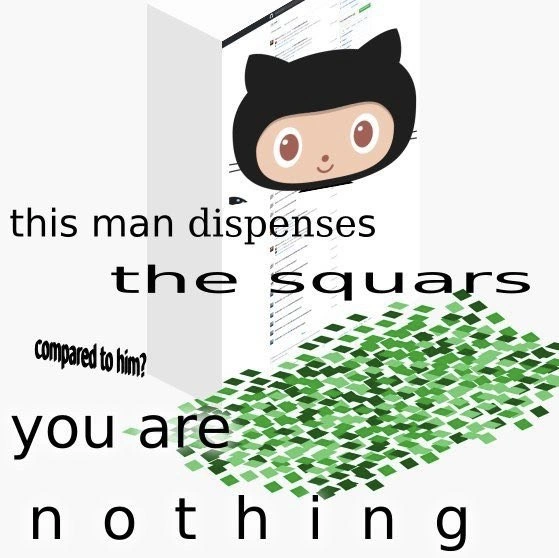
In the image, the Octocat mascot (GitHub’s cartoon cat/octopus logo) is depicted as literally giving out endless green squares. This implies an absurdly productive coder or entity that has infinite contributions. The text reinforces the joke: “this man dispenses the squars ... you are nothing.” It deliberately spells “squares” incorrectly as “squars” – a common meme technique to appear humorously exaggerated or goofy. The phrase “you are nothing compared to him” is hyperbole – an exaggerated way to say that next to this mythical super-coder, our own contribution counts look insignificant. Essentially, it’s poking fun at how we sometimes compare ourselves based on these GitHub stats. It’s a form of self-deprecating humor: developers laughing at their own relatively meager commit counts. The meme uses over-the-top imagery (a flood of green tiles) and dramatic text to make it clear it’s joking. Nobody actually thinks you’re “nothing” if you have fewer commits – it’s making fun of the idea that commit counts equal worth. In real life, one great contribution can outweigh hundreds of trivial ones, but the “green square game” can make newbies forget that.
Let’s explain a few terms: A commit is like saving a snapshot of your code at a point in time, along with a message describing the change. GitHub keeps track of your commits and other activities. A contribution streak means you’ve made contributions many days in a row. Some developers try to maintain long streaks just to fill their graph – for fun or bragging. The meme is ridiculing that impulse. “Dispensing the squares” imagines someone who can generate contributions on demand, effortlessly. It’s like saying, “This guy can create commits like a machine, and here I am with barely any.” The comedic effect also lies in the contrast: the Octocat’s infinite carpet of green vs. an ordinary dev’s sparse few squares. By exaggerating it (literally flooding the floor with green squares), the meme makes it obvious that focusing too much on these squares is a bit ridiculous. It also touches on how developer communities sometimes emphasize the wrong things (quantity of commits over quality). The categories of this meme – VersionControl and DevCommunities – hint that it’s about how version control platforms (like GitHub) intersect with the social aspects of coding. In simple terms: GitHub turned coding activity into a visible chart, and developers, being competitive humans, sometimes treat it like a contest. This meme is a playful critique of that mindset. And yes, the meme typos (“squars”) and eccentric spacing (“n o t h i n g”) are just there to amplify the silliness — a wink that this is all in good fun.
Level 3: It’s Full of Squares
In this surreal scene, the GitHub Octocat mascot emerges from a portal shaped like a profile page, literally dispensing green squares by the hundreds. These green squares represent the familiar GitHub contribution graph entries – each square is a day you made code contributions (commits, pull requests, etc.). The meme’s overlaid text dramatically proclaims “this man dispenses the squars” (typo and all) and taunts, “compared to him? you are n o t h i n g”. It’s a tongue-in-cheek smackdown of our coding self-esteem via version control humor. Why is this funny to seasoned developers? Because it hyperbolically mocks the vanity metrics of open source contribution counts. We’ve all seen those GitHub profiles with an absurd wall of green tiles – an infinite commit streak that makes ordinary coders feel like mere mortals. This meme cranks that feeling up to 11 by turning Octocat into a green-square-dispensing deity, humorously implying that next to such prolific output, our own commit counts are insignificant. It’s developer humor weaponized with exaggeration.
On a serious level, the meme highlights how OpenSourceCulture often turns GitHub into a social scoreboard. In many dev communities, people equate one’s worth with the frequency of code contributions. The “green squares” on a GitHub profile became a status symbol – a quick visual metric hinting at how active a programmer is. It’s like a high score in an arcade game, except it’s your commit count. Seasoned devs recognize this as a gamification of coding: a well-intentioned feature (the contribution graph) that developers now treat as a scorecard. The humor here is that the Octocat (essentially GitHub itself) is shown literally controlling this game, pouring out green squares effortlessly. It’s a sly nod to how the platform can create commit count heroes who rack up contributions like tickets at a carnival. Meanwhile, regular developers might be working hard on meaningful projects but have a relatively sparse contribution graph, making them feel inadequate when they compare profiles. The meme sarcasm — “compared to him, you are nothing” — captures that irrational inferiority complex. It’s self-deprecating meme culture: we laugh because deep down many of us have felt that goofy anxiety seeing someone’s contribution_count_flex.
From a senior engineer’s perspective, the absurdity is obvious. Git commit counts are a classic vanity metric: easy to measure, easy to obsess over, but not truly indicative of skill or value. Ten one-line typo fixes count as 10 contributions; a single brilliant algorithm overhaul might count as just 1. Smart developers know quality ≻ quantity. So we find it funny when people chase those green squares as proof of productivity. This meme exaggerates that chase to comic extremes — the Octocat has an infinite cheat code for green squares. The deliberate misspelling “squars” adds an ironic tone, hinting that this shouldn’t be taken too seriously. It’s written like a shitpost on purpose, poking fun at how silly the obsession is. The varied font sizes and spacing (e.g. “you are n o t h i n g”) mimic the style of absurd, exaggerated image macros that thrive on distorted text for dramatic flair. It’s DeveloperHumor meeting meme_typos culture.
There’s an unspoken industry joke here: we’ve seen newbies (and even some companies) treat GitHub profiles like a résumé scoreboard. In reality, a wall of contributions might just mean someone wrote a script to commit daily or split their work into ultra-tiny commits. In fact, there have been developers who automate their contributions to keep a streak going. For instance, scheduling a job to push an empty commit every day at 11:59 PM – just to not break the chain. Yes, that happens. 🙄 GitHub once even displayed your “Longest streak” on your profile, which led folks to do absurd things like coding from hospital beds or during vacations just to keep the streak alive. (GitHub later removed the streak counter, implicitly admitting it was incentivizing unhealthy behavior.) As a battle-scarred dev, it’s hard not to smirk at the idea of someone thinking more commits = better coder. We know brilliant open-source maintainers who commit less frequently but with massive impact, and we know projects where countless commits are just tweaking package versions or re-formatting code. Quantity doesn’t equal quality, and this meme jabs at that truth by showing Octocat literally dumping quantity everywhere.
The juxtaposition of the Octocat “dispensing” an avalanche of contributions and the line “you are nothing” also satirizes the imposter syndrome many developers feel. It’s so over-the-top that it becomes cathartic to laugh at. The VersionControl aspect (GitHub being a version control-based platform) here is essentially a backdrop for a social comparison joke. It’s lampooning how a tool meant for collaboration and source code management can morph into a competitive stage. The experienced engineer in us knows that real productivity isn’t measured in green pixels, yet we can’t help checking our own GitHub timeline now and then. This meme takes that guilty cultural quirk and dials it up to absurdity. In short, it’s ridiculing the open source bragging rights mentality. The Octocat, usually a friendly mascot, becomes an almost cosmic figure of coder clout, effortlessly generating what some treat as the holy grail of dev communities: infinite commits. And we laugh, because nothing deflates a pompous metric better than a good parody. After all, when production is on fire at 3 AM, no amount of green squares will save you – and the cynical veteran inside us takes comfort (and a bit of schadenfreude) in that.
#!/bin/bash
# A tongue-in-cheek "green square generator" (do NOT try this at home... unless you really love vanity metrics)
while :; do
echo "Another day, another pointless commit." >> README.md
git add README.md && git commit -m "Daily ritual commit"
sleep 86400 # Wait 24 hours before the next artificial contribution
done
Above: a satirical script illustrating how some developers practically treat GitHub like an RPG grind, ensuring an endless streak. It’s a joke – much like measuring coding skills in squares.
Description
A surreal meme featuring the GitHub Octocat mascot's head on a tall, white, dispenser-like object. From the base of this object, a large, isometric grid of green squares, representing the GitHub contribution graph, is being dispensed onto the floor. The image is overlaid with distorted, sans-serif text in black that reads 'this man dispenses the squares' and 'compared to him? you are nothing'. The meme humorously deifies GitHub and its contribution graph, satirizing the developer culture phenomenon of 'chasing green squares' where a developer's worth or productivity is absurdly judged by the consistency of their commit history. The surreal, almost worshipful tone highlights the pressure some developers feel to maintain a perfect contribution streak

Comments
7Comment deleted
I'm not saying my GitHub contribution graph is important, but I have a cron job that commits 'updates' to my README every day just to keep the dispenser happy
Octocat can flood the repo with a lawn of green squares, but one staff-level `git rebase -i --autosquash` and suddenly his 800 “wip” commits are a single minimalist masterpiece - scoreboard gone, ego diff -100%
The real irony is that the most productive engineers often have sparse contribution graphs because they're too busy architecting systems that actually matter to farm commits with daily README updates and whitespace changes
The irony here cuts deep: we've gamified software development to the point where a cartoon cat's hypothetical contribution graph makes us question our worth. Senior engineers know that those green squares measure keystrokes, not impact - yet we still feel a pang of inadequacy when our graph looks sparse during that month we spent architecting a system that prevented $2M in technical debt. The Octocat doesn't have to explain to stakeholders why refactoring doesn't generate commits, or why sometimes the best code is the code you delete. But sure, let's all feel inferior to a mascot who's never had to debug a race condition at 2 AM
All hail Octocat, dispenser of green squares - the only KPI you can max out with a 23:59 cron that commits whitespace to README
He optimized for the only KPI GitHub visualizes (#30a14e squares) with no-squash merges and a 23:59 UTC cron; I cut p99 by 70% in one PR, yet his calendar is greener
NPM cat: turning 'npm i' into a package tsunami that buries your disk space faster than a viral tweet