The Agony and Ecstasy of a Three-Line Fix
Why is this Debugging Troubleshooting meme funny?
Level 1: Little Fix, Big Win
Imagine you’ve been working on a giant jigsaw puzzle for three days, but there’s one last piece missing. You search everywhere – under the couch, in every drawer, even in your toy box. You’re getting super frustrated because without that piece, the puzzle isn’t complete. After days of looking, you suddenly find the missing piece hiding in a corner of the puzzle box itself. You snap that one piece into the puzzle, and ta-da! The picture is finally whole. You feel amazing – all that searching and the solution was just this tiny piece. You’re relieved and proud, like you’ve solved a big mystery.
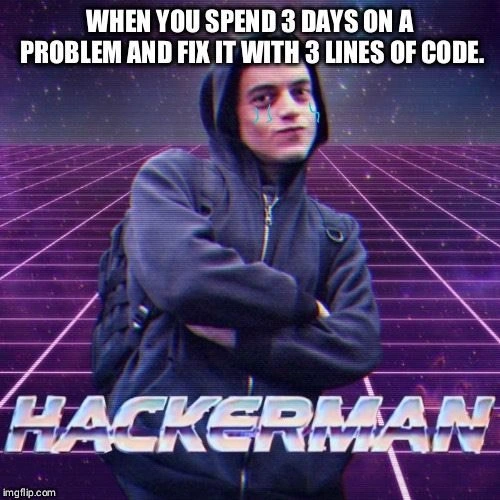
That’s exactly what’s happening in the meme. The programmer spent three days trying to fix a big problem in their code (kind of like looking for the puzzle piece). They tried so many things and were really annoyed it was taking so long. Then, they discover the answer and it’s just a small change – three lines of code did the trick (that’s the tiny puzzle piece!). Those three lines fixed everything in the program, and the huge problem was gone. The programmer is overjoyed. They feel like a superhero who just saved the day, or in the joke of the meme, like “Hackerman” – a cool hacker from an old movie. It’s funny because such a little fix gave such a big win. The person went from totally frustrated to feeling on top of the world. That big contrast – lots of effort versus a tiny solution – is why this meme makes programmers smile. It’s a high-five to anyone who finally solved a hard problem and felt like the coolest kid on the block, even if only for a moment.
Level 2: The Three-Line Fix
For a newer developer, it might be surprising that fixing a bug can take far longer than writing the code in the first place. A bug is just a mistake or error in the software that makes it act in unexpected or wrong ways. Debugging is the process of finding and fixing that mistake – and it can feel like detective work. You don’t know where the problem is, so you gather clues. This often means using tools and techniques to narrow things down: for example, adding print statements (console.log("here")) to check if certain parts of the code run, or using a debugger to pause the program at specific points (called breakpoints) so you can inspect the values of variables step by step. You might read through lengthy log files (recorded details of what the program was doing) looking for any hint of the issue. If you’re really stuck, you might try talking through the problem out loud – that’s the idea behind rubber duck debugging (explaining your code to a rubber duck or an imaginary listener to see if you catch your own mistake).
In this meme’s story, a developer did all that for three whole days. They were methodically checking every possibility in their codebase to find one stubborn bug. Maybe the program was crashing or giving the wrong result, and nothing obvious explained why. This is a pretty familiar scenario in Debugging_Troubleshooting – sometimes a bug hides really well! It’s frustrating and time-consuming. The tag DebuggingFrustration exists because every developer hits a bug that makes them want to tear their hair out at some point.
Finally, after days of investigation, the developer pinpoints the cause. And it turns out the solution is incredibly simple – just a tiny change in the code. Literally, the fix might be adding or changing three lines of code. For example, perhaps a value wasn’t being checked for validity and they add two lines to check it and handle the bad case. Or maybe a file path was wrong, and they correct one line and add two lines of configuration. It could be as small as correcting a misspelled variable name or moving a line of code up a few lines. Whatever it is, it’s a minimal patch, but it completely solves the problem. This is often called a patch or a hotfix – a small update to fix a bug. The meme specifically highlights “3 lines” because it emphasizes how tiny the code change is compared to the 3 days of effort. That contrast is both amusing and oddly satisfying to anyone who’s been in those shoes.
Now, why “Hackerman”? The image is using a retro ‘80s aesthetic: a neon purple grid, starry space in the background, and the word “HACKERMAN” in shiny chrome letters. This comes from a popular meme template (originating from an over-the-top hacker montage in the comedy film Kung Fury). In that scene, an ultra-confident character does fantastical “hacking” (like time-travel hacking!) and calls himself Hackerman. It’s intentionally absurd and funny. Developers online love to use this Hackerman meme to celebrate even trivial tech accomplishments in a jokey way. So, when you finally squash a nasty bug with a few keystrokes, you put on the Hackerman persona as a joke. You know you didn’t actually do anything world-shattering, but it feels epic because of the struggle leading up to it. It’s a mix of relief and tongue-in-cheek pride.
For someone learning to code, this meme also carries a reassuring lesson: debugging is tough, but perseverance pays off. Even if the end fix seems small, the journey to get there is valuable. You might spend days to save the program with a quick fix, and that’s okay – it’s normal in software development. In fact, solving a bug can be a bigger victory for the team than adding a new feature, because it means the software is more reliable now. That’s why this scenario hits home in terms of DeveloperProductivity: productivity isn’t just writing lots of new code, sometimes it’s about investing time to find that one critical fix. And when you do find it, you earn that big feeling of accomplishment. In short, three days of debugging for a three-line fix is a classic tale in Developer Humor circles – it perfectly captures the patience, pain, and payoff of being a programmer.
Level 3: Rubber Duck Revelation
Spending three days debugging a single issue is a rite of passage in software development. It often starts with confident isolation of the problem: "It must be the new API module," you think. But hours later, that theory falls apart. You scour log files for suspicious errors, scatter printf or console.log statements throughout the code like breadcrumbs, and set breakpoints in your debugger to step through execution one agonizing line at a time. Perhaps you even suspect a Heisenbug (a bug that vanishes when you try to study it) or blame cosmic rays flipping bits in memory. By day two, you've rewritten chunks of code, rolled back buggy commits, and questioned your life choices.
In desperation, you turn to rubber duck debugging – explaining the code, line by line, to a rubber duck or an empty room. Miraculously, while describing what the code should do, you spot what it actually does wrong. It's a eureka moment: maybe a variable was misnamed, or an if condition had the logic inverted. Perhaps a null pointer wasn’t checked, or a loop’s boundary was off by one. The root cause crystalizes in your mind, and it's shockingly simple. Heart pounding, you implement the fix: a few careful lines added or changed.
// After 72 hours of hunting, the fix is just three lines:
if (configPath.endsWith("/")) {
configPath = configPath.substring(0, configPath.length() - 1);
}
// This tiny patch fixes the entire issue that had you stumped.
And just like that, the bug is gone. Three days of intense troubleshooting distilled into three lines of code. There’s a moment of disbelief — "Was it really that simple?" — followed by sheer developer triumph. You feel a surge of pride disproportionate to the size of the patch. It’s as if those three lines unlocked a secret level in the game of code. All the frustration evaporates, replaced by a swaggering satisfaction. You might lean back, smirk, and jokingly think, "I’m an elite hacker now."
This juxtaposition of effort versus outcome is both painful and hilarious to experienced developers. We’ve all been there: chasing a phantom bug for days, only to discover a one-line fix or a missing semicolon was the culprit. It highlights a truth in software development: the difficulty of a bug fix is rarely correlated with the number of lines changed. A critical production issue might be solved by deleting a line, while a one-hour task could require writing a hundred lines — Developer productivity isn’t about churning out code, it’s about solving problems. Here, the “product” of three days’ work is just a few characters, but those characters are invaluable.
So why the “Hackerman” persona in the meme? It’s tongue-in-cheek irony. Hackerman, with his retro-’80s neon grid and techno mystique, is the embodiment of over-the-top hacking prowess. Slapping that title on yourself for adding a humble null-check is self-deprecating humor that seasoned devs adore. It’s a way of laughing at the situation: you expended enormous effort for a modest change, and for one gleaming moment you feel like you hacked the Gibson. In reality, you just fixed a mundane bug – but emotionally, you conquered a monster. The meme perfectly captures that mix of exhaustion and exhilaration. Arms crossed, smirking at the screen, you declare victory as “HACKERMAN,” savoring a hard-won win that only took three lines of code.
Description
This meme features the 'Hackerman' character, portrayed by Rami Malek as Elliot Alderson from the TV series Mr. Robot. He is shown wearing a black hoodie with his arms crossed, with two crudely drawn light-blue tears on his face. The background is a retro-futuristic purple grid landscape, evoking a synthwave or outrun aesthetic, with a grainy CRT screen effect. The text at the top reads, 'WHEN YOU SPEND 3 DAYS ON A PROBLEM AND FIX IT WITH 3 LINES OF CODE.' At the bottom, the word 'HACKERMAN' is displayed in a large, stylized chrome font. The meme humorously and ironically captures a common, deeply relatable developer experience: the immense frustration and effort of debugging a difficult problem for days, only to discover the solution is deceptively simple. The tears represent the pain of the struggle, while the 'Hackerman' title signifies the ironic sense of god-like genius and relief one feels after finally solving it. It highlights that in software engineering, the value of a fix is not proportional to the lines of code written, but to the depth of understanding required to identify the root cause
Comments
8Comment deleted
It's not about the three lines of code you write. It's about the three days you spend figuring out *which* three lines to write and, more importantly, the one character you needed to change in the config
72 hours of flamegraphs, heap dumps, and distributed traces - turns out the outage was a missing null-check; I added three lines, then spent ten more writing the RCA so it looks like architecture
The real hack was convincing yourself those three days of architectural diagrams, distributed tracing, and Kubernetes yaml debugging were necessary when the actual problem was a missing database index
Three days, three lines: the commit message says 'fix typo' but the git blame says 'character development'
The real O(n³) complexity wasn't in the algorithm - it was the three days spent architecting an enterprise-grade solution with design patterns, abstractions, and future-proofing, only to realize the bug was a missing null check. Sometimes the best refactor is `git reset --hard` on your ego
Three days of distributed tracing, git bisect, and flame graphs - the patch was three lines: set a sane default, add a null check, and a two-page ADR explaining why
Spent 3 days spelunking through microservices; the fix was 3 lines: rename, invalidate cache, and fix the off‑by‑one. Senior bingo complete
Those three days? Just the tax on writing production-ready one-liners that juniors mistake for magic