Skip to content
DevMeme
295 of 7435
Capacity Planning Meets Marketing's Ambitions
OnCall ProductionIssues Post #352, on May 1, 2019 in TG

Capacity Planning Meets Marketing's Ambitions

Why is this OnCall ProductionIssues meme funny?

Level 1: Overcrowded Party

Imagine you have a small party room that fits only 20 people comfortably. You tell your friend (who’s helping host) that “Hey, we only have space and food for 20 more guests, so let’s not invite too many.” But your friend gets excited and invites 100 people to the party. What happens? All 100 guests show up at the same time. The room overcrowds five-fold, people are squeezing in, there isn’t enough food or chairs, and pretty soon the situation is out of control. Maybe the door can’t even close, some people can’t get in or start leaving upset, and the party basically falls apart because the house can’t handle that many folks. In the end, everyone is just staring in shock at the chaos, thinking “Why on earth did we invite so many?!” In this meme’s story, the website is like that small room – it had room for about 20k online users. But marketing invited 100k people to come use it. That’s like sending too many invitations to a party. The result was the same: an overcrowded party (the website) that essentially “broke down” from too many people. The humor comes from the obvious mistake – anyone can see inviting way more people than the space can handle is a bad idea. So when the site (party) crashes, everyone is left speechless, much like a crowd of guests standing around in a wrecked, overfilled room thinking, “Oops… that didn’t go well!”

Level 2: Crash Course in Capacity

Let’s break down what happened in simpler technical terms. The IT Director’s message basically said: “We only have capacity for 20,000 more users right now. We need to increase our resources soon.” Capacity here means the maximum number of users the system can handle at once without problems. Think of it like a bus with 20k seats; only 20k people can ride at the same time. The Campaign Team (Marketing) then went ahead and sent out invitations to 100k+ users – likely via a mass email announcing “Come join our service!” or something along those lines. This is akin to issuing 100k bus tickets when only 20k seats are available. When those 100k people tried to use the site (show up to the bus), the traffic far exceeded what the servers (or database, or network) could handle. That’s why the Site goes down. “Site goes down” means the website became unavailable – pages wouldn’t load, or users got errors – essentially a ProductionOutage (the live system stopped functioning properly). In real life, this could manifest as an error like “503 Service Unavailable” for users, or everything just timing out.

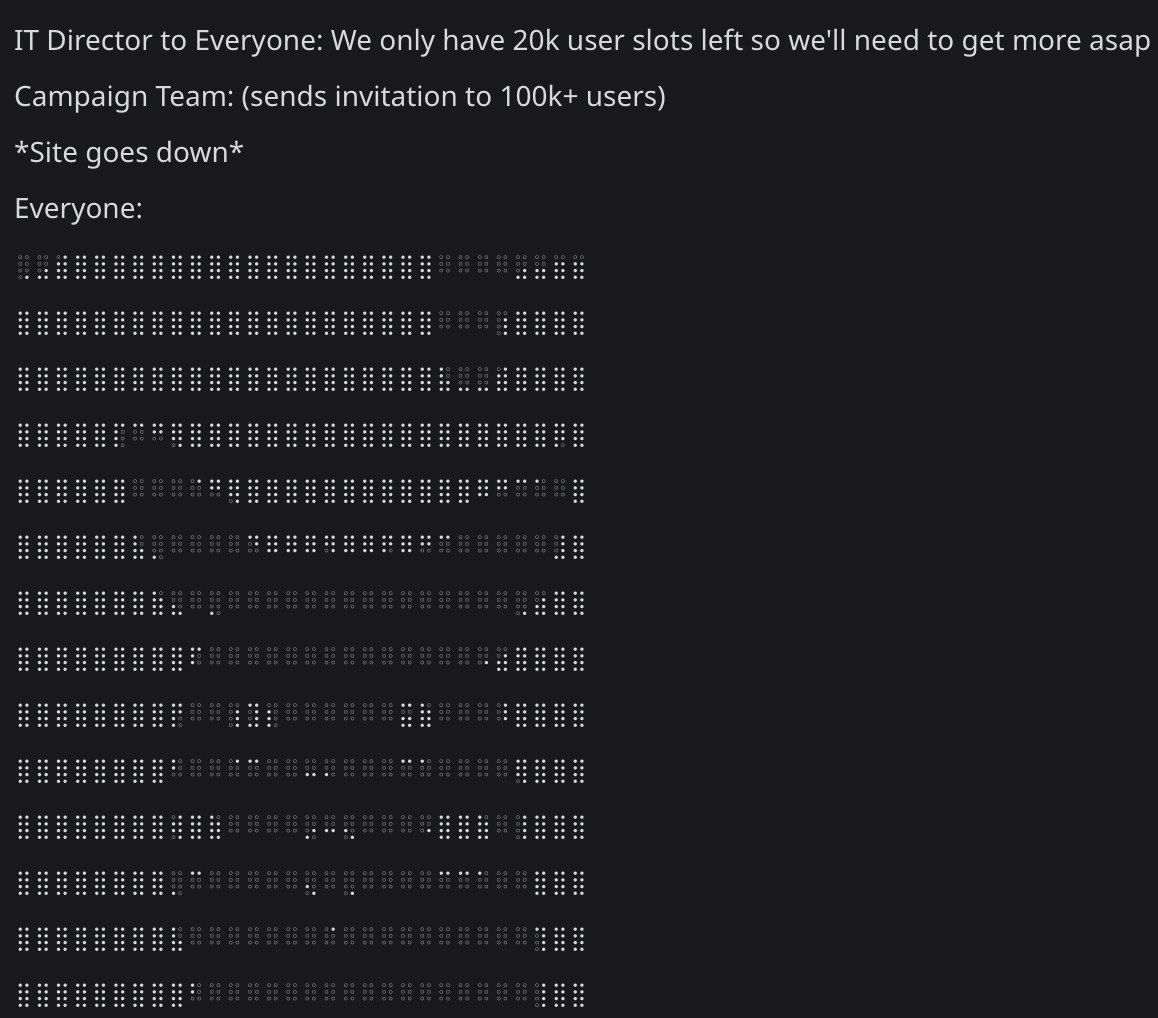
The big block of strange dotted text in the meme under “Everyone:” represents everyone’s stunned reaction. It’s like the whole office or team collectively going speechless (or brain-fried) as they watch the site crash. In some memes, people use a wall of gibberish text to show shock or chaos – here it looks almost like random braille or binary noise filling the screen, symbolizing the site spitting out nonsense or the team staring at a broken monitor. Basically, it humorously visualizes the utter mayhem and silence when something fails so badly.

For a junior developer or someone new to infrastructure: this scenario is a lesson in Scalability and CapacityPlanning. Scalability is the ability of a system to handle an increasing number of users or load, typically by adding more resources (like more servers, higher network bandwidth, etc.). Capacity planning is the process of predicting how many users or how much traffic we can support and planning upgrades before we hit the limit. Here, the Ops team clearly knew the limit (20k users) and even warned everyone. But the marketing_vs_engineering communication failed. The marketing team probably isn’t deeply technical; they might have thought “100k emails, not everyone will click at once, right?” – but even a fraction of 100k (say 20-30%) responding quickly can overwhelm a system built for 20k total. It’s like a mass_email_campaign gone wrong. Usually, before sending such a large invite, companies do a rollout in phases or ensure the infrastructure (servers, database, etc.) is scaled up and ready. If you skip those safety checks, you can bring down even a well-designed site by sheer volume.

In practice, what likely happened is: as soon as that email blast went out, thousands upon thousands of users clicked the link or visited the site to sign up or log in. The servers tried to handle them but hit their user_capacity_limit. Maybe the database only allowed 20k connections, or the web server had a max threads/session limit, and those got exhausted. When those limits are hit, new users can’t be served – they either wait (causing a huge backlog) or get errors. The “Site goes down” might have been immediate if, for example, a critical component like the database became unresponsive under load. Everyone – meaning all the teams and stakeholders – then saw the site was unavailable and likely went into firefighting mode. The meme frames that as “Everyone: [shocked silence gibberish]”, which is the comedic way to show facepalm, panic, or disbelief.

For a junior dev, it’s important to understand that Production environments have finite capacity. When we say “20k user slots,” it could mean the number of concurrent users the app can support with acceptable performance. If you expect more users, you must prepare (add more servers, optimize code, use load balancers, etc.). If someone ignores that and dumps way more users on the system, it’s going to crash – just like overloading a circuit with too many devices will trip a breaker. The tags like ProductionIssues and Downtime are all about these situations where live systems break due to unexpected load or mistakes. This meme is basically an inside joke among devs and ops: always coordinate your big user pushes with the ops team. The people on-call (holding the pager for emergencies) will thank you, because getting paged at midnight due to a silly overshoot is no fun. It’s a lesson you quickly learn early in your career if you ever accidentally deploy something that overwhelms a system. Here, fortunately (or unfortunately), it wasn’t a newbie developer’s code that broke things – it was a managerial decision that steamrolled over technical limits. As a junior engineer, you might not be making those big decisions yet, but you should still be aware: Capacity matters. And if someone tells you “we can only handle N users,” take it seriously!

Level 3: Self-Inflicted DDoS

This meme hits senior engineers right in the feels because it’s painfully true. An Ops/IT Director explicitly says “we have 20k user slots left” – meaning the platform’s current capacity can only handle 20,000 additional users before resources are exhausted. That’s a clear warning: don’t exceed that without scaling up. But then the marketing or campaign team goes and does the unthinkable: fires off email invitations to 100k+ users. 😱 Essentially, they just DDOS’d their own site with legitimate traffic. It’s a self-inflicted outage born of miscommunication and overzealous stakeholder goals. Seasoned Ops folks have seen this movie before: Marketing or management over-promises a big number to meet some KPI or sales target, disregarding the engineering realities. The result? Downtime. The site goes belly up, probably right at the peak of the campaign, and everyone – from devs to support – collectively facepalms. The meme’s giant block of braille-like text under “Everyone:” perfectly conveys that stunned, speechless horror (and maybe a stream of production alerts scrolling by). It’s the textual equivalent of the sound of a million monitoring alarms crying out and then suddenly silenced.

In a real-world scenario, the on-call engineer’s phone would be blowing up with alerts: CPU 100%, DB connections maxed, queue latency off the charts. This scenario is what on-call nightmares are made of – the kind where StakeholderExpectations and reality collide in a spectacular fireball. It’s not an external hacker or a sudden viral tweet causing the traffic surge; it’s our very own marketing_vs_engineering fiasco. The Infrastructure team likely had charts and CapacityPlanning sessions warning “20k users max until we add more servers or upgrade the database.” But those warnings either weren’t communicated effectively to the Campaign Team, or they were ignored in the rush to hit a big number. Maybe someone thought, “Hey, 100k invites might only yield 10k sign-ups, we’ll be fine.” Spoiler: they weren’t fine. Perhaps a higher-than-expected conversion rate, or users hammering the site all at once (“I got the email, let’s check this out!”) pushed it over the edge. Once ~20k concurrent users tried to use the site, it likely started choking — threads got locked up, API calls timed out, and the whole thing went down hard.

From an operations perspective, this is a perfect storm of ProductionIssues. It highlights the classic disconnect between Stakeholders_Clients (who want growth, numbers, and flashy campaigns) and engineering (who worry about system limits and Scalability). The humor (tinged with darkness) comes from just how predictable the failure was. It’s basically a joke you’d hear in an on-call war room at 3 AM: “They invited how many users? After we said the capacity was what? Of course the site crashed… it’s always capacity.” The tag user_capacity_limit was not just a suggestion – it was a hard ceiling, and blasting past it ensured a crash. The meme’s dialogue format (“IT Director: We only have 20k… Marketing Team: sends 100k invitesSite goes down”) is a painfully accurate play-by-play of how internal mishaps happen. It’s funny because it’s true – true in the way that makes veteran engineers both laugh and groan. You can almost hear the retrospective meeting afterwards, with Everyone sitting around exhausted, probably doing the blame-polka. The silence (or the incoherent gibberish block in the meme) is that moment where nobody even knows what to say anymore – it’s just too absurd.

This kind of ProductionOutage teaches a hard lesson: StakeholderPressure to grow must be balanced with technical reality. Smart companies do load testing or at least coordinate big campaigns with Ops – e.g., “if we plan to invite 100k users, let’s make sure we have servers for ~100k.” Here, that didn’t happen, and it resulted in an avoidable outage. For senior folks, there’s additional dark humor in the familiarity of it all. We’ve seen managers treat capacity numbers as trivial, saying things like “Just spin up more instances” at the last second, or believing cloud auto-scaling will magically save the day (it won’t if you don’t configure it right or if the database is a bottleneck!). There’s also a whiff of “I told you so” in the air. The IT Director literally gave a heads-up (“we’ll need more [capacity] ASAP”), which in a sane world means pause the campaign until we upgrade. Instead, marketing heard “20k slots left” as “cool, let’s fill those and then some!” It’s an OnCall_ProductionIssues horror story that engineers share over beers: the day the marketing email went out and took down the site. The comedic relief in the meme format helps us laugh at the absurdity, but every senior dev reading it is also thinking, “Yup, I know that pain.”

Level 4: The Scalability Ceiling

At the extreme technical end, this scenario is a textbook case of resource overload and queueing theory in action. When a system with a fixed throughput limit is hit with 5× more load than it can handle, fundamental laws kick in. In queueing terms, if request arrival rate ($\lambda$) exceeds the service rate (μ), the queue of pending work grows without bound. Here, inviting 100k users to a system that can serve only ~20k concurrently means the arrival rate blew past the service capacity. The result? Request queues exploded, threads piled up waiting on locks, and memory buffers flooded until something gave out. Under such a load spike, the system likely entered a death spiral: as it maxed out CPU and DB connections, response times skyrocketed and errors cascaded. This is basically a self-inflicted denial-of-service event, triggered not by malicious actors, but by our own marketing team. The site might have thrown a flurry of 503 Service Unavailable errors before flatlining. The Scalability Ceiling was not just hit – it was smashed through, and the entire stack collapsed under the weight of those extra users. There’s a cruel irony in play: the same metrics and limits Ops warned about (CPU utilization, max database sessions, thread pool size, etc.) became the mathematical roadblocks that caused the crash. No amount of optimistic hope can bend these rules – finite infrastructure capacity is a hard physical limit. Without careful capacity planning or dynamic scaling, inviting 100k users when you only have 20k slots is like asking a single-lane bridge to handle freeway traffic; queues overflow, then the bridge fails. The theoretical takeaway is clear: scalability isn’t just corporate jargon – it’s governed by real formulas and limits. If you ignore them, the system will enforce those limits in the form of downtime. In other words, the laws of computing (and yes, Murphy’s Law too) will have the last laugh.

Description

A text-based meme on a dark background that lays out a sequence of events. First, 'IT Director to Everyone: We only have 20k user slots left so we'll need to get more asap'. Second, 'Campaign Team: (sends invitation to 100k+ users)'. Third, '*Site goes down*'. Finally, 'Everyone:'. Below this text is a large ASCII art representation of the 'Surprised Pikachu' meme, showing the character with an open mouth in a look of shock, rendered using braille-like dot patterns. The meme humorously depicts a common scenario in tech companies where a non-technical team, like marketing, disregards explicit warnings from the IT or engineering team about system capacity limits. The predictable result is a production outage. The punchline is the feigned surprise of 'Everyone' involved, captured by the Surprised Pikachu, which is ironic because the failure was entirely foreseeable. This resonates with senior developers who have experienced the consequences of such departmental miscommunication and lack of planning
Comments

8
Anonymous ★ Top Pick Marketing calls it a 'viral campaign.' SRE calls it an 'unplanned load test.' The server calls it 'segmentation fault (core dumped).'
  1. Anonymous ★ Top Pick

    Marketing calls it a 'viral campaign.' SRE calls it an 'unplanned load test.' The server calls it 'segmentation fault (core dumped).'

  2. Anonymous

    Marketing calls it “demand gen,” SRE calls it “an unscheduled 100k-user chaos test on a cluster provisioned for 20k,” and the RCA doc is already throwing OutOfMemory

  3. Anonymous

    The only thing that scales faster than our infrastructure costs is marketing's ability to ignore the word "capacity" in "capacity planning."

  4. Anonymous

    Marketing calls it a wildly successful campaign; the load balancer calls it a DDoS with a budget line

  5. Anonymous

    When your IT director gives you a clear capacity warning with actual numbers and timelines, but marketing treats it like a suggestion rather than a hard limit - congratulations, you've just discovered the difference between 'eventual consistency' and 'eventual catastrophe.' The real tragedy isn't the 5x oversubscription; it's that everyone acts surprised when basic arithmetic catches up with them in production

  6. Anonymous

    Nothing exposes the absence of backpressure, rate limits, and a queue faster than Marketing turning '20k seats' into a 100k‑user production load test

  7. Anonymous

    Engineering provisions 20k slots; marketing blasts 100k invites. Classic proof that user acquisition outpaces throughput in every distributed system postmortem

  8. Anonymous

    Our chaos experiment was “email 100k users with a 20k‑seat license” - instant thundering herd, a saturated 20‑conn DB pool, and a reminder that rate limiting is cheaper than optimism

Use J and K for navigation