Skip to content
DevMeme
3364 of 7435
A Developer's Home is Where 127.0.0.1 Is
Networking Post #3696, on Sep 14, 2021 in TG

A Developer's Home is Where 127.0.0.1 Is

Why is this Networking meme funny?

Level 1: The Computer’s Home Address

Imagine you have a special address that always means your own house. Whenever you write that address on a letter, the mail comes straight back to you at home. Computers have something a bit like that – a special home address that always points to the computer itself. 127.0.0.1 is a number that means “this computer I’m using right now.” It’s like the computer saying, “Hey, that’s me!” People who work with computers a lot call this address localhost, which basically means “local home.”

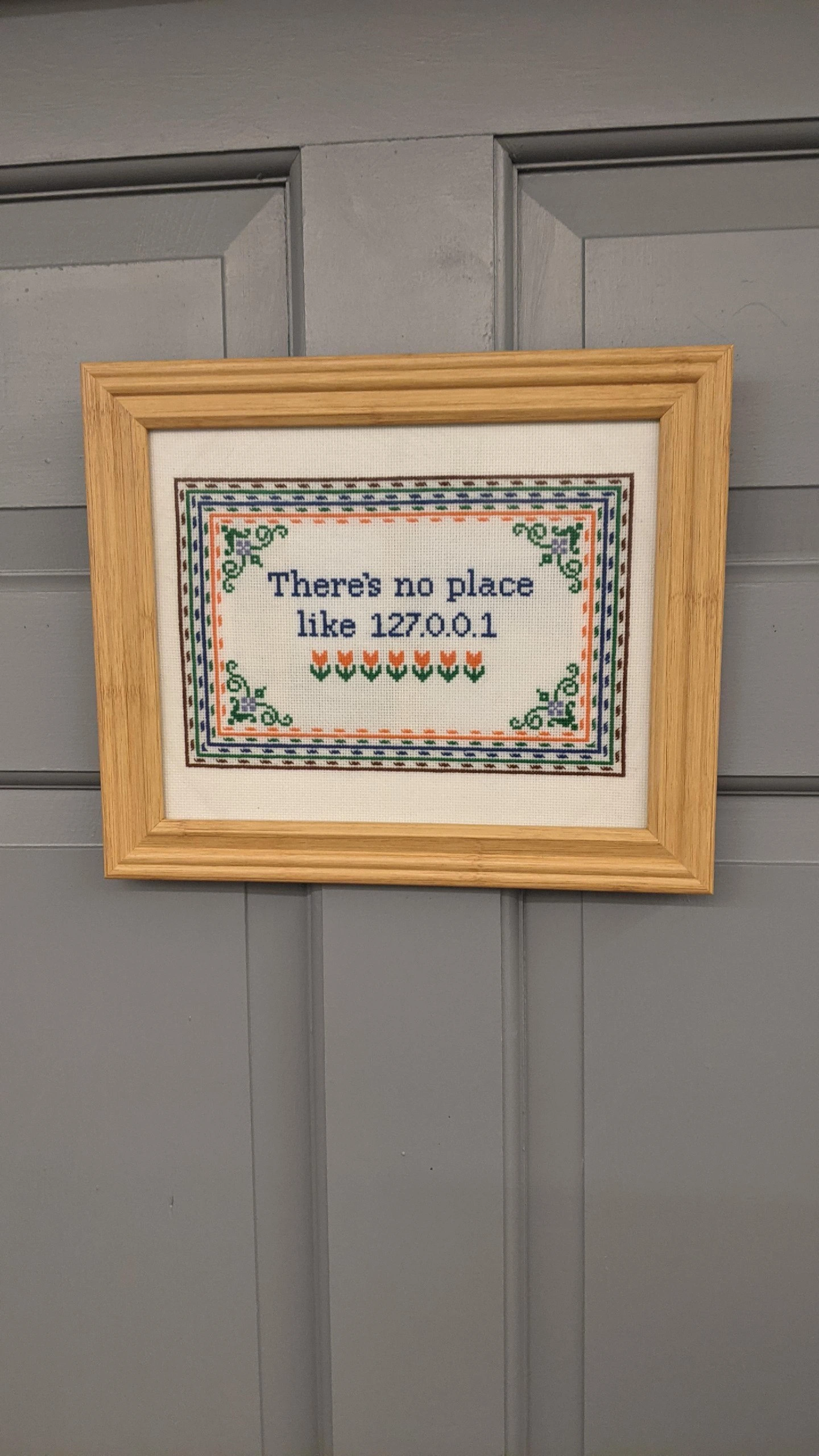
Now, there’s a famous saying: “There’s no place like home.” It means home is the most wonderful place in the world. This meme is making a gentle joke by saying “There’s no place like 127.0.0.1”, which really translates to “There’s no place like home” in computer language. It’s funny because it’s true in two ways: Just like we love being in our cozy home, computer folks love working on their own trusty computer (nothing goes wrong when you’re just talking to yourself!). It’s also using a secret code – only people who know the computer’s home address (127.0.0.1) get the joke right away.

The way it’s presented is also silly in a charming way. The words are stitched with colorful thread and framed nicely, just like a grandma might hang a sign that says “Home Sweet Home” in the living room. But instead of a normal home saying, it’s this string of numbers and dots! To someone who knows computers, those numbers immediately mean something warm and familiar (their own computer). To someone who doesn’t, it might just look like random numbers until it’s explained. That contrast makes it extra delightful.

So essentially, the meme is saying: Our computer is our home, and we feel happy there. And it says it in a smart, sneaky way by using the computer’s special home address. It makes people who understand it smile and maybe even feel a little proud of being part of the “in-crowd” who get the joke. It’s a friendly, geeky twist on a loving message about home. After all, whether you’re a person or a computer, there really is no place quite like home!

Level 2: Know Your Localhost

Let’s break down why “127.0.0.1” is such a beloved term in developer humor. In computer networking, every device on a network gets an address called an IP address (Internet Protocol address). Think of it like a street address but for computers, so data knows where to go. For example, a server out on the internet might have an address like 142.250.190.78 (one of Google’s IPs). However, there’s a special IP address reserved on every computer: 127.0.0.1. This one is very unique because it doesn’t refer to some other machine or go out over the internet – it always means “this computer right here.” We call 127.0.0.1 the loopback address or simply localhost. “Loopback” because any network message sent to that address loops back to the same machine. It’s like addressing a letter with your own house as the destination – the mailman just hands it back to you immediately instead of sending it out.

So, when you run a web application or database server on your PC and you connect to localhost, you’re using this very IP (127.0.0.1) under the hood. Typing http://127.0.0.1 in your web browser will try to load a site from a web server running on your own computer. Developers do this constantly for testing: it’s safe, quick, and doesn’t depend on an internet connection. In fact, most computers have a tiny configuration file (the hosts file) that maps the name “localhost” to 127.0.0.1 so that when you type localhost, the system knows you really mean “hey, myself!”. On many systems you can even see a line like:

127.0.0.1    localhost

This ensures the name localhost always points to that loopback IP.

Now, the meme takes the well-known saying “There’s no place like home.” and gives it a geeky twist. Normally, “home” means your house – where you feel most comfortable. In computing, we often casually call 127.0.0.1 the computer’s “home” address because it’s the address for itself. So the text “There’s no place like 127.0.0.1” basically reads as “There’s no place like home” in tech-speak. It’s a loopback_address_joke that only makes sense if you know what 127.0.0.1 represents. For someone in on the joke, it immediately clicks: home = localhost. It’s like a secret phrase that network and software folks chuckle at. This kind of NetworkHumor thrives on substituting everyday words with technical terms or numbers.

The visual of the meme amplifies the joke. It’s done as a cross-stitch sampler, the kind of decorative embroidery you might see hanging in a family living room or your grandmother’s kitchen. These samplers often have heartfelt quotes or proverbs (like “Live, Laugh, Love” or “Home Sweet Home”) stitched in pretty fonts, bordered by little flowers or patterns. Here, the border is indeed full of cute patterns and tiny tulip motifs, just like a traditional piece – but the message in the middle is a nerdy quip about an IP address! This contrast is playful and unexpected. It says “I’m a sentimental wall decor… but for a techie!” The frame and stitching make it look earnest and old-fashioned at first glance, which makes the punchline (the 127.0.0.1 text) even funnier when a tech-savvy person reads it.

For someone newer to programming or IT, it’s worth noting how beloved 127.0.0.1 is in developer culture. Not only is it used in practice constantly, but it features in many jokes and memes. For instance, developers often joke about things “working on localhost” but not on other machines, leading to the classic line: “Well, it works on my machine!” Localhost is this almost magical zone where you can experiment freely. So saying “no place like 127.0.0.1” also carries that sense of comfort: the code never crashes as badly at home, the network requests never time out on your own machine. It’s where developers feel at ease – similar to how people feel at home in real life.

This piece of developer humor is wholesome enough that even a junior dev can appreciate it once they understand the reference. It’s actually a nice little lesson: one of the first networking facts many learn is that 127.0.0.1 = “me, my own computer”. Here that fact is reinforced in a memorable way. Plus, it shows how tech folks like to blend their world with normal life – even our wall art gets a tech upgrade! If you’ve ever configured a server or tested an app on your PC, you’ve used 127.0.0.1. Now you can chuckle at the idea that, truly, there is no place like localhost. It’s a fun, decorative reminder of a key concept every programmer eventually knows.

Level 3: Home Sweet Localhost

At the senior developer level, this meme’s charm lies in its elegant play on a fundamental networking concept. The phrase > “There’s no place like 127.0.0.1” is an inside joke that merges classic homely wisdom with tech humor. In networking, 127.0.0.1 is the IPv4 loopback address, universally known as localhost. It’s essentially “home” for any machine – a special address that points right back to itself. When a developer says “I’m running it on localhost”, they mean the program is running on their own computer and accessible via 127.0.0.1 (or the hostname localhost). The meme riffs on the famous saying “There’s no place like home” (hello, Wizard of Oz fans!) by replacing “home” with the nerdy literal home of every computer on a network. It’s the ultimate network humor double entendre: “home” as in your cozy house and “home” as in your computer’s local address.

Beyond the wordplay, experienced devs smile because of the unspoken truth: indeed, there’s no place like localhost when coding. Why? On 127.0.0.1, everything is under your control. There are no pesky firewalls, DNS misconfigurations, or unpredictable network hiccups – it’s your own little world. Every seasoned engineer has felt the relief of debugging a service on their local loopback interface after a long day of “works on my machine” issues. It’s a gentle nod to the reality that code always behaves on localhost (until, of course, it leaves for the wild world of servers and cloud). This is developer humor at its finest: acknowledging that contrast between the ideal safe haven of your local dev environment and the chaotic networking issues that await outside.

The cross-stitched presentation adds an extra layer of irony that a senior dev can appreciate. Traditionally, cross-stitched samplers hang on the wall with phrases like “Bless this mess” or “Home Sweet Home” – expressions of domestic wisdom. Here we have a cross_stitch_meme celebrating technical wisdom instead. The beautifully stitched floral border and tulips around a blocky IP address is hilariously incongruous. It’s like seeing ultra-modern tech language in Grandma’s antique frame. For many in tech, it’s a proud display of geek culture in a place you’d least expect it (a piece of developer_home_decor blending into regular home decor). There’s an implicit senior-level chuckle at how far our industry’s inside jokes have penetrated everyday life: we’re literally hanging networking jokes on the wall as art. It’s simultaneously wholesome and nerdy.

And let’s not overlook how 127.0.0.1 itself has a bit of lore. Networking veterans know that the entire 127.0.0.0/8 block (all addresses from 127.0.0.1 up to 127.255.255.255) is reserved for loopback. That’s historical trivia dating back to early ARPANET decisions – an old-school detail likely to delight the tech historian type of engineer. The choice of 127 (the last network in the old class A range) for loopback has been around for decades, and it’s one of those eternal standards in computing. Even today, if you ping 127.0.0.1, the request never leaves your machine – the kernel short-circuits it back, confirming your TCP/IP stack is working. So when a meme declares there’s no place like 127.0.0.1, seasoned devs appreciate that it’s not just cute, it’s technically spot-on: nothing is as safe or as reliable as packets addressed to yourself.

Ultimately, this meme resonates strongly with those who have spent long hours coding, testing, and troubleshooting network issues. It’s a moment of solidarity and laughter among developers and network engineers. We’ve all yearned for that safe haven where nothing mysteriously breaks – and that haven is localhost. Seeing that sentiment immortalized in tidy stitches and a wooden frame is both absurd and heartwarming. It says: Our work is stressful, but we can still laugh about it and decorate our lives with that humor. There really is no place like 127.0.0.1 – every senior dev knows it’s true, both as a networking fact and as a tongue-in-cheek life philosophy.

Description

A photo of a framed cross-stitch piece hanging on a gray, paneled door. The cross-stitch, in a simple light wood frame, has a traditional, homey design with a decorative border in green, blue, and orange, and a row of orange tulips at the bottom. The central text, stitched in blue, reads 'There's no place like 127.0.0.1'. This piece is a classic developer joke, a pun on the famous line 'There's no place like home' from 'The Wizard of Oz'. In networking, the IP address 127.0.0.1 is the 'localhost' or 'loopback' address, which always refers to the local computer. For developers, their local machine is their primary work environment - their digital 'home' - where they write code, test applications, and spend a significant portion of their time. The juxtaposition of a modern tech reference with a traditional craft like cross-stitch adds to the humor


Comments

52
Anonymous ★ Top Pick DNS resolution is just trying to find your way home, but you always know the address for 127.0.0.1 by heart
  1. Anonymous ★ Top Pick

    DNS resolution is just trying to find your way home, but you always know the address for 127.0.0.1 by heart

  2. Anonymous

    “There’s no place like 127.0.0.1 - until your Kubernetes pod resolves $DB_HOST to it and the whole cluster turns into a self-care retreat for lonely services.”

  3. Anonymous

    After 20 years in tech, I finally understand why my grandmother cross-stitched "Home Sweet Home" everywhere - she was just trying to avoid the SSL certificate warnings on 0.0.0.0

  4. Anonymous

    After 20 years in the industry, you realize 127.0.0.1 isn't just where your dev server lives - it's where you've spent most of your career. No DNS lookup required, no load balancer needed, no cross-region latency to worry about. Just you, your IDE, and the comforting certainty that localhost will always resolve. Sure, production might be running on a globally distributed Kubernetes cluster across three continents, but there really is no place like home... especially when 'home' is the only environment where everything actually works as documented

  5. Anonymous

    After enough incidents, you learn the most reliable multi‑region is 127.0.0.1 - zero egress, perfect SLO, and an auth provider that never flakes: whoami

  6. Anonymous

    There’s no place like 127.0.0.1 - P99 under 1ms, 100% uptime, and the compliance policy is “works on my machine.”

  7. Anonymous

    Localhost: the only endpoint that returns 200 OK without CORS headaches or SRE pagers

  8. @ZgGPuo8dZef58K6hxxGVj3Z2 4y

    Haha

  9. @Strangerx 4y

    There’s no place like $HOME

  10. @prirai 4y

    There's no place like ~

    1. @ZgGPuo8dZef58K6hxxGVj3Z2 4y

      There is no place like C:\...\...\...\...\...

      1. @prirai 4y

        🤮🤮🤮 A place where your Winblows pukes

        1. @ZgGPuo8dZef58K6hxxGVj3Z2 4y

          Windows itself is not garbage just the bloatware

          1. @RiedleroD 4y

            windows literally makes it deliberately hard to change the default browser to make more people use edge

            1. @Dobreposhka 4y

              idk, just one click and chrome is by default

              1. @prirai 4y

                Wait then

              2. @RiedleroD 4y

                that was the case, but there's been some switcheroo regarding that

            2. @ZgGPuo8dZef58K6hxxGVj3Z2 4y

              Google says "Use Google Chrome as more faster and secure experiance." When I literary use CHROMIUM

              1. @ZgGPuo8dZef58K6hxxGVj3Z2 4y

                And by google I mean any google service

          2. @sashakity 4y

            windows is hostile software. when you use it you do not dictate what the computer does in all cases, the computer dictates what you do

            1. @ZgGPuo8dZef58K6hxxGVj3Z2 4y

              No. Windows has more options built in than linux. I literally have to recompile anything to be customizable on linux. Windows fits my needs so I will use it

              1. @RiedleroD 4y

                wtf are you using to have to recompile shit?

                1. Deleted Account 4y

                  das gentoo

                  1. @RiedleroD 4y

                    in gentoo, it's the whole point.

                  2. Deleted Account 4y

                    need to change muh use flags again

              2. Deleted Account 4y

                idk, windows just lacks software support

              3. @sashakity 4y

                what distro are you using, ubuntu? lmao

                1. @RiedleroD 4y

                  lmao sounds like it

                2. @ZgGPuo8dZef58K6hxxGVj3Z2 4y

                  Just compare the control panels of the 2 OSes. Also i am not aware that any registry like stuff is available on linux

                  1. @RiedleroD 4y

                    which control panel?

                    1. @RiedleroD 4y

                      the one of ubuntu? yeah, that one's shit

                      1. @ZgGPuo8dZef58K6hxxGVj3Z2 4y

                        I have never seen another one

                        1. @sashakity 4y

                          just take a trip to your /etc directory. you will be amazed.

                    2. @ZgGPuo8dZef58K6hxxGVj3Z2 4y

                      Windows control panel and linux settings whatever

                      1. @RiedleroD 4y

                        "linux settings whatever" yeah that sounds like ubuntu

                      2. Deleted Account 4y

                        there is no "linux settings"

                        1. Deleted Account 4y

                          well, sysctl may be called one

                          1. Deleted Account 4y

                            which is based in itself, and doesn't exist on windows

                  2. Deleted Account 4y

                    there is no registry crap on linux

                    1. Deleted Account 4y

                      you don't need it

                    2. @RiedleroD 4y

                      actually dconf

                  3. @sashakity 4y

                    yes there is. dconf-editor

                  4. @chupasaurus 4y

                    GNOME has a registry like stuff

                    1. @sashakity 4y

                      i already mentioned dconf editor

                    2. @ZgGPuo8dZef58K6hxxGVj3Z2 4y

                      What is it called?

                    3. @RiedleroD 4y

                      gsettings is just dconf + GUI (+ abstractions)

  11. @f3rr0us 4y

    echo "There's no place like " $(curl https://ipecho.net/plain)

  12. @prirai 4y

    Garbage hidden off places

  13. @RiedleroD 4y

    there's no place like :root

    1. @mrybs1 4y

      superuser: i don't think so

  14. @prirai 4y

    When you are inside a pond, you'll only see as much as the boundaries.

  15. @prirai 4y

    Come out and explore.

Use J and K for navigation