Skip to content
DevMeme
3365 of 7435
The Sophisticated Acronym for Python's Paradigm
Languages Post #3697, on Sep 14, 2021 in TG

The Sophisticated Acronym for Python's Paradigm

Why is this Languages meme funny?

Level 1: Fancy Suit, Silly Word

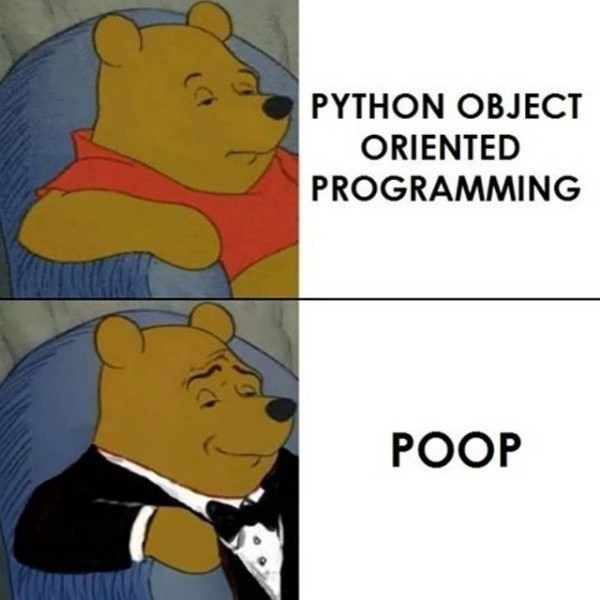
Imagine a very serious teacher introduces a new school program called "Advanced Reading Skills Education." It sounds super important and fancy, right? But then you notice the first letters of each word spell "ARSE" (which is a cheeky word for butt). Suddenly, this oh-so-proper program name makes everyone giggle. This meme is doing the same thing! In the picture, Winnie-the-Pooh tries to act very fancy (he’s even wearing a tuxedo) while using a short form "POOP" for a long, formal idea ("Python Object Oriented Programming"). It's funny because "poop" is a silly, childish word – the kind of word that might make a five-year-old laugh. So we have something that was supposed to sound grown-up and sophisticated ending up sounding like a potty joke. The contrast is what makes it so silly and enjoyable: it's like someone in a tuxedo accidentally telling a fart joke. In simple terms, the meme is joking that sometimes our big important phrases can hide little kid jokes, and it's perfectly fine to laugh at how goofy that is.

Level 2: What "POOP" Means

Let's break down what's happening in this meme in simpler terms. First, Python is a popular programming language known for being easy to read and use. It's the one with a snake logo (named after Monty Python comedy, funnily enough, which shows that Python’s creators appreciate humor). Now, one way to write programs in Python is by using Object-Oriented Programming (often shortened as OOP). Object-Oriented Programming means organizing your code by creating "objects" – these are like virtual entities that have their own properties (data) and abilities (functions). You define a class, which is like a blueprint for an object (for example, you might have a class Dog that defines what a dog is and what it can do). Then you create instances of that class (like a specific dog named "Spot"). OOP is one of the fundamental ways to structure code (a key concept in computer science): it helps manage complexity by grouping related variables and functions together into neat packages (the objects).

Now, "Python Object Oriented Programming" is just a phrase that means "using object-oriented programming in Python." If you take the first letter of each word in that phrase – P, O, O, P – they spell "POOP." Yes, that's the same funny word kids use to mean poo (or feces). This kind of shortening is what we call an acronym – an abbreviation formed from the initial letters of a series of words. Acronyms are super common in tech: for example, HTML stands for HyperText Markup Language and NASA stands for National Aeronautics and Space Administration. Usually, we like acronyms because they save time and sometimes form catchy names. But in this case, the acronym for "Python Object Oriented Programming" accidentally spells a silly word! This is where the joke comes from: it's like discovering that a very serious term hides a potty humor word in its initials.

The meme itself shows Winnie-the-Pooh in two different moods to play with this idea. In the top image, Pooh looks plain or unimpressed, next to the full phrase "Python Object Oriented Programming" written out. It's like saying, "Here's the whole formal term, nothing special." In the bottom image, Pooh has donned a fancy tuxedo and looks smug and elegant, sitting next to just the acronym "POOP" in big letters. This is a popular Winnie-the-Pooh meme template where the second panel (the one with Tuxedo Pooh) implies a more refined or superior way of saying something. You might have seen similar memes where the first panel is something ordinary and the second panel rephrases it in an exaggeratedly fancy way. Here, calling "Python Object Oriented Programming" by the shorthand "POOP" is presented as if it's the stylish, elite term. It’s funny because normally calling anything "poop" is not fancy at all! Winnie-the-Pooh being a beloved cartoon bear (from children’s stories) makes it even funnier – the character’s name "Pooh" is one letter off from "poo," so the whole image doubles down on this innocent, childlike humor.

For someone new to programming, let's clarify the tech part: if someone says "Python OOP," they simply mean writing Python code in an object-oriented style (using classes and objects to design the program). For example, instead of just writing a bunch of separate functions, you might organize related functions and data into a class. Here’s a tiny Python code example to show what OOP looks like in practice:

class Greeter:
    def __init__(self, name):
        self.name = name  # store the name when creating a new Greeter object

    def greet(self):
        print(f"Hello, {self.name}! Welcome to OOP in Python.")

# Using the class to create an object and call a method
greeter = Greeter("Alice")
greeter.greet()  # This will output: Hello, Alice! Welcome to OOP in Python.

In this code:

  • We defined a class Greeter with an __init__ method (the constructor that runs when you make a new Greeter) and a greet method.
  • We then created a greeter object (an instance of Greeter) and called its greet method.
  • This is a simple illustration of object-oriented programming in action within Python.

So yes, Python fully supports OOP, and many Python programs use classes and objects to keep code organized. However, saying the entire phrase "Python Object Oriented Programming" is a mouthful. That’s why people usually abbreviate it to "Python OOP" in conversation or writing. The meme humorously takes this one step further by combining Python + OOP and noticing it forms the word "POOP."

It’s important to stress that "POOP" isn't an official term you’ll find in a textbook – it's just a funny coincidence and a play on words. If you told your instructor or team "I'm great at POOP," you would definitely get some confused looks until you explained the acronym! This meme is a form of coding humor – it pokes fun at how our technical jargon can sometimes end up sounding like regular silly words. It's the kind of joke programmers share to lighten the mood.

To put it simply, the second panel with Pooh in a tuxedo is treating the acronym "POOP" like it's a fancy new concept or a classier way to refer to Python OOP. It's like saying, "I don't just do Python object-oriented programming, I excel at P.O.O.P." (perhaps spoken in a posh accent for full effect). The humor comes from the contrast between the dressed-up, sophisticated presentation and the fact that "POOP" is a childish slang term. Even if you're just starting out in tech, you can see why that's amusing: something that was meant to sound serious and important turned into a bit of potty humor.

This meme is essentially a pun and a reminder that even in the serious world of programming, there's room for laughter. It highlights how naming things in computing can lead to unintended jokes. As you learn more, you'll encounter lots of abbreviations and acronyms. Many will be ordinary, but a few might form funny words that make everyone giggle. When that happens, you’ll remember this Winnie-the-Pooh meme and smile, realizing you're in on the joke that developers have been laughing about too.

Level 3: Aristocratic Acronym

In the top panel of this meme, we see the phrase PYTHON OBJECT ORIENTED PROGRAMMING spelled out plainly, accompanied by a casual Winnie-the-Pooh slouching in a red shirt. This phrase refers to using Object-Oriented Programming (OOP) principles in the Python language. At first glance, it's a straightforward, formal description of a programming approach. OOP is often regarded as a sophisticated paradigm in software development – complete with classes, objects, inheritance, and all those high-minded design principles. Normally, saying "we're doing OOP in Python" might sound academic or proper, something you'd find in textbooks or technical discussions on serious CS fundamentals.

Now, the bottom panel transforms both Pooh and the phrase. Pooh is dressed in a black tuxedo with a smug, refined expression, and next to him the text has been distilled to a single word: "POOP". This isn't a random choice of word – it's the acronym formed by the initial letters of "Python Object Oriented Programming." The meme brilliantly takes that formal phrase and rebrands it into something that looks absurdly elegant at first (because of the tuxedo Pooh), but is literally a childish word ("poop"). This contrast is the core of the humor. It's the classic internet trope of the classy upgrade meme format (the Winnie-the-Pooh template) where the second panel pretends a concept is more refined when phrased differently. Here, calling Python OOP by its acronym POOP is ironically presented as the more high-brow terminology – as if it's an exclusive, refined term – even though "poop" is anything but classy.

For seasoned developers, there's an extra layer of chuckle here about language quirks and naming in tech. We deal with a lot of acronyms in programming (think of JSON, HTTP, SQL), and sometimes these acronyms accidentally spell out real words (some more unfortunate or humorous than others). There's a well-known tongue-in-cheek saying: "There are only two hard things in Computer Science: cache invalidation, naming things, and off-by-one errors." Naming things is notoriously tricky, and acronyms often emerge from long technical names as a convenience. But as this meme highlights, when you contract a formal term into an acronym without checking, you might end up with a silly or embarrassing word. It's a programmer's inside joke to double-check what your project or feature names abbreviate to – nobody wants their serious new library or system abbreviated to CRUD (oh wait, that's actually a common technical term meaning Create, Read, Update, Delete) or something like PEBKAC (which jokingly stands for "Problem Exists Between Keyboard And Chair"). In this case, the phrase "Python Object Oriented Programming" condenses into P.O.O.P.: a harmless coincidence that tickles the juvenile sense of humor we all still have.

Beyond the acronym itself, there's a subtle jab at the idea of making something sound fancier than it really is. OOP in Python is a perfectly respectable topic – Python supports classes and objects, and many Python developers use OOP to structure their code. However, Python is also known for being multi-paradigm and pragmatic; you don't always need to wrap everything in classes, and sometimes overly object-oriented code in Python can feel unnecessarily pompous or heavy. A senior developer might smirk here, recalling times when a simple script was blown up into a tangled object hierarchy in the name of "OOP purity" – the result often being messy or overwrought code (some might jokingly call that outcome "poop code" as a pun on code smell). The meme winks at this possibility: by literally labeling Python OOP as "POOP," it's as if the community is poking fun at taking OOP too seriously or dressing it up too much. We have a cheeky developer humor scenario where an advanced concept (OOP) is deflated by a punny acronym, keeping us humble. It's a reminder that in tech culture, we often oscillate between trying to sound extremely refined with jargon, and laughing at ourselves when that jargon reduces down into something utterly mundane or giggle-worthy.

Moreover, the use of Winnie-the-Pooh specifically adds extra charm. Pooh's name itself sounds like "poo" (one letter off from "poop"), so it's a perfect character choice to embody this joke. The "Classy Pooh" meme format is a visual wordplay staple: it usually contrasts a normal statement with a pretentious rephrasing. Here it's inverted cleverly – the pretentious vibe is achieved through the character's tuxedo, yet the phrasing "POOP" is actually more crude than the original. For a seasoned programmer with a keen eye, this meme might also echo how we often invent grandiose acronyms for our projects or methodologies to sound cutting-edge, when in reality, the fancy names often mask something pretty ordinary (or occasionally something that stinks). In the era of elaborate design patterns and fancily named frameworks, it's refreshing (and a bit cathartic) to see a fundamental concept like "object-oriented programming in Python" being playfully knocked off its pedestal by four letters that spell a potty joke. It's as if the community collectively says: "Yes, we do serious work, but we can still laugh at ourselves – even our most revered acronyms can end up as elementary humor."

In summary, at this senior/expert level, the meme operates on multiple layers:

  • Terminology Irony: A high-level programming phrase becomes a low-brow word via its acronym.
  • Cultural Self-Awareness: A nod to the habit of making everything an acronym or fancy term in programming culture, only to sometimes create unintentional comedy.
  • OOP in Context: An implicit commentary on how Python's approach to OOP is flexible and down-to-earth, in contrast to languages that treat OOP as almost sacred. Pythonistas might even find calling it "POOP" fitting when OOP is overused or overhyped.
  • Shared Amusement: A clever inside joke that even the most experienced dev with a serious job title can’t help but smirk at, because it reminds us that even in advanced tech, we're all human enough to laugh at the word "poop."

The refined tuxedo Pooh elevating "POOP" to a term of distinction is a comedic reminder not to take our jargon too seriously. Even as experts, we appreciate a good pun hidden in our daily work vocabulary – it keeps the TechHumor alive amid all the abstract complexity.

Description

This meme utilizes the two-panel 'Tuxedo Pooh' format to make a simple, juvenile joke about a programming acronym. In the top panel, a standard, relaxed Winnie the Pooh is shown next to the text 'PYTHON OBJECT ORIENTED PROGRAMMING'. In the bottom panel, a more dapper, sophisticated Pooh in a tuxedo is paired with the acronym 'POOP'. The humor derives entirely from the fact that the initials of 'Python Object Oriented Programming' spell out 'POOP'. For experienced developers, this is a low-brow chuckle that lightly pokes fun at the formality of programming paradigms. It can also be interpreted as a subtle commentary on how some developers view OOP in Python - as either unsophisticated or, when poorly implemented, as literal 'poop' code

Comments

8
Anonymous ★ Top Pick POOP is what you get when you try to force Java patterns into a Pythonic world. The 'P' stands for 'pain'
  1. Anonymous ★ Top Pick

    POOP is what you get when you try to force Java patterns into a Pythonic world. The 'P' stands for 'pain'

  2. Anonymous

    We call it POOP, but after the third metaclass and a stray __getattr__, it’s really just duck typing wearing a tux while the GC quietly flushes the mess

  3. Anonymous

    After 20 years in the industry, I've learned that the most elegant abstractions often have the most unfortunate acronyms - from POOP to SOLID to DRY, it's like our design patterns were named by a committee of 12-year-olds who somehow also understood the Liskov Substitution Principle

  4. Anonymous

    Ah yes, POOP - the paradigm where everything inherits from `object`, your methods are bound to `self`, and you spend half your time deciding whether to use composition or inheritance. At least when your architecture goes to shit, the acronym was already there to warn you

  5. Anonymous

    You know it’s POOP when BaseManagerMixinFactory inherits from six classes and the MRO diagram looks like a compliance matrix

  6. Anonymous

    Python OOP: 'poop' because MRO resolution after multiple inheritance turns your clean hierarchy into a diamond disaster

  7. Anonymous

    Python OOP: when your super() chain routes through three mixins and a metaclass, and C3 linearization assures you it’s correct - hence, POOP

  8. Deleted Account 4y

    Yep

Use J and K for navigation