When Your Bad Code Ideas Need Professional Help
Why is this CodeQuality meme funny?
Level 1: Broken Instructions
Imagine you have a special robot friend that follows your spoken instructions exactly. You tell your robot, “If it’s not raining, we will play outside.” The robot understands that just fine: if the condition (raining or not) is true or false, it knows what to do. But now imagine you accidentally invent a nonsense word in your instruction. You say, “Ifn’t it’s raining, we will play outside.” Ifn’t? That’s not a real word or command. Your poor robot friend stops and tilts its head, completely confused. It’s like you gave it an instruction that it can’t even read. Maybe it heard “if” and then some gibberish. In the end, the robot does nothing because your sentence didn’t follow the rules it was taught. You both just sit there, not playing, and you feel a bit upset that your plan failed.
This meme is funny because it shows a programmer treating that kind of situation — basically a little mistake in giving instructions to a computer — as if it were a huge emotional problem to discuss with a therapist. It’s an exaggeration. We know a tiny grammar mistake in code isn’t actually a life crisis, but anyone who’s struggled to fix a stubborn error can relate to feeling frustrated. It’s like writing a sentence with bad grammar and your friend not understanding at all, and you jokingly say “Ugh, that was so bad it gave me trauma.” In reality, you’d just correct yourself and move on, but the joke is pretending the frustration runs so deep you need counseling! The core idea is: computers are super picky about language, and even a small made-up word like “ifn’t” will break their understanding. To us humans, that’s a bit silly — and that silliness, combined with the dramatic therapy scene, makes us laugh. So the developer in the picture is basically saying, “I used this made-up code word once and it was such a painful experience that I haven’t gotten over it!” Of course, they’re not really going to therapy for it; it’s a playful way to express how exasperating coding errors can feel sometimes.
Level 2: When Syntax Attacks
Let’s break this down in simpler terms. The code snippet in the meme is trying to look like an if statement, which is one of the most common programming structures. In almost every language, if checks a condition: if the condition is true, then do something. For example, in C-style syntax you might write:
if (isLoggedIn) {
showWelcomeMessage();
}
This means “if isLoggedIn is true, then execute the code inside the braces.” Now, sometimes you want to do something only when a condition is not true. Many languages use a NOT operator for that. In C/C++/Java/JavaScript, the NOT is the exclamation mark !. So you’d write:
if (!isLoggedIn) {
showLoginPrompt();
}
This reads as: “if NOT logged in, then show the login prompt.” In Python, you’d do if not is_logged_in: (using the word not). Some languages like Ruby even have an unless keyword that basically means “if not”. But here’s the key: there is no language where you write ifn’t. That’s not a real keyword or operator — it’s completely made up. It looks like someone tried to contract “if not” in the style of English (where is not becomes isn’t). But programming languages don’t work like English; you can’t just invent contractions or words on the fly. They have a fixed vocabulary (keywords and symbols) and grammar.
Because ifn’t isn’t part of that vocabulary, a compiler or interpreter will simply not understand it. This is what we call a syntax error – essentially a grammar mistake in code. It’s like writing a sentence that doesn’t follow the rules of a language, except programming languages are far less forgiving than human languages. If you have even one character out of place, the computer often can’t figure out what you mean. In our case, the compiler sees ifn’t(condition) and goes “Huh? That doesn’t match any instruction I know,” and it will error out. A compiler error (or specifically a compiler syntax error) stops the program from running at all. It’s different from a logical bug: a bug might let the program run but produce wrong results; a syntax error prevents the code from running until it’s fixed.
To a newer developer, it might not be immediately obvious why ifn’t is invalid. After all, we use shorthand in natural language all the time. But in code, if you want to say “if not (something)”, you must use the proper tools the language gives you — like the ! operator or the word not in languages that support it. You cannot jam the word “not” onto the if. The meme exaggerates this by showing that weird ifn’t syntax as if it were legitimate code in a code editor (dark theme and all!). Any programmer can immediately tell it’s wrong and likely remembers a time they accidentally made a typo just as silly. For example, forgetting to close quotes or misspelling a keyword (like writing elnse instead of else) can produce a flood of errors. It’s a rite of passage to encounter these problems and learn to read error messages. The pain is real in the moment — you might spend 30 minutes looking for why your code won’t compile, only to find a tiny mistake. It’s equal parts frustrating and embarrassing, and later on, it becomes a funny story to tell.
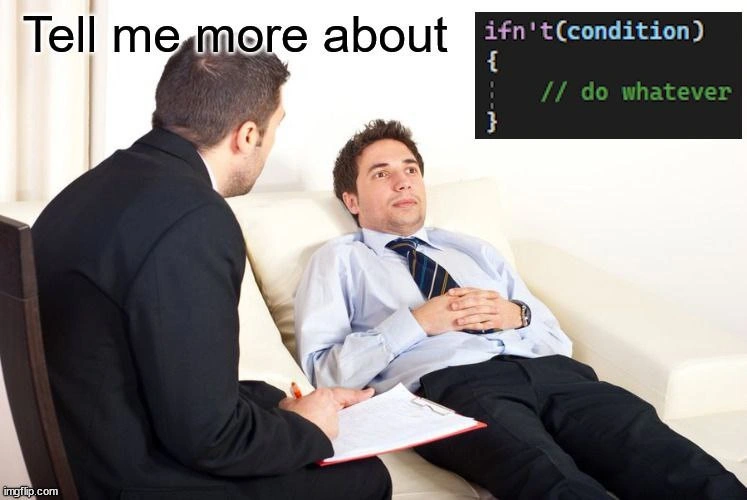
Now, the image itself sets a scene: a developer (the patient) is reclining on a couch, and the therapist is saying “Tell me more about ...”. In the top-right, we see the code ifn’t(condition) { // do whatever }. Basically, the “therapist” meme format is being used to joke that this piece of code caused the developer so much grief that it’s like a traumatic memory. Of course, in reality we don’t go to a therapist for code problems, but the joke lands because intense debugging sessions feel exhausting. The humor comes from mixing a serious setting (therapy for deep personal issues) with a trivial-sounding problem (a silly code error). It’s a form of relatable developer experience: if you’ve ever banged your head against a compile error for hours, you might half-jokingly say “I’m scarred by that experience.”
Let’s also clarify “invalid control flow” in the context tags: control flow refers to the way we direct the order of execution in a program (through statements like if, else, loops, etc.). ifn’t is not a valid control flow statement in any language, so it’s an invalid attempt at controlling flow. And custom syntax – this highlights that ifn’t looks like someone tried to introduce a custom language syntax that doesn’t exist. In large projects, sometimes people do create custom scripting languages or weird macros, but even those have to follow some kind of formal definition. You can’t randomly throw an apostrophe into a keyword and expect the computer to know what you mean.
To a junior dev or someone learning: don’t worry, you won’t find ifn’t in any real codebase (unless it’s an inside joke). It’s a made-up example to poke fun at how a tiny mistake or a fanciful idea can blow up. The key takeaway is that programming languages are strict; even something that seems as small as one extra letter or symbol can cause a complete failure to run the program. And when you’re new, encountering these errors can be frustrating — but over time, you get better at avoiding and fixing them. Eventually, you might even laugh at the memory of how stumped you were by a missing bracket or a misspelled keyword. This meme is basically an experienced developer laughing (so they don’t cry) about those kinds of memories.
Level 3: Haunted by Syntax
For seasoned developers, this meme hits a relatable nerve — it humorously dramatizes the lingering trauma of dealing with utterly wrong code. The image of a developer on a therapist’s couch talking about a mysterious ifn’t statement is a tongue-in-cheek exaggeration of how frustrating syntax errors and weird code can be. We’ve all had those “WTF” moments in our careers: stumbling upon code that’s so baffling or a bug so elusive that it haunts us afterward. Developer humor often equates debugging horrors to ghost stories or war stories. Here, ifn’t represents an absurd piece of code that presumably someone wrote or encountered, and it was so painful to deal with that the poor developer is jokingly shown seeking therapy to recover from the experience.
Why ifn’t? It’s a mashup of an if statement with an English contraction “n’t” (as in isn’t = is not). It highlights a common source of developer pain: code that looks almost legitimate, but is fundamentally wrong. Perhaps a tired programmer or a junior dev thought, “hey, what if we had an if not keyword?” or tried to be clever in code comments. The result is a SyntaxError that stares you in the face, yet in the heat of the moment you might waste time wondering “what on earth is this supposed to be?” Many of us have been in scenarios where a simple typo or a bizarre language quirk led to hours of troubleshooting. For example, a missing semicolon ; or a stray character can produce a cascade of confusing compiler errors. By the time you find the root cause, you’re equal parts relieved and mentally exhausted. Those experiences stick with you (“trauma” in jest) — you double-check that particular issue compulsively in the future, much like a person avoiding a past trauma trigger.
The therapist couch setup in the meme is a classic format in DeveloperHumor: it’s the absurd idea that programming problems give us such emotional baggage that we need professional help to unpack them. It’s funny because it contains a grain of truth: after wrestling with inexplicable bugs or legacy code from hell (imagine hundreds of lines of ill-formed logic), developers do joke “I’ll need therapy after this project.” The unresolved trauma of ifn’t implies this wasn’t just a one-off chuckle; it was an ordeal. Maybe the developer spent a long night trying to run a program that refused to compile, only to discover some teammate had put a nonsense placeholder like ifn’t in the code as a joke or by mistake. Picture real-world analogs: a comment like “// TODO: handle ifn’t case” left in a codebase, confusing everyone, or a misguided macro attempt to create an if not construct that went horribly wrong. Seasoned programmers have seen some crazy things in code, from copy-paste gobbledygook to half-implemented features that make no sense. This meme plays on that shared understanding.
We can also appreciate a meta-joke here about language design. Over the years, there have been humorous or strange proposals on programming forums (especially around April Fools’ Day) suggesting new keywords or operators. For instance, someone tongue-in-cheek might propose an ifn’t keyword to save typing ! or not — only to be met with groans and facepalms. Experienced devs generally react to such LanguageQuirks suggestions with, “Please, no more magical syntax, we have enough nightmares already.” So the developer in therapy could be seen as a victim of a bizarre language proposal come to life or a codebase that implemented some wacky custom syntax. It’s the kind of thing that in an enterprise project could occur if a zealous architect decides to create clever macros or a domain-specific language embedded in the code. The result? Confusion and suffering for anyone who inherits that code. The meme captures this perfectly: the therapist’s gentle “Tell me more about…” sets up the punchline that what troubles the patient isn’t childhood or work stress, but an invalid control flow statement! That incongruity is what makes us laugh. We’ve felt disproportionate stress from silly things in code, so the scenario resonates. It’s a safe way for developers to mock our own tendency to get way too emotionally invested in code correctness.
In short, for a senior developer this image conjures darkly comic memories of late-night debugging sessions and cursed code snippets. It’s both a catharsis and a warning: don’t invent crazy new syntax on your own, or you’ll traumatize whoever maintains your code! The next time we see something as ridiculous as ifn’t, we’ll chuckle nervously and maybe book a therapy session — or at least an extra coffee session with the team to vent about it.
Level 4: Syntax Panic Mode
At the deepest technical level, this meme riffs on how programming languages and compilers enforce strict grammar rules — and how something like ifn’t utterly breaks those rules. In a typical language grammar (say C, C++ or Java), an if statement is a well-defined construct: the compiler’s parser expects the keyword if followed by a condition in parentheses. Here, the code snippet ifn’t(condition) throws the compiler into confusion. Why? Because there is no ifn’t keyword in any standard language syntax. The compiler performs lexical analysis first, chopping code into tokens. It might see the characters ifn’t and try to interpret them as known symbols. It recognizes if at the start, but then the extra n’t part violates the token patterns. In a C-like language, ifn’t would likely be split into an identifier ifn and a stray 't character (that ' could be read as the start of a character literal, causing even more chaos). This means the sequence of tokens doesn’t match any rule in the language’s context-free grammar. The parser doesn’t know how to reduce ifn’t into a valid AST (Abstract Syntax Tree) node. It’s as if you suddenly introduced a new control flow construct out of thin air.
When a compiler encounters an unexpected token like this, it goes into panic mode – quite literally in compiler theory there’s panic-mode error recovery, where the parser synchronizes by discarding nonsense tokens until it finds something it recognizes (like a ; or } that indicates end of statement). The meme description jokes that ifn’t would send the compiler "straight into a syntax panic," which is apt: the poor compiler’s like, “I have no idea what this means!” Typically you’d get a syntax error message, possibly along the lines of: “error: expected ‘(’ after if” or “unknown token ‘ifn’”. The exact error might vary, but the compilation failure is guaranteed. There’s no valid parse tree for an ifn’t construct, so the compiler just halts in bewilderment.
The humor at this level comes from how absurd the code is from a language design perspective. Languages are defined by formal grammars (often specified in BNF/EBNF for language specs). Introducing a contraction like ifn’t (short for “if not”) isn’t a trivial tweak — it would be a radical language change requiring compiler support and careful grammar conflict resolution. It reminds us of real language quirks and proposals: many languages let you express “if not” in some way (e.g. if (!condition) in C-style syntax or unless condition in Ruby), but no mainstream language uses a quirky apostrophe-laden keyword. Any compiler or interpreter that encounters such a token will either treat it as a bizarre variable name (and then choke on the ' character) or just flat-out error. This meme scenario is like throwing a bizarre, non-conforming code snippet at a compiler and watching it crash and burn. The compiler’s strict adherence to defined syntax is merciless — if your code even slightly deviates from the grammar (say, by using an invalid control flow keyword), you get a hard CompilerError and no mercy. In summary, ifn’t is a lexical and syntactic abomination that no compiler could parse, highlighting the ultra-rigidity of programming language syntax (and setting the stage for the comedic trauma the developer experiences).
Description
The image uses the 'man in therapy' meme format. A man in a shirt and tie lies on a therapist's couch, looking up with a troubled or distant expression. A therapist, seen from behind, sits in a chair holding a clipboard and pen, seemingly taking notes. Above them is the text 'Tell me more about' followed by a black code block. The code block contains the following text: 'ifn't(condition) { \n // do whatever \n}'. The joke lies in the fictional 'ifn't' statement, a portmanteau of 'if not'. It represents a nonsensical or 'cursed' coding idea that a developer has invented. The meme humorously suggests that such a terrible idea is a source of psychological trauma for the developer, requiring a therapy session to process. For experienced developers, it's a relatable jab at the 'clever' but unreadable shortcuts one might invent and later regret, touching on themes of code quality, maintainability, and the inner monologue of programming
Comments
21Comment deleted
Some developers write code that needs a profiler. This developer writes code that needs a psychologist
Somewhere out there a compiler just added another stage: denial, anger, bargaining, depression, acceptance… and now ‘ifn’t’. Guess we finally shipped the Kübler - LLVM pipeline
The same developer who writes if(!(condition)) is now explaining why their microservice needs 47 environment variables and a custom DSL for configuration because "YAML wasn't expressive enough."
This is what happens when you let your code reviewer take a sabbatical - someone merges 'if'n't' into production and now your entire team needs therapy to process the trauma. It's the programming equivalent of discovering your predecessor implemented a custom boolean algebra where true means 'maybe' and false means 'ask again later.' The real horror isn't the syntax itself - it's knowing that somewhere, in some legacy codebase, there's probably a macro that actually makes this work, and it's been in production for 15 years because nobody dares touch it
It starts as a cute macro - ifn't(x) expands to if(!(x)) - and ends with on-call debugging ifn't(!feature_enabled && !!ready) at 3am and a new style guide that simply says: never be clever
After 20+ years, ifn't(condition) remains the holy grail of syntax sugar - languages give us !condition instead, and therapy bills for the emotional debt
‘ifn’t’ is cute until 3am on-call, when the only interpreter left is your future self
condition't Comment deleted
return't Comment deleted
COME FROM Comment deleted
whilen't Comment deleted
read like violent Comment deleted
don't { // whatever } while (c); Comment deleted
don't looks like multiline comment block Comment deleted
vnature Comment deleted
It's awesome! Can be useful:) Comment deleted
Ruby coming in with the unless Comment deleted
actually why not, just a block for correct code that can be highlighted and linted but is unreachable Comment deleted
#if 0 Comment deleted
int variable = foo #if 0 + #else - #endif bar; so the code in unreachable preprocessor blocks always has to be cut off by linter to not eat some junk instead. The pure {} is supposed to have complete statements only. That's it Comment deleted
https://t.me/devs_chat/114545 credits? Comment deleted