Skip to content
DevMeme
5350 of 7435
The Eternal Cycle of 'Just One More Patch'
GameDev Post #5867, on Feb 2, 2024 in TG

The Eternal Cycle of 'Just One More Patch'

Why is this GameDev meme funny?

Level 1: Not Done Yet

Imagine you spent all afternoon cleaning your room. You put away all your toys, made the bed, and then proudly tell your parents, "I'm finished!" You feel really good and relieved because you think the job is done. But then, oops – you spot a bunch of toy blocks that rolled under the dresser. The room isn’t really clean yet. Now you have to pick up those blocks and finish cleaning again. It’s a little funny and a little frustrating: you thought you were completely done, and then you discovered there’s more to do. This meme is joking about that same feeling – when you say something is final and finished, but it turns out there’s one more round of work before it’s truly done.

Level 2: One More Hotfix

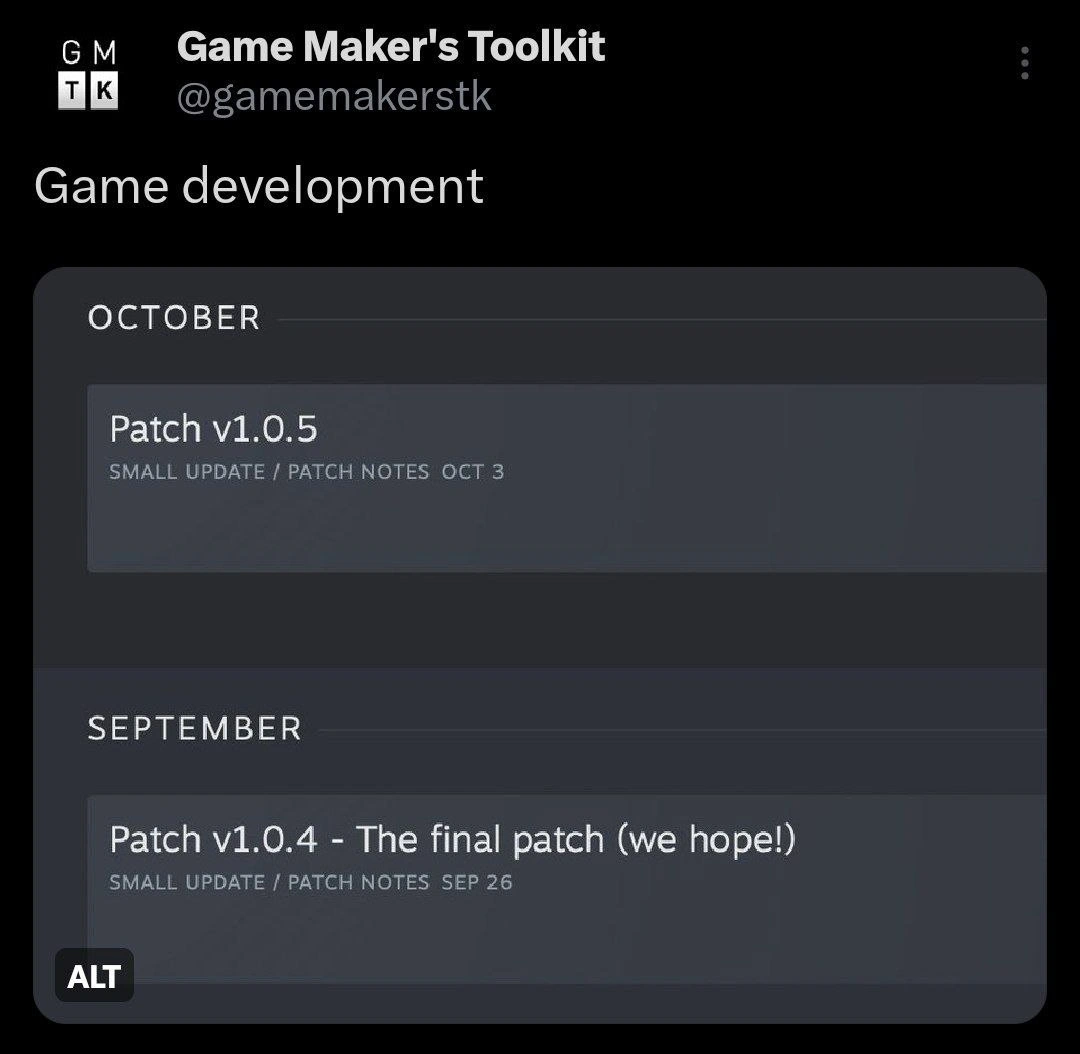
Let's break down the joke for a newer developer. Imagine you're working on a video game. The team releases Patch v1.0.4 and even calls it “the final patch.” In other words, they believed this update would be the last set of bug fixes or changes the game needs. "Final" implies they're done supporting the game (at least for now). But then, only a week later in October, out comes Patch v1.0.5. That means something unexpected happened – probably a bug or issue was discovered – and the developers had to put out one more hotfix to address it.

First, some terminology: A patch is a small update to a software or game that fixes issues (bugs) or makes minor improvements. It's called a patch because it's literally about "patching up" holes or problems in the code. A hotfix is a special kind of patch that's rushed out to fix a critical bug that can't wait. Hotfixes often happen soon after a release when an urgent problem is found in the wild. So, Patch 1.0.4 was supposed to fix everything, but Patch 1.0.5 in this case is essentially a hotfix released quickly after the "final" patch to fix one more issue.

Now, about those version numbers: the game is using a form of semantic versioning. This means each version number has three parts: Major.Minor.Patch. Here we have 1.0.4 followed by 1.0.5:

  • 1 is the major version (the game’s main version – "1" usually means the first full release of the game).
  • 0 is the minor version (0 means no significant new features have been added since the initial release; it's still on the original feature set).
  • 4 and then 5 are the patch numbers. They go up by one each time the developers release a new small update or bug fix.

So going from v1.0.4 to v1.0.5 means they released one more small update. They didn’t jump to 1.1 or 2.0 because it wasn’t a big new feature release – just a quick fix.

The screenshot shows a release notes panel or log with entries by date. In September, it lists “Patch v1.0.4 – The final patch (we hope!)” and then in October it lists “Patch v1.0.5.” Release notes are basically a list telling users what changed in each update. The funny part is that the September entry literally says "final patch (we hope!)" – the developers added "we hope!" because they suspected there might be more to do – and sure enough, the next month they had to add another entry for the new patch.

The reference to a “follow-up hotfix sprint” in the title means the team had to plan an additional sprint just to work on this urgent fix after the supposed final patch. In agile development, a sprint is a short, focused period of work (often 1-2 weeks) where a team tries to complete a set of tasks or fixes. So basically, after releasing patch 1.0.4, the team thought they were done with the project. But then they discovered a problem that forced them to say, "Okay, we need one more sprint to fix this," and that sprint produced patch 1.0.5 as a quick solution.

This kind of situation is very common in software development (especially in games). Even when you think a project is finished and you've fixed every bug you know about, real players or users might do something unexpected that breaks the software. Then you have to scramble to patch it again. The meme is poking fun at that exact scenario: the moment you proudly announce "We're done!", something else jumps out that needs fixing, so you're not done after all.

Level 3: The Final Patch Paradox

We all know in GameDevelopment, labeling any release the “final patch” is just tempting fate. In the meme’s screenshot, the ReleaseNotes timeline says it all: under September, we see Patch v1.0.4 – The final patch (we hope!), and then under October – surprise! – there's Patch v1.0.5. The tweet above the image simply captions it as “Game development.” – because of course in this industry final really means “until the next hotfix.”

Seasoned developers can practically hear the weary sigh behind that parenthetical “(we hope!)”. This is classic DeveloperHumor forged from real DeveloperPainPoints. Why is it funny (and painful)? Because we've all lived it. You push a “final” update on Friday, celebrate – and by Monday you're scrambling to fix a crash report nobody saw coming. Boom, now you have to coordinate yet another release deployment, feeling that familiar DeploymentPainPoints sting right after you thought everything was wrapped up. It's the never_ending_final_patch saga: every time you think you're done, another sneaky bug crawls out of the woodwork. Naming a build final is almost like a challenge the code happily accepts to prove you wrong.

From a ReleaseManagement perspective, this scenario highlights how SemanticVersioning can turn into a slow creep of numbers when reality defies our plans. The version jumps from 1.0.4 to 1.0.5 – a tiny increment by VersioningStrategy standards – indicating a quick hotfix_after_final_release. In theory, that last digit in the version (the patch number) is for small bugfix updates. In practice, watching it tick up one more notch right after a "final" build is the hallmark of semantic_version_creep. It's basically the software saying, “Oops, not quite done yet.” Each new patch entry in the release notes is a public admission that something needed fixing post-"final".

The real punchline is how routine this has become in GameDev. Post-launch support is expected – you can call it a post_launch_support_cycle or just the reality of modern games – which means developers always keep one eye open after release. In game development pipelines, every "final" build is often followed by an inevitable hotfix once thousands of players start hammering the game in unpredictable ways. Maybe a physics glitch only happens at scale in production, or a level exploit appears when players do something crazy. No matter how much QA you did, there's always that one surprise. So the team ends up pulling together another mini-sprint to release Patch 1.0.5 just to put out the fire. It's practically tradition at this point: the moment you declare victory, the code finds a way to humble you.

In short, this meme lands a bullseye because it captures a universal truth of software development: “final” is a fleeting concept. The only truly final patch is when you stop supporting the product entirely (or run out of budget). Until then, there's always one more bug, one more tweak. That endless cycle can cause some game_patch_fatigue for the team and players alike. As the joke implies, The Final Patch™ is never truly final – and every engineer who's been through a release can laugh (and cry) at that.

Description

A screenshot of a post from the 'Game Maker's Toolkit' (@gamemakerstk) account, with the heading 'Game development'. The image displays a list of software patches organized by month. Under the 'SEPTEMBER' section, an entry reads: 'Patch v1.0.4 - The final patch (we hope!)' dated 'SMALL UPDATE / PATCH NOTES SEP 26'. Directly above it, in the 'OCTOBER' section, is a newer entry: 'Patch v1.0.5' with the date 'SMALL UPDATE / PATCH NOTES OCT 3'. The humor comes from the classic developer experience of optimistically declaring a release 'final,' only to be immediately contradicted by the need for another patch. The parenthetical '(we hope!)' adds a layer of self-aware irony, acknowledging the inherent unpredictability of software maintenance. For experienced engineers, this is a deeply relatable scenario that illustrates the futility of ever considering a project truly 'finished.'
Comments

15
Anonymous ★ Top Pick That '(we hope!)' is doing more heavy lifting than the entire CI/CD pipeline
  1. Anonymous ★ Top Pick

    That '(we hope!)' is doing more heavy lifting than the entire CI/CD pipeline

  2. Anonymous

    Why call it ‘v1.0.4-final’ when everyone knows the real LTS branch is whichever commit fixes the typo in the previous “final” changelog?

  3. Anonymous

    After 20 years in the industry, I've learned there are only two types of 'final' releases: the one before the hotfix, and the one before the emergency patch that fixes the hotfix. The real final version is always n+1, where n is whatever you just shipped

  4. Anonymous

    Every game developer's famous last words: 'This is the final patch!' - right before discovering that edge case where players can clip through the floor by jumping backwards while holding a specific item combination. Six months later, you're on v1.0.47 and the parenthetical '(we hope!)' has evolved into '(narrator: it wasn't)'. The real game isn't what you ship - it's the friends we debug along the way

  5. Anonymous

    In semver, declaring “final patch” is a quantum state that observability collapses into v1.0.5 on the hotfix branch

  6. Anonymous

    Every “final patch” is a release note for the next regression - SemVer is just an audit trail of optimism

  7. Anonymous

    Game dev's 'final patch (we hope)': asymptotically approaching stability, eternally one hotfix from done

  8. @taustus 2y

    literally every development

  9. @Johnny_bit 2y

    _FINAL_FINAL_v2_v3_REALLYFINAL_v4

    1. @SamsonovAnton 2y

      Subj: Re[127]: Small fixes to "Terms of Reference v8 final approved.doc"

  10. @Sp1cyP3pp3r 2y

    Final Minecraft update

    1. @kinf0rm 2y

      the sex update?

      1. @Sp1cyP3pp3r 2y

        Piss and shit update

        1. @kinf0rm 2y

          🤯

  11. @MANGIAMONDI3000 2y

    Terraria

Use J and K for navigation