React's Official Decree on Component Terminology
Why is this Frameworks meme funny?
Level 1: Soda, Not Pop
Imagine you’re at a friend’s house and you ask for a “pop” to drink, and your friend’s parent chuckles and says, “In this house we call it soda, not pop.” 😜 It’s basically the same fizzy drink, but they have a family rule about what word to use. It’s a tiny, funny difference in wording. The React meme is just like that, but for computer programmers. The people who make React are gently saying, “Hey, we like using one special term instead of a slightly different word.” It’s kind of silly-funny because it shows how even smart grown-up developers can be a bit like a picky family about the words they use. They’re all in on the joke that this little naming rule is a thing. Essentially, the tweet is playful: it’s reminding everyone of the “house rule” in the React family — use the word “function” when talking about these components, not “functional.” It’s a friendly nudge, and people who write code find it humorous because it’s so relatable. Just like calling a soda “pop” might get a lighthearted correction in some families, calling a React component “functional” gets a joking correction to say “function component” instead. It’s all in good fun and helps everyone speak the same language!
Level 2: What’s in a Name?
Let’s break down the joke for those newer to React or frontend humor. React is a popular JavaScript library for building user interfaces, and it uses the idea of components — reusable pieces of UI. There are two common ways to write a React component: as a class component or as a function component.
A class component is written using a JavaScript class (an older style in React). For example:
class Welcome extends React.Component { render() { return <h1>Hello, {this.props.name}</h1>; } }Here
Welcomeis a class with arendermethod that returns some JSX (React’s syntax for UI).A function component is written as a plain function that returns JSX, like so:
function Welcome(props) { return <h1>Hello, {props.name}</h1>; }This accomplishes the same thing but with simpler syntax. Originally, these were sometimes called “functional components” in conversation because they’re made of functions.
So why is the React tweet saying call it function instead of functional? It’s about naming conventions – basically, agreeing on consistent terminology. In React’s official documentation and community guides, the preferred term is function component. The word functional can be confusing here. In general programming, “functional” refers to functional programming, a style where you avoid changing state and rely on pure functions (no side effects). However, React function components aren’t limited to that style – especially after React introduced Hooks. With Hooks, a function component can have its own state (useState) and perform side effects (useEffect for data fetching or subscriptions). In other words, React function components are not purely functional in the academic sense; they’re just components defined with functions.
Calling them function components (noun form) keeps things clear: it’s a component that is a function. Saying functional component (adjective form) might incorrectly imply something about functional programming principles, which could mislead beginners. The React team wants to avoid that little trap. It’s a bit like proper vocabulary or jargon specific to the React community – using the right term makes sure everyone understands each other without confusion.
The humor in the tweet also comes from the tone: “psst: in this house we say…” – it feels like a friendly whisper from the React team to its followers. It’s as if the React community is a family or a club with its own lingo. If you’re new to React, you might not have realized there’s even a distinction. But those who’ve been around a while have seen people correct each other on this exact point. It’s a community in-joke. The tweet’s timing and phrasing implies the React team is playfully throwing shade at the wrong term (“functional”) while reinforcing the correct one (“function component”).
This highlights something about Developer Experience (DX) too: consistent language in docs and code can make learning and collaborating easier. It might feel like a trivial detail, but consistent naming avoids mix-ups. Many frameworks and libraries have these little preferred terms. For example, in React we say props (short for properties) to describe data passed to components, and everyone learns that term. Here, they’re just nudging us to use the agreed term “function component” so that when you read official guides or discuss issues, everyone’s on the same page. And of course, it’s done with a wink and a smile – acknowledging that, yes, developers can get a tad obsessive about naming. After all, there’s a famous saying: “Naming things is one of the hardest problems in computer science.” This tweet turns that seriousness into a bit of tech humor. It’s React’s way of lightly saying: “We care about this little wording, and we know our developer community cares (and jokes) about it too.” If you’ve ever seen developers quibble over whether to call something a “bug” or an “issue”, or whether a file should be named UserDAO vs UserRepository, you’ll recognize the pattern. Here it’s just on a smaller, meme-worthy scale with a specific React twist.
Level 3: Function Over Functional
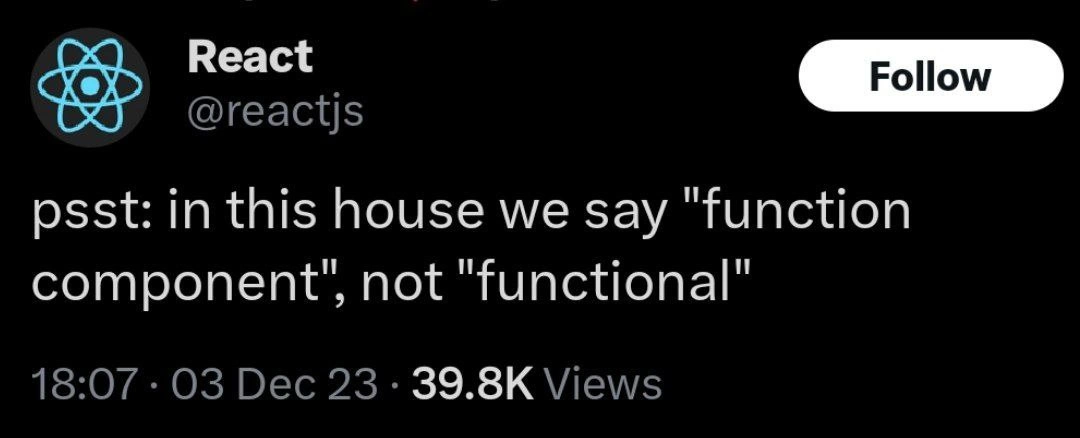
The official React Twitter account’s cheeky reminder — “psst: in this house we say 'function component', not 'functional'” — hits a nerve only seasoned frontend developers fully appreciate. It’s poking fun at a naming convention that has sparked countless code review nitpicks and style-guide debates in the React community. On the surface, it’s a single word difference. But in the world of Frontend Development, that tiny 'al' suffix carries surprising weight.
Why do senior React devs smirk at this tweet? Because they’ve lived through the naming holy wars. In React’s early days, we casually said “functional component” to mean a component written as a function instead of a class. It was an easy shorthand to contrast with the older class components. But over time, the React core team nudged everyone toward the term “function component”. Why so pedantic? Chalk it up to clarity and a bit of Developer Experience (DX) polish. The word functional brings along baggage from functional programming (FP) — a paradigm where functions are pure and side-effect-free. React’s function components aren’t necessarily pure; with Hooks like useState and useEffect, they can have state and side effects. Calling them “functional” started to feel like a misnomer, especially after Hooks let these once-stateless components become stateful. It’s as if the community collectively agreed: let’s drop the misleading suffix and stick to the basics.
This tweet reads like an inside joke between React veterans. The phrasing “in this house we say X, not Y” mimics a common meme format and implies a kind of tongue-in-cheek doctrine. The React core team is gently asserting their preferred terminology, and experienced devs find it hilarious because it echoes all those PR comments and docs changes they’ve seen:
- Code reviewer: “Great work on the component! Just a nit: we prefer calling it a function component rather than functional component for consistency with the docs.” 😅
- Team lead: “Our style guide flags ‘functional component’ — we follow official React nomenclature.”
Yes, this has even led to joke ESLint rules and elaborate bikeshedding. Bikeshedding, for the uninitiated, is when teams argue endlessly over trivial issues (like paint color… or naming). Seasoned devs have a scar or two from these battles. They know naming things is famously one of the hardest problems in programming (right up there with cache invalidation and off-by-one errors!). So, when React’s official account drops a playful “psst” about saying function instead of functional, it’s both a lighthearted grammar lesson and a reminder of how seriously our industry takes naming. It’s funny because it’s true: we obsess over terminology even while wrestling with complex framework mechanics. This tiny tweet encapsulates a shared experience — the collective sigh and chuckle of developers who’ve been down the rabbit hole of naming conventions, where a single word can spark a mini flame-war or a long Slack thread. In a fast-moving frontend framework ecosystem (where Framework Fatigue is real), it’s oddly comforting (and comical) to rally around something as small and enduring as a terminology preference. React’s tweet is essentially saying: “We’ve been through hooks, context, suspense, and countless new APIs together — we can at least get our naming straight, right?” 😉
Description
A screenshot of a tweet from the official React Twitter account (@reactjs) with its recognizable blue and black atom logo. The tweet is on a black background with white text, stating: "psst: in this house we say \"function component\", not \"functional\"". Below the text, the timestamp reads "18:07 · 03 Dec 23" and it shows "39.8K Views". This meme captures a subtle but persistent point of terminological debate within the React community. For years, developers have used "functional component" and "function component" interchangeably. The tweet serves as a gentle but firm correction from the framework's creators, establishing the official nomenclature. For senior engineers, this is a nod to the importance of precise language in technical discussions and documentation, distinguishing between components written as JavaScript functions ('function components') and the broader paradigm of 'functional programming'
Comments
47Comment deleted
We've finally settled the 'function component' vs 'functional' debate. Now, can we have a conversation about why my 'useEffect' is firing twice in Strict Mode?
Somewhere a React maintainer just added "functional component" to the ESLint banned-words list; expect a major version bump labelled “grammar breaking change.”
After 15 years of arguing about tabs vs spaces, we've finally evolved to debating whether it's 'functional' or 'function' components - because nothing says senior engineer quite like correcting terminology while your production build is 2MB of unshaken tree
Ah yes, the eternal React pedantry: 'function components' are just JavaScript functions that return JSX, while 'functional programming' is the paradigm we all pretend we're doing until someone mutates state in a useEffect. The React team knows that if they let us call them 'functional components,' half the team will start arguing about pure functions and referential transparency during code review instead of just shipping features. It's not functional programming - it's just functions that happen to render UI and occasionally cause infinite re-render loops when you forget the dependency array
Call it a 'function component' - if it were truly functional, useEffect wouldn’t exist and your analytics hook wouldn’t be mutating localStorage
React enforcing 'function component' lest we conflate hooks with monads - FP purists approve
We say 'function component' because 'functional' implies purity - tell that to useEffect's side effects
Now I wish I have seen that spam 👀 Comment deleted
you can Comment deleted
Seriously tho, maybe let’s keep some spam if not offensive and looks interesting? Comment deleted
let me guess you wanna have an AI waifu Comment deleted
We may make some good memes out of it Comment deleted
Bruh Comment deleted
Oh.. Comment deleted
faggot is a slur Comment deleted
slurs are forbidden? Comment deleted
depends on context. generally homophobia, transphobia, xenophobia, etc. etc. is forbidden hate speech and adjacent stuff. Comment deleted
he commented a meme Comment deleted
…wat? Comment deleted
He just made a little homophobic joke without directly insulting anyone. Comment deleted
yes that's still forbidden Comment deleted
homophobia, even if not directed at anyone in specific, is not something I want to see here Comment deleted
literally 1984 Comment deleted
if you have a genuine problem with that moderation decision, DM me if not, yes literally 1984 🤪 how dare I demand people don't normalize hate speech against vulnerable minorities Comment deleted
Not trying to insult anyone here or say something inappropriate but... Can anyone explain why is it always called something like "...phobia"? People are making fun of other people and not running away in panic. Comment deleted
what do you do when you have arachnophobia and see a spider? kill it. it is a kind of fear, but less direct. *-phobes usually don't fear the people themselves, but their effects on society, or rather what they believe they will do to society Comment deleted
it's always "oh the gays will mutilate your children" and stuff, it's definitely a kind of internalized fear of queer people Comment deleted
In that particular case it makes sense yeah. Comment deleted
the other explanation is that it's just called that way because it's called that way, don't think too much about it 😛 Comment deleted
some people have switched to calling it -misia so e.g. transmisia Comment deleted
transmisia as in cars? why not mis- prefix as in misoginy? Comment deleted
what cars misia is a suffix that comes from ancient greek uhh… *looking it up* mîsos, which means "hatred" Comment deleted
and what do you think of miso- part of misoginy? the literal same Comment deleted
doesn't work because homo is a prefix, so you need a suffix to complete the word Comment deleted
otherwise 10/10 very nais Comment deleted
in russian language we dont care we dont even need a root for a word to be normal (link) Comment deleted
misoginy comes from miso → hatred gyno → woman -y → suffix because english is englishing Comment deleted
what about adding -y everywhere?) Comment deleted
idk english is englishing Comment deleted
and thought about vim -y Comment deleted
https://en.wikipedia.org/wiki/Transmission_(mechanical_device) RU: Трансмиссия (approximately trahns-MIS-see-yah "transmisia") Comment deleted
vroom vroom Comment deleted
so..., pedophillia is supported in this chat? Comment deleted
what's xenophobia? Comment deleted
xeno means "different" so fear of (or hatred for) the unknown or unfamiliar Comment deleted
Damn Comment deleted
I found the real meme in the comments Comment deleted