Skip to content
DevMeme
5062 of 7435
The Duality of Theoretical Computer Science: Abstract Logic vs. A Box on Wheels
CS Fundamentals Post #5541, on Sep 29, 2023 in TG

The Duality of Theoretical Computer Science: Abstract Logic vs. A Box on Wheels

Why is this CS Fundamentals meme funny?

Level 1: Genius vs Child’s Play

Imagine you’re reading a really advanced science book — on one page there’s a super complicated equation or a strange logical sentence that looks like a secret code. It’s full of symbols and it’s hard to read, like something only a genius or professor would understand. 😵 Then you turn the page, and suddenly there’s a simple little cartoon of a box rolling on a strip of tape, something that looks like it came from a kids’ book. 😄 You’d probably do a double-take and maybe giggle, thinking, "Wait, these two things are in the same book?" That’s exactly the funny idea here! The meme is saying theoretical computer science can be really, really hard and really, really simple at the same time. One moment it’s like solving an insanely tough puzzle, and the next moment it’s like playing with a toy. Seeing those two back-to-back is surprising and amusing. It’s like if a math professor’s lecture suddenly switched to a kindergarten story hour — you don’t expect them together, and that unexpected switch makes it funny. In short, the meme jokes that the world of computer science theory ranges from mind-bending formulas to child-like drawings, all under one roof, and that contrast is what makes us laugh.

Level 2: Symbols & Tapes

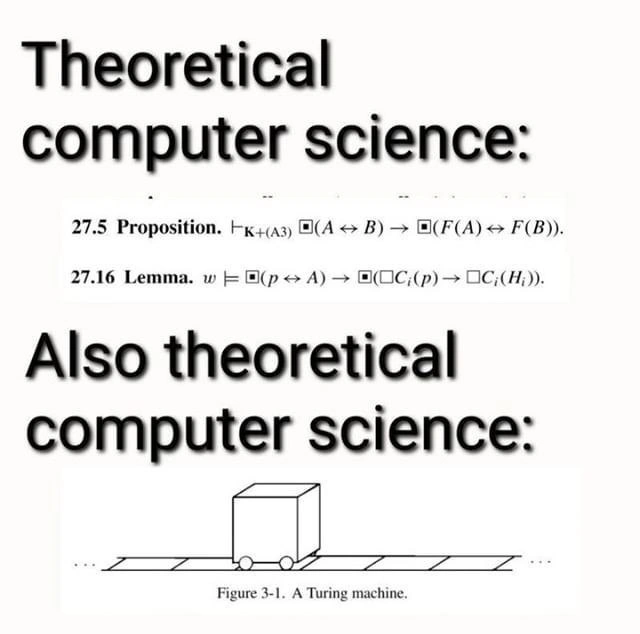
Let’s break down what’s actually shown, in plain terms. The top half of the meme is portraying the heavy, mathematical side of theoretical computer science. It shows lines from what looks like a textbook or academic paper. You can see words like "Proposition" and "Lemma" with numbering (27.5, 27.16), followed by a string of symbols: lots of arrows, boxes, letters, and strange punctuation. This is an example of formal logic notation. In computer science theory (and math in general), we use formal logic to state and prove facts rigorously. Here’s what some of those symbols mean:

  • (turnstile symbol) means “provable” or “derivable”. Writing something like ⊢ □(A ⇔ B) means that statement is proved within a certain logical system. In the snippet, ⊢_{K+(A3)} indicates the proof is done in a specific logical system named "K+(A3)" (which is probably a variant of modal logic with some extra axiom called A3). That’s a detail about the logical rules being assumed.
  • (double turnstile) means “satisfies” or “entails” in a semantic sense. When we see w ⊨ ..., it reads as "world w satisfies ...", essentially saying “in a particular scenario or model (labeled w), this statement holds true.” It’s a way to talk about truth in a model rather than provability in a system.
  • is often called the "box" and stands for the modal operator “necessarily” (or "always"). If you see □P, read it as “it is always the case that P” or “P is true in all possible situations under consideration.” Modal logic introduces □ (necessarily) and sometimes ◇ (diamond, meaning “possibly”) to reason about things like necessity, possibility, time, or knowledge.
  • is a one-way arrow meaning “implies”. So X → Y reads as “if X is true, then Y is true.”
  • is a two-way arrow meaning “if and only if”, a logical equivalence. A ⇔ B means A and B have the same truth value in every case (both are either true together or false together). It’s like saying “A implies B and B implies A,” i.e., A and B are essentially the same statement in logic.
  • Proposition and Lemma are labels for statements. A proposition is usually an important statement or theorem to prove. A lemma is a smaller, supportive statement proved on the way to a bigger result. Think of a lemma as a helper puzzle piece that will be used to solve a larger puzzle (the proposition or theorem). So, item 27.5 being a Proposition suggests it’s a main result, and 27.16 being a Lemma means it’s a stepping stone result likely used somewhere later (perhaps Proposition 27.17 or a Theorem 27.x). They’re numbered according to the chapter or section.

Now, you definitely don’t need to fully understand the specific formulas shown (even many grad students would need context to parse them!). The point is: this is how theoretical CS often looks in textbooks and research papers — lots of symbols and logic. It’s abstract and can be pretty intimidating. For instance, □(A ⇔ B) → □(F(A) ⇔ F(B)) in Proposition 27.5 is basically saying: "if A and B are equivalent in all cases, then F(A) and F(B) are also equivalent in all cases". In other words, the function or operation F preserves logical equivalence under the necessity modal operator. That’s a fancy way of stating a property you’d prove in logic or theoretical computer science about some transformation F. The Lemma line w ⊨ □(p ⇔ A) → □□C_i(p) → □C_i(H_i) is even more complex. It’s talking about what holds at some world w: if in all cases p is equivalent to A, then (something about C_i) holds implying something about H_i. The notation C_i(p) and C_i(H_i) is a bit mysterious out of context, but it likely refers to some operator or modality indexed by i. It could be something like “Agent i’s knowledge of p” or “Condition C for component i” — it really depends on the topic of the text. Given it’s theoretical CS, this could be from a section about knowledge in distributed systems or an advanced logic system (maybe Epistemic Logic where multiple agents have knowledge and H_i could be some hypothesis or state for agent i). In any case, it’s highly formal and specific. The takeaway is that theoretical CS uses math-like notation to make very precise statements, and those statements can look really complex!

Now, the bottom half of the meme is showing something completely different: a diagram of a Turing machine. This is the uber-simple side of theoretical computer science. A Turing machine is an abstract model of a computer invented by Alan Turing. It’s one of the cornerstone concepts in CS theory and computability. What does it consist of? In that figure, you see a tape drawn as a long strip divided into squares (segments), and a box with little wheels on it sitting on the tape. In a typical depiction:

  • The tape is like the machine’s memory. Each cell of the tape can hold a symbol (often a 0, 1, or a blank, or any character from some alphabet). The tape is conceptually infinite in both directions, so the machine never runs out of tape to use.
  • The box on wheels represents the machine’s head and state. Inside that box, imagine there’s a finite set of instructions (this is the machine’s "program" essentially, often encoded as states and transition rules). The wheels indicate it can move along the tape. In operation, the Turing machine can do a few simple things: read the symbol on the current tape cell under the head, change that symbol to a new symbol (or maybe leave it as is), and then move the tape one step left or right, and switch to a new internal state according to its instructions. That’s it! Despite this simplicity, Turing showed that with a well-chosen set of rules, such a machine can perform any calculation that any computer can (given enough time and tape).
  • The caption “Figure 3-1. A Turing machine.” suggests this image comes from Chapter 3 of some book, probably at the start of a chapter where they introduce Turing machines. It’s a very simplified, conceptual diagram meant to give you the idea of a Turing machine without drowning in details. It doesn’t show the specific states or the transition function or anything — just the general idea: "think of it like a little cart that can roll along a tape, reading and writing symbols." Because, really, that’s an intuitive way to picture how a simple computing device might work.

So here’s the funny contrast the meme points out: theoretical computer science spans from extremely complex notation to extremely simple imagery. On one page, you might be proving a theorem with modal logic, staring at lines of symbols that look like they belong in pure math. On another page (or another chapter), you’re looking at what looks like a kid’s drawing of a box on a line, learning about how a basic abstract machine works. The meme literally labels both as “theoretical computer science” to highlight that this is the same field! It’s almost hard to believe, right? One part of CS theory could be mistaken for a graduate-level logic puzzle, and another part looks like a toy schematic. But that’s exactly the spectrum of abstraction we deal with.

For a junior developer or student encountering this meme, here’s why it’s humorous: if you’ve taken a theoretical CS class (like Computability and Automata or Logic in Computer Science), you’ve seen both of these things, but you might not have consciously realized how starkly different they appear. It’s like the field has a split personality. On Mondays, it speaks the language of pure mathematics (heavy on symbols, very precise and formal). On Tuesdays, it suddenly speaks in pictures and simple metaphors (machines, boxes, tapes). The content is related — both panels are about fundamental truths of computation and logic — but the presentation is night-and-day. Seeing them stacked like this is amusing because it’s so jarring: Complexity vs. simplicity, side by side. It highlights a kind of inside joke among CS students: “Only in theoretical CS will you go from deciphering modal logic to playing with a pretend Turing toy in the same course.” The simple Turing machine diagram almost looks like it belongs in an elementary lesson, especially compared to the hard logic above it. That contrast can make you chuckle and also appreciate that learning computer science involves both kinds of thinking: very abstract reasoning and very concrete models.

In sum, the meme is showing two extremes every CS theorist comes to know well:

  • Formal logic proof (top): the intimidating, symbol-heavy part of theory where precise propositions and lemmas are proved with strict formality.
  • Turing machine picture (bottom): the foundational computational model presented in the easiest-to-grasp way, as an image of a little machine on a tape.

Seeing them labeled together is a playful reminder that theoretical computer science isn’t just one mode of thought. It requires toggling between deep abstract math and simple fundamental concepts. And honestly, that contrast is a big part of its charm (and challenge)! The meme gets a laugh by showing just how drastically the style can shift — yet it’s all under the same banner of “CS fundamentals.” For a newcomer, it’s a hint that you’ll need both your logical brain and your imaginative, model-building brain to fully appreciate the field.

Level 3: Proofs & Playthings

For anyone who’s survived a theoretical CS class (or dared to open a theoretical computer science textbook), this meme hits home with a knowing grin. It’s showing us two faces of the same coin. Theoretical computer science can feel like intellectual whiplash: one moment you’re squinting at a wall of symbols and Greek letters, convinced you’ve stumbled into a math PhD’s lair, and the next moment you’re looking at what appears to be a diagram from a children’s science book. The top panel’s grainy textbook excerpt is emblematic of the "hardcore" side of CS theory — the realm of lemmas and propositions, where statements like “⊢ □(A ⇔ B) → □(F(A) ⇔ F(B))” are completely normal and might even extend for paragraphs. This is the side where your brain hurts, where proofs about logic, automata, or complexity classes get so formal that only careful study (and maybe a strong cup of coffee) can decode them. Many of us have sat in a lecture or read a paper where the notation was so dense we felt like we were reading hieroglyphics. It’s intimidating and impressive — a rite of passage for CS students to grapple with these abstract proofs. In that shared struggle lies some humor: we bond over the absurdity of just how convoluted things can get. (“Did that proposition really have three nested boxes and a double arrow? Who cooked up this notation?!” is a common chuckle in study groups.)

Then comes the flip side: the bottom panel, boldly labeled “Also theoretical computer science”, reminding us that the very same field also has a charmingly simple, almost naive aspect. That minimalist line drawing of a Turing machine — a little box on wheels traversing a tape — looks ridiculously simple, almost like a toy. And yet, any CS veteran recognizes it instantly and reverently: “Ah yes, the famous Turing machine figure.” It shows up in Chapter 1 of computability theory courses, in slideshows, even on t-shirts. It’s so basic you could explain it to a middle-schooler: “This box moves along the tape and reads or writes symbols.” After the nightmare of modal operators and inference rules, seeing that humble diagram feels like a breath of fresh air. In fact, it’s often by design: educators introduce a picture of a Turing machine to build intuition before drowning students in formal definitions of it. So if you’ve been wrestling with high-level proofs, encountering a stick-figure machine is almost comical relief — like the textbook is suddenly saying, “Don’t panic, here’s a friendly picture!”. Many of us cracked a smile the first time we saw how adorably simple a Turing machine is drawn, especially given the profound importance of what it represents.

The humor for an experienced developer or computer scientist comes from recognizing this extreme contrast and the cognitive switch it requires. It’s a bit like taking a grad-level theory exam where one question asks you to prove a complex theorem about modal logic semantics, and the very next question asks you to sketch a Turing machine that adds two numbers. The internal reaction is: “Wait, are we still in the same course?!” Yes, we are — theoretical CS is just that broad. There’s an almost nostalgic laughter in it: remembering late-night study sessions where half the time was spent deciphering dense proofs and the other half doodling state diagrams or Turing tapes on scratch paper. In practice, these two extremes feed into each other. Those simple “playthings” (like the Turing machine diagram or basic automata) are often what the heavy proofs are about. Conversely, the only way to be absolutely sure that “little box on a tape” actually does what we claim (compute anything computable) is to dive into proof mode and get mathematical about it. For seasoned folks, the meme also highlights an academic humor trope: theoretical computer scientists have a notorious habit of mixing high complexity with child-like simplicity in their presentations. This might be the only field where your lecture slides oscillate between something that looks like an insane equation from a quantum physics paper and a cartoon of a machine made of a square and two wheels. It’s as if the discipline can’t decide whether it’s playing with LEGO blocks or solving enigmatic puzzles—and in truth, it’s joyously doing both!

So when we see “Theoretical computer science:” followed by an impenetrable formula, and “Also theoretical computer science:” followed by the simplest machine sketch ever, we nod and chuckle. We’ve been there. We remember that aha! moment when after pages of logic, the professor drew that exact little Turing machine on the board, and suddenly the big ideas clicked. We also remember flipping pages from a goofy figure to a nightmare proof and getting academic whiplash. The meme perfectly captures that abstraction rollercoaster we all rode in our theory days. It’s funny because it’s true: theoretical CS lives simultaneously in a world of high abstraction and elementary metaphor, and surviving it means appreciating the brilliance (and absurdity) of both.

Level 4: Axioms to Automata

At the highest theoretical tier, this meme spotlights the dual nature of theoretical computer science: on one side, ultra-formal logical proof systems with dense symbolism; on the other, extremely simple models of computation. The top panel is a snippet of modal logic—notice the operator (a square “box”), which typically means "necessarily" or "in all cases" in modal logic. The formula ⊢_{K+(A3)} □(A ⇔ B) → □(F(A) ⇔ F(B)) is written in the style of a proposition from a logic textbook. Breaking it down: indicates a theorem provable within a formal system (here the system is called K+(A3), likely a normal modal logic K augmented with an extra axiom named A3). The formula inside says if A is logically equivalent to B (A ⇔ B) in all possible worlds (that’s the □(A ⇔ B) part), then F(A) is equivalent to F(B) in all possible worlds (□(F(A) ⇔ F(B))). In plainer terms, it’s proving that some transformation F preserves logical equivalence under necessary conditions. This is a highly abstract property — something you’d encounter in a formal semantics or logic of programs context, ensuring that if two statements mean the same thing, applying F to each yields results that also mean the same thing, everywhere. Immediately, this plunges us into deep waters of theoretical CS: formal logic notation with implications (→), biconditionals (⇔), and specialized rules.

Just below that, the snippet shows a lemma: w ⊨ □(p ⇔ A) → □□C_i(p) → □C_i(H_i). Here w ⊨ ... denotes that in a particular model (at world w), a certain logical implication holds. The double box □□ and terms like C_i and H_i hint at an epistemic logic or modal system with layers of necessity or knowledge (e.g., one might guess C_i could be some operator like "agent i knows that..."). In such logics, an expression like □C_i(p) might mean “it is necessarily true that agent i satisfies property p,” and □□C_i(p) nests that necessity operator twice. Without diving too far into the specifics, this line is specifying a very precise condition in a multi-modal context—perhaps something to do with knowledge or state in a distributed system—using strict formal semantics. The key point: it’s heavy. Theoretical CS often requires this level of rigor: every assumption about worlds w, every operator’s meaning, all laid out symbolically to prove things like consistency, completeness, or correctness of systems. This is the realm of formal verification, logic frameworks, and mathematical proofs of propositions. It’s not uncommon to see pages of these symbols just to assure one property holds under all possible interpretations. To a seasoned CS theorist, the above lines are recognizable as the kind of symbolic onslaught found in academic papers or advanced textbooks — a place where one line of proposition might encapsulate an entire proof’s essence.

Now, contrast that with the bottom panel’s delightfully stark diagram: a Turing machine illustrated as a little cube on wheels moving along a segmented tape. The caption “Figure 3-1. A Turing machine.” suggests it’s from a textbook chapter introducing this fundamental model of computation. The Turing machine is one of theoretical CS’s most universal models. Formally defined by Alan Turing in 1936, it’s an abstract machine consisting of a tape (divided into cells to hold symbols), a head that can read/write symbols on the tape, and a set of rules (states and transitions) that dictate its behavior. In textbooks, instead of presenting the full formal 7-tuple definition right away, authors often begin with a friendly diagram like this: a boxy cart that moves left or right on an infinite tape, reading and writing symbols. It looks almost toy-like—deceptively simple in appearance. Yet, in theory, this simple machine can simulate any algorithm. It’s the mother of all computing machines in the theoretical sense: given the right instructions (and unlimited tape), this little box-on-wheels could compute anything that any real computer can, at least in principle. This concept underpins the Church-Turing thesis, which informally states that any effectively calculable function can be computed by some Turing machine. In other words, that cute blocky diagram represents the full power of computation distilled into a childishly simple form.

It’s deeply ironic (and delightful) from a theoretical standpoint: the same discipline that demands rigor with modal operators and proofs about all possible worlds also cheerfully includes a diagram that looks like a grade-school drawing of a robot on a line. The abstraction levels couldn’t be more different. In formal logic, we ascend into a Platonic realm of symbols and necessity, grappling with proofs that a transformation preserves truth across all universes. In automata theory, we descend to the simplest imaginable computational gadget—so simple it can be sketched in 10 seconds—yet we imbue it with the mantle of a universal machine. The juxtaposition is a nod to how theoretical CS spans from highly axiomatic reasoning to mechanical models. It’s the field where you might prove a theorem about the invariance of knowledge in distributed systems on one page, then turn to the next and find a basic diagram explaining how a machine reads ones and zeros off a tape. This contrast isn’t a flaw but a feature: it shows that computer science theory values both the ultimate precision of math and the accessible intuition of simple models. Seasoned researchers know that behind every cute figure (like that Turing machine) lies a mountain of formal theorems proving its properties — and conversely, behind each abstruse formula, there’s often an intuitive “machine” or scenario it corresponds to. The meme’s humor at this level comes from recognizing this breadth of abstraction: it’s like catching a renowned professor alternating between writing intricate proof calculi and playing with a tiny toy box on wheels, all in service of explaining computation. Theoretical CS in practice truly does swing between “mind-bendingly abstract” and “disarmingly elementary,” and this meme nails that beautiful irony.

Description

A two-panel meme illustrating the contrasting nature of theoretical computer science. The top panel, labeled 'Theoretical computer science:', displays two lines of complex formal logic notation from a textbook or academic paper (Proposition 27.5 and Lemma 27.16), featuring symbols for modal logic, implications, and equivalences, representing the highly abstract and mathematically dense side of the field. The bottom panel, labeled 'Also theoretical computer science:', shows a very simple, almost child-like diagram of a cube on a set of wheels resting on a segmented track, which is captioned 'Figure 3-1. A Turing machine.' The humor arises from the stark juxtaposition between the intimidating complexity of the formal proofs and the deceptively simple, blocky visualization of the Turing machine, one of the most fundamental and powerful concepts in the entire field of computation. It captures a core experience of studying computer science: grappling with profound, complex ideas that are built upon surprisingly simple foundational models


Comments

16
Anonymous ★ Top Pick The top half is what you write in the paper to prove the halting problem is undecidable; the bottom half is the machine you're proving it for, which looks like it couldn't even decide what's for lunch
  1. Anonymous ★ Top Pick

    The top half is what you write in the paper to prove the halting problem is undecidable; the bottom half is the machine you're proving it for, which looks like it couldn't even decide what's for lunch

  2. Anonymous

    Only in theoretical CS do you slog through 40 pages of Kripke semantics just to confirm that a cardboard cube sliding left-right on infinite receipt paper can, in principle, run Kubernetes

  3. Anonymous

    The duality of theoretical CS: spending months proving a lemma about decidability in higher-order logic, only to realize the entire field rests on a glorified tape recorder that can barely handle a shopping list. Yet somehow that simple box captures all of computation - which is either deeply profound or suggests we've been overthinking this whole thing since 1936

  4. Anonymous

    The duality of theoretical CS: spending three pages proving a lemma about modal operators and type systems, then explaining the foundation of all computation with a box on wheels. It's the academic equivalent of deriving quantum mechanics from first principles and then drawing a stick figure to explain gravity - both are technically correct, but one makes you question if your PhD was worth it while the other makes you question if a child drew your textbook diagrams

  5. Anonymous

    Only theoretical CS: pages of modal logic followed by a box on an infinite tape; in prod the first question is how to shard the tape and whether the head needs Raft

  6. Anonymous

    Only in TCS do you spend 20 pages proving □(A↔B) ⇒ □(F(A)↔F(B)) and then explain computation with a shoebox on a tape - enterprise architecture diagrams usually invert that ratio

  7. Anonymous

    Theoretical CS: lemmas proving undecidability. Also: a Turing machine your distributed system wishes it could reduce to

  8. @endisn16h 2y

    HQ meme 🔥🔥

  9. @RiedleroD 2y

    hmm prove you're not a bot

    1. valentyn 2y

      collecting simps

    2. valentyn 2y

      some1 kicked me?

      1. @RiedleroD 2y

        no?

        1. valentyn 2y

          joined again lol

          1. @RiedleroD 2y

            the bot always greets new group members, regardless if you were in the chat before or not

            1. valentyn 2y

              i pressed join group

              1. @RiedleroD 2y

                yes, that's what triggers it

Use J and K for navigation