Skip to content
DevMeme
5061 of 7435
The Moment Every Developer Realizes Stack Overflow Isn't a Joke
DevCommunities Post #5540, on Sep 29, 2023 in TG

The Moment Every Developer Realizes Stack Overflow Isn't a Joke

Why is this DevCommunities meme funny?

Level 1: Copying Homework Shock

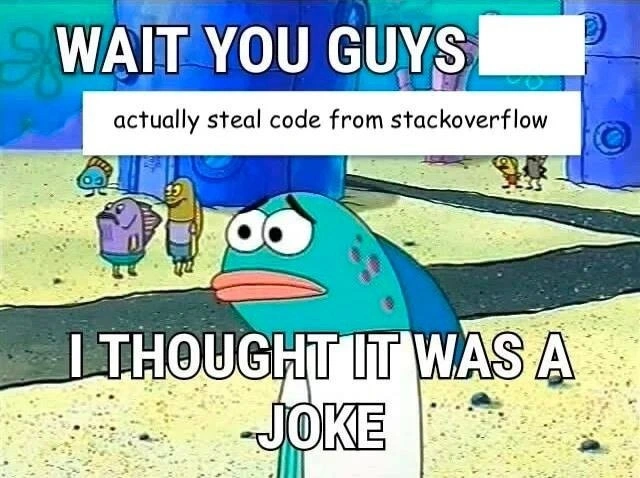
Imagine you’re in school and there’s a big homework assignment. You’ve always heard jokes about kids copying answers from each other, but you figured, “Nah, that’s just something people joke about. No one actually does that, right?” Then one day, you find out your best friends have been swapping homework answers behind your back the whole time! You’d be as wide-eyed as that teal fish in the picture, saying, “Wait, you guys actually copy homework? I thought that was just a joke!”

In this meme, programmers are like those students. There’s a website with tons of answers for coding problems (kind of like the back of the math textbook with all the solutions). Many new coders think, “Real programmers must solve everything themselves. Using those answers would be like cheating.” But then they discover that practically all the programmers they admire have been quietly grabbing solutions from that site whenever they get stuck, just like classmates sneaking answers for tough homework questions. The teal fish’s surprised face is basically the look of an innocent kid who just caught the whole class sharing an answer sheet. It’s funny because the kid (or the fish, or the new coder) was out of the loop on something almost everyone else was doing. The emotional core is a mix of shock and a little bit of relief – shock that the “cheating” is real and relief that you weren’t the only one finding things hard. In everyday terms: it’s a joke about finding out that even the pros take peeks at the answer key sometimes, and that moment of realization is both surprising and oddly comforting.

Level 2: Copy-Paste Coding

Let’s break down the meme in simpler terms. First, the image itself: it’s a scene from SpongeBob SquarePants, specifically a popular meme template where a character (a teal fish with big wide eyes) is surprised about something. The original line from the show was “Wait, you guys are getting paid?” and people on the internet often change that caption to fit different jokes. Here, the top text says “WAIT YOU GUYS” and the bottom says “I THOUGHT IT WAS A JOKE.” In the middle, on a white bar, it says “actually steal code from stackoverflow”. So read together, it’s like the fish is saying: “Wait, you guys actually steal code from StackOverflow? I thought it was a joke.” The fish’s shocked expression matches that feeling of surprise. In short, the meme format is using a SpongeBob reaction image to express developer surprise about something.

Now, what is that “steal code from StackOverflow” part about? This is referring to a well-known habit among programmers: copying and pasting code from the website Stack Overflow. Stack Overflow is a huge Q&A site for developers. If you run into a programming problem or error, chances are someone else has asked about it on Stack Overflow and gotten an answer (often with sample code). The site is basically a treasure trove of coding knowledge. Copy-paste coding means taking a piece of code from somewhere (like an answer on Stack Overflow) and directly inserting it into your own project. It’s like if you needed to write an essay and you find a perfect paragraph on Wikipedia and drop it into your essay – except in coding this is extremely common and sometimes even encouraged when done right! Developers jokingly call this “StackOverflow-driven development” – solving coding issues by searching online and copying the solution.

The meme jokes about “stealing” code. Of course, Stack Overflow answers are public and meant to be shared – no one is literally committing a crime by using them. The term “steal” is used humorously because when we just copy something without really understanding or without giving credit, it feels a bit like cheating. In many programming jokes and DeveloperHumor circles, people tease about how often we rely on Google and Stack Overflow to do our jobs. There’s even a classic t-shirt that says “Google is my IDE” (IDE being an Integrated Development Environment, basically the program you write code in) implying that searching online is a huge part of coding. New developers might think, “Surely real professionals don’t just copy solutions from the internet, right? That’s just a joke or an exaggeration.” The meme is funny because it shows a character who genuinely believed that. That character is now stunned to find out, nope, developers really do copy-paste from Stack Overflow all the time!

Let’s talk about CodeQuality for a second. When someone copy-pastes code without understanding it, the code might work, but it can be risky. For example, imagine you find a snippet on Stack Overflow to sort a list of numbers, and you just drop it in your code. If it works, great! But what if there’s a hidden bug or it doesn’t cover a special case? You might not know until later when things break. That’s why more experienced devs say you should always read and test code you got from the internet. The meme’s humor is partly in that phrase “I thought it was a joke” – the implication that surely professionals wouldn’t do something so potentially sloppy as copy-paste coding. But in truth, even good developers do it when they’re in a rush or need help. They just try to be careful about it. It’s a bit of an open secret in DevCommunities: everybody uses shared code, but we kind of laugh it off as a joke so we don’t feel bad about it.

Another aspect is the communal guilt/admission. In developer meetups or online forums, you’ll often see someone confess with a grin, “Yeah, I just grabbed that from Stack Overflow,” and others laughing in recognition. It’s a bonding moment – we’ve all been bailed out by that one perfect answer on some obscure question. DeveloperMemes frequently poke fun at this. For instance, someone might post a meme about a developer’s brain being 90% Stack Overflow solutions. It’s exaggeration humor: obviously we do more than copy code all day, but sometimes it feels like that, especially when you’re learning. The SpongeBob meme here captures that learning-phase surprise: the moment you realize using online code isn’t just comic relief, it’s actually part of the toolkit.

Now, why SpongeBob? SpongeBob memes are super popular and recognizable. The “Wait, you guys…” format is a way to set up a punchline where someone admits ignorance. In this meme, the fish (let’s call him Surprised Fish) represents a developer who has just learned the truth. The bright, cartoony image also makes the joke lighthearted rather than serious. We immediately know it’s meant in good fun. The background with other Bikini Bottom characters (blurred out) implies the whole world behind him (other devs) was doing this all along, and he never noticed.

To a junior developer or someone just starting out, this meme is both funny and a bit enlightening. It tells you: “Hey, everyone uses Stack Overflow, even if they joke about it. Just be aware and use your head.” It’s normal in programming to search for solutions – nobody writes everything from scratch because that would waste a lot of time. Part of being a developer is learning from others. Stack Overflow is basically a huge online classroom where someone asks, “How do I fix this error?” and an expert might answer with a nice code snippet. The copy_paste_culture has grown from that – we trust those answers (especially if they have a lot of upvotes or were written by well-known users) and incorporate them into our own code.

However, reusing code is also why code quality discussions come up. If you rely on code you found, you should at least understand what it does. Say you find a snippet to calculate the factorial of a number and you drop it in. If later a teammate asks, “Hey, why does this work?” you’d want to explain it, not say, “I have no idea, I just copied it.” 😅 The meme jokingly highlights people blindly copying (“stealing”) code, which is something we warn against in programming education. It’s as if the shocked fish is one of those students who learned “don’t plagiarize code; write your own” and then discovers all his seniors are copy-pasting like there’s no tomorrow! That contrast is comedic.

In developer culture, there are also plenty of jokes about how much of our job is just searching error messages online. It’s common to have a problem, paste the error text into Google, click the Stack Overflow link, and find an answer with maybe five lines of code to fix it. That moment feels almost like cheating – you skipped a whole investigation by using someone else’s knowledge. But it’s also smart teamwork on a global scale. The meme taps into that feeling. StackOverflow (often written as one word like that by developers) is basically part of a coder’s daily life. There’s even a term “rubber duck debugging” for talking to a rubber duck to solve a problem yourself, but if that fails, your next step is probably “ask Stack Overflow or search for a Stack Overflow answer.”

So, summarizing Level 2: this meme uses a SpongeBob scene to joke about an aspect of developer behavior – using Stack Overflow code directly. It’s highlighting the surprise of someone who thought that was just a joke, only to realize it’s actually very real. DevCommunities find it funny because it’s poking fun at something we all do. We laugh, a bit embarrassed, because yeah… we do copy-paste from Stack Overflow, and seeing it called out like this is both hilarious and a tiny bit uncomfortable (in a truthful way). It encourages newcomers not to feel too ashamed – if done carefully, learning from existing answers is just part of coding. Just remember to learn from it, not only copy. The meme, with its bold text and cartoon fish, delivers that message in a comical, memorable way.

Level 3: Ctrl+C Culture Shock

In the developer community, this meme strikes a nerve by revealing a dirty little secret: Stack Overflow–driven development. The shocked teal fish from SpongeBob (a still from the famous “Wait, you guys are getting paid?” scene) now laments, “Wait, you guys actually steal code from StackOverflow… I thought it was a joke.” This captures the moment a developer realizes that copy-paste coding isn’t just a running gag – it’s practically a rite of passage. Many of us have been that wide-eyed fish, discovering that our peers routinely grab code snippets from Stack Overflow to solve problems under tight deadlines. It’s funny because it’s true: behind the scenes, even experienced programmers resort to a quick Ctrl+C, Ctrl+V from an online answer when stuck.

Why is this so humorous and relatable? Because it highlights a clash between ideal and reality. Ideally, good CodeQuality means understanding and writing your own solution. In reality, crunch time or an irritating bug at 3 AM often leads to a desperate Google search and a Stack Overflow post that exactly matches the error message. Upvote counts become a proxy for trustworthiness, and before you know it, that copy_paste_culture kicks in – you paste the code, tweak a variable name, and voilà, problem solved (for now). The meme’s punchline lands because one character is naive enough to think copying code was just a joke, while every seasoned dev around them is nodding guiltily. It’s a shared secret in DevCommunities: we chuckle about “borrowing” code, but we’ve all done it. The fish’s shock is our self-aware humor about how common this practice really is.

There’s an underlying commentary on CodeQuality and maintainability too. Blindly copying code is a double-edged sword. On one hand, you get a ready-made solution from a reputable community resource. Heck, that Stack Overflow snippet might even be from a famous engineer’s answer with hundreds of upvotes. On the other hand, if you don’t fully grasp that code, you might introduce a sneaky bug or a security flaw. Seasoned developers have war stories of copy-paste gone wrong – like the time someone grabbed a quick "DELETE * FROM table" SQL fix that also deleted all their data because they didn’t read the fine print. 😅 The meme hints at this absurdity: the shocked fish assumed nobody would actually take such a risky shortcut, but in truth it’s happening in codebases everywhere.

Historically, this copy_paste_culture has been around since long before Stack Overflow. (Anyone remember borrowing code from programming books or forum posts on Usenet? Same thing, new platform.) Stack Overflow just made it lightning-fast and communal. It became the developer’s cookbook: instead of reinventing the wheel, you search for a recipe. Over time an unwritten rule emerged: if the code is on Stack Overflow, it’s free game. Legally that’s a gray area – Stack Overflow content is under a CC BY-SA license (requiring attribution), but most of us have conveniently forgotten ignored that detail during crunch time. This adds another layer to the joke: we say “steal code” because, technically, lifting code without credit is a kind of stealing. The fish in the meme is like someone realizing, with horror, that all those StackOverflow copy-paste jokes were actually admissions of petty theft!

In practice, experienced devs approach Stack Overflow solutions with a mix of gratitude and caution. A senior engineer might quip, “Always test the snippet and read the comments before trusting it,” after seeing a junior developer paste something blindly. The meme cleverly uses SpongeBob’s innocent fish character to represent that junior or outsider perspective – someone who hasn’t yet internalized that grabbing code from the internet is practically an occupational skill in software development. The developer_surprise on that fish’s face resonates with anyone who’s witnessed a coworker fix a critical bug in 30 seconds by googling an error message and pasting the top-voted answer. It’s equal parts impressive and terrifying.

Let’s not forget the absurd humor of the SpongeBob image itself. In the original cartoon scene, this fish asks a naïve question (“Wait, you guys are getting paid?”) to reveal he’s been missing out on something obvious. In our meme, the obvious thing is the rampant use of Stack Overflow solutions. By reusing this familiar spongebob_reaction image, the meme taps into a broader comedy tradition while keeping it ultra-relevant to DeveloperHumor. It implies that copying code is so ubiquitous that not doing it is like working for free when everyone else is getting paid. This hyperbole lands well with veteran programmers who might sarcastically say, “Oh, you actually write your own code from scratch? Adorable.” The DevCommunities category loves this kind of joke because it’s an acknowledgment of our collective behavior. We’re poking fun at ourselves for relying on the hive mind of the internet.

From a senior perspective, there’s also an interesting reflection on why this culture exists. High-pressure projects, ever-changing frameworks, and stackoverflow.com being just a browser tab away all incentivize quick solutions over perfect ones. It’s not that developers are lazy or malicious; often it’s the opposite: we’re pragmatic. Why struggle for days on a problem that someone out there already solved and generously shared? Reusing code can be smart knowledge sharing – a hallmark of healthy dev communities – as long as you refactor and verify it. The meme’s humor comes from framing this practical strategy as a scandalous secret, when in fact it’s a cornerstone of modern coding practice. It’s the tone of scandal (“steal code”) that makes us laugh, because we know the truth isn’t so black-and-white. Yes, we copy and paste, but we also learn in the process (hopefully). Still, the initial shock of that realization – that even veteran coders aren’t hand-crafting every line – is a memorable moment in a developer’s journey. The meme immortalizes that exact “Wait, really?!” feeling.

To illustrate just how common this is, consider a snippet like this one you might find on Stack Overflow:

// Source: StackOverflow answer (user: CodeGuru) - merges two arrays with unique values
function mergeArraysUnique(a, b) {
  return Array.from(new Set(a.concat(b)));
}

A time-strapped developer might drop this StackOverflow snippet straight into their codebase to merge two lists without duplicates. It’s short, clever, and does the job. But maybe they didn’t fully consider what happens if a or b aren’t arrays, or if the environment doesn’t support Set. The code works in the answer’s context, so they assume it’s golden. This is the kind of CopyPasteCoding the meme is teasing. The joke’s on us when such “borrowed” code later blows up because of an edge case, and we have to sheepishly admit we don’t totally understand our own code. The maintainer who inherits this code might think, “This looks familiar…” and indeed, a quick search reveals the code was lifted from a 2013 Stack Overflow post. Oops. That scenario is hilarious to developers because it’s so common – it’s practically a trope in DeveloperMemes by now.

In summary, at the expert level this meme encapsulates the humorous reality of modern programming: StackOverflow is the world’s biggest codebook, and nearly everyone references it, though few openly admit to copy-pasting. The meme winks at this truth. It uses a beloved cartoon with a bold caption format to say what we’re all thinking. For a senior engineer, it’s funny because it’s a mirror – we’ve laughed about “Stack Overflow copying” for years, and here it is, laid bare in meme form. The punchline lands with a mix of cynicism and camaraderie: Yes, it’s a joke… and yes, we really do it.

Description

A meme using a scene from the cartoon SpongeBob SquarePants. The image features a turquoise fish character with a shocked, sad, and disillusioned expression, looking directly at the viewer. The top text, in a bold, white, all-caps font, reads, 'WAIT YOU GUYS'. A white rectangle is overlaid in the middle, containing the text 'actually steal code from stackoverflow'. The bottom text continues the fish's thought, stating, 'I THOUGHT IT WAS A JOKE'. This meme humorously captures the loss of innocence for a new or junior programmer who discovers that the common joke about copying and pasting code from Stack Overflow is, in fact, a widespread and fundamental practice in the software development world. It reflects the realization that practical problem-solving often involves leveraging existing community solutions rather than writing every line of code from scratch
Comments

13
Anonymous ★ Top Pick The difference between a junior and a senior developer isn't whether they use Stack Overflow; it's that the senior knows which answer from 2011 has a subtle race condition and which one just needs the variable names changed
  1. Anonymous ★ Top Pick

    The difference between a junior and a senior developer isn't whether they use Stack Overflow; it's that the senior knows which answer from 2011 has a subtle race condition and which one just needs the variable names changed

  2. Anonymous

    Copy-pasting from StackOverflow is all laughs - right up until the SCA scan flags your entire microservice as GPL and legal files a Jira ticket named “Explain This, Please.”

  3. Anonymous

    The real senior developer moment isn't when you stop copying from Stack Overflow - it's when you recognize which answers are from 2009 jQuery and which ones actually use modern async/await patterns without a trace of callback hell

  4. Anonymous

    The real Stack Overflow workflow: Copy code, paste into IDE, spend 3 hours debugging why it doesn't work in your context, finally understand the solution, refactor it completely, then realize you've just reinvented the wheel that was already in your codebase under a different name. At least you can now confidently say you 'adapted' the solution rather than 'stole' it

  5. Anonymous

    We don’t steal from Stack Overflow - we import technical debt under CC BY-SA

  6. Anonymous

    Stack Overflow: where 10k-upvoted 'quick fixes' become your next decade's refactoring backlog

  7. Anonymous

    We call it SOA: Stack Overflow Architecture - ship the 2013 accepted answer, then open a ticket titled “add attribution and unit tests later.”

  8. dev_meme 2y

    We need better spam bots :(

  9. @SomeWhereIBelong 2y

    No

  10. @SomeWhereIBelong 2y

    I steal from chatgpt

    1. valentyn 2y

      *=&stackoverflow

      1. @RiedleroD 2y

        considering chatgpt itself most likely stole from SO, stealing from chatgpt is really just stealing from SO, but with an extra step

  11. @patsany_horosh_mne_v_dm_pisat 1y

    Let's hope not

Use J and K for navigation