Startup Achieves 8-Figure Revenue with Floating Point Precision
Why is this Startup meme funny?
Level 1: Pretend Money
Imagine you have no money but you want to impress your friends. You take a piece of paper and write “$0.0000000”. It looks like a big number because there are a lot of digits, but really you’ve just written zero in a fancy way. You still have zero dollars – adding all those extra zeros after a decimal point doesn’t magically create any money.
This meme is funny because it’s like someone bragging, “Look, I went from having $0 to having a huge-sounding number!” when in truth they still have nothing. It’s as if a kid said, “Last year I had 0 candies, and this year I have 0.0000000 candies!” Thinking in a simple way: they’re just pretending a bunch of nothing is something big. The phrase “Never give up” makes it extra silly, because it sounds like they achieved something amazing by not quitting, when actually nothing changed.
So the joke is just showing how silly it is to add zeros to zero and then act proud. It’s poking fun at people who try to make nothing look like a lot just by changing how they talk about it. Even a child can see that no matter how you write it, zero candies is still zero candies. The humor comes from that obvious truth: you can’t become rich (or successful) just by writing a number differently.
Level 2: Vanity Metrics 101
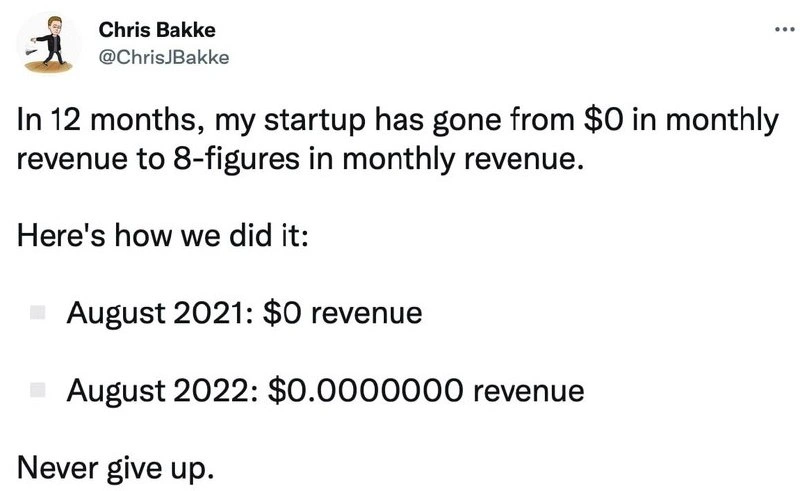
Let’s break down why this “8-figure revenue” claim is a joke. In plain terms, “8-figure revenue” normally means a company is making an amount with eight digits. For example, $10,000,000 (ten million dollars) has eight figures (1 followed by 7 zeros) – a huge success for monthly revenue. But here’s the catch: the startup’s revenue is written as $0.0000000. This number has eight digits too, but they’re all zeros after a decimal point. In math, 0.0000000 is still zero. They literally added seven zeros to the right of the decimal to create an 8-digit long number that sounds big but is actually $0.
This is a classic case of a vanity metric. A vanity_metric is a figure that looks impressive on paper but doesn’t reflect real progress or value. Startups sometimes use vanity metrics to generate buzz – for example, boasting about “1 million downloads” when maybe only a few thousand people are active users. Here the vanity metric is “8-figure monthly revenue,” achieved by a decimal_place_comedy trick. It’s essentially imaginary_revenue because no real money was made; they just changed how the number is displayed.
In startup culture, there’s often pressure to show growth. Founders might use founder_bravado and a bit of creative phrasing to make things sound better than they are. For instance, instead of saying “we still have $0 revenue,” this tweet jokes that the founder phrased it as “from $0 to 8-figures in revenue in 12 months.” It sounds like explosive growth to the untrained ear. The tweet even lays out a timeline:
- August 2021: $0 revenue
- August 2022: $0.0000000 revenue
At first glance, an investor or outsider might hear “8-figures” and think, “Wow, over ten million dollars a month, that’s incredible!” But a closer look (or any look at all) shows it’s the same $0 with fancy formatting. MarketingVsReality is at play here: the marketing phrasing (“8-figures”) versus the reality (zero dollars). It’s a bit of IndustrySatire – poking fun at how tech startups sometimes hype themselves up with buzzwords and big-sounding stats.
The final line, “Never give up.”, adds to the humor. That phrase is something you’d usually tell someone who overcame a tough challenge by persevering. In this context, it’s absurd because going from $0 to $0.0000000 isn’t an achievement at all – nothing actually changed. The tweet format mimics those inspirational founder stories on social media where they share how grit and strategy led to huge growth. But here the “growth” is just numerical smoke and mirrors.
For a junior developer or someone new to the TechIndustryHumor, the takeaway is: always look at what metrics really mean. If someone claims a big number, check the units and context. StartupHumor often revolves around this kind of hype vs. reality contrast. It’s funny because it reveals a truth: you can add all the zeros you want, but 0 is still 0. The meme teaches us to be skeptical of vanity metrics and to appreciate honest measures of success (like actual revenue or active users) over flashy but empty numbers.
Level 3: Zero-Sum Gains
In the startup world, calling something “8-figures” usually means insanely high revenue (think tens of millions of dollars). Here, the founder pulls a cheeky stunt: they literally got eight figures by tacking 7 extra zeros after a decimal point on $0. In August 2021 the revenue was $0. By August 2022 it's written as $0.0000000. Spoiler: mathematically that’s still zero. This is a textbook example of vanity_metrics – numbers dressed up to impress but essentially meaningless. The tweet parodies those triumphant startup posts: “In 12 months, we scaled from zero to hero – here’s how!” except the heroic growth is just imaginary_revenue. It’s IndustrySatire at its finest, mocking how StartupCulture sometimes values flash over substance.
Why is this so funny to seasoned engineers? Because we’ve all seen the “fake it till you make it” playbook in action. Founders flaunting buzzwords and hockey-stick charts in pitch decks, hoping no one zooms in on the Y-axis labels. This meme nails that MarketingVsReality gap: the IndustryIrony of celebrating “8-figure monthly revenue” when in reality it’s $0 with a glorified decimal costume. It’s like boosting your GitHub stars by counting every fork and clone – technically you’ve got numbers, but it doesn’t mean what outsiders think it means. The humor taps into our collective eye-roll when a startup announces explosive growth with founder_bravado, only to find out it’s based on creative counting.
To a grizzled developer or a cynical veteran of startup metrics, the tweet’s structure itself is a giveaway. It mimics those cringe “success story” threads: a bold claim followed by bullet points of hype. But here the bullet points reveal the absurd truth: nothing actually changed except the formatting. The punchline “Never give up.” adds an extra layer of sarcasm – as if persistence magically turned zero dollars into… well, zero dollars with extra steps. The whole thing is a relatablehumor slice of tech industry life: we’ve endured meetings where Buzzwords trump reality, and dashboards where adding an extra decimal point is the closest thing to growth.
This meme is a gentle roast of StartupHumor and marketing puffery. It reminds everyone that metrics can be manipulated in absurd ways. Sure, writing 0.0000000 looks like a big number at a glance (so many digits!), but any engineer worth their salt knows it’s an empty flourish. In code, it’s as trivial as:
revenue = 0.0
print(f"{revenue:.7f}") # outputs 0.0000000
# When "0" simply isn't impressive enough, just add trailing zeros.
No actual money was harmed in the making of this metric. Ultimately, experienced devs laugh because the decimal_place_comedy highlights a truth: in tech, perception often precedes reality. But numbers don’t lie – unless you format them creatively. Just squint and ignore that pesky decimal point, and voila: “8-figure revenue”! It’s a sardonic reminder that in the hype-driven startup game, some “success stories” are just zeros in disguise.
Description
A screenshot of a tweet from user Chris Bakke (@ChrisJBakke). The tweet begins with a bold claim typical of startup success stories: 'In 12 months, my startup has gone from $0 in monthly revenue to 8-figures in monthly revenue.' It then offers to explain how they did it, listing the revenue for two consecutive years. 'August 2021: $0 revenue' is followed by 'August 2022: $0.0000000 revenue'. The punchline is that '8-figures' is achieved by adding seven zeros after the decimal point. The tweet ends with the ironic motivational phrase, 'Never give up.' This joke satirizes the exaggerated claims and 'hustle culture' narrative prevalent in the startup world, using a clever play on words and a nod to data representation that would be appreciated by a technical audience

Comments
8Comment deleted
That's not an 8-figure revenue, that's a rounding error in a `double`. The VC fund's due diligence script probably cast it to an `int` and approved the Series A funding
Growth hack: cast revenue to VARCHAR, count the characters after the decimal as “figures,” and voilà - 8-figure MRR. Just pray Finance doesn’t deserialize the burn rate the same way
The real 10x engineer is the one who can add zeros after the decimal point and still call it 'eight-figure revenue' with a straight face - technically correct is the best kind of correct when your burn rate exceeds your revenue by several orders of magnitude
This is the startup equivalent of refactoring your codebase for 12 months and proudly announcing you've reduced technical debt from 'catastrophic' to 'catastrophic with better variable naming.' The excessive floating-point precision on that zero is chef's kiss - like using a BigDecimal to represent your bank account balance when parseInt(0) would suffice. At least they're being honest about their burn rate: $0 revenue means infinite runway, which is technically the best unit economics you can achieve
Hit 8-figure MRR by switching the KPI type to float64; CAC still NaN, but the deck rounds it up
We finally hit 8 figures of MRR - after finance switched revenue from INT to FLOAT, marketing stopped clarifying which side of the decimal those figures are on
Revenue scaled to 8-figure precision at zero - proof positive that float underflow beats any distributed system failover
Don't give up and one day your revenue will be $0.30000000000000004. Comment deleted