Skip to content
DevMeme
4429 of 7435
Modal Logic Proofs Versus Box-on-Tape Diagrams: Theoretical CS Humor Whiplash
CS Fundamentals Post #4851, on Sep 8, 2022 in TG

Modal Logic Proofs Versus Box-on-Tape Diagrams: Theoretical CS Humor Whiplash

Why is this CS Fundamentals meme funny?

Level 1: Big Book vs Kid's Drawing

Imagine you’re reading a really dense, complicated page full of strange symbols – it feels like trying to read a secret code or the hardest puzzle ever. Your head hurts just looking at it. Now imagine that right after that, someone shows you a simple little picture drawn in crayon: a tiny box on a long strip that looks like a toy train on a track. And then they say, “Believe it or not, this picture is about the same idea as that crazy page of symbols!” You’d probably blink and laugh, right? It’s such a funny contrast. The meme is doing exactly this. It shows how the same topic can look insanely confusing in one moment and super simple the next. The joke makes us feel the surprise: "Wait, how can something so complex suddenly seem so simple?" It’s like having a big, intimidating textbook on one side and a kid’s doodle on the other, both telling the same story. That mismatch is what makes it funny – it reminds us that even the most complicated ideas can sometimes be explained with the simplest picture. Seeing them side by side like that just highlights how crazy it is, and it makes us laugh in surprise.

Level 2: Abstract vs Concrete

This meme highlights two extremes within theoretical computer science, and you don't need a PhD to appreciate the contrast. Let’s break down what’s shown:

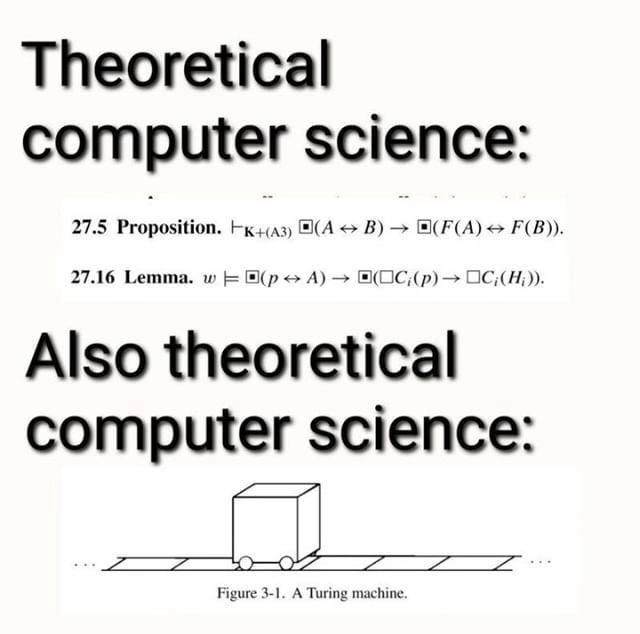
Top half – Modal Logic Proof: The first part (under "Theoretical computer science:") is an excerpt from a textbook, and it's full of logic symbols. This is an example of a modal logic statement. Modal logic is like an advanced form of regular true/false logic (the kind you might know from Boolean algebra), but it adds extra operators to talk about truth in different contexts (like "necessarily true" or "possibly true"). In that snippet, □(A ⇔ B) is using a square symbol (□) which stands for "necessarily". So □(A ⇔ B) roughly means "it is necessarily true that A is equivalent to B". The arrow means "implies". So one part of that line says something like "if A is equivalent to B, then F(A) is equivalent to F(B), and this is necessarily true (the □ applies to the whole thing)". The details aren't super important unless you're deep into logic theory; the main idea is that this is a formal proposition and lemma from a theoretical CS text. In plain terms, it's a bunch of mathematical logic used to prove something. People in theoretical CS spend a lot of time with these kinds of proofs to make sure things are absolutely correct. Every symbol (, , ) has a specific meaning: for example, often denotes "provable" (it shows that what follows can be derived using the rules of the logic system), and means "satisfies" or "models" (used to say a certain statement is true in a given situation or "world"). So this top part is really abstract and symbolic – it's the kind of precise logical reasoning that theoretical computer scientists do on paper (or whiteboards) to prove how systems behave or to verify algorithms in a mathematically rigorous way. It definitely looks intimidating if you're not used to it!

Bottom half – Turing Machine Diagram: The second part (under "Also theoretical computer science:") shows a very simple line drawing labeled "A Turing machine." This is a completely different angle of theoretical CS. A Turing machine is a basic theoretical model of a computer, named after Alan Turing. It’s a hypothetical machine used in thought experiments to understand what computation is. The drawing shows a little box (that’s the "machine" or the read/write head) on a horizontal strip divided into squares (that strip is the tape, which you can imagine as the machine’s infinite memory). Each square on the tape can hold a symbol (like a 0 or 1), and the machine can move left or right along the tape one square at a time, reading or writing symbols according to a set of simple rules. Despite how elementary it looks, a Turing machine can theoretically compute anything that any computer program can, given enough time and tape. It’s one of the fundamental models you learn in theoretical CS to understand the limits of what computers can solve. (This ties into questions in computational complexity theory and computability – basically understanding what problems can be solved at all, and how efficiently.) The diagram here is super simplified – basically a little cartoony box on a line – because it’s focusing on the core idea without any extra detail. If you've ever seen a basic physics diagram of, say, a box sliding on a frictionless plane, this is similar but for computing: a bare-bones visual for a big concept.

Why it's funny: These two images side by side are both labeled "theoretical computer science" because they truly are both part of the field – but they look ridiculously different! The top one is pure abstraction and mathematical notation; the bottom one looks like an illustration from a kid’s book. If you’re new to this, you might wonder, "How can the same subject involve both something that looks like an alien code language and something that looks like a simple toy?" That surprise is exactly the joke. The meme is using juxtaposition (putting two contrasting things together) to make us laugh. It highlights how theoretical CS has a very abstract side (deep logical proofs, complex equations) and also a very concrete, visual side (simple diagrams and models to explain how computation works). For a student or new developer, it’s a reminder that sometimes you'll be dealing with heavy math, and other times with straightforward models – and both are important in understanding computers. In other words, theoretical computer science can be mind-bending and down-to-earth at the same time. Seeing those extremes back-to-back is kind of absurd, and that absurdity is what makes it funny and memorable. Even if you haven’t studied this stuff, you can get the humor: it's like seeing a super complicated textbook page next to a basic sketch and being told, "Yep, both of these are the same subject." It’s a classic bit of academic humor poking fun at how high-level theory and simple fundamentals coexist in the world of computer science.

Level 3: Proofs vs Doodles

Picture yourself as a seasoned developer who still remembers those brain-bending college theory classes. This meme hits like a flashback to CS Fundamentals 301: one minute you’re staring at a wall of symbols, the next you’re looking at a cartoon of a machine on a tape. The humor comes from that exact "you’ve got to be kidding me" whiplash we all felt in theoretical CS courses. It’s the stark contrast between overwhelming abstraction and disarming simplicity living under the same roof. Anyone who slogged through an automata theory or logic class can relate. You spend an hour working through a dense proof – maybe you’re proving something esoteric like the modal logic proposition in the meme, carefully following each and trying not to lose track of what A3 or C_i even mean. Your brain is overheating, you're questioning your life choices, and then... the professor flips the slide (or page) and there it is: a friendly little diagram of a Turing machine that looks like it escaped from a children's book. “Also theoretical computer science,” the meme reminds us, as if the field itself is saying, "Hey, don't forget, we also have cute pictures!"

For those of us with some years in the industry or academia, this juxtaposition is both very familiar and very funny. We’ve seen how theoretical computer science swings like a pendulum. One moment, you’re proving a lemma about the transitivity of a modal operator or constructing a diagonalization proof (with enough symbols to make your eyes water). The next moment, you’re grounding those ideas by thinking of a little machine that reads ones and zeros off a tape. It's almost like the discipline has a split personality: there's the ultra-formal, mathematical side and the ultra-conceptual, model-building side. The meme nails this duality by literally labeling them both "theoretical computer science" – no difference, just two flavors. It's an inside joke that says: yep, if you go deep enough into CS theory, you're going to toggle between feeling like you're in a pure math seminar and a grade-school science fair.

This contrast is funny because it’s true. After enough years, you realize that these two extremes actually need each other. We remember being confused as students: why on earth am I proving theorem 27.5 about some crazy $□(A ⇔ B)$ stuff? Then later, when analyzing what a Turing machine can or cannot do, those formal proofs become the tools to answer big questions (like "Is this problem decidable? How do we prove no algorithm can ever solve this?"). Still, the day-to-day visual of a Turing machine – a little box moving on tape – is so deceptively simple it’s almost comedic in hindsight. It's like having a super complex software system but describing it with a crayon drawing: "Here’s the entire algorithm, drawn as a stick figure."

Seasoned devs and computer science folks chuckle at this because we've lived it. We survived the academic humor of professors who would follow a horribly complex derivation with a quip like, "And now for something completely different," then draw a smiley-faced Turing machine on the board. Or the textbooks where Chapter 3 gives you a comforting introduction with diagrams and by Chapter 27 you're in symbol hell. It's a rite of passage. We all collectively learned that the same field that introduced us to the cute concept of a machine with a tape would later demand we express its limits in logic so dense it makes regex look tame.

In essence, this meme speaks to the experienced crowd — those who appreciate the full spectrum of computer science theory. It’s poking fun at the Jekyll-and-Hyde nature of academic CS content: one moment it’s refined and formal, the next it’s almost childishly simple. The joke is that the field that gave us something as concrete as the Turing machine diagram also gives us proofs that feel like deciphering ancient hieroglyphs. That absurd incongruity? That's the point. It's a knowing nod between those who have wrestled with theory: "We’ve been there – and isn't it ironically delightful (and a little ridiculous) how our field spans from the mind-bending to the childish, all in service of understanding computation?"

Level 4: Axioms to Automata

At the highest echelons of theoretical computer science, it's perfectly normal to swing between dense symbolic logic and starkly simple computation models. The top half of this meme is a snippet of a formal proof plucked straight out of a theoretical CS textbook, complete with arcane modal logic notation. We see symbols like , , and the famous "box" operator . In classical Boolean logic, every statement is either simply true or false; modal logic extends this by introducing layers of necessity and possibility. For example, □P means "P is necessarily true" (P holds in all possible worlds or circumstances), while ◇P means "P is possibly true" (true in at least one possible scenario). So that little box operator indicates a claim about all situations or contexts where something could happen. In the excerpt ⊢_{K+(A3)} □(A ⇔ B) → □(F(A) ⇔ F(B)), we are working in a specific logical system (here, system K plus an additional axiom A3) and proving something quite meta: if $A$ and $B$ are equivalent statements, then applying some operation $F$ to them preserves their equivalence under the "necessarily" operator. In plain terms, any property $F$ that holds for $A$ will hold for $B$ in every possible world (and vice versa). This is heavy mathematics territory – the kind of proposition that might appear in chapter 27 of a logic textbook (as the numbering suggests) after pages of prior lemmas and axioms. Just below that, the Lemma 27.16 goes even deeper into modal semantics: w ⊨ □(p ⇔ A) → □(C_i(p) → □C_i(H_i)). Here $w \models ...$ (the turnstile symbol with a world $w$ in front) means "in world $w$, the following formula holds true." It’s employing Kripke semantics, where truth is evaluated relative to possible worlds in a model. The lemma itself is a doozy: in any given world $w$, if it’s necessarily true that proposition $p$ is equivalent to formula $A$, then it’s necessarily true that for each index $i$, $C_i(p)$ implies necessarily $C_i(H_i)$. Without knowing the textbook's context, we can guess $C_i$ and $H_i$ are some parameterized formulas or conditions (perhaps something like "the $i$th condition implies, necessarily, the $i$th hypothesis"). The exact meaning isn't vital for the joke; what matters is that these expressions are formidably abstract. They represent the ultra-rigorous side of theoretical CS: every statement must be proven with symbolic precision, every nuance captured in notation that only the initiated can parse. This is the realm of proofs about proofs, logic about logic – the stuff that makes undergrads cry and logicians smile.

Now contrast that with the bottom half: a bare-bones diagram labeled "Figure 3-1. A Turing machine." It features what looks like a child’s sketch – a simple cube with two little wheels sitting atop a horizontal line of squares. That line is an infinite tape, and the cube is the machine’s read/write head (the wheels hint that it can trundle left or right along the tape, one square at a time). This cartoon is the iconic model of computation introduced by Alan Turing in 1936. It's almost comical in its simplicity – just a box that moves on a tape and changes symbols one cell at a time. Yet, in theoretical computer science, this humble diagram embodies something monumentally powerful: the foundation of computability and computational complexity theory. With this model, you can formally define what an algorithm is. The Church-Turing Thesis boldly states that anything which can be computed by any conceivable method can be computed by a Turing machine. In other words, that little box-on-a-tape is as powerful, in principle, as any modern computer or program when it comes to the ability to compute things (though certainly not in speed or practicality). The diagram is minimalistic because it needs to be: theoretical CS often strips systems down to their bare essentials to reason about them. A Turing machine has just a finite set of states, a tape (memory) that is unbounded but only one cell is accessed at a time, and a simple set of rules. With these minimal components, Turing machines can simulate the logic of any computer program.

The humor here arises from the whiplash of abstraction between these two extremes of theoretical CS. On one hand, you have a page of modal logic laden with boxes, arrows, turnstiles, and subscripts – a formal proof that could be part of verifying a complex property of a system or establishing a theoretical result about logic itself. On the other hand, you have the exact same field represented by a cartoonishly simple diagram of a machine on a tape. It's a jarring juxtaposition, almost a non-sequitur to anyone unfamiliar with the field: how can the discipline that produces such profound logical contortions also draw doodles of little machines? Yet, this contrast captures the essence of theoretical computer science. It's a field comfortable with multiple levels of description: from the lofty heights of symbolic logic (which provide precision and generality), down to the concrete simplicity of fundamental models (which provide intuition and clarity). In fact, these two extremes often complement each other. Those scary formulas might be used to prove things about models like the Turing machine (for instance, proving in logic that a certain problem is undecidable by any Turing machine). Meanwhile, the Turing machine diagrams often appear early in textbooks (note the figure number 3-1, likely from Chapter 3) to introduce concepts that later get formalized in heavy notation by Chapter 27. So in practice, a theoretical computer scientist might spend the morning proving a lemma about modal operators and the afternoon reasoning about tape and state transitions – all in a day's work. The meme nails this incongruity: the same discipline can feel like you need a secret decoder ring to read it, then suddenly flip to feeling like kindergarten craft time. That cognitive gear-shift is both painful and comical to anyone who has studied computer science theory. In short, the meme is laughing at how CS fundamentals swing wildly between the ultra-abstract and the ultra-concrete, yet expects you to be fluent in both. It's a kind of inside joke among academics and developers with a foot in theory – an acknowledgment that yes, this is all part of the grand tapestry of computing knowledge, as absurd as it seems in contrast.

Description

The meme is on a white background with large, bold black headings. The top heading reads "Theoretical computer science:" followed by a textbook excerpt showing dense modal-logic statements: "27.5 Proposition. ⊢ₖ+(A3) □(A ⇔ B) → □(F(A) ⇔ F(B))." and "27.16 Lemma. w ⊨ □(p ⇔ A) → □(Ci(p) → □Ci(Hi))." All symbols, arrows, and equivalence signs are clearly visible in black serif font. A second bold heading says "Also theoretical computer science:" below which a minimalist line drawing labeled "Figure 3-1. A Turing machine." depicts a plain cube with two small wheels sitting on a single horizontal line representing an infinite tape. The joke highlights the wild contrast inside theoretical computer science: pages of forbidding symbolic proofs versus a cartoonishly simple model of computation, resonating with developers who have juggled formal logic and Turing-machine abstractions


Comments

8
Anonymous ★ Top Pick Theoretical CS: 10 pages of modal logic; also theoretical CS: a shoebox-on-a-tape diagram - basically the academic precursor to our architecture docs where a rigorous TLA+ spec is followed by one slide labeled “BOX → CLOUD”
  1. Anonymous ★ Top Pick

    Theoretical CS: 10 pages of modal logic; also theoretical CS: a shoebox-on-a-tape diagram - basically the academic precursor to our architecture docs where a rigorous TLA+ spec is followed by one slide labeled “BOX → CLOUD”

  2. Anonymous

    The duality of theoretical CS: spend three hours proving a function is computable, then realize you just reinvented a for loop with extra steps and a tape that's theoretically infinite but practically just crashed your IDE

  3. Anonymous

    The duality of theoretical CS: spending three semesters proving properties of modal logic operators in formal systems, only to realize the entire field rests on a box with wheels that reads and writes symbols on an infinite tape. It's the academic equivalent of deriving quantum field theory equations and then explaining computers with 'it's just rocks we tricked into thinking.'

  4. Anonymous

    CS theory swings from Kripke semantics to a box on an infinite tape - the same energy as enterprise architecture: twenty pages of spec followed by a three‑box diagram that supposedly proves it will scale

  5. Anonymous

    Theoretical CS: 27 lemmas to prove implication, one doodle for universal computation - priorities

  6. Anonymous

    Only in CS can '⊢ □(A ↔ B) → □(F(A) ↔ F(B))' coexist with a doodle of a box on wheels and be considered the same chapter - yet it’s still a more faithful system diagram than the average microservices slide

  7. @azizhakberdiev 3y

    A turing machine we deserve

  8. @viktorrozenko 3y

    Did you want them to draw a Tesla instead?

Use J and K for navigation