The x86 Weekend Reading List
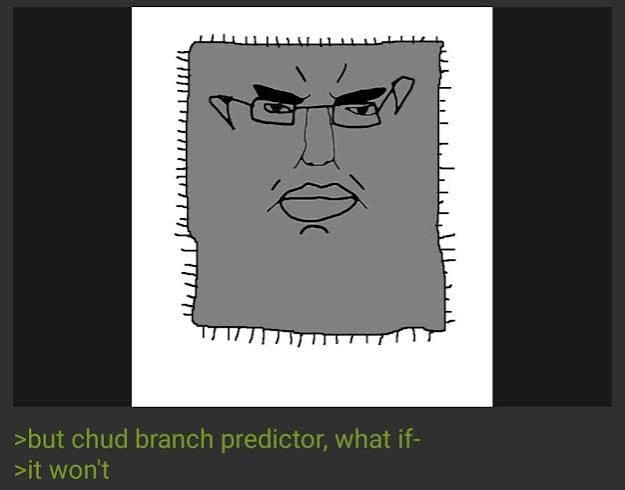
Why is this LowLevelProgramming meme funny?
Level 1: The Giant Instruction Book
Imagine buying a toy robot and asking, "How do I make it take one step?" Then someone hands you a 4,778-page instruction book and says the answer is definitely in there. The meme is funny because low-level programming can feel exactly like that: one tiny question about how the computer works sends you into a giant manual where every small detail matters.
Level 2: The CPU Rulebook
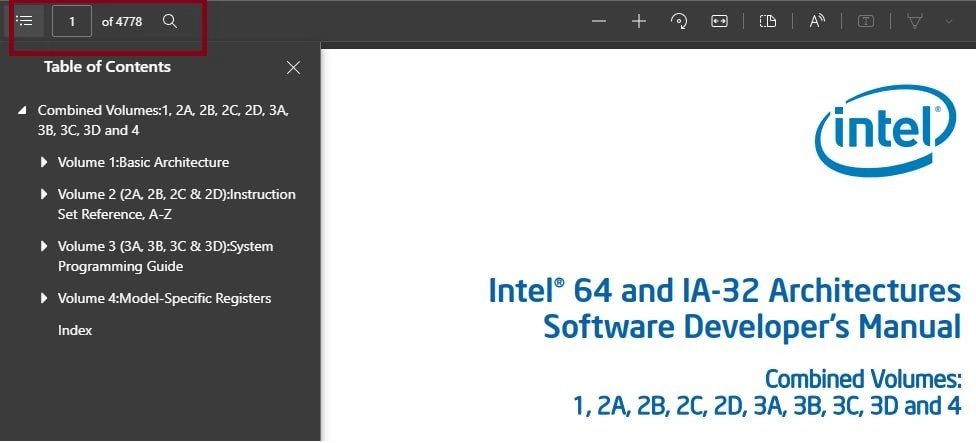
x86 is a family of CPU instruction sets used by many desktop, laptop, server, and workstation processors. IA-32 refers to 32-bit x86 architecture, while Intel 64 refers to Intel's 64-bit extension. The image shows the official developer manual that explains how software is supposed to interact with those processors.
An instruction set is the set of commands a CPU understands: move data, add numbers, compare values, jump to another instruction, call functions, work with memory, and much more. In assembly language, developers write instructions closer to what the processor executes than in languages like Python, JavaScript, or Java.
Systems programming means writing software close to the machine: operating systems, drivers, hypervisors, runtimes, embedded components, compilers, and performance-critical libraries. Those programs need details that ordinary application code usually ignores. For example, an OS needs to know how paging works because paging controls how virtual memory maps to physical memory.
The funny part for a newer engineer is that "read the manual" sounds simple until the manual is 4,778 pages. The size signals how much hidden machinery sits below normal programming. When your code says x = y + 1, many layers make that possible: compiler output, CPU instructions, registers, caches, memory rules, and operating-system services.
Level 3: Weekend Light Reading
The senior-developer humor is the red box around the tiny PDF counter. It does not highlight a shocking diagram or a weird opcode. It highlights the fact that the manual starts at page 1 and ends at page 4778. The joke is the implied workflow: "I just need to understand this one low-level behavior," followed by opening a document large enough to qualify as a furniture item when printed.
Low-level programming has this special talent for turning small questions into excavations. Why did this flag change? Is this instruction serializing? What exceptions can this addressing mode raise? Does this atomic operation imply the barrier we think it implies? Which privilege level can touch this register? Is this undefined, implementation-specific, reserved, deprecated, or merely cursed by an erratum three product generations ago?
That is why technical documentation becomes part of the craft rather than a side resource. For application code, docs often explain an API that somebody designed last year. For CPU architecture, docs describe a compatibility surface built over decades. The manual is enormous because x86 has to describe both modern 64-bit execution and historical IA-32 behavior, plus all the features added to keep the platform useful for operating systems, compilers, virtual machines, debuggers, cryptography libraries, game engines, databases, and performance tools.
The original post message adds a historical jab: many years ago, Intel would send printed copies of these books for free. That matters because it evokes an era when serious systems programmers literally kept architecture manuals on shelves. The meme turns that old professional artifact into a modern PDF endurance test. Same manual energy, less shelf space, more search box despair.
The deeper industry pattern is that abstraction always leaks downward eventually. Most developers can ignore the CPU until they cannot: a JIT compiler bug, a memory-ordering race, a kernel crash, a virtualization issue, a performance cliff, a SIMD miscompile, or a security mitigation forces the team below the language runtime and into the architecture contract. Then the page count stops being funny and starts being the map.
Level 4: Rings, Flags, Footnotes
The image is funny because it shows a PDF viewer at
1 of 4778
while the page itself is titled
Intel 64 and IA-32 Architectures Software Developer's Manual
with combined volumes covering basic architecture, instruction-set reference, system programming, and model-specific registers. That page count is not decorative; it is the visible mass of the contract between software and one of the most historically accumulated hardware platforms in computing.
At this level, x86 is not "assembly language" in the classroom sense. It is an instruction set architecture plus decades of compatibility promises, privilege mechanisms, memory-model rules, interrupt semantics, paging modes, vector extensions, virtualization support, performance counters, power states, and machine-specific escape hatches. The manual is huge because real processors are not abstract machines with ten cute opcodes and a chalkboard stack. They are silicon products that must run old binaries, new kernels, hypervisors, debuggers, firmware, and highly optimized user-space code while preserving behavior that software has come to rely on.
The table of contents visible on the left tells the story:
- Basic Architecture explains registers, execution environment, data types, memory organization, and architectural state.
- Instruction Set Reference documents the thousands of instruction encodings, operands, flags, exceptions, and edge cases.
- System Programming Guide covers protected mode, paging, interrupts, task management, privilege, memory ordering, and OS-level machinery.
- Model-Specific Registers exposes control and status knobs that software can use only if it knows exactly which processor family it is negotiating with.
The complexity is partly mathematical and partly archaeological. Hardware needs stable abstractions, but microarchitectures change underneath them. An instruction like MOV may look simple architecturally, yet the processor beneath it is decoding variable-length bytes, tracking dependencies, scheduling micro-operations, handling speculation, honoring memory ordering rules, and reporting precise exceptions. The programmer sees a line of assembly. The CPU sees a treaty.
Operating systems live in the densest part of that treaty. A kernel cannot hand-wave what happens during a page fault, system call, interrupt, privilege transition, TLB invalidation, or atomic operation. If it misreads one sentence about flags, exception priority, canonical addresses, or control-register bits, the result is not a friendly stack trace. The result is a boot loop, silent corruption, a security boundary failure, or a machine that works on one CPU stepping and fails on another because apparently the universe needed character development.
Description
A PDF viewer is open to page 1 of 4778, with a red box emphasizing the tiny page counter in the top-left toolbar. The left table of contents lists Intel architecture volumes including Basic Architecture, Instruction Set Reference, System Programming Guide, and Model-Specific Registers. The main page shows the Intel logo and the title "Intel 64 and IA-32 Architectures Software Developer's Manual" with "Combined Volumes: 1, 2A, 2B, 2C, 2D, 3A, 3B, 3C, 3D and 4." The humor comes from treating nearly five thousand pages of CPU architecture documentation as normal prerequisite reading for low-level systems programming.
Comments
13Comment deleted
Nothing says "quick bug fix" like opening a 4,778-page PDF to confirm what one instruction flag actually means.
And now?.. Comment deleted
it's online I'm assuming Comment deleted
Theyll give you the Pdf it looks Comment deleted
By the way, it’s the best documentation I’ve ever found. The explanations are cleaner than in cs textbooks Comment deleted
Amen. They are all you need in that regard. Comment deleted
I had one of those reference books for the 8085 I think. I'd have to check in my mother's house. Comment deleted
Yeah it's pointless, read AMD. Comment deleted
On the page where you can download them, they explicitly mention this is no longer offered and that whoever still wants it, can purchase it via print-on-demand. https://www.intel.com/content/www/us/en/developer/articles/technical/intel-sdm.html (2nd note on that page) Comment deleted
senior: oh you'll just need to read a simple instruction and start coding right away! instruction: Comment deleted
whats hard instruction then Comment deleted
black book of electronics or SICP probably Comment deleted
Now you can read it on the Internet for free Comment deleted