When Your Red Team Gig Looks Suspiciously Like Ransomware to the Cops
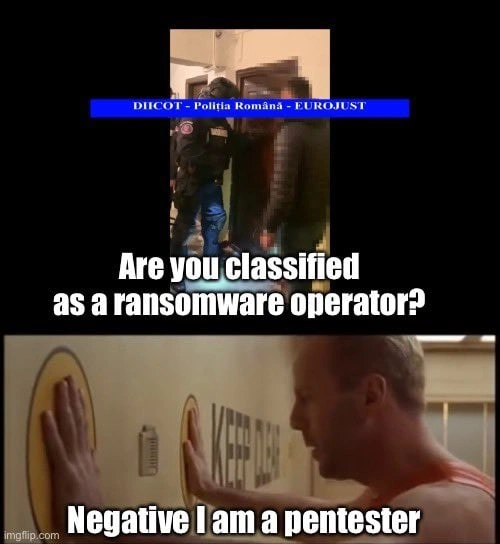
Why is this Security meme funny?
Level 1: Permission Slip to Hack
Think about it like this: your friend’s family wants to test how good their home security is. They secretly ask you to try to break into the house (without actually stealing anything) to see if their new alarm system works. You agree and, one night, you put on a dark hoodie and start sneaking around their house, checking windows and doors. Now imagine a neighbor spots you jiggling a window or the noise sets off the alarm. The police show up and see you trying to get in. From their point of view, you look just like a burglar – how are they supposed to know you’re doing it with permission?
Unless your friend is standing right there saying, “It’s okay, I asked them to do that,” you’re going to have a hard time convincing the cops. You might quickly say, “No, no, I’m not a thief, I have a note from the homeowner!” This note from the homeowner is like a permission slip. If you can show it (or have your friend on the phone to confirm), the officers will understand you’re not really breaking in to steal – you’re breaking in to help. But if you can’t prove that on the spot, you’d likely end up in big trouble first because, well, you were caught acting exactly like a burglar would.
In the tech world, companies do something similar: they hire good-guy hackers to test their security by trying to break in, hack, or even pretend to be criminals just to see how strong the defenses are. These good hackers have a sort of “hall pass” or written permission from the company – basically a letter that says, “We gave this person permission to try to hack us as a test.” It’s very specific about when and what they can do. Now, if someone else, like the police or another team at the company, sees unusual things happening (like alarms or strange network activity) and isn’t aware of the test, they will assume it’s a real attack. The good hacker could get stopped or arrested just because not everyone knew it was authorized. That’s why communication and that permission letter are super important.
The meme jokes that a pentester (the good hacker) might almost shout “I have permission!” while metaphorically slapping a big emergency stop button to avoid getting arrested. It’s funny because it’s a bit absurd – usually you wouldn’t literally do that – but it highlights a real feeling: the relief of having proof that you’re allowed to do what you’re doing. In simple terms, the difference between a “bad guy” hacker and a “good guy” hacker is like the difference between a burglar and a locksmith who’s been asked to test a lock. They both might look the same unlocking a door, but one has an okay from the owner. If nobody else knows about that okay, misunderstandings happen. So the lesson is kind of like, always have your permission slip and let people know when you’re doing something that might look wrong even if it isn’t. The meme makes us laugh because it’s taking that serious idea – make sure people know you’re the good guy – and exaggerating it into a humorous scenario we can all picture.
Level 2: White Hat, Black Hoodie
This meme is all about the thin line between penetration testing (ethical hacking) and actual cybercrime. Let’s break down the key pieces. A penetration tester (pentester for short) is a security professional who is paid to legally hack into systems, with the goal of finding vulnerabilities before real bad guys do. It’s like hiring someone to sneak into your house to figure out how a burglar might get in – so you can fix those weak points. These “good guy” hackers are often called white hat hackers (white hat = good, like the hero in an old Western), as opposed to black hat hackers, who are the malicious ones trying to break in for criminal reasons. Pentesters usually operate as part of a Red Team (the offensive team) working against a Blue Team (the defenders) in a company, often without the Blue Team knowing the exact details, so the test is realistic.
Now, ransomware is a notorious form of cybercrime. Ransomware operators are criminals who break into systems, encrypt all your files, and demand a ransom payment (often in cryptocurrency) to unlock them – or they threaten to leak your data. In 2021 especially, ransomware attacks were rampant and a huge concern for companies and law enforcement alike. These attackers are definitely not hired by the company – they’re the enemies, and police (like Romania’s DIICOT or international teams like EUROJUST) actively hunt them down. The top panel of the meme literally shows a ransomware suspect (or some cybercriminal) being arrested by a tactical police unit. It has the official DIICOT – Poliția Română banner, meaning it’s referencing real-world arrests of hackers. That’s the fate of actual bad actors: getting busted in raids.
The punchline here is that a pentester’s activities can look exactly like a ransomware gang’s activities to an observer who doesn’t know better. Both pentesters and criminals might be doing things like: scanning a company’s network for open ports, exploiting a security hole to get into a server, or even physically sneaking into a building after hours. The only difference is that the pentester has permission from the company to do all this (and their ultimate goal is to report the holes, not to do harm). The meme highlights this with the text exchange: “Are you classified as a ransomware operator?” / “Negative, I am a pentester.” It’s a funny, formal way of saying: “Hey, are you a hacker criminal?” / “No, sir, I’m an ethical hacker.”
In practice, when a pentester starts an assignment, the client gives them an engagement letter or written authorization. This is essentially a “permission slip” that says, “We authorize [person] to try to hack us between these dates. If you catch them, please don’t arrest them – call us.” It’s like if you’re playing a prank on a friend’s house with their permission; you’d want a text or note from that friend to show anyone else so you don’t get in trouble. Pentesters often carry this letter (or have a copy in their email/phone) at all times during the job. Some even inform local police beforehand, especially if the test might trigger alarms or involve noticeable activity. Despite all that, misunderstandings can still happen if communication isn’t perfect. For example, the on-site security guards or an employee might see someone picking a lock or downloading a bunch of data and call the cops before verifying it’s a test. If that happens, the pentester has to quickly prove they’re not a criminal. Until the folks in charge verify the story, law enforcement will treat it like a real break-in because, well, it looks like one.
The context tags like pentest_scope_creep hint at another issue: scope creep means going beyond what was allowed. Say the agreement was “you can test the website and this one server.” If the pentester accidentally starts testing a different server or a partner company’s network that wasn’t in the agreement, they’ve stepped out of bounds. They’re no longer protected by that permission slip if something goes wrong. It could be an honest mistake or over-enthusiasm, but it has consequences. One moment you’re an authorized tester; go a bit too far, and you might become an unauthorized attacker in the eyes of the law. Pentesters must be super careful to stay within the scope (the defined targets and rules of engagement) given by the client. This includes time windows (only test during these hours) and methods (sometimes certain aggressive techniques are off-limits). If they break those rules, even by accident, “I am a pentester” might not save them from legal trouble.
Let’s talk about the gear and why it looks sketchy. Lock-picks are used by pentesters to test physical security (like can they get into a locked server room or office). They’re legal to own in many places if you’re a locksmith or have a valid reason, but try explaining that at an airport X-ray scan. A laptop full of exploits and hacking tools – which for a pentester is just their toolbox – can look awfully suspicious if you’re not clearly a security professional. There have even been cases of security researchers being stopped at borders because their equipment or software looked dubious (for instance, having malware samples or hacking programs on a hard drive). That’s why many pentesters take special steps when traveling: clean laptops with minimal data, explanatory letters, and being ready to show proof of their legitimate work. It’s all part of SecurityAwareness in this field: you have to be aware not just of the technology, but of how people perceive what you’re doing.
The bottom image with the big KEEP CLEAR button and the phrase “Negative I am a pentester” is basically illustrating a pentester loudly declaring their innocence. Picture a burly security guy slamming an alarm button shouting “I’m not the bad guy!” It’s comedic exaggeration. In reality, if confronted by police, a pentester would calmly put down anything in their hands, not make sudden moves 😅, and explain the situation – likely urging the officers to call a specific person at the company or look at the engagement letter. The phrase engagement_letter_or_handcuffs from the tags sums it up: you either have that letter to show, or you might be wearing handcuffs for a while. It sounds dramatic, but when you’re simulating break-ins, those are the stakes.
To a junior developer or someone new to security, the takeaway is: always get proper authorization before doing any kind of hacking or security testing. If you’re just curious about a system, don’t go testing its security without permission – that’s illegal. Professionals follow strict rules and have contracts and get everything in writing. The meme is funny to pros because we’ve all triple-checked we have our “permission slip” before doing something sneaky on a network. It’s also a bit of an insider joke warning: even with permission, things can go sideways if you’re not careful. So dot your i’s and cross your t’s – let the local IT team know you’re coming, maybe notify building security (“if you see me at 1 AM, don’t panic”), and always know exactly what you are allowed and not allowed to do. The difference between RedTeam (authorized attackers) and real attackers isn’t in the tools or methods – it’s all about that explicit permission and trust. This meme humorously reminds us that without clear communication, a friendly hacker and a hostile hacker look the same in the dark.
Level 3: Engagement Letter or Handcuffs
At the elite level of security consulting, the line between a red team engagement and a felony hacking operation is alarmingly thin – often just a piece of paper separates the two. This meme hits on that nerve with dark humor. In the top panel, we see a law enforcement raid in progress: Romanian police (DIICOT – Romania’s organized crime unit) with a big blue official overlay from EUROJUST are detaining a suspect in a hallway. It’s a scene ripped from real ransomware gang busts. The caption asks: “Are you classified as a ransomware operator?” – basically, “Are you a bad-guy hacker?” The bottom panel cuts to a muscled man slamming a KEEP CLEAR emergency-stop style button, captioned “Negative, I am a pentester.” This is the pentester frantically flagging that he’s one of the good guys. It’s a direct parody of a classic sci-fi movie line (in The Fifth Element, a character quips “Negative, I am a meat popsicle” to cops) – here repurposed for infosec. The humor lands because, to an outsider or a cop, a pentester in the middle of a gig and an actual ransomware criminal look indistinguishable until proven otherwise. The seasoned folks reading this are nodding (or smirking) because every penetration tester has had that “uh-oh, do they know I’m authorized?” moment.
Officer: “Are you classified as a ransomware operator?”
Pentester: “Negative, I am a pentester.”
The meme exaggerates a pentester’s nightmare scenario: getting treated like a hacker-for-ransom by cops mid-engagement. And honestly, it’s not far-fetched – it’s happened. There are legendary war stories of pentests gone wrong. For example, a few years back two security consultants got hauled off in handcuffs after hours while pentesting a county courthouse – even though they had a signed contract. Why? Someone high up approved the test, but the local deputies weren’t told. Imagine picking a lock at 2 AM (as part of the job) and suddenly you’re staring down the barrel of law enforcement who think they’ve caught an actual burglar. 😬 In that real case, the poor pentesters spent the night in jail until the misunderstanding was cleared (paperwork surfaces, finally). The meme’s joke about “engagement letter or handcuffs” is the lived reality: if you can’t produce that get-out-of-jail letter on the spot, you’re in for a bad day. Seasoned red teamers speak of that letter with almost religious reverence – it’s the thin shield between them and an orange jumpsuit.
Why is this so funny (and frightening) to insiders? Because a white hat hacker’s toolkit and behaviors are scarily similar to a black hat’s. A righteous red team will use the same exploits, the same network scanners, the same phishing emails, even the same hoodies 🕵️♂️ as the criminals. They might fire up nmap to scan ports, deploy a Metasploit payload, or use a C2 tool like Cobalt Strike to simulate malware control – exactly the tricks of ransomware crews. To any onlooker or SIEM alert, that activity screams “active breach in progress!” There’s no magical flag in the packets that says “don’t worry, I’m just testing.” As the meme implies, cops kicking down the door won’t know the difference at first. The pentester’s emphatic “Negative, I am a pentester” is basically him slamming the brakes, yelling “I have permission!” like an operatic save.
# Whether it's a criminal or a pentester running this scan, it looks identical on the network:
$ nmap -sS -Pn --top-ports 1000 targetCorp.com
# From the firewall's perspective, this traffic looks malicious either way.
# Only context (a signed engagement letter vs. none) separates a legal pentest from an illegal attack.
That code snippet above? It’s a typical port scan command. The joke is that both an ethical hacker and a cybercriminal might run that exact same command. The company’s firewall or intrusion detection will see “someone is aggressively scanning our ports.” Now, if it’s an authorized pentest, the security team should know to expect it… but if the memo didn’t get around? Hello, panic mode, and possibly hello, police raid (especially in a high-stakes environment where ransomware attacks are front-page news). In 2021, ransomware was such a scourge that international task forces (like Europol/Eurojust, shown in the meme) started swooping in on suspects across borders. Law enforcement was on high alert. You bet that put extra stress on pentesters – nobody wants their engagement to accidentally become the subject of the next “misunderstood hacker arrested” headline.
The meme’s text “Are you classified as a ransomware operator?” is also poking fun at the absurdity of the question. If you were a ransomware criminal, would you honestly answer yes to the police? Of course not! So the pentester’s deadpan response “Negative, I am a pentester” is like a parody of that interaction. It’s a cheeky way of saying “I know I look like a villain, but I swear I’m the hero in disguise.” Every security consultant who’s ever traveled with lock-picks, bizarre gadgets, and a laptop full of exploit code has felt that tiny nibble of anxiety: what if airport security or cops don’t buy my story? The experienced ones carry business cards, a copy of the contract, and phone numbers of the client security chief on speed dial, just in case. One cynical mantra is “Always have your engagement letter and a lawyer’s number, because if something can be misunderstood, it will be.”
Digging deeper, this meme highlights a systemic issue in cybersecurity: the gap between how hackers operate and how legal systems work. Technically, the best way to test defenses is to behave exactly like an attacker – no holds barred, no loud announcements. It’s called an objective-based red team: you do whatever a real adversary would, to truly challenge the blue team. But that very realism is what lands good guys in hot water. It’s an awkward reality that breaking into a system with permission looks just like breaking in without permission until someone checks the paperwork. If internal coordination fails or the pentester strays outside the agreed scope (e.g., touches a server that wasn’t explicitly in-contract), boom – you’re suddenly doing unauthorized access. That’s why scope control is drilled into juniors and seniors alike: you hack ONLY what the client said you could. A stray packet to the wrong IP address can mean you’re hacking someone else by accident (oops, illegal), or tripping an alarm at a partner company. It’s every red teamer’s dread that a scope creep mistake or a miscommunication will end with actual handcuffs.
So, this meme gets a knowing chuckle from veteran security folks. It wraps up that mix of pride and paranoia in one bite. Pride because, hey, pentesters are basically doing high-end heists (like in movies) but for good – we’re the ones who find the holes before the bad guys do. Paranoia because if anything at all goes wrong in how others perceive it, you might be explaining yourself to a very grumpy police officer at 3 AM. The text could easily be rephrased as: “Do you realize this looks like a crime?” – “Relax, officer, I have an hall pass for this.” The engagement_letter_or_handcuffs vibe is real: without that signed authorization in hand, your red team gig can turn into an episode of Cops. The laugh comes with a wince, because it’s funny and terrifying how true that is.
Description
The meme is split into two vertically - stacked panels. Top panel: a blurry hallway photo shows Romanian police officers (black tactical gear, blue pants) detaining a hooded man; a blue banner across the top reads “DIICOT - Poliția Română - EUROJUST.” White bold text beneath asks, “Are you classified as a ransomware operator?” Bottom panel: a well-muscled man (face blurred) presses his palm on a large yellow wall button next to the stencilled words “KEEP CLEAR”; the caption states, “Negative I am a pentester.” The joke riffs on how legitimate penetration testers can look indistinguishable from ransomware crews until the paperwork surfaces, highlighting the thin legal line between authorized red-team engagements and outright cybercrime - something every seasoned security engineer has worried about when traveling with lock-picks and a laptop full of exploits
Comments
7Comment deleted
Always carry the signed rules-of-engagement - otherwise your next ‘internal security audit’ might get triaged under incident response code 404: freedom not found
The only difference between my penetration test report and a ransomware note is that mine includes a SOW number and recommendations they'll ignore for three years until someone else exploits them
The only difference between a pentester and a ransomware operator is a signed scope-of-work - and his was apparently still in legal review
The difference between a ransomware operator and a pentester is just a signed scope document and a few zeros in the retainer agreement. Both use the same exploit chains, both exfiltrate data, both encrypt systems - one just has permission and a 'Get Out of Jail Free' card from Legal. Though explaining to law enforcement that your Cobalt Strike beacon and lateral movement through their infrastructure was 'authorized testing' while they're kicking down your door at 6 AM is the ultimate test of your documentation practices. Pro tip: Keep that SOW handy, preferably not encrypted with your own ransomware
Same C2, different SOW - amazing how a signature turns Cobalt Strike from malware into a 40‑page deliverable
Pentesters: Where 'controlled compromise' meets DIICOT's zero-day raid tolerance
Intent is a non‑functional requirement in security: without a signed ROE and a POC on call, your red‑team exercise is indistinguishable from a live incident - until someone checks the invoice