Skip to content
DevMeme
3723 of 7435
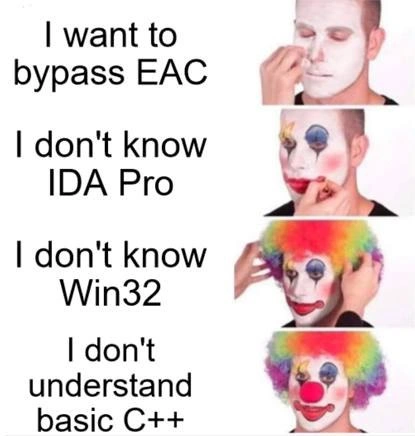
Demanding kernel-level exploits before learning pointers, the full clown progression
Security Post #4062, on Dec 20, 2021 in TG

Demanding kernel-level exploits before learning pointers, the full clown progression

Why is this Security meme funny?

Level 1: Final Boss Without Tutorial

Imagine a kid who just picked up a video game for the first time. They’ve barely learned which button makes the character jump, but they announce, “I’m going to beat the hardest boss in the game right now!” They skip the tutorial, ignore all the early levels, and head straight to the final level. We all know how that story ends: the poor character gets wiped out in seconds, and the kid looks pretty silly for thinking they could pull that off. This meme is the programming equivalent of that scenario. The person wants to do the hardest thing (break a super-tough game security system) without doing any of the easy or medium things first (like learning the tools and basic skills). It’s funny because it’s obviously a recipe for failure – they’re biting off way more than they can chew. Just like you’d chuckle at someone wearing a cape saying they’ll fly without even knowing how to jump, developers laugh at this meme because we immediately see the person is overconfident and unprepared. In simple terms: they’re trying to run before they’ve learned to walk, and the only one they’re fooling is themselves.

Level 2: Bypassing the Basics

Let’s break down what’s happening in this meme in simpler terms, and why each part is important:

  • Easy Anti-Cheat (EAC): This is a software used in many online games to prevent cheating. It runs with very high privileges on your PC (in kernel mode, which is like having administrator powers on steroids). EAC watches for any cheating tools or unusual game modifications and stops them. “Bypass EAC” means finding a way to cheat in the game without EAC catching you. That’s a very advanced thing to do because EAC is designed to be hard to trick. Think of EAC as a super strict security guard inside your computer, always on duty. Getting past that guard isn’t simple at all.

  • IDA Pro: Short for Interactive Disassembler, IDA Pro is a professional tool that hackers and security researchers use to reverse engineer programs. Reverse engineering means taking a compiled program (which is just machine code – not human-readable) and figuring out how it works internally. IDA Pro translates the machine code back into an assembly language (or a pseudocode) that experts can read and analyze. It’s like having x-ray glasses for software: you can see the code structure and logic inside an application or game, even if you don’t have the source code. If someone doesn’t know IDA Pro (or similar tools like Ghidra), it likely means they’ve never done serious program analysis. In the meme, when the person says “I don’t know IDA Pro,” it shows they lack reverse engineering experience – a key skill if you’re trying to defeat something like EAC. This is where the clown makeup starts to appear, because wanting to do an advanced hack without knowing your tools is pretty foolish.

  • Win32: This refers to the core Windows API (Application Programming Interface). It’s basically the collection of all the functions and system calls that Windows provides to programs. For example, Win32 includes functions to open files, create windows, communicate with hardware, manage memory, etc. If you write a program for Windows without using super-high-level engines or frameworks, you’ll inevitably use Win32 calls. Knowing Win32 is essential for understanding how Windows software operates under the hood. When the meme’s clown-in-the-making says “I don’t know Win32,” it means they haven’t learned how Windows works or how programs run on Windows. This is a big deal because Easy Anti-Cheat is deeply tied into Windows internals. It’d be like trying to fix an engine without knowing the names of the engine parts. At this point (third panel), the clown wig is on – they’ve admitted they don’t understand the operating system environment they want to hack in.

  • Basic C++ (and pointers): C++ is a programming language widely used to build games and system software (like anti-cheat drivers). “Basic C++” includes things like understanding variables, control structures (loops, if-statements), and crucially, pointers. A pointer is a feature in C/C++ that holds a memory address. In simple terms, if a variable is a mailbox holding a letter (some data), a pointer is a piece of paper with the address of that mailbox. Using that address, you can go directly to the mailbox and read or change the letter. Pointers let programs directly access and manipulate memory, which is very powerful for low-level programming. However, they can be tricky – if you go to an address that doesn’t belong to you or handle it incorrectly, the program can crash or behave in weird ways. When our clown says “I don’t understand basic C++,” it implies they haven’t even learned how to deal with something like pointers. Yet, bypassing EAC could involve writing your own C++ code that deals with memory addresses or reading EAC’s code, which itself is doing low-level C++ operations. Not understanding these basics is like a chef saying they want to create a complex new dish but they “don’t know how to boil water.” It’s a fundamental prerequisite that’s missing. In the fourth panel, when this admission is made, the clown makeup is complete – they’ve effectively announced that they lack all the foundational knowledge for the task at hand.

To put it in perspective, imagine the steps needed to actually bypass a kernel-level anti-cheat:

  1. Understanding the game and anti-cheat behavior: You’d observe how the anti-cheat interacts with the game, what it checks, etc. This likely involves reading a lot of technical information and logs.
  2. Reverse engineering the anti-cheat: You’d load the anti-cheat’s program (maybe a .sys driver or .dll file) into a tool like IDA Pro to study its code. You’d look for things like “How does it detect cheats? Where does it hook into the game or OS? Are there any weaknesses in how it works?”
  3. Knowledge of Windows internals: While analyzing, you need to recognize Windows-specific functions and patterns. For instance, if you see it calling NtOpenProcess (a core Windows function to open a process handle), you should know what that means and why it might matter for cheating. If you see it setting up callbacks or filters in the OS, you need to understand those mechanisms.
  4. Writing a bypass (the exploit/development part): Armed with the knowledge of how the anti-cheat works, you’d then possibly write your own code to interfere with it. This could mean a small program or driver that tricks the anti-cheat or disables some of its checks. Writing this code would almost certainly be done in C or C++, and you’d be directly using pointers and system calls to do things like patching game memory or intercepting functions. You might use legitimate Win32 APIs to hide your program or allocate memory in clever ways, or conversely, you might exploit a vulnerability in EAC if one exists. Either way, you’re coding at a pretty advanced level.

Now, if someone hasn’t learned C++ or ever touched a pointer, step 4 is practically impossible. If they haven’t heard of IDA Pro or reverse engineering, step 2 is a non-starter. And without knowing Win32 or Windows internals, step 3 is blindfolded. Each missing piece is like removing a rung from a ladder that they’re trying to climb. Eventually there are no rungs left, and attempting to climb just makes you look… well, like a clown falling on their face.

The meme uses the clown makeup format to visually drive home this point. It’s a popular meme format where a person incrementally applies clown makeup to themselves, corresponding to a series of increasingly foolish or delusional statements. By the final panel, they are in full clown attire, symbolizing that they’ve made a fool of themselves. Here, each statement (“I want to bypass EAC” → “I don’t know IDA” → “I don’t know Win32” → “I don’t understand C++”) is one more step in turning into the clown. It’s basically saying: “I have an extremely advanced goal, but I admit I haven’t done the basic homework, nor the intermediate homework, nor even the beginner homework.” No wonder the end result is comedic.

In summary, this meme is outlining a scenario that anyone starting in security or low-level programming might find as a cautionary tale: you can’t jump to expert-level tasks without the fundamentals. Each panel’s caption highlights a critical foundational skill that’s missing. And the GamingCulture reference (wanting to bypass a game’s anti-cheat) combined with the Security/ReverseEngineering tags (IDA Pro, exploits) makes it clear why this is laughable to those in the know. It humorously educates: don’t put on the clown makeup by skipping the basics!

// Example: A basic C++ pointer illustration
int secretValue = 1337;
int *p = &secretValue;  // p points to the address of secretValue
std::cout << "Value via pointer: " << *p << std::endl; 
// If someone finds this concept confusing, diving into kernel-level memory hacks is way beyond reach.

Level 3: Clowning in Ring-0

This meme perfectly captures a common phenomenon in hacker culture and game hacking communities: the overconfident novice. We’ve all seen it – someone on a forum boldly declares “I’m going to build a hack to bypass Easy Anti-Cheat!” (ambition through the roof) and moments later admits they have no idea about the basics (facepalm). Each panel in the clown makeup progression represents another layer of naïveté being revealed:

  • “I want to bypass EAC.” Ambitious goal set – they want to defeat a robust kernel-level anti-cheat used by many games. (At this point, they’re still just a normal person with a dream.)
  • “I don’t know IDA Pro.” Uh-oh, first red flag. They lack experience with the primary tool for reverse engineering binaries. Makeup is being applied. 🤡
  • “I don’t know Win32.” Second flag. They haven’t learned Windows system programming or internals, yet EAC is all about Windows internals. Now the clown wig comes on. 🎪
  • “I don’t understand basic C++.” Final flag – they don’t even have fundamental programming skills (like pointers, memory management). Full clown suit achieved. 🎉

By the end, this aspiring hacker has unwittingly turned themselves into the full clown. The humor hits home for experienced devs because we immediately recognize the absurd gap between the goal and the person’s preparation. It’s like watching someone claim they’ll win a Formula 1 race and then confess they don’t know how to drive stick shift or even change a tire. Each step of ignorance is the equivalent of squeezing that red nose and honking it.

In the world of reverse engineering and exploit development, there’s a well-known path one must walk. It starts with learning to program (often in C/C++ for low-level work), understanding how operating systems work (especially if you’re targeting Windows, you must grasp the Win32 API and concepts like user-mode vs kernel-mode), and practicing with tools like debuggers and disassemblers (IDA Pro being a gold standard) to analyze how programs function under the hood. Only after trudging through those fundamentals can you tackle something like a kernel anti-cheat. So when a newcomer wants to jump straight to the final boss of hacking without doing the “grind” of learning, seasoned engineers find it both funny and frustrating. We’ve encountered countless self-proclaimed “hackers” on forums who basically ask, “How do I hack this game’s anti-cheat? Please send code.” — but any probing question reveals they haven’t even written a “Hello World” in C++ or debugged a single program. It’s the script kiddie archetype on steroids. (A script kiddie is a term for amateurs who use others’ scripts and tools to hack without understanding them.) This meme’s clown is essentially a script kiddie who doesn’t realize how much they don’t know.

The mention of Easy Anti-Cheat is key. Despite the name “Easy,” EAC is notoriously not easy to bypass. It’s a professional-grade anti-cheat mechanism that digs deep into the OS to detect cheating behavior. It’s as if our clown protagonist picked the hardest target possible right off the bat. The seasoned folks chuckle because it’s a classic case of Dunning-Kruger effect in action: the less someone knows, the more they underestimate the complexity. Here, the individual literally doesn’t know what they don’t know. They’re gearing up to climb Everest in shorts and flip-flops, proudly oblivious to the blizzard ahead.

There’s also an element of shared schadenfreude for experienced devs. Many of us went through the slow, sometime painful process of learning these low-level skills properly — nights spent debugging stack overflows, reading Windows internals documentation, experimenting with IDA Pro on crackmes, learning to avoid pointer mistakes that crash everything. So when we see someone try to skip all that and go straight for the glory, it’s equal parts hilarious and eye-rolling. The clown meme format nails this feeling: by the time the clown’s face is fully painted (after the fourth panel), we’re looking at someone who has made themselves the joke.

In summary, panel by panel, the meme is satirizing the huge disconnect between aspiration and ability. It’s a friendly roast of those who want the thrill of exploit development without the boring prep work. And as every senior engineer knows, when you skip the fundamentals, the only thing you’re hacking is your own credibility – ending up as the clown in the room.

Level 4: Zero Knowledge, Ring-0 Ambitions

At the lowest level of a system, Windows kernel-mode (ring-0), there are no training wheels. Here you deal directly with memory addresses, CPU instructions, and privileged operations. Easy Anti-Cheat (EAC) operates in this space as a kernel driver, meaning it has near-total control to monitor and prevent cheats. Bypassing a protection like EAC essentially means writing a kernel-level exploit or custom driver to outsmart it. This is bleeding-edge exploit development territory: one wrong move (like a misused pointer or bad memory write) can crash the entire OS with a blue-screen.

Now consider that kernel exploits and drivers are almost invariably written in low-level languages like C or C++. In these languages, pointers are fundamental – they let you reference and manipulate specific memory locations. Want to read the game’s memory or alter a value without the anti-cheat noticing? You’ll be working with pointers to navigate process memory, maybe even altering function pointers or system call tables. Not grasping pointers is like not understanding coordinates but trying to perform GPS-guided surgery. A kernel exploit often involves things like pointer arithmetic, data structure offsets, and careful memory management. For example, a common trick to cheat might be scanning memory for a player’s health value and patching it; doing that in a protected game requires knowing how to safely handle memory addresses (pointers) so you don’t trip EAC’s alarms or corrupt something unintentionally. Without that foundation, any “exploit” attempt will likely just exploit your own machine (hello, BSOD 🙃).

Reverse-engineering the anti-cheat itself is another massive hill. Tools like IDA Pro (Interactive Disassembler) or its open-source cousins (Ghidra, radare2) are how professionals study binary code. EAC’s driver is a compiled binary; you won’t find comments or variable names in there – just raw assembly instructions. IDA Pro helps translate those inscrutable bytes back into a (somewhat) readable form. But if someone “doesn’t know IDA Pro,” it means they’ve never seriously analyzed a binary. That’s like saying you want to solve a complex puzzle box but you’ve never seen a lockpick. Seasoned exploit developers live in IDA: they identify functions, system calls, and memory references with it. Not knowing how to use it (or any disassembler) means you can’t even begin to understand what EAC’s code is doing, let alone find a weakness to bypass.

Then there’s Win32, the core Windows API. This is the collection of system calls and libraries that all Windows programs use to do things (creating processes, allocating memory, drawing to screen, etc.). EAC, being a system component, interacts heavily with Windows internals – it might hook or monitor Win32 calls like OpenProcess, ReadProcessMemory, or low-level kernel routines. If you “don’t know Win32,” you basically lack knowledge of how programs talk to the operating system. You might not recognize in IDA’s output when EAC is calling, say, NtQueryVirtualMemory or setting a filter on system events. You’d be blind to the significance of what you see in a disassembly. Understanding the Windows API (and by extension, some Windows internals) is crucial for both building cheats and understanding how the anti-cheat might be catching them. For instance, EAC might prevent handles from being opened to the game process or might watch for suspicious memory patches. A would-be cheater unfamiliar with the normal Windows process and memory management will be completely out of their depth trying to circumvent such measures.

In short, bypassing EAC is a task that sits atop a mountain of prerequisite knowledge: computer architecture, operating system internals, reverse engineering, and proficient C++ programming. Skipping all those steps isn’t just inadvisable – it’s borderline impossible. The meme’s humor springs from this reality: expecting to magically craft a kernel exploit with zero background is a fantasy. It defies the fundamental law of ** hacking and low-level programming** — you can’t cheat the learning process, even if your end goal is to cheat a game.

Description

Four-panel clown makeup meme. Panel 1 (top): plain-faced man begins applying makeup; caption reads “I want to bypass EAC”. Panel 2: more makeup applied, face partly blurred, caption “I don’t know IDA Pro”. Panel 3: rainbow wig goes on, caption “I don’t know Win32”. Panel 4 (bottom): full rainbow wig, white face paint, red nose and lips - the complete clown; caption “I don’t understand basic C++”. The joke highlights wannabe anti-cheat hackers who skip foundational reverse-engineering, Windows internals, and C++ knowledge yet still aim to defeat Easy Anti-Cheat, a kernel-mode protection used by many games. Seasoned engineers will recognise the absurd gap between aspiration (kernel-mode bypasses) and missing prerequisites (disassemblers, Win32 API, language basics)
Comments

15
Anonymous ★ Top Pick Trying to bypass EAC without IDA, Win32, or C++ is like filing a kernel bug report with Notepad.exe - technically possible, but only if the universe NULL-dereferences first
  1. Anonymous ★ Top Pick

    Trying to bypass EAC without IDA, Win32, or C++ is like filing a kernel bug report with Notepad.exe - technically possible, but only if the universe NULL-dereferences first

  2. Anonymous

    Ah yes, the classic 'I'll just write a kernel driver real quick' energy - where ambition meets reality and reality wins by TKO. Nothing quite like watching someone discover that bypassing modern anti-cheat is slightly harder than following a YouTube tutorial on Python web scraping

  3. Anonymous

    Wants to defeat a kernel-mode anti-cheat, can't defeat a linker error - the privilege escalation he needs is from Hello World to userland

  4. Anonymous

    Wanting to bypass kernel-mode anti-cheat without knowing Win32 APIs or C++ is like trying to exploit a zero-day before understanding what a pointer is - you're not a security researcher, you're just a clown with ambitions and a GitHub full of copy-pasted injectors that don't compile

  5. Anonymous

    Every “bypass EAC” request without IDA, Win32, or C++ reads like: please ship me a PatchGuard‑ and ETW‑safe kernel driver while I’m still Googling what a HWND is

  6. Anonymous

    Wanting to bypass EAC without IDA, Win32, or C++ is declaring war on a ring0 adversary with ring3 memes - PatchGuard and driver signing will turn your DLL injector into a clown car

  7. Anonymous

    Aspiring to crack EAC binaries without IDA fluency or Win32 thunking? That's not reverse engineering - it's just cosplaying a null deref

  8. @Nufunello 4y

    What's the EAC?

    1. @Infinitelineman 4y

      east African community

    2. @Stepan_Poznyak 4y

      Electronic Arts Company

      1. @Nufunello 4y

        Thanks

    3. @Generis_Human 4y

      easy anti cheat

  9. @tgrd44 4y

    Event alarm cadence https://youtu.be/ajYO9GArnug

    1. Deleted Account 4y

      Oh my gosh! That is my childhood

  10. @neizvestnyi 4y

    ... but my target runs java server with admin privileges

Use J and K for navigation