When ops advice is always the same: just restart the box again
Why is this Debugging Troubleshooting meme funny?
Level 1: Off and On Again
Imagine you’re playing a video game and suddenly the game freezes. Nothing you press works. What’s the first thing your friend or parent might say? “Turn the console off and then on again.” It sounds almost too simple, right? But you do it, and lo and behold, the game works again! This meme is joking about that exact idea happening in a software engineering office with servers and computers.
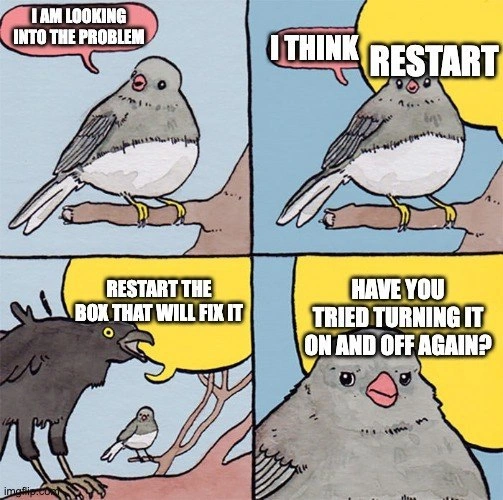
In the picture, a little bird is asking about a problem, and the advice he keeps getting is basically, “Have you tried restarting it?” It’s like when your toy robot isn’t working and someone asks if you’ve tried switching it off and back on. The funny part is how always the same that advice is. The bird tries to be patient at first (“I’m looking into it”), but in the end, even the bird just says, “Did you turn it off and on?” with a kind of this again? face.
Why is that funny? Because it’s a very simple fix that somehow ends up being the answer to very complicated problems more often than you’d think. It’s a bit like if every time your bicycle had a problem, the solution was just to stop and start pedaling again – it would be silly if that worked almost every time! In real life, when computers or gadgets act up, turning them off and on is often the quickest way to set things right. It’s almost magical how hitting the restart button can make a troublesome computer behave.
So the meme is basically the tech world’s way of laughing at itself. No matter how advanced things get, sometimes the best we can do is the same thing you’d do for a TV that’s not working: flip the power off, then back on. The little bird in the last panel is essentially saying to the big, complex server, “Hey, buddy, try a nap and wake up fresh.” And funny enough, that nap (the restart) often fixes everything, at least for a while. The humor is in recognizing that even experts rely on this super basic trick. It’s comforting and a bit comical to realize that, at the end of the day, solving a high-tech problem might be as straightforward as rebooting – the digital equivalent of “try turning it off and on again.”
Level 2: Power Cycle 101
Let's break down what’s happening in this meme for those newer to the On-Call and DevOps life. The scenario is a classic one in IT and tech support. You have something broken in production (the real, live system). People are asking the Ops team (short for Operations, the folks responsible for running the servers and infrastructure) to solve it. The meme uses a simple bird cartoon to play out the scene:
- In Panel 1, the small grey bird says, "I am looking into the problem." This is basically the ops person initially saying, "Alright, I'm investigating the issue." At this point, you’d expect some real debugging: checking logs, diagnosing what’s wrong. The pink speech bubble shows it’s a calm, standard response.
- In Panel 2, the same grey bird quickly says, "I think restart." The speech bubble is yellow now, indicating maybe a shift in tone. Already, after just a moment, the bird (the ops guy) is suggesting a restart. “Restart” here means rebooting the server. (In IT, calling a server a “box” is common slang, since servers used to be literal metal boxes in racks. So “restart the box” = turn the server off and on again.)
- Panel 3 gets dramatic: a giant black crow looms over the grey bird, with big bold text: "RESTART THE BOX THAT WILL FIX IT." This crow represents the voice of authority or culture in Ops basically yelling the advice. It’s like a senior engineer or a boss jumping in to insist, "Just reboot it now!" The grey bird is shown tiny in the background, meaning his attempt to analyze is overruled by this louder opinion. The humor here is in the exaggeration – the suggestion to reboot becomes literally larger-than-life (the crow is huge), implying how dominant and forceful this idea is in practice.
- Panel 4 zooms in on the grey bird’s face, now with a kind of resigned or deadpan expression, delivering the well-known question: "HAVE YOU TRIED TURNING IT ON AND OFF AGAIN?" This is the punchline. The grey bird has basically given up on fancy troubleshooting and is repeating the most stereotypical fix for any tech problem.
Now, if you've ever called IT support or worked in tech, you've likely heard the phrase "Have you tried turning it off and on again?" many times. It’s almost a cliché in the tech world. Why? Because it’s often the first thing you do when something is wrong. Computer frozen? Phone acting weird? Internet router not working? The simplest remedy is often to power cycle the device – meaning, turn it off completely (power it down) and then start it back up (power it on). This is exactly what “restart” or “reboot” means in this context: shut the system down and boot it up fresh.
So why do tech people ask this right away? Because restarting clears the current state of the system. Think of a server that’s been running for a long time: it might have a bunch of programs in memory, maybe one of them got stuck or confused. By restarting, you wipe the slate clean – all programs are stopped and then everything starts over. Often whatever glitch was happening goes away (at least for a while) after a reboot. It’s a bit of a catch-all fix. There might be a deeper reason something went wrong, but rebooting at least gets things working again temporarily.
In the meme, the ops team’s advice is “always the same” – just restart. This highlights a kind of running joke: that some IT support or operations folks seem to have only one solution in their toolkit, and they apply it to every problem. It’s funny because in complex systems you’d expect customized solutions for different issues, but here they just say the same thing regardless: turn it off and on. It’s like asking a car mechanic for any engine problem and they always say, "Have you tried turning the car off and on again?" It sounds silly, but in our tech world this basic step solves a surprising number of issues.
Let’s define a few terms and tags mentioned:
- OnCallDuty / OnCall: This means being the person (or team) designated to respond to problems with the system at any time, often outside of normal hours. If you’re “on-call”, you might get woken up at 2 AM by an alert that something is broken. The meme’s situation fits this: something’s wrong (a production incident) and the ops on-call person is handling it.
- ProductionIncidents: These are problems or outages in the production environment (the live system users rely on). A production incident could be a server crash, a site going down, a critical bug causing errors – anything that disrupts normal operation.
- DevOps/SRE: DevOps is a culture/practice that combines development and operations, aiming for faster deployment and more reliability. SRE stands for Site Reliability Engineering, which is a role or approach Google popularized – essentially software-engineered approach to operations. These folks build systems and also handle operations, focusing on reliability. In any case, both DevOps engineers and SREs often end up on-call to fix issues, just like traditional Sysadmins (system administrators).
- SysadminHumor / OpsHumor: Jokes and memes that come from the experiences of system administrators and operations folks. This meme is a textbook example: only someone who’s been responsible for keeping servers running would fully appreciate why “just reboot it” is both funny and painfully relatable.
- DebuggingAndTroubleshooting: The process of finding out why something is broken and fixing it. The meme illustrates a very shortcut form of troubleshooting – instead of systematically checking what’s wrong, they jump straight to a known quick fix. The pink and yellow speech bubbles in panels indicate someone speaking (the ops person) and thinking of solutions, but those solutions rapidly collapse into that one-liner.
- turn_it_off_and_on_again / restart_fix_everything: These tags capture the core idea: turning things off and on is humorously portrayed as the fix for everything. It’s a nod to how common and almost farcical this practice is.
The context also mentions bird_comic_meme_format. Indeed, this meme uses a four-panel comic with birds. These specific bird illustrations (a small grey bird and a large crow) have been used in various memes to represent one character being cowed or overwhelmed by another, often with text added. In this case, the small bird is the person trying to solve a problem and the big crow is the pushy voice telling them to reboot. Using animals in IT memes is a quirky way to make the scenario feel light and funny, even if the actual topic (production issues) is stressful in real life.
So, to a junior engineer or someone new to IT: what’s the takeaway? It’s that “Have you tried turning it off and on again?” is almost always the first question you’ll get when you report a tech problem. And that’s not without reason. Many times, rebooting a system does fix the immediate issue.
For example, say a web server (which is just a program running on a machine that serves web pages) gets stuck because of a bug. If you restart the web server program or the whole machine, that bug’s effects clear out (the program stops and starts fresh, freeing up memory, resetting any weird conditions). The underlying bug in the code is still there, but at least the site might work again for now. In a pressure situation, ops people care about restoring service quickly. They’ll often do the quick fix (restart) and make a note to investigate the cause later. It’s a bit like putting a Band-Aid on a wound so the patient (the system) stabilizes, even if you haven’t cured the disease yet.
The humor and slight “frustration” captured in the meme come from the fact that this advice is so overused. If you’re a developer who spent days working on a complex feature and something goes wrong, hearing “just reboot it” can be annoying – it feels too simple or like a brush-off. But at the same time, if you’ve been on the other side (the one responsible for an outage at ungodly hours), you know why that advice comes up. It’s practical. Sometimes you don’t want to dig into a hairy problem at 3 AM; you just want the site back up.
And yes, the final line in the meme is a direct reference to a popular TV comedy “The IT Crowd.” In that show, whenever someone calls the IT department, the technicians famously answer the phone with, “Hello, IT. Have you tried turning it off and on again?” They say it in a bored voice because they ask it so often. It’s poking fun at how that simple step is universally recommended in tech support. The meme is basically showing an ops person going through that exact motion, from earnest investigation to defaulting to that catchphrase.
In summary, Level 2 takeaways:
- Restarting the box = rebooting the server.
- It’s a super common practice in troubleshooting.
- The meme humorously shows that no matter what the problem is, the ops team ends up suggesting a reboot.
- This resonates with anyone who has done tech support or been on-call, and it teaches beginners that power cycling is indeed a go-to move (even if sometimes it feels silly to rely on it so much).
Level 3: The Nuclear Option
In the ops world of DevOps/SRE, there's a grim joke: when all else fails (or even before that), reboot the server. This meme nails that shared experience. The four panels escalate the inevitable advice progression: from a polite “I am looking into the problem” to the exasperated battle-cry “RESTART THE BOX, THAT WILL FIX IT”. Every seasoned sysadmin or on-call engineer has lived this. It's 3 AM, the system is mysteriously misbehaving, users are furious, dashboards are red, and logs are a cryptic horror show. What’s the quickest way to make the pain stop? Have you tried turning it off and on again? :boom:
This one-panel bird comic captures the reality that a quick reboot is often the first (and second... and third) step in real incident response. Why is it funny? Because it’s so true. The little grey bird initially pretends to investigate, but by panel two he’s already leaning towards the reboot. By panel three, a giant crow (think of it as the collective voice of hardened ops veterans past) is looming over him, practically shouting the “solution.” That crow represents every senior sysadmin who's seen weird issues vanish after a restart. It's the voice in your head (or the gruff senior engineer over your shoulder) growling "Just bounce the damn box!" In the final panel, the grey bird gives in completely, parroting the classic line made famous by The IT Crowd: “Have you tried turning it off and on again?”. This punchline lands because it’s the exact generic advice we all know and joke about. It’s the ultimate tech support go-to, delivered here as if it were enlightened wisdom after all that buildup.
Under the hood, there's a bitter reality: restarting a server often does magically fix transient problems. Why? Running systems accumulate entropy – memory leaks, hung threads, locked files, or misbehaving services. A clean reboot is like waving a wand that flushes memory, resets network sockets, and restarts processes fresh. It’s essentially clearing the cache of the entire machine. In complex distributed systems, tracking down the precise line of code or the root cause of a glitch can be maddeningly difficult (think finding a needle in a haystack of millions of log lines). Meanwhile, every minute of downtime costs money and stress. So the pragmatic on-call philosophy becomes: restore service first, diagnose later. A reboot has a high chance to reduce mean time to recovery (MTTR), even if it’s a brute-force tactic. It’s the nuclear option because it’s a blunt, one-size-fits-all maneuver – you're basically carpet-bombing every possible cause at once by restarting everything. Sure, it’s not elegant and it might be overkill, but when users are down or an alert is blaring, a fast fix is gold.
This meme is also poking at operational culture. Instead of meticulous debugging, some ops teams develop a habit of quick, repetitive fixes. It highlights a bit of Ops humor: the stereotype that any call to the Ops/SRE team yields the same answer: “reboot it”. Seasoned developers chuckle (or cringe) because they recall those war-room calls where someone inevitably asks, “Did we try rebooting?”, and to everyone’s chagrin, that actually resolves the issue. :sweat_smile: It feels like defeat and victory at the same time – you fixed the outage, but you still have no clue what the heck went wrong. The dark comedy here is that sometimes even complex production incidents get the turn-it-off-and-on-again treatment. It’s both a joke and an uncomfortable reality in OnCall_ProductionIssues: we rely on a method so simple a grandma could suggest it.
The trade-off at play is well-known among senior engineers:
| Approach | Upside (Pros) | Downside (Cons) |
|---|---|---|
| Investigate Deeply | Might find the true root cause and prevent it from happening again. | Takes time; system stays down longer, angry customers wait, and at 3 AM nobody has patience. |
| Quick Reboot | Fast recovery – get the service running ASAP, satisfying uptime metrics and sleeping bosses. | Root cause remains a mystery, so the bug might bite again. You're basically sweeping issues under the rug (until next time). |
In practice, teams often compromise: reboot to get out of the fire, then later (hopefully) do a post-mortem to identify what caused the blaze. The meme’s humor is that the later analysis part often gets forgotten once the immediate pressure is gone. The big crow yelling “RESTART THE BOX” is like that manager or senior tech who doesn’t care why it’s broken, just fix it now. And the tiny grey bird acquiescing with the tired catchphrase is the engineer internally sighing, "Fine, let's just reboot and move on."
There’s also a wink here at how helpdesk or junior IT support often handle calls. "Have you tried turning it off and on again?" is literally Step 1 on many support scripts. It's funny because it’s so basic—a line you’d expect from an intern—yet even top-tier engineers resort to it. In a way, the meme is a bit cynical: no matter how advanced our systems get, sometimes the solution is no smarter than power-cycling a 20-year-old PC. :wink: The phrase is ubiquitous for a reason. Even in the era of cloud microservices and Kubernetes, we sometimes solve problems by destroying a container or node and letting it restart clean. Cattle, not pets, as the DevOps mantra goes – treat servers as replaceable. The reboot-as-fix is the human version of that philosophy: if one cow in the herd gets sick, you don’t perform surgery at 3 AM; you swap it out (or in crude terms, shoot it and bring in a new one). Harsh? Maybe. Effective? Often, yes.
The DevOps_SRE ethos recognizes that automation and self-healing systems are basically institutionalizing "turn it off and on again." Think about orchestration tools: if a container reports unhealthy, Kubernetes will kill and restart it automatically. That’s just a fancy programmed version of this same old advice. The meme gets a laugh from experienced devs and ops because it’s an old habit that never dies. There's a tongue-in-cheek resignation: after all these years of progress in computing, our last resort is still flipping the power switch. The sysadmin humor here is a mix of “this is stupid” and “hey, it actually works”. As a battle-scarred on-caller might quip, "No one ever got fired for rebooting a downed server." It’s far safer to try the universal fix than to spend an extra hour combing through hex dumps while the incident clock is ticking. In summary, the meme humorously distills a core truth of ProductionFirefighting: when you're in doubt, reboot. And if you weren’t in doubt... reboot anyway just to be sure. :smirk:
# The classic 3 AM ops fix, in crontab form (schedule an automatic daily reboot)
0 3 * * * /sbin/reboot # Because who needs sleep when the server can start fresh?
(Above: a darkly comedic example — setting a server to reboot every night at 3 AM to preempt mysterious crashes. It’s a real “strategy” some of us have seen or done to avoid dealing with a memory leak or other lingering bug.)
Ultimately, “just restart the box” has become a sardonic mantra in tech circles. We know it’s not a real solution, but the meme winks at us because of how often it’s recommended with straight-faced seriousness. The next time someone says it in a meeting, half the room will chuckle – not because it’s a clever insight, but because they’ve all been that tired grey bird yielding to the quick fix.
Description
Four-panel cartoon of a grey bird perched on a branch being advised about a problem. Panel 1 (upper-left, pink speech bubble): text reads “I AM LOOKING INTO THE PROBLEM.” Panel 2 (upper-right, yellow speech bubble): the same bird says “I THINK RESTART.” Panel 3 (lower-left): a large black crow looms over the smaller bird, with text “RESTART THE BOX THAT WILL FIX IT,” while a tiny version of the grey bird appears in the background. Panel 4 (lower-right, yellow speech bubble): close-up of the grey bird asking, “HAVE YOU TRIED TURNING IT ON AND OFF AGAIN?” The meme riffs on real-world incident response where the default sysadmin / SRE recommendation for mysterious production glitches is simply to reboot the server, highlighting both debugging shortcuts and operational culture

Comments
13Comment deleted
$2 M of observability, eBPF flame graphs, and distributed tracing - all so the incident bridge can conclude with the senior ops bird declaring “rolling restart,” and the post-mortem template scrambling to list it as a mitigation strategy
After twenty years of debugging distributed systems, I've learned that "turn it off and on again" is just a fancy way of saying "let's clear the memory leaks and hope the race condition doesn't reproduce."
The three stages of senior engineering: Stage 1 - Analyzing logs, checking metrics, reviewing recent deployments. Stage 2 - Realizing the issue started exactly when Jenkins auto-deployed at 3 AM. Stage 3 - Admitting that yes, a restart would have saved 2 hours of investigation, but now you've at least documented why the connection pool wasn't releasing handles after the ORM upgrade
If your health check’s remediation is “kubectl delete pod,” congratulations - you’ve productized “have you tried turning it off and on again?”
Restarting: the empirical proof that even Kubernetes pods achieve eventual consistency after a power cycle
We rebranded 'turn it off and on again' as self-healing; it's amazing how a daemonized memory leak becomes SLO-compliant once systemctl restart is step zero of the runbook
Sometimes it's the only solution. Comment deleted
how can I get the raw form of this meme? Comment deleted
thanks a lot Comment deleted
np Comment deleted
🪟 Comment deleted
It work in 90% problems Comment deleted
What’s funny here? Comment deleted