The Fragile Confidence of Self-Written Unit Tests
Why is this Testing meme funny?
Level 1: Homework and Self-Checking
Imagine you have a big math homework, and you’re not sure if all your answers are correct. You feel a bit worried (panic). Then you remember you checked all your answers using a calculator, and everything seemed fine. You feel better – calm, even confident that your homework is perfect. But then it hits you: you were the one who punched in the formulas on that calculator and double-checked your work, not your teacher. If you made a mistake in the way you checked (or the calculator was used incorrectly), that mistake would still be there. Now you’re worried again because you realize the checking might not have caught everything.
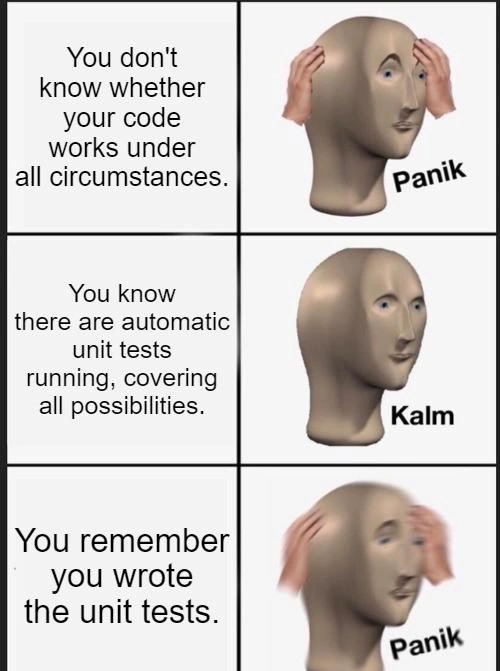
This meme is just like that. At first the person is scared their work might have errors, then they relax because they think it was all checked over, and finally they freak out again when they remember the check itself might not have been reliable (because it was done by the same person who wrote the work). It’s funny in a “oh no, that’s so true!” way. Basically, it’s saying: it’s great to double-check your work, but if you’re the only one checking it, you might miss the same things. Sometimes, we trust something just because we did it ourselves, but that can be a bit like giving yourself a high-five – it doesn’t tell you if you’re actually right or just confident for no reason. The meme makes us laugh and remember that feeling when confidence suddenly turns back into dread.
Level 2: But Did You Test It?
Let’s break down the meme’s scenario in simpler terms. Imagine you just wrote some code and you’re not entirely sure it works in every situation. That’s a common feeling for any developer, especially when the code might face different inputs or unexpected conditions. In the meme’s first panel text (“You don't know whether your code works under all circumstances.”), the developer is worried – this is the “Did I handle every case?” anxiety. It’s like when you finish a big assignment and then wonder, “Did I consider all the requirements? What if there’s a case I missed?” In coding, those “missed cases” often turn into bugs when the software encounters them.
Now, onto the second panel: “You know there are automatic unit tests running, covering all possibilities.” Here the meme references unit tests – small pieces of code written to check that individual parts (units) of your program work correctly. Often, developers write these tests themselves and include them with their code. When we say “automatic unit tests running,” we’re talking about a Continuous Integration (CI) system. CI is a practice (and set of tools) where every time you make changes and push your code, a server automatically runs all these tests. The idea is to catch problems early: if a test fails, it sends up a red flag before your code is merged or deployed. So hearing “don’t worry, the tests all passed” usually makes a developer feel safe – hence the Kalm (calm) face in the meme. The text claims the tests are “covering all possibilities.” In reality, no test suite covers absolutely every possible scenario (there are infinitely many in most non-trivial programs!), but a good test suite tries to cover all likely and critical cases. So at this moment, the developer feels confident: there’s a safety net. If something were wrong with the code, the tests would fail and alert me, right? Nothing to panic about now.
The punchline is the third panel: “You remember you wrote the unit tests.” The same developer who’s worried about the code is the one who wrote those reassuring tests. Why is that suddenly scary? Because of a simple truth: if you didn’t think of a certain scenario when writing the code, you probably didn’t think of it when writing the tests either. The tests might only check the conditions you imagined. This realization can make your earlier confidence crumble. For a newer developer, it’s a lesson learned: tests are only as good as the cases you include in them. If you forgot an edge case in code, you likely forgot to write a test for that edge case, meaning the test suite would happily report “All good!” while that forgotten case could still break the program.
Think of it like doing your homework and then also making the answer key for that homework. If you misunderstood the problem in your homework, your answer key might be wrong too – so everything “checks out” on the surface, even though both the homework and the key have the same mistake. In software, ideally, we have someone else review or write tests (or we use methodologies like Test Driven Development where you write tests from requirements before writing code). But in many real-world scenarios, the developer of the code is responsible for testing it as well. That’s normal – who knows the code better, right? – but it does mean we have to be extra careful to step outside our own assumptions.
Key terms explained: A unit test is just a small script that calls a function or part of your code with a specific input and checks that the output or behavior is what you expect. For example, if you have a function add(x, y), a unit test might call add(2, 3) and expect the result to be 5. If the function returns 5, the test passes (success); if it returns something else, the test fails (alerting you to a problem). When we have many unit tests, we usually run them automatically with each code change – that’s the continuous integration process. It’s great because it acts like an automated teacher grading each of your new changes immediately. But if the tests themselves have flaws (like checking the wrong thing, or not checking enough things), they can give you a false positive – basically saying “it’s all good!” when it isn’t. This meme humorously reminds us of that: the developer’s confidence was based on tests that might have the same blind spots as the code.
So, put simply, panel by panel for a junior developer:
- Panik: You’re not sure your code covers every case – common fear of unknown bugs.
- Kalm: But you have tests running automatically, which usually means if there’s a bug, they’ll catch it – so you feel better.
- Panik again: Then you realize those tests might not catch the bug if they weren’t well-written, especially since you wrote them under the same assumptions as the code. Doubt creeps back in.
This is a bit of TestingHumor that carries a real lesson: writing tests is crucial, but writing good tests (and reviewing them critically) is just as crucial. Don’t assume “no news is good news” just because your tests are green; always consider if you truly tested the tricky parts of your code. As developers gain experience, they learn to anticipate more edge cases and write better tests – and also to occasionally have someone else review their tests or code, because a fresh pair of eyes can catch things you didn’t. In short: Yes, you tested it… but did you test it well? That’s the question making our meme character panic in the end.
Level 3: Green Tests, Red Flags
At first glance, this meme is a tongue-in-cheek nod to the false sense of security developers get from their own tests. It plays out in three acts (Panik → Kalm → Panik), which any seasoned engineer recognizes all too well:
Uncertainty about your code: The developer realizes “You don't know whether your code works under all circumstances.” This triggers that familiar dread. In real projects, code can behave unpredictably with new inputs, weird states, or edge cases (like leap years, null values, or network timeouts). A veteran developer knows there are always more edge cases than you anticipated – it's practically a software axiom. No matter how confident you are, there's always that one scenario at 3 AM that makes you whisper, “Did I handle that case?” Hence the initial Panik is entirely justified.
Relief via test automation: Next, reassurance: “You know there are automatic unit tests running, covering all possibilities.” Our frantic developer suddenly remembers the CI pipeline (Continuous Integration) is running a suite of UnitTesting scripts every time they push code. This is where the meme shows Kalm – the cool, collected relief of a dev convincing themselves: “It’s fine, the tests will catch any bug.” In principle, a comprehensive test suite is the backbone of CodeQuality. Good tests are like safety nets that catch RegressionBugs whenever you change code. In a perfect world, these unit tests would indeed cover “all possibilities” — every edge, every corner case — giving you near-mathematical assurance that the code works. This is the dream scenario every TestDrivenDevelopment evangelist talks about, where you write thorough tests first and code against them, achieving nirvana-like confidence in your software.
Reality check – who wrote those tests?: Then comes the cheeky gut-punch: “You remember you wrote the unit tests.” Cue Panik again. That sudden dread isn’t just self-deprecating humor; it’s well-earned skepticism born from experience. Why? Because automatic tests are only as good as the person who wrote them – and in this case, that’s you, the same hurried developer who isn’t sure the code works. It’s a classic case of “Quis custodiet ipsos custodes?” or “Who tests the tests?” in coding form. Seasoned devs know that writing tests for your own code can create a blind spot: if you misunderstood the requirement or missed a corner case in your code, chances are your tests have the exact same blind spot. The result? All tests pass, CI is green, yet a bug quietly slips through to production anyway. You felt Kalm because of those green tests, but now there’s a red flag: the realization that your safety net might be woven from the same flawed thread as the code itself.
This meme hits on the industry-wide inside joke about coverage vs. quality. We sometimes joke that “100% code coverage* (every line executed by tests) *doesn’t equal 100% correctness.” It’s painfully true. A trivial example: a developer writes a function and a matching unit test that simply confirms the function’s output equals an expected value. But if both the code and the test share the same wrong assumption, the test will happily pass even though both are wrong. Coverage can be deceiving – you might execute all your code in tests, but are you checking the right things? Experienced engineers have seen absurd scenarios where tests assert nothing meaningful or simply mirror the code:
def calculate_total(items):
# Suppose there's a bug here: using minus instead of plus
return sum(items) # (Imagine this was a more complex wrong calculation)
def test_calculate_total():
# Developer uses the same logic as the code to compute expected outcome
expected = sum([1, 2, 3]) # using sum, just like the function
assert calculate_total([1, 2, 3]) == expected
# This test will pass even if calculate_total is implemented incorrectly,
# because the expected value was computed the same buggy way as the code!
In the snippet above, the test isn't independent at all – it’s effectively duplicating the implementation logic. If calculate_total had a bug, the test likely has the same bug when computing expected, so it wouldn’t catch the error. This illustrates why a test suite can give a false security net. The meme’s comedic twist (“oh no, I wrote them!”) echoes every senior dev’s internal monologue after seeing a green build: Did I actually test the right things, or just the easy things? We’ve all seen test suites that:
- Only test the “happy path”: The simplest, expected usage scenario passes, but any deviation blows up. (E.g., tests check
divide(6,3)==2but never trydivide(6,0)for divide-by-zero handling.) - Assert the obvious or the same logic: Tests that essentially assert
TrueisTrueor replicate the code’s formula to compute expected results, as shown above. These tests will always pass and inflate coverage, yet they tell us nothing about real correctness. - Were written under deadline duress: Perhaps late Friday, you wrote minimal tests just to appease the QA checklist or to make that coverage graph look good. They run and pass, but they might not stress the code in any meaningful way.
A grizzled engineer reading this meme is likely smirking (or maybe sobbing) because they remember that time the CI reported “All checks passed ✅” right before a deployment, only to discover a glaring bug in production. The tests didn’t catch it because the person who wrote them (yep, that would be us developers) didn’t anticipate that scenario either. It’s a humbling reminder: a green test suite can sometimes be a mirage. We feel “Kalm” seeing all green, but if those tests were naive, incomplete, or outright flawed, we’re basically high-fiving ourselves for work that might be wrong. CodeQuality isn’t just having tests – it’s having good tests.
In summary, level 3 exposes the humor and horror behind relying on your own UnitTesting too much. It’s a light-hearted stab at the developer guilt: “Did I do enough? Oh right, I was the one who did it… uh oh.” The meme resonates strongly in engineering circles because it rings true: trust, but verify – and maybe have someone else verify the verifier.
Description
This is a three-panel 'Panik, Kalm, Panik' meme featuring the surreal 'Meme Man' character to illustrate a developer's rollercoaster of emotions regarding code quality. In the first panel, Meme Man is clutching his head in distress with the text 'You don't know whether your code works under all circumstances' and the caption 'Panik'. The second panel shows a composed Meme Man ('Kalm') with the reassuring thought, 'You know there are automatic unit tests running, covering all possibilities.' The final panel returns to chaos, with a blurry, distressed Meme Man ('Panik') accompanied by the dreadful realization: 'You remember you wrote the unit tests.' The humor resonates deeply with experienced developers who understand that the existence of unit tests is no guarantee of quality. It hilariously captures the moment of self-doubt and imposter syndrome when one realizes that the safety net was built by their own potentially flawed hands, questioning whether the tests are truly comprehensive or just green because they were written to pass
Comments
7Comment deleted
The only thing more dangerous than no tests is a suite of lovingly handcrafted tests that assert `True == True` and achieve 100% line coverage
Passing your own unit tests is like reviewing your own PR - CI says green, but production says ‘I trusted you, buddy.’
The real test coverage metric should include 'percentage of tests written while fully understanding the business logic' - mine hovers around 30% on a good day, which explains why my 100% coverage still lets production burn down quarterly
The real horror isn't untested code - it's realizing your comprehensive test suite was written by past-you, who thought mocking the entire database layer and testing only happy paths constituted '100% coverage.' At least production will provide the integration tests you forgot to write
CI proves your assumptions compile; coverage just confirms the same assumptions politely agree
Unit tests: 100% coverage of the bugs you already knew about, zero for the ones prod invented
Nothing inspires confidence like 100% coverage from tests that verify the mocks called the stubs I wrote to satisfy the mocks