Skip to content
DevMeme
3336 of 7435
The Developer-Client Communication Gap, A.K.A. 'Eating the Baby'
Communication Post #3663, on Sep 8, 2021 in TG

The Developer-Client Communication Gap, A.K.A. 'Eating the Baby'

Why is this Communication meme funny?

Level 1: A Scary Misunderstanding

Imagine you’re showing your friend a treasured toy – let’s say a cute teddy bear that you love very much. It’s like your favorite thing in the world, almost like your little baby. Now, your friend looks at your teddy and says, “Aw, it’s so cute I could just gobble it up!” You might gasp and hold your teddy tight, thinking, “Gobble it up? 😱 Are they going to eat my teddy bear?!” You feel frightened because it sounds like your friend wants to harm your beloved toy.

But then your teacher or another friend quickly explains, “No, no – they don’t actually want to eat your teddy! When people say ‘gobble it up’ about something cute, they just mean it’s adorable. It’s a funny way of saying they really like it.” Suddenly, you breathe a sigh of relief and maybe even laugh at the mix-up. Your friend never wanted to hurt your toy at all. It was just a silly misunderstanding because of the way they said it.

That’s exactly what’s happening in the meme. The developer asked something in a confusing way, and the client (who loves her “baby” project) thought he meant something scary. She got upset, but really it was just the words being misunderstood. Once it’s explained, everyone realizes nobody wanted to harm anything – it was just an oops in how it was said. And that little moment is both funny and relatable because we all know how mixed-up words can cause big confusion!

Level 2: Don’t Eat the Baby

Let’s break down what’s happening in simpler terms. This meme shows a classic requirements specification meeting moment – that’s when developers and clients sit down to define what the project should do. Here we have three characters in the meeting:

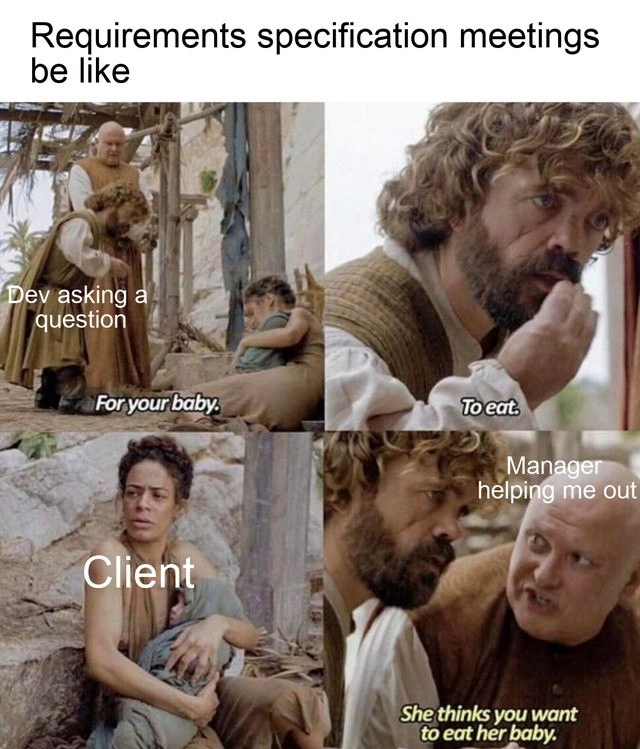
  • The Developer (Dev) – the person building the product. The dev is trying to clarify a requirement, meaning they’re asking questions to understand exactly what the client needs. Developers often ask very direct questions to avoid RequirementsAmbiguity (confusion about what’s needed). In the meme, the dev’s question is labeled “Dev asking a question: For your baby. To eat.”

  • The Client (Stakeholder) – the person who wants the product built (or who the project is being done for). They care a lot about the outcome. In fact, we often say a client treats their project like their baby – something precious that they’ve nurtured from an idea. Here the client is literally depicted as a woman holding a baby, to symbolize how protective she feels about the project. She hears the dev’s question and completely misunderstands it. The phrase “For your baby to eat” sounds to her like the developer is asking to eat her baby! Naturally, she’s horrified – in the meme image she’s clutching her child defensively. This represents a ClientExpectation nightmare: she thinks the dev wants to do something terrible to her project (her “baby”).

  • The Manager – often a Project Manager or Team Lead who acts as a bridge between the technical team and the client. In the fourth panel, the manager leans in to whisper to the dev, effectively translating. The caption says: “Manager helping me out: She thinks you want to eat her baby.” The manager realizes the client completely misinterpreted the dev’s question, and is clarifying this to the developer. In real-life meetings, managers or product people frequently step in to rephrase a developer’s words so the client understands it correctly. They perform stakeholder management – making sure the client’s fears are addressed and everyone is aligned. Here, the manager is basically saying, “I know you were just asking an innocent question, but the way it sounded made her think something absurd. Let’s reword that!”

Now, why did this misunderstanding happen? Communication in technical meetings can be tricky because developers and clients use language differently. The dev in the meme likely meant to ask something like, “Is the deliverable (the product) meant for your baby to eat?” Maybe in the project context, “baby” is actually something like an end-user or a metaphor. But by splitting the phrase weirdly (“For your baby. To eat.”), it sounded like he was offering something to the baby to eat, or worse, asking if he could eat the baby! This is a case of RequirementsGathering gone wrong due to an unfortunate choice of words. It’s a humorous example of RequirementsVsReality – the requirement was probably about what the baby (product) needs, but the reality of how it was said caused confusion.

In everyday developer-client communication, there are lots of terms that can cause confusion if you’re not careful. For instance:

  • A developer might say, “Our app will consume this feed of data.” They mean the app will use or process the data. But if a client isn’t familiar with that terminology, consume might sound strange – “consume” literally means eat or use up.
  • Or a dev might say, “We’ll kill the process if it hangs.” In tech, kill just means force-stop a program. But a non-technical person hearing “kill” could momentarily think something destructive or bad is happening.

So in the meme’s case, when the dev mentioned “baby” and “to eat” in the same breath, it set off alarm bells. The client likely thought the dev was about to “eat up” or destroy her baby (the project she loves). This is a comedic extreme of MisalignedExpectations: the developer is trying to help, but the client hears a threat.

The manager’s job here – and in real life – is to fix that misunderstanding. This often means rephrasing the question in plain language. For example, the manager might turn to the client and say, “Don’t worry, he’s just asking who the end-user of this product is – whether it’s literally for a baby (if the project is about baby food or a toy) or for someone else.” By explaining the intent behind the dev’s weird-sounding question, the manager realigns the conversation. This is key in project management: ensuring stakeholder alignment so that the client and dev are on the same page.

For a junior developer or anyone new in these meetings, the lesson is: phrasing matters. You may know what you mean, but the client might take your words very differently, especially if you use technical jargon or incomplete sentences. It’s important to speak the client’s language or at least clarify your own words. If something you ask causes a client to look shocked or confused, don’t panic – calmly rephrase, or let a manager help out. Everyone in the room ultimately wants the same thing (a successful project), but they might use different words to talk about it. This meme humorously reminds us that asking questions is good, but how you ask them can make a world of difference in keeping the conversation productive (and non-scary!).

Level 3: Lost in Specification Translation

At a glance, this meme is a painfully accurate satire of what can go wrong in a requirements specification meeting. The developer asks an apparently simple clarifying question about the client's "baby" (their beloved project or deliverable), but a CommunicationBreakdown warps the meaning into something horrifying. In the panels, the dev leans in and says, "For your baby..." then quietly adds, "to eat." The Client’s eyes widen in panic as she clutches her metaphorical baby (the project) protectively. Enter the Manager, who whispers to the dev, "She thinks you want to eat her baby."

This tongue-in-cheek scenario resonates with seasoned developers because it exaggerates a familiar failure mode in meetings: requirements ambiguity. The dev’s innocent question — probably meant to clarify who or what the "deliverable" is for — was phrased unfortunately. Perhaps the developer was trying to ask “Is this feature for your baby (the product) to eat (i.e. to consume or use)?” But breaking that sentence awkwardly (“For your baby. To eat.”) made it sound like something out of a grim fairy tale. The client hears “the dev wants to consume my baby!”, a complete disaster of MisalignedExpectations.

Why is this funny (and cringey) to us in tech? Because we’ve all been in meetings where a poorly worded remark sends stakeholders into a frenzy. It highlights the perpetual gap between developer-speak and client-speak. Developers often use metaphors or shorthand that make sense in a technical context but sound perilous to others. In daily engineering, we casually say things like “the service will consume your data feed,” or “we might kill that process if it hangs.” To a non-tech stakeholder, words like “consume” and “kill” can sound like we’re unleashing a monster. Here, the dev talked about the client’s “baby” (their project) and “to eat,” triggering the client’s primal fear that the engineers will devour her precious product or idea. It’s a caricature of StakeholderExpectations going haywire due to one stray phrase.

From a senior perspective, this reveals several project management anti-patterns. First, there’s the lack of a translation layer between the developer and client. Ideally, a Product Manager or Business Analyst helps interpret developer questions in a less scary way – essentially what the Manager helping me out does in the last panel. In real life, a good manager will rephrase: “I think what they mean is, who is the end-user of this deliverable?” That simple translation diffuses tension and aligns everyone’s understanding. This meme sums up that StakeholderManagement role in one hilarious whisper: “She thinks you want to eat her baby.” In other words: “You totally phrased that wrong, and now she’s terrified – let me fix it.”

Second, it underscores how crucial clear communication is during RequirementsGathering. When specs are discussed, both sides carry mental models and emotions. The client often treats the project as their baby – something cherished, to be nurtured carefully. The developer just wants concrete answers (e.g. “who is the end-user?” or “what’s the exact use-case?”). If the developer’s wording is off, the client may assume the worst – that the dev fundamentally doesn’t “get” the project, or might misuse it (metaphorically “eating” it). This is meeting humor rooted in truth: we laugh because it’s so easy for requirements discussions to go off the rails over a simple misunderstanding. Everyone in software has experienced that awkward silence when a question lands wrong and a client’s StakeholderAlignment confidence plummets.

Lastly, the meme’s medieval film imagery brilliantly amplifies the absurdity. By repurposing a serious dramatic scene (it looks like something out of a historical drama or fantasy show) and overlaying corporate labels (“Dev”, “Client”, “Manager”), it draws a parallel between ancient mistranslations and modern office life. In medieval times, saying the wrong thing could literally get you accused of sorcery or worse – here, it gets the dev virtually accused of plotting to harm the project. The stakes feel comically high, but any senior dev or project manager will tell you that miscommunication really can make or break a project. We’ve seen teams go in entirely wrong directions because a requirement was phrased vaguely and nobody clarified (RequirementsVsReality syndrome). This meme cleverly exaggerates that risk: one mis-phrased clarification, and suddenly the client fears the devs will destroy what she holds dear. It’s an extreme, darkly funny take on a very real problem in tech: when we fail to speak the same language, even well-intentioned questions can sound like “I’m going to eat your baby.”

Description

A four-panel meme captioned 'Requirements specification meetings be like', using a scene from Game of Thrones to illustrate a communication breakdown. The first panel shows Tyrion Lannister, labeled 'Dev asking a question', offering something 'For your baby.' to a poor woman. A second panel shows a close-up of Tyrion, with his internal thought being 'To eat.' The third panel shows the horrified woman, labeled 'Client', clutching her baby protectively. The final panel shows Lord Varys, labeled 'Manager helping me out', whispering to a confused Tyrion, 'She thinks you want to eat her baby.' This meme masterfully captures the frequent and painful miscommunications between technical teams and non-technical clients. A developer's probing question, meant to clarify an edge case or technical requirement, can sound bizarre or even threatening to a client who is deeply invested in their project (their 'baby'). The manager's attempt to translate often fails, further muddying the waters and confirming the client's worst fears
Comments

7
Anonymous ★ Top Pick The dev was just asking about garbage collection for orphaned child objects, but the manager translated it as a proposal for a 'finalizer' solution
  1. Anonymous ★ Top Pick

    The dev was just asking about garbage collection for orphaned child objects, but the manager translated it as a proposal for a 'finalizer' solution

  2. Anonymous

    Pro tip: phrase your questions as "consume the API" - clients panic less than when you ask if it’s okay to "eat the payload."

  3. Anonymous

    After 20 years in tech, I've learned that every requirements meeting is just an elaborate game of telephone where 'we need better observability' somehow becomes 'the client wants real-time 3D visualizations of every database transaction with blockchain verification' by the time it reaches the sprint planning

  4. Anonymous

    This perfectly captures why we now write acceptance criteria in Gherkin syntax with Given-When-Then scenarios - because apparently 'What should happen when the user clicks submit?' can somehow be interpreted as 'The developer wants to consume our firstborn child' after passing through three layers of stakeholder telephone

  5. Anonymous

    Requirements via PM: the ultimate lossy codec, compressing 'edge case?' to 'eat my baby project'

  6. Anonymous

    Asking “Do we deprecate v1 after GA?” and watching the PM transcode it into “they want to eat your baby” is why we write ADRs and a ubiquitous glossary - human middleware has a surprisingly high bit‑error rate

  7. Anonymous

    When the PM becomes the translation layer, requirements go through lossy NAT - skip Ubiquitous Language and example mapping, and you’ll ship an endpoint nobody asked for with beautifully documented undefined semantics

Use J and K for navigation