Skip to content
DevMeme
3338 of 7435
Agile Knight Prioritizes Kanban Board Over Princess Rescue
Agile Post #3665, on Sep 9, 2021 in TG

Agile Knight Prioritizes Kanban Board Over Princess Rescue

Why is this Agile meme funny?

Level 1: Just Do Something

Think of it like this: you’re trying to build a big Lego castle step by step, following the instructions carefully. You want to make sure each piece goes in the right spot so the castle doesn’t fall apart. But your friend is stuck waiting to play with the castle, and they’re really impatient. They keep yelling, “Come on, just put some bricks down already! Do something!” They don’t care about the instructions or planning – they just want the castle finished now so the game can continue.

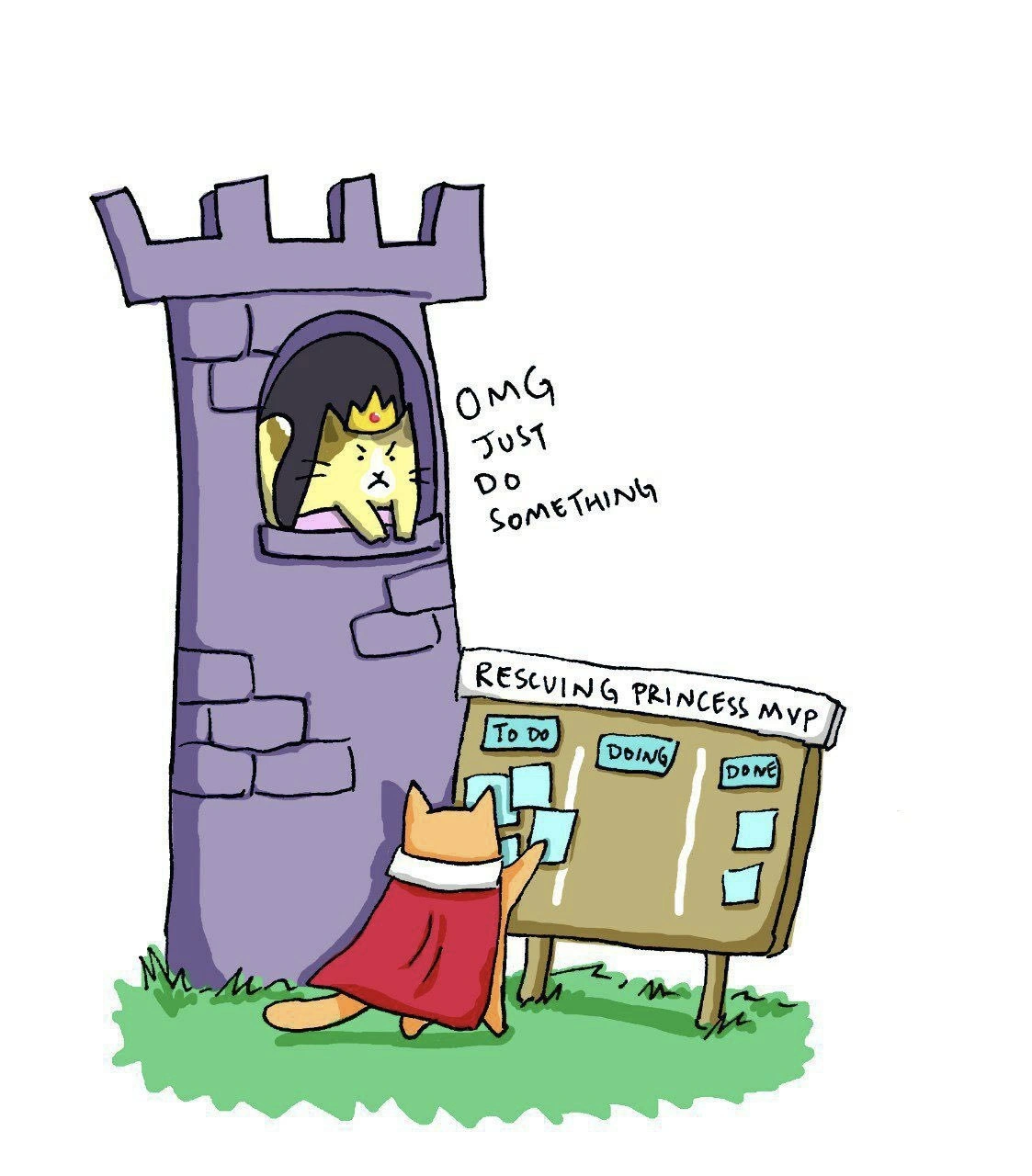
In this meme, the developer is like the kid carefully building with Lego according to a plan (that’s the cat knight with his task board), and the product owner or client is like the impatient friend yelling from the tower window (that’s the cat princess). It’s funny because we all understand both sides: one person knows if you rush and just do anything, the result might be a mess (a wobbly castle or a failed rescue), and the other person is just tired of waiting and wants to see something happen. The cartoon uses a fairy tale rescue to show this in a silly way. Instead of really saving the princess immediately, the knight is treating it like a project – writing down tasks on sticky notes – which is as silly as writing instructions for a simple job while someone screams for you to hurry up. The princess shouting “OMG JUST DO SOMETHING” is basically what the frustrated friend would say: Stop planning, just start doing!

So, the whole joke is like when your mom or teacher says “Quit planning and just start your homework already!” but you’re there making a neat to-do list. One side is yelling “Hurry up!”, and the other side is saying “Hold on, let me do this right.” It’s a playful way to show how trying to do things carefully can clash with someone who just wants it done fast. In the end, it’s funny because both really want the same thing (a completed castle or a successful rescue), but the way they go about it – one slow and steady, the other impatient and hurried – turns into a comical scene.

Level 2: Plan vs Panic

In simpler terms, this meme uses a cute medieval cat cartoon to highlight a common Agile team problem: the difference between careful planning and panicked urgency. On the ground, we see a cat dressed as a knight (our developer) standing before a Kanban board. A Kanban board is a tool that helps teams track work; it’s divided into columns like “TO DO,” “DOING,” and “DONE.” The knight’s board even has a funny project name, “Rescuing Princess MVP,” written on it. Each blue sticky note on the board is like a little task or story that needs to be done for the project (in this case, tasks to rescue the princess). There are only a few notes visible, which means the knight has started planning but not much is in progress or finished yet.

Now, look up at the tower on the left. There’s a grumpy cat princess (with a tiny crown) leaning out of the window, shouting “OMG JUST DO SOMETHING.” She represents the Product Owner or client – basically the person who wants the project done. We call her “deadline-obsessed” because all she cares about is that the rescue (the project) happens quickly by a certain time. She’s not interested in the details of the Kanban board or the careful breakdown of tasks; from her perspective, it looks like the knight is just standing around organizing stickies while she’s still stuck. This is a classic case of stakeholder expectations clashing with the developer’s process. The stakeholder (princess) expects fast action and results (she wants out of that tower ASAP!), whereas the developer is trying to follow a structured approach to ensure nothing is missed.

Some terms here: MVP stands for Minimum Viable Product. In software (or any project), an MVP is the most basic version of the product that still works – it’s the smallest set of features that delivers value. On the board, “Rescuing Princess MVP” implies the knight is focusing on the minimum needed to save her (maybe just get her safely out of the tower, skipping any fancy heroics). This is actually a smart Agile idea: deliver something workable first, then improve. But to the princess, that sounds like he’s only going to do the bare minimum and might leave her hanging (literally!). That contrast is part of the joke – she doesn’t want a “partial” rescue or an early demo, she wants the whole thing right now. It’s poking fun at how a client or product owner might not be satisfied with just an MVP; they want all the promised features immediately, even if Agile methodology would normally deliver it in increments.

The Kanban method the knight is using is all about steady workflow. Unlike Scrum (another Agile framework) which has time-boxed sprints (fixed-length intervals for work, often 2 weeks), Kanban is more continuous. You constantly pull the next task from the backlog (the to-do list) when you’re ready, and you try not to have too many things going on at once (WIP limits, meaning Work-In-Progress limits, are a thing in Kanban to avoid overload). The knight appears to be mid-planning or doing one small task at a time, which is why the board isn’t full. From a junior developer’s perspective, this might look familiar: maybe you’ve seen a board during sprint planning or daily stand-ups where tasks move from To Do to Done slowly, one by one. It’s disciplined, but someone impatient might think “Why aren’t we handling all these tasks at the same time?” In the meme, the princess is exactly that impatient stakeholder. Her “JUST DO SOMETHING” essentially means she’d prefer the knight to drop the process and just start doing — any task, really — to show progress. This can lead to scope creep, where you start doing things outside the planned tasks just to please the stakeholder, often causing chaos later.

For a junior dev or someone new to project management, the meme is a reminder (in a funny way) of why we use tools like Kanban boards in the first place. It keeps us organized so we don’t forget a step in the “rescue mission.” If the knight just rushed into the tower without checking his To Do list, he might forget to, say, bring a ladder or a key – analogous to a developer skipping planning and later discovering they missed an important requirement. The princess (client) might not understand why you need to take that time to plan; she just sees delay. This is super common in real projects: the people waiting for the product (or feature) often get anxious when they don’t see immediate results. They might start shouting figuratively (or literally) like, “Why is this taking so long? Just code something quick!” Meanwhile, the dev team knows that coding something quick without structure could backfire (bugs, rework, failed deployments, etc.).

In the cartoon, the whole scenario is wrapped in a fun fairytale metaphor. The medieval setting with a tower, princess, and knight gives a lighthearted twist to a modern office situation. It’s basically saying: software projects can feel like quests, and sometimes the project manager or client can act like a distressed princess yelling for help, while the developer is the knight trying to follow a map (or Kanban board) to make sure the quest succeeds. The visual of the princess cat’s angry face and the knight cat’s calm focus on the board really drives home the two mindsets:

  • Princess Product Owner: Results now! She’s anxious, maybe afraid of failure or delays, and possibly under pressure herself (hence the crown could also hint she has higher-ups expecting her to deliver the “kingdom” by a deadline).
  • Kanban Knight Developer: Process first. He’s carefully laying out steps, possibly thinking “If I just do something random, this rescue could fail spectacularly. Let’s prioritize and do it right.”

For someone new to Agile or workplace dynamics, the meme’s humor also lies in exaggeration. In reality, a product owner wouldn’t (hopefully) scream “OMG just do something!” at the team – but they might say things like “We need to increase our velocity” or “Can’t we cut corners to meet the deadline?” This cat princess is a cartoonish way to depict that sentiment. And the cat knight staring at the board is every developer who’s been told to hurry up when they know rushing work might cause more problems.

So if you’re a junior dev, imagine a time when you’re debugging or planning a feature and a manager comes by asking if it’s done yet. Even though you’ve only just started and have a list of steps to go through, they’re impatient to see something working. That pressure can feel exactly like a princess yelling from a tower! The knight is doing what developers do: sticking to a workflow (here it’s Kanban, but it could be any project tracking method) to ensure the job is done correctly. The princess is like a client peeking in and not understanding why, say, out of five tasks, only one is Done and the rest are still To Do. She might worry the team is slow or inactive – hence, “do something!”

The punchline is clear even to a less experienced person: the cat princess’s over-the-top frustration combined with the cat knight’s strict adherence to his board shows the silliness of the situation. The developer is literally treating “rescue the princess” as a project with sticky notes – that’s funny by itself – and the impatient princess just wants action, not sticky notes – also funny, because we know planning is important but from her view it’s absurd. It’s a light poke at both sides: developers can sometimes get too absorbed in process, and stakeholders can be too obsessed with deadlines. The key takeaway is that communication and expectation alignment are crucial: maybe the knight could explain his plan to the princess to reassure her, and the princess could give input on which task is most urgent (“maybe skip slaying the dragon, just get me a rope first!”). In Agile terms, that would be like the product owner and dev collaborating on priorities rather than shouting. But the meme keeps it comedic and relatable by showing what often happens instead: panic and miscommunication.

Level 3: Sprint vs Siege

At the highest level, this meme hilariously captures a clash between Agile ideals and old-school stakeholder expectations. We have a Kanban knight (the developer) methodically following a Kanban board for a “Rescuing Princess MVP” project, while a deadline-driven princess (the product owner) leans out of a tower bellowing “OMG JUST DO SOMETHING.” This juxtaposition is instantly recognizable to seasoned devs: it’s the age-old battle of process vs. panic. The cat knight is treating the rescue like an Agile project – breaking it into tasks on sticky notes under “TO DO,” “DOING,” “DONE” columns – whereas the cat princess just cares that it gets done now. He’s focused on flow and finishing the minimum viable product of the rescue (perhaps just getting her out safely), but she’s obsessed with the overall deadline and wants visible progress yesterday. It’s a literal medieval project management satire of what happens in real software teams when meticulous planning meets deadline pressure.

In real life Agile teams, a Product Owner (like our crown-wearing princess cat) is supposed to prioritize the backlog and work with the team – but here she’s portrayed as the impatient stakeholder yelling for velocity. The humor comes from how the knight’s Kanban board (a symbol of calm, organized workflow) is ridiculously out-of-place during an urgent fairy-tale rescue. It lampoons the situation where engineers earnestly hold a Sprint Planning or update a Kanban board, while the client or manager is furiously asking, “Why isn’t it done yet?!” The sparse sticky notes on the board (only a few blue notes under each column) suggest the team is still triaging the backlog – identifying tasks like “locate tower,” “find ladder,” “slay guard” – but the princess just sees an empty “Done” column and loses it. This is a comical nod to how managers worry when they don’t see lots of items completed: Misaligned expectations galore! They demand more velocity (“just do something!”) without realizing that yelling doesn’t magically pull in more throughput.

To experienced developers, this feels too real. We’ve all been that knight with a careful plan, confronted by a panicked boss or client who essentially plays the damsel in distress stakeholder. The meme exaggerates it as a fairytale, but it’s pointing to a genuine tension: Agile’s emphasis on managing work in progress vs. a stakeholder’s fixation on deadlines and deliverables. The product owner princess in the tower represents a client who maybe doesn’t fully grasp the process – she’s practically inciting scope creep by yelling “do something!” (anything to show progress). Meanwhile, the dev knight knows that randomly charging the tower without a plan might cause a chaotic mess (the software equivalent of a failed rescue). It’s a playful take on the classic scenario: engineers want to do it right (even turning a straightforward rescue into an MVP with iterative steps), while the business side is anxious and wants it right now.

Notice the sign atop the board: “Rescuing Princess MVP.” This is a brilliant little pun that merges the fairytale theme with startup lingo. The term MVP (Minimum Viable Product) usually means the smallest functional product that can be delivered to satisfy early requirements. Here, it implies the knight is approaching the rescue as an iterative project – maybe first get the princess out (basic functionality), worry about extras (slaying the dragon, formal wedding, etc.) later in versions 2.0. It’s poking fun at the startup culture of doing the bare minimum to launch, even in a life-or-death rescue. The princess, of course, is not amused by being a “minimum viable” anything – she wants the full rescue ASAP. This reflects how client expectations often differ from development realities: the team might aim to deliver a quick MVP to prove value, but the client (or product owner) might have imagined a grand, complete solution by a strict date (the fairy-tale “happily ever after” right now).

From a process perspective, Kanban is all about pulling work at a sustainable pace and limiting WIP (Work in Progress) to maintain quality. The knight is literally pulling tasks from “TO DO” to “DOING” one by one – that’s classic Kanban discipline. The frustrated princess, however, is basically demanding a push of work – she wants him to start everything at once if it speeds things up. Any veteran will chuckle here, because we know that’s a recipe for chaos: break WIP limits and you’ll likely slow the whole rescue (and your cycle time goes through the roof). In queuing theory terms, flooding the board due to “JUST DO SOMETHING!” urgency can actually reduce throughput – a concept any Kanban practitioner or Lean enthusiast knows well. This subtle nod to how systems really work (you can’t magically get nine women to make a baby in one month, as the saying goes) is what gives the meme its senior-level humor. It’s a comedic critique of those well-intentioned but counterproductive management tactics that ignore the core Agile principle: sustainable, manageable flow beats frantic rush.

To summarize the dynamic, let’s compare the two viewpoints in this scenario:

Kanban Knight (Dev Team) Princess Product Owner (Stakeholder)
Uses a structured Kanban board to plan each step methodically (TO DO → DOING → DONE). Expects instant action and visible progress on everything (deadline-driven impatience).
Focuses on delivering a MVP first – the bare minimum to call the rescue a “success.” Assumes the full scope (complete rescue with all the trimmings) will be done by the deadline.
Limits work in progress, tackling one quest at a time to maintain quality and flow. Demands doing “something, anything!” immediately – even if it means juggling all tasks at once.
Believes in Agile process: clear backlog, prioritized tasks, steady sprint or flow. Cares mainly about delivery date and velocity: “Why isn’t it done yet?!”
Triages and plans to avoid pitfalls (no one wants a tower rescue to fail due to a missed step). Willing to skip planning steps – just start storming the castle and figure it out on the fly.

Seasoned engineers reading this are likely nodding (and maybe laughing a bit painfully) at how on-point this parody is. It’s common in project management humor to depict misaligned expectations as a fairy tale: the dev team’s quest for a well-organized project vs. the stakeholder’s dragon of constant pressure. The meme taps into that shared experience: you can almost hear the product owner’s real-life counterpart saying, “Why are we still in planning? We have a deadline! Stop analyzing and just code something!” And you can imagine the developer thinking, “If I charge in now without a plan, this whole thing could collapse… let me put up these sticky notes first!” It’s Agile humor 101: the careful sprint planning/Kanban grooming process can look absurdly slow to an outsider who just wants results. In the end, the “Kanban Knight” vs. “Deadline Princess” scenario reminds us that even in modern Agile environments, the age-old tension between doing things right and doing things fast is alive and well – and sometimes all you can do is laugh (and maybe gently remind the princess that burn-down charts exist for a reason).

Description

A cartoon meme depicts a cat princess with a golden crown, looking annoyed from her purple castle tower and shouting, 'OMG JUST DO SOMETHING'. Below, her would-be rescuer, a cat knight in a red cape, is turned away from the tower. Instead of fighting a dragon or climbing the tower, he is meticulously managing a large wooden Kanban board titled 'RESCUING PRINCESS MVP'. The board is divided into three columns: 'TO DO', 'DOING', and 'DONE', with several blue sticky notes in the 'TO DO' and 'DOING' columns and two in the 'DONE' column. The knight is actively moving a task from 'TO DO' to 'DOING'. The meme humorously applies software development's Agile methodology to a classic fairytale. It satirizes situations where developers (the knight) become so engrossed in the process and project management tools that they lose sight of the actual goal, leading to frustration for the stakeholder or client (the princess), who just wants to see results. The 'MVP' (Minimum Viable Product) in the title adds another layer of corporate tech jargon, making the scenario even more absurd
Comments

10
Anonymous ★ Top Pick The princess is the stakeholder whose feature request has been in the backlog for three sprints, while the knight is explaining why 'rescuing' is an epic that needs to be broken down into smaller, story-pointed tasks
  1. Anonymous ★ Top Pick

    The princess is the stakeholder whose feature request has been in the backlog for three sprints, while the knight is explaining why 'rescuing' is an epic that needs to be broken down into smaller, story-pointed tasks

  2. Anonymous

    Even in stone-tower monoliths, leadership assumes throughput doubles if you just shout “JIRA harder.”

  3. Anonymous

    After 15 years in tech, I've learned that even rescuing a princess requires a properly groomed backlog, three planning meetings, and at least one retrospective on why the dragon wasn't in the original requirements

  4. Anonymous

    When your stakeholder is literally trapped in production screaming for help, but you're still moving tickets from 'To Do' to 'Doing' because the retrospective revealed we need better process adherence. Classic case of optimizing the rescue methodology while the castle burns - at least we'll have excellent sprint velocity metrics to present at the post-mortem

  5. Anonymous

    Stakeholder screaming 'ship the MVP' while the epic lacks acceptance criteria - classic sprint zero forever

  6. Anonymous

    Minimum Viable Princess: verify presence, log a heartbeat metric, and defer ladder integration to v2

  7. Anonymous

    I'd love to "just do something," but our expedite lane is at its WIP limit and the ladder microservice is owned by another team

  8. @dellism1 4y

    i wonder whats already done

    1. dev_meme 4y

      Board definitely is in place!

      1. @dellism1 4y

        lmao

Use J and K for navigation