Skip to content
DevMeme
510 of 7435
The Futility of Experience Against Uncommented Code
Documentation Post #587, on Aug 18, 2019 in TG

The Futility of Experience Against Uncommented Code

Why is this Documentation meme funny?

Level 1: Lost Without a Map

Imagine you’re really good at solving puzzles – you’ve solved lots of them, so you feel confident you can tackle any puzzle in the world. Now your friend gives you a huge jigsaw puzzle, but there’s a catch: the puzzle has no picture on the box. You have no idea what the final image is supposed to be, and none of the pieces have any hints or markings. Suddenly, even though you’re a puzzle expert, you feel totally confused. Where do you even start? What is this puzzle supposed to look like when it’s done?

That’s exactly what’s happening in this meme. The “senior developer” is like that puzzle expert saying, “I’ve traveled everywhere and seen every puzzle – I can solve it.” But then they open the box (the mile-long code file) and there’s just a giant mess of pieces (code) with no picture or notes (comments) to guide them. They quickly realize, “Oh no... I have no clue what this is.”

In simpler terms, writing code without any comments is like leaving no map or guide for others (or yourself later) to understand it. It’s as if you built a complex LEGO set but didn’t include the instruction booklet for the next person. Even a master LEGO builder would feel lost if they don’t know what they’re trying to build. The meme is funny because the person who thought nothing could surprise them just got completely surprised (and overwhelmed) by a lack of guidance. It reminds us that no matter how experienced you are, sometimes you really do need a little hint or explanation – a map legend, a puzzle box image, or a comment in the code – to make sense of a complicated thing.

Level 2: Tribal Knowledge Trap

Let’s break this down in simpler terms. In programming, comments are notes a developer writes alongside the code. The computer ignores comments entirely – they’re just there for humans. For example, a Python developer might write:

# This function calculates compound interest over a number of months
def compute_interest(principal, months):
    return principal * (1.05 ** months)

Here the line starting with # is a comment explaining what the function does and the significance of 1.05 (a 5% growth rate per month). If we remove that comment, someone new to this code might wonder, “Why 1.05? What’s this formula for?”

Now imagine a single file that’s thousands of lines long (that’s the “mile-long file”). Normally, we split code into multiple files or sections each handling a specific part of the job. A mile-long file suggests everything is jam-packed in one place. That’s hard to navigate, like a book with no chapters or even paragraph breaks – just one gigantic block of text.

When the meme says “Codes without comments,” it’s pointing out a code file that has zero explanations inside it. Every function, every tricky bit of logic, every oddly named variable is left to the reader’s imagination. It’s as if you found an old treasure map with no legend or annotations – just cryptic lines and X’s, but no hints. Developers call this scenario a Tribal Knowledge Trap because the only people who understand the code are those who have the tribal knowledge (the info kept in their heads, shared informally). If those people leave the project or company, everyone else is stuck puzzling over the code with no guidance.

For a newer developer (or any developer really), opening such a file is daunting. You might think, “Okay, I know the programming language, I’ve seen a lot of code, I should be able to figure this out.” But without any comments or documentation, you have to deduce the purpose of every little piece just from context. It’s time-consuming and frustrating. Often you end up reading the code multiple times, maybe running it to see what it does, or asking colleagues (if they even know). This slows down maintenance because understanding the code is a huge task in itself before you can fix or improve anything.

In code review practices, senior developers encourage adding comments for clarity. For instance, if there’s a complex algorithm or an important business rule in code, a one-line comment like // apply 5% interest rate monthly can save the next reader a lot of headache. CodeReadability isn’t just a nicety – it’s critical for teamwork. When you see “zero comments,” that often correlates with low readability. There’s even a humorous measure among programmers: the WTF/minute rate – if code is bad, a reviewer will be saying “What the...??” repeatedly. High WTF/minute means the code is confusing. Lack of comments is almost guaranteed to raise that confusion rate.

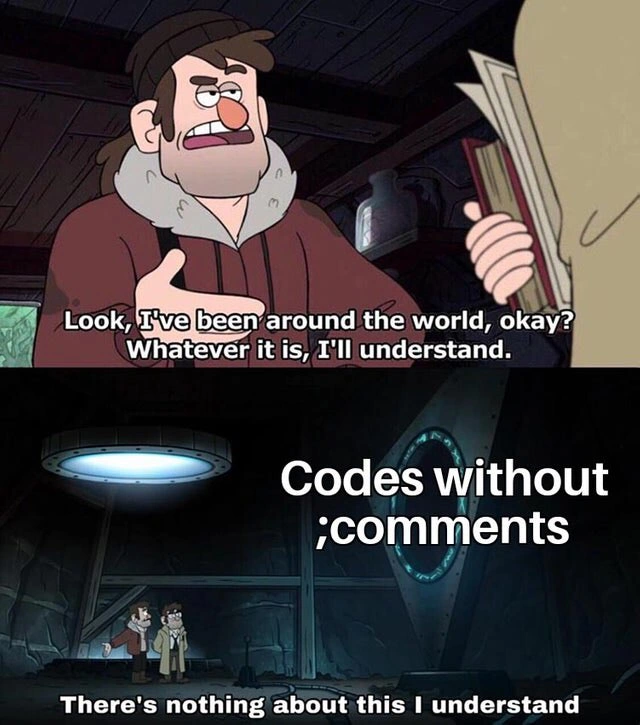
The meme captures this perfectly: the top text (“I’ll understand whatever it is”) is the confident developer speaking before seeing the code. The bottom text (“There’s nothing about this I understand”) is what they say after scrolling through 3000 lines of uncommented, opaque code. It’s a relatable situation for many developers, combining DocumentationHumor with a lesson: don’t underestimate the value of comments and clear structure. Even a senior dev can feel completely lost when confronted with a raw wall of code that has no explanations attached.

Level 3: Big Ball of Mud

From a senior developer’s perspective, a mile-long file with zero comments is a telltale sign of the “Big Ball of Mud” architecture – a sprawling, sloppy codebase with no clear structure or explanation. This meme nails a scenario many experienced engineers know too well: the moment when confidence meets a codebase that grew unchecked. CodeQuality and CodeReadability have taken a nosedive here. The humor (and horror) comes from shared PTSD: even the grizzled Grunkle Stan (the senior dev archetype) is floored by the sheer chaos of a file that should’ve been broken into 20 modules and peppered with clarifying notes.

Why is this funny to us coders? Because it’s relatable. Seasoned devs often project a bit of bravado – “I’ve seen it all, I can decipher any code.” But then reality hits: you open a 5,000-line monster function named ProcessData() (of course it’s named vaguely), find no comments, cryptic variable names like x, y2, flag, and you realize you’re utterly lost. It’s the classic WTFs per minute metric come to life: as you scroll, your internal alarm is going “WTF… WTF… WTF…” at each confusing line. The meme’s second frame text “Codes without ;comments” is basically the dev’s brain screaming “I don’t understand any of this!”

Let’s break down the elements that cause this disbelief:

  • No Comments, No Clues: Comments are the documentation right next to the code. They explain why something is done, or the intent behind non-obvious logic. In their absence, you’re left guessing. It’s like reading a novel with pages missing – the plot (intent) has gaping holes. A veteran dev knows that good code comments can be a saving grace during maintenance and CodeReviews. When they’re missing, even simple tasks become arduous.
  • Mile-Long File: A single file that’s absurdly long hints at poor separation of concerns. Most well-structured systems break functionality into smaller pieces (functions, classes, modules). A giant file suggests one or more of the following: the original author didn’t know better, deadlines forced quick dirty additions, or nobody ever refactored it. It’s probably a legacy code artifact that evolved over years of band-aid fixes. Each new developer added a bit more code to the same file because they were afraid to split it – perhaps due to risk or lack of tests – and over time it became an unmaintainable blob.
  • Tribal Knowledge: In teams, tribal knowledge means crucial info is passed verbally or retained only in people’s heads, not written down. This file is likely a product of tribal knowledge dependency – only old-timers knew how it worked. If “Joe” wrote that file 5 years ago and has since left, everyone else avoids touching it because there’s no reference doc or comments. The team might even joke, “Only Joe understood that thing, and he’s gone, so… good luck.” The meme captures the moment someone new (or even senior) confronts the “sacred code” without the tribal elders around to guide.
  • Code Review Nightmare: Picture a code review where you’re handed this beast. As a senior reviewer, your first question would be “Why is this all one file? And where are the comments explaining this math formula or that conditional block?” You’d likely send it back with a request for at least some documentation. The humor is that this scenario usually doesn’t happen in review before merge – it happens afterward, when the code is already in production and something breaks. That’s when the poor soul on call opens the file fresh and experiences the Stan-like realization of “There’s nothing about this I understand.” At 3 AM, no less.

In essence, the meme uses Gravity Falls’ comedic scene to highlight a painful truth in programming: CodeMaintainability suffers without documentation. It’s a gentle reminder (through dark humor) that even the best of us can’t magically intuit the purpose of a convoluted, uncommented codebase. The bravado melts into bewilderment. Every senior dev has been there – one minute you’re Indiana Jones ready to grab the golden idol, the next minute you’re staring at illegible ancient runes, realizing you might unleash a curse by altering one line. It’s both funny and tragic: funny because we recognize the overconfidence, tragic because we know the real slog of deciphering that code lies ahead.

Level 4: Software Archaeology

In the realm of software engineering, encountering a mile-long source file with zero comments turns into an exercise in software archaeology. Imagine digging through layers of legacy logic, trying to piece together why things were done a certain way. Without any inline documentation or code comments, you’re essentially reconstructing the code’s purpose from scratch. It’s the antithesis of Donald Knuth’s concept of literate programming – where code is written as an explanatory essay for humans, interleaved with actual logic. Here, instead of a narrative, we have a dense wall of instructions devoid of context.

Some theoretical and historical perspective:

  • Cognitive Load Theory – Human memory has limited capacity for new information. A huge uncommented code file overwhelms that capacity. You’re forced to keep track of variable names, relationships, and logic entirely in your head. Without comments to offload meaning, the brain’s “RAM” thrashes. Academic research in program comprehension shows that meaningful naming and documentation significantly reduce the mental effort needed to understand code.
  • Information Theory – In a sense, comments increase the information content available to the reader without affecting the program’s behavior. Without them, the entropy (uncertainty) of the system’s intent is high. You must infer intent from code alone, which is like decoding a message with missing pieces.
  • Historical Anecdote – The legendary Apollo 11 guidance computer code had abundant comments (and even jokes) embedded by NASA engineers. In assembly language (which is extremely terse and unreadable), comments were literally life-saving context. Those engineers knew future readers (or maintainers on Apollo 12) would need every hint possible to grasp the mission-critical logic. In contrast, our mile-long file’s author left no breadcrumb trail. We’re essentially reading a log of machine instructions with zero help – a tough challenge even for a veteran who’s “been around the world.”

When a senior dev claims “Whatever it is, I’ll understand,” they assume the code follows known patterns or at least some documentation exists. But an uncommented behemoth breaks that assumption. It violates fundamental CodeMaintainability principles. In theoretical terms, the Bus Factor of this code is dangerously low – if knowledge isn’t written down (in comments or docs), it lived only in the original developer’s head (and that’s long gone). The result? Even a worldly engineer stands in that metaphorical dimly-lit chamber of code, admitting defeat: “There’s nothing about this I understand.”

Description

A two-panel meme from the animated series 'Gravity Falls'. The top panel features a rugged, confident male character with a beard, wearing a brown coat, who states, 'Look, I've been around the world, okay? Whatever it is, I'll understand.' The bottom panel shows the same character and a companion looking bewildered at a large, cryptic, glowing blue triangular object in a dark, cavernous room. Superimposed over this scene is the white text 'Codes without ;comments'. Below, the character's dialogue continues: 'There's nothing about this I understand.' The meme humorously contrasts a developer's overconfidence with the humbling reality of encountering a codebase lacking any comments or documentation. It underscores the universal truth that no amount of experience can easily decipher complex, uncommented code, making it as alien as a mysterious artifact

Comments

7
Anonymous ★ Top Pick The fastest way to induce imposter syndrome in a principal engineer is to show them their own uncommented utility script from three years ago
  1. Anonymous ★ Top Pick

    The fastest way to induce imposter syndrome in a principal engineer is to show them their own uncommented utility script from three years ago

  2. Anonymous

    Uncommented code is Schrödinger’s design doc - both perfectly clear and utterly inscrutable until the on-call engineer opens the file at 3 A.M

  3. Anonymous

    Twenty years of experience, three exits, and a patent portfolio, yet here I am reverse-engineering why someone named a variable 'temp2Final_v3' in a business-critical payment processor

  4. Anonymous

    Every senior engineer has uttered 'I've seen it all' before opening a legacy codebase with zero comments - only to discover that the previous developer apparently believed in self-documenting code so strongly they documented nothing, not even the arcane bit-shifting magic that somehow calculates tax rates. The confidence-to-comprehension ratio inversely correlates with comment density, a relationship more reliable than any distributed system's CAP theorem guarantees

  5. Anonymous

    After 20 years mastering CAP trade-offs, uncommented code is the one theorem where consistency always partitions

  6. Anonymous

    Senior heuristic: when a codebase is called “self‑documenting,” the docs are just git blame, the ADRs are folklore, and the bus factor equals whoever remembers why useLegacyTurboMode gates the entire checkout flow

  7. Anonymous

    Uncommented code is a distributed system - intent is eventually consistent and only queryable via git blame and Jira archaeology

Use J and K for navigation